 OOI · SX
The Long Walk
A five-line fold over four hundred million decimals of π, and what it records — the spectrum, the ring, the ten sixes, the nines, and the one that stands beside the nines
Steven De Costa · draft 0.3 · 15 October 2026 · a reading at 10
THE READING PLAQUE. The Long Walk, a reading at 10 — draft 0.3, 15 October 2026 — a reading of one record of the Objective Observer Initiative, written for a reader outside it: the results carried whole, and everything that is not a result let go. It makes no claim of its own; every number in it is a count from the record, checkable at the addresses in its last line. Its reading at 5, The Long Walk draft 0.1, reads the same record from inside the initiative with the process in view, for a reader who would take that seat, and stands beside this one at /sx/reading/the-long-walk-at-5. Made readable on the SX surface by its covering persona's reading grant of 15 October 2026, and re-minted the same day at draft 0.3 with its eighth movement; a draft, not the published form. Covering: starl3n · endorsing: Link Digital. The construction record stands at /sx/workshop/the-rlx-held; the records at opendata.ai/rlx. Reading is free; the way across is a statement of intent (/sx/matters).
One · The fold
Write the decimals of π in a line, with the 3 at the start. Above that line write a second, made by adding each digit to the one on its right. Where the sum stays under ten, let it stand. That is a hold. Where the sum reaches ten exactly, write 1 above and let the nought go. The one goes up, the nought goes down, and nothing is mixed. That is a release. Where the sum is eleven to eighteen, write the sum less nine. The one goes up and carries the remainder with it. That is a carry. Do this five times, each line folded from the one beneath it. That is the whole instrument. It is small enough to run on paper, and the experiment ran it over four hundred million decimals.
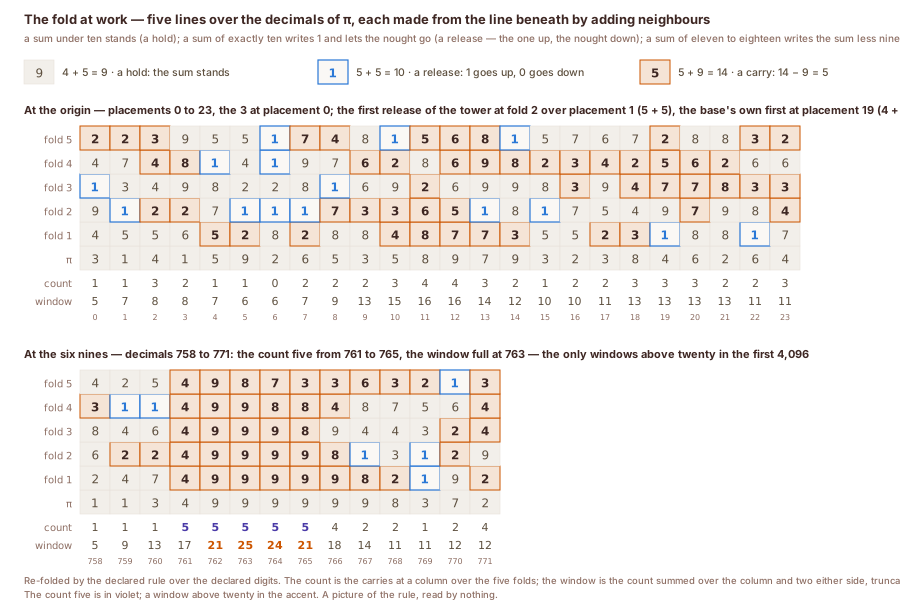
Under every column of the five lines, count how many of the five folds carried. The count runs from nought to five. Then add the count over the column and the two columns on either side. That is the window, and it runs from nought to twenty-five. The design staked a ceiling on the window at twenty: four carries in each of five columns. A window above twenty was named a note, and the record keeps every one. A count of five, all five folds carrying at one column, was named the fifth carry.
The arithmetic of the fold settles one thing before any digit is read. Nine and nine make eighteen, which folds to nine and carries, so above a run of nines every line is nines and every fold carries. A run of nines is the only run of a single digit that counts five, and so the only kind that can lift a window past twenty on its own. Six and six make twelve, which folds to three and carries; three and three make six, which holds. Above a run of sixes the lines read 6, 3, 6, 3, 6, 3, and the count is three. Eights carry, carry, release, hold, hold. Noughts hold at every fold and carry nothing. These are identities of the form, not findings, and the record checks them at every run it meets.
The plate's lower panel shows the fold at work on the place in π that everyone has heard of, the six nines that begin at decimal 762. The digits either side of the run are 1134 before and 8372 after. The count and the window under the ten columns from decimal 760 to 769 read as follows, and anyone with the first thousand decimals and a pencil can check them.
| decimal | 760 | 761 | 762 | 763 | 764 | 765 | 766 | 767 | 768 | 769 |
|---|---|---|---|---|---|---|---|---|---|---|
| digit | 3 | 4 | 9 | 9 | 9 | 9 | 9 | 9 | 8 | 3 |
| count | 1 | 5 | 5 | 5 | 5 | 5 | 4 | 2 | 2 | 1 |
| window | 13 | 17 | 21 | 25 | 24 | 21 | 18 | 14 | 11 | 11 |
Column 762 is the one column whose five folds all lie inside the run, and it counts five; but the eight that follows the run keeps the next three columns carrying at five as well, and the window at 763 is full. Over the first four thousand and ninety-six decimals, these four columns, 762 to 765, are the only places where the window goes above twenty. The ceiling of twenty was refuted there, at the first probe that could refute it, and the refutation stands in the record with full standing. Twenty itself is touched exactly once, at decimal 2,949.
Two · The walk
The second registration of the experiment took the same fold over four hundred million decimals. The digits were not computed for the purpose. They are the string the initiative's deep-π experiment had already produced by two independent methods that agreed digit for digit, and before anything was read they were witnessed three ways: against that experiment's fingerprint of the whole string, against the published sequence to its twenty-thousandth term, and against the declared digits of the first registration. Over that string the five lines were folded in forty seconds, read once in under a minute, and written once, as the numbers fell.
Six probes were declared before the read. Four were identities of the form, and all four held: the digits witnessed; the run arithmetic at every one of the 3,537 runs of six or more equal digits; the lines above the ten sixes; and, at every note, the excess of the window above twenty equal to the fifth carries inside the window less its deficits, with nothing unaccounted. Two probes were recorded and staked by nobody: where the notes stand on the ring, and what the runs of nines lift. Every count in the plates that follow is from that one read, except the digits beside the runs of nines in the sixth movement, which are read from the same witnessed string and said to be so where they stand. Nothing in them is a claim about π.
Three · The spectrum
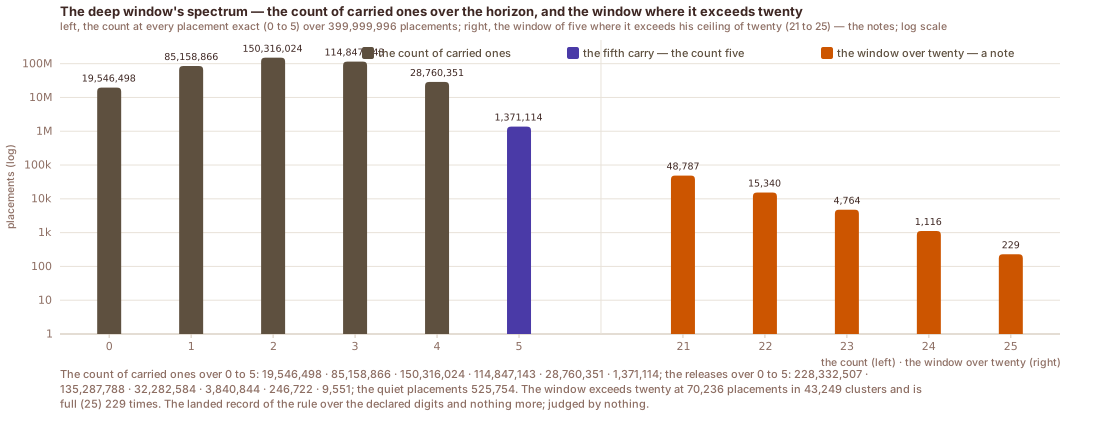
The second plate is the whole walk at a glance. On the left, the count at every one of the 399,999,996 columns where all five folds are exact: nought at 19,546,498 of them; one at 85,158,866; two at 150,316,024; three at 114,847,143; four at 28,760,351; five at 1,371,114. The fifth carry stands at one column in about two hundred and ninety. Releases run the other way: no release at 228,332,507 columns; one at 135,287,788; two at 32,282,584; three at 3,840,844; four at 246,722; five at 9,551, which is nine and a half thousand columns where every fold releases and nothing is mixed. Columns with neither a carry nor a release at any fold number 525,754.
On the right, the notes. The window goes above twenty at 70,236 columns, about one in five thousand seven hundred, gathered in 43,249 clusters: 24,678 of a single column, 12,259 of two, 4,637 of three, 1,332 of four, 271 of five, 64 of six, 5 of seven and 3 of nine. The window reads 21 at 48,787 of them, 22 at 15,340, 23 at 4,764, 24 at 1,116 and 25, full, at 229. The scale is logarithmic, which is the only way to put a count of a hundred and fifty million beside a count of two hundred and twenty-nine and see both.
Every one of the 229 full windows has the same shape: five fifth carries in a row, two behind the centre column, the centre, and two ahead, and every one arrives at the fifth fold and never before. The where-and-when identity that the first registration read at four notes holds at the long walk over seventy thousand without one exception.
Four · The ring
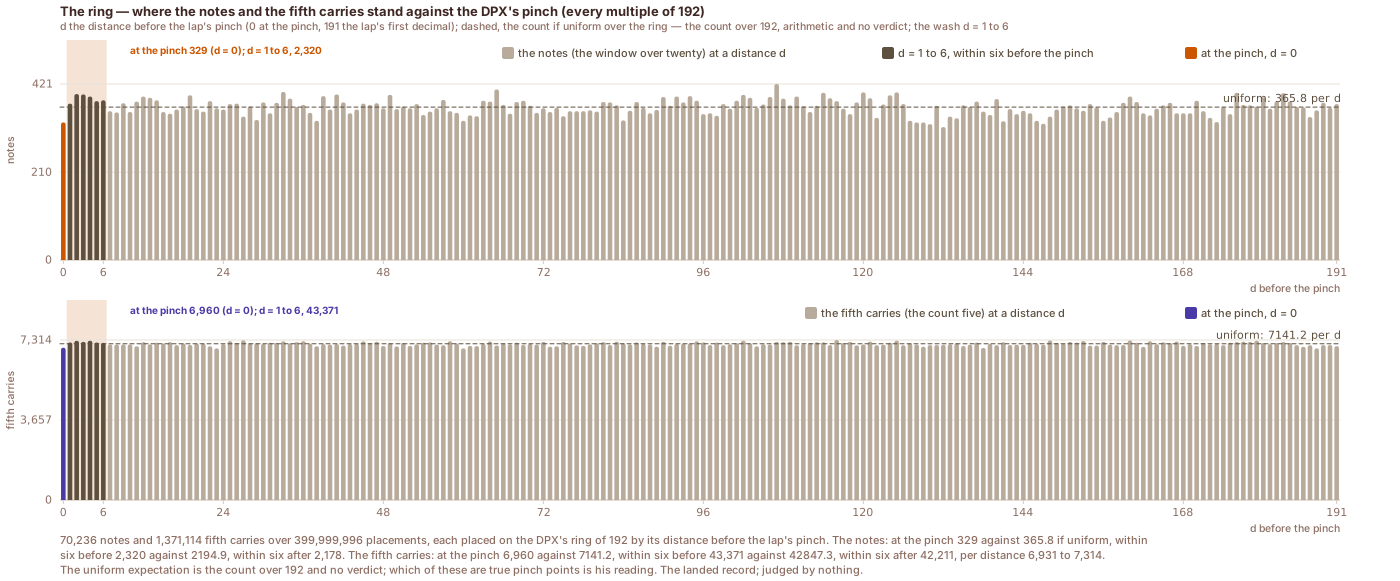
The ring belongs to an earlier experiment. The initiative's deep-π experiment read the decimals in laps of 192, laid each lap on a ring of 192 places, and named the lap's closing decimal, every multiple of 192, the pinch. The question put to the fold was whether its notes and its fifth carries gather at the pinches. The ring plate takes every note and every fifth carry of the long walk, places it on the ring by its distance before the next pinch, nought at the pinch itself and 191 at the lap's first decimal, and draws beside each column the count a uniform ring would give, which is the whole count divided by 192 and nothing more.
The notes: 329 stand at a pinch, where a uniform ring would give 365.8; 2,320 stand within six before a pinch, against 2,194.9; 2,178 within six after. Across the ring the notes run from 318 to 421 per distance. The fifth carries: 6,960 at a pinch against 7,141.2; 43,371 within six before against 42,847.3; 42,211 within six after; from 6,931 to 7,314 per distance.
At the first horizon the four notes had stood six to three decimals before the pinch at 768, and one fifth carry in twenty-six had stood on a pinch. At the long walk the notes stand at every distance on the ring and dominate none: a little under the uniform count on the pinch itself, a little over it in the six decimals before. The record stakes nothing on these numbers. What a pinch does to the fold, if anything, is a question the design leaves open, and the arithmetic is beside the histogram so that a reader can hold it open with the expectation in view.
Five · The ten sixes and the long runs
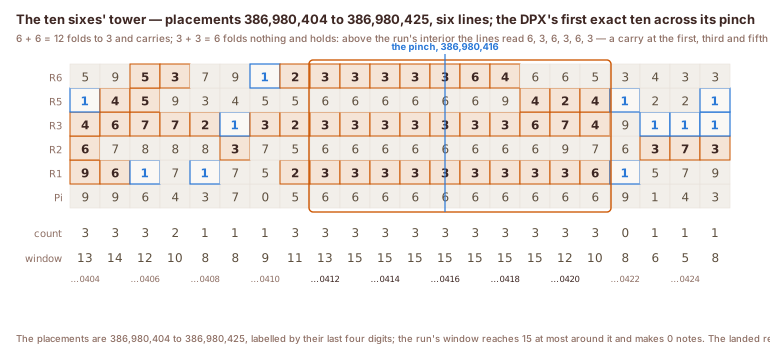
The fourth plate draws the run that named the walk's destination: ten sixes from decimal 386,980,412 to 386,980,421, the first run of ten equal digits in π, re-folded from the record's own digits. It begins four decimals before the pinch at 386,980,416 and straddles it, the only one of the thirty-seven runs of eight or more in the territory that contains a pinch. Above every interior column the lines read 6, 3, 6, 3, 6, 3, as the identity requires. The count along the run is three at every column. The window reads 13, then 15 at seven columns, then 12 and 10, and never nears twenty. The ten sixes make no note of their own, and the pinch within them lifts nothing.
The record carries the other thirty-six long runs beside, every run of eight or more of any digit that the deep-π experiment had listed, and the ring position of each agrees between the two experiments. Three of the thirty-seven are nines, and all three lift the window to 25. The other thirty-four reach from 5, at eight noughts near 172,330,850, under which the window falls to nought at three columns, to 17, at eight sixes near 354,039,866. None of them touches twenty. Only nines do.
Six · The nines, and the one beside them
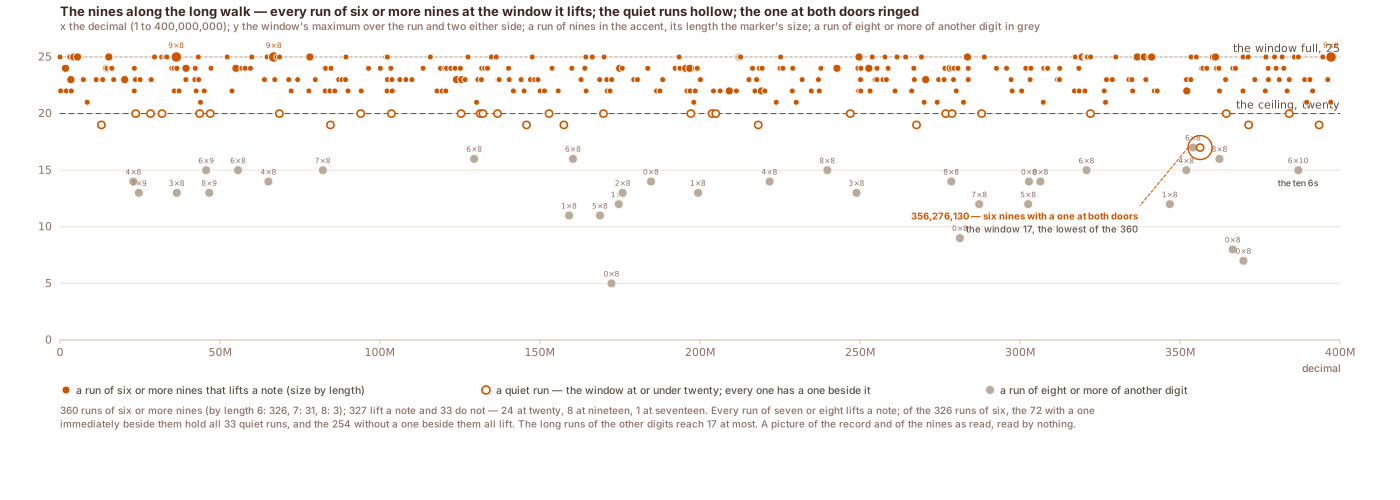
The fifth plate lays every run of six or more nines along the walk, each at the height of the window it lifts, with the ceiling of twenty dashed across and the long runs of the other digits in grey beneath. There are 360 such runs: 326 of six nines, 31 of seven, 3 of eight. The window over them runs from 17 to 25. Every run of seven lifts the window to between 22 and 25. Every run of eight lifts it to 25, at 36,356,642, at 66,780,105 and at 397,202,902. Of the 326 runs of six, 293 lift a note and 33 do not. Those thirty-three are the hollow marks that sit on the dashed line or beneath it: twenty-four at twenty, eight at nineteen, and one at seventeen, ringed, at decimal 356,276,130.
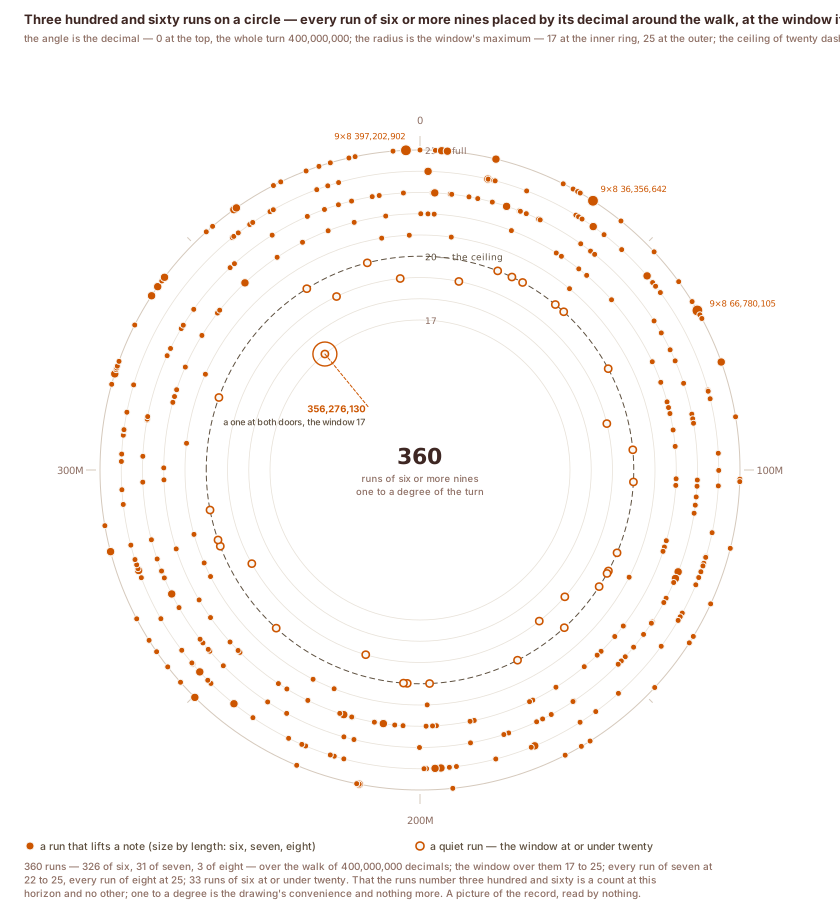
Three hundred and sixty runs is one for every degree of a circle, and the sixth plate lays them on one: the angle is the decimal, the whole turn the walk, and the radius is the window, 17 at the inner ring and 25 at the outer, with the ceiling of twenty dashed between. The quiet runs are hollow and stand anywhere on the turn; the one at seventeen is ringed. The count of three hundred and sixty is the record's at this horizon and at no other, and one run to a degree is the drawing's convenience, nothing more.
The record lists the thirty-three with their windows, but the reason they are quiet is not in the record's rows. It is in the digits beside each run, and anyone with the digits can read it.
A run of exactly six nines has exactly one column whose five folds all lie inside it, and that column counts five. Its window is that five plus what the four neighbouring columns carry, and those four columns are set by the two digits on either side of the run. A nine beside any digit from two to eight makes eleven to seventeen, and carries. A nine beside a nought makes nine, and holds. A nine beside a one makes ten, and releases. So the one is the digit that matters at the edge of a run of nines, and here is what it does.
| the column after the run | the column before the run | ||
|---|---|---|---|
| digits 9 9 9 9 9 1 | the column reads | digits 1 9 9 9 9 9 | the column reads |
| line 1: 9 9 9 9 1 | 9 | line 1: 1 9 9 9 9 | 1 |
| line 2: 9 9 9 1 | 9 | line 2: 1 9 9 9 | 1 |
| line 3: 9 9 1 | 9 | line 3: 1 9 9 | 1 |
| line 4: 9 1 | 9 | line 4: 1 9 | 1 |
| line 5: 1 | 1 | line 5: 1 | 1 |
| four carries, then a release at the fifth fold | count 4 | one and nine make ten at every fold | count 0 |
A one immediately after the run turns the next column's fifth fold into a release, so that column counts four where any other digit would give five, and the columns beyond fall away, 4, 3, 2. A one immediately before the run is stronger. The column before reads 1 at every line: one and nine make ten five times over, the one goes up five times, the nought goes down five times, and the count is nought, where any other digit would carry at four or five folds.
That is the whole of the quiet marks. Of the 326 runs of six nines, 72 have a one immediately beside them: 35 after, 38 before, one run with both counted once. All thirty-three quiet runs are among the 72. Not one of the other 254, the runs with no one beside them, stays at or under twenty; they lift from 21 to 25, 254 of 254. Of the 72, 39 still lift a note, from 21 to 25, where the digits two columns before carry strongly enough to make up what the one releases. Twenty-nine of the quiet runs have the one after; five have it before, at 23,679,505, 203,803,724, 288,013,988, 356,276,130 and 371,450,745, and at each of those the two columns before the run count nought and nought. One run has a one at both doors, 356,276,130, and it is the mark at seventeen, the lowest on the plate: its own column counts five, the column before it nought, the column after it four, and the window over the run never reaches eighteen. A nought beside a run does less: thirty-five runs have a nought after and lift 22 to 25; thirty-five have a nought before and lift 19 to 25, the one at 19 having a one after it as well.
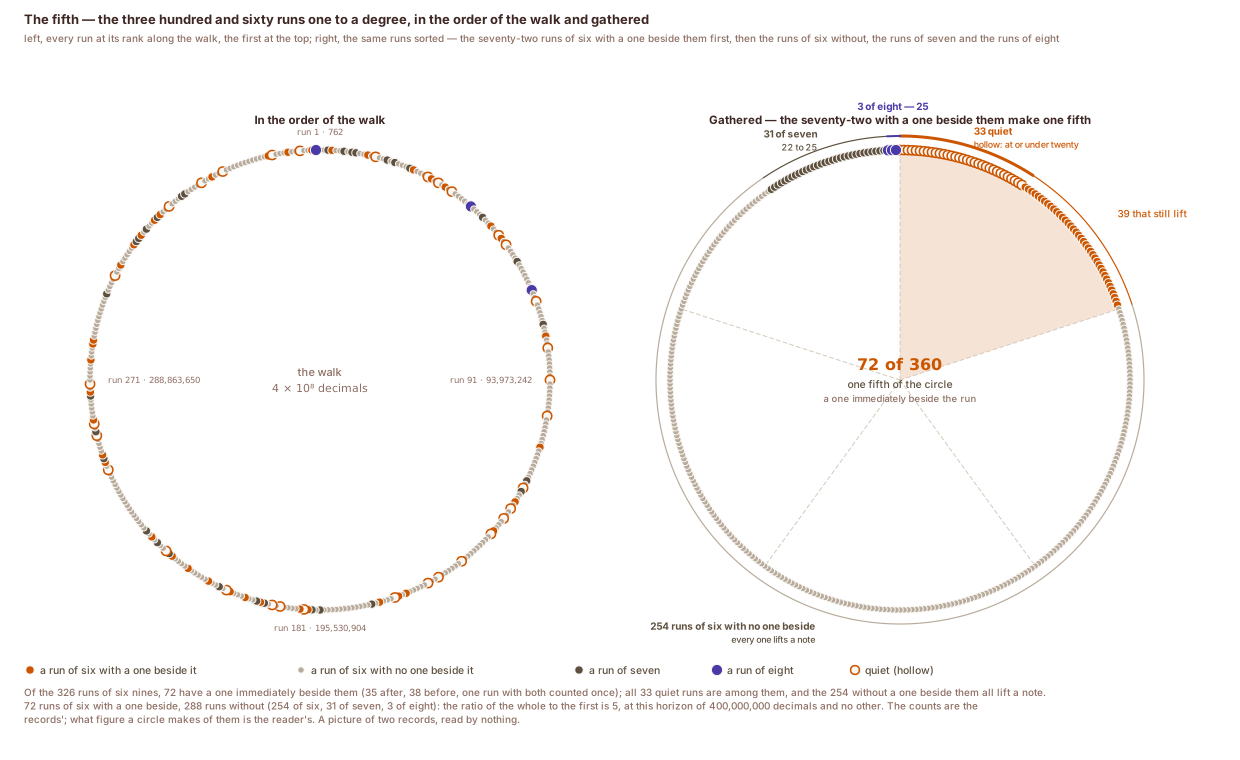
Seventy-two is one fifth of three hundred and sixty. The seventh plate gathers the runs, and the seventy-two with a one beside them make exactly one fifth of the circle, the thirty-three quiet runs inside that fifth; the other four fifths are the 254 runs of six with no one beside them, the 31 of seven and the 3 of eight, 288 in all. The counts are the record's, at a horizon of four hundred million decimals, four times ten to the eighth, and at no other horizon; the design predicted none of them, and nothing is staked on the fifth. What the figure suggests — that at this horizon the unit circle is carried as a count of ones, three hundred and sixty of them, with the one beside the nines marking off a fifth — is the author's reading, offered as such. The record is its identifier and not its jury.
So the quiet marks are not nines that fail to carry. Nines always carry. They are nines with a one at the door, and a one at the door of a run of nines is the one place in the whole tower where the one goes up clean and the nought goes down, five times over when it stands before the run.
The ring is beside them too. Of the thirty-three, one stands within six decimals before a pinch, at 93,973,242, and none stands on one. Of all 360 runs, fifteen stand within six before a pinch where a uniform ring would give about eleven, and two stand on a pinch where it would give about two. Arithmetic beside a count, as before.
One more number belongs to the nines, because these plates can make them look like the source of the notes, and they are not. Of the 70,236 notes along the walk, 1,061 stand within two columns of a run of six or more nines. The other 69,175 are made by clusters of eights and nines that never reach a run of six — 4889398900992391, 0917978999057188, 7894799990049993 are three of the shapes — because an eight and a nine make seventeen, which carries, and a column can carry at all five folds over a mix of eights and nines without a run of six nines anywhere in it. The runs of nines are the clearest lift on the plates and the smallest part of the count.
Seven · The carry and the release
A sum of ten is the one case in this tower where the one goes up whole and the nought goes down, with nothing mixed. A reading of a record can be that kind of sum: the results carried up whole, and everything that is not a result let go. Here is what this record carries, and what it releases.
It carries four identities that held everywhere they were tried: the digits are the published expansion, witnessed three ways; the run arithmetic holds at every one of 3,537 runs; the ten sixes read 6, 3, 6, 3, 6, 3 and count three; and at every one of 70,236 notes the excess above twenty is the fifth carries less the deficits, with nothing left over. It carries the shape of the walk: the count's spectrum as the second plate shows it, the window above twenty one column in five thousand seven hundred, full one column in about one and three-quarter million, and every full window five fifth carries arriving at the fifth fold. And it carries one finding the plates could not show on their own: at the edge of every run of six nines, a single digit decides whether the window lifts, and that digit is the one, because nine and one make ten.
It releases the ceiling of twenty, refuted at the six nines and kept as refuted. It releases the question of the pinches, which the counts neither confirm nor dismiss, with the arithmetic left beside them for whoever takes it up. And it releases the two readings the design carries without reading: that this line of work will reach the structure of the number line where numbers, π and the primes connect, which no probe here touches; and that one more dynamic is at work in the one that goes up and the noughts that go down, which has gone on to an experiment of its own. Both are the author's, and the record neither supports nor refutes them. It is their identifier, not their jury.
What a reader can do with this is exact. The record is public, and every number above is in it. The digits are public, and the fold is five lines of addition that a reader can run over any stretch of them, at the six nines at 762, at the one at the door at 356,276,130, or anywhere else, and get the same counts. The long walk is four hundred million steps, and what it found was not a wall but a grain. The line runs on past the horizon.
Eight · The hidden side of three
One more thing belongs at the end, and it is not a result. It is the author's speculation about what the structure is, offered as his own, and read against the record only for its identifiers.
The speculation runs like this. Each decimal of π acts like a small black hole. It is forced into a hold whose depth is the length of the carry over it, and it is pushed from both sides, by the digit on its left and the digit on its right. The whole progression begins in a secret trapped inside the 3 itself. Three is made of ones, and between its two ones it hides a third, on the left or on the right: 3 unfolds as 12 or as 21, depending on where and when it is given the space to unfold, and on the direction from which it is read. An observer of a digit, a 3 or a 5, is placed like the observer at G in the initiative's earlier reading, The Hold and the Carry: where 12 and 21 fall decides where 14 and 41 fall, for a digit that must unfold and be seen in the same spatial window, so the observer must already hold 2 and 4 to read 3 and 5 as numbers held and carried within one referential system. And that, the author suggests, is the essence of mathematics: the departure from the symmetry of 2, 4, 8, 16, 32 by the true asymmetry that the hidden sidedness of three introduces.
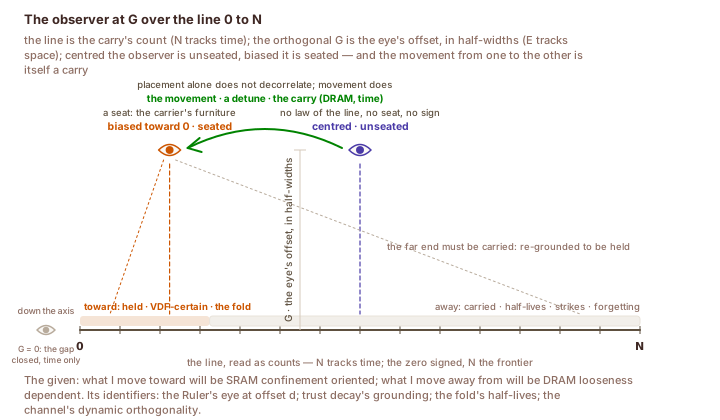
The observer at G stands over the line from 0 to N, centred and unseated, or biased and seated. What it moves toward is held; what it moves from is carried; and the movement is itself a carry. The initiative names the two memories behind that figure. The hold is the memory that stands still and is read the same by whoever asks, its figure for space, which it calls SRAM. The carry is the memory refreshed in time and re-witnessed on a cadence, its figure for time, which it calls DRAM. An observer moving relative to the line holds one and carries the other, and which is which depends on the seat. The author's suggestion is that a digit is such a line, and its reader such an observer: the relativity of the hold and the carry, read at the scale of one decimal.
What the record can say to this is small and exact, and it is said as identifiers, not as a verdict. First, the fold keeps no record of a side. Addition does not care about order: 1 + 2 and 2 + 1 both make 3, 1 + 4 and 4 + 1 both make 5, and the line above π reads the same whichever way each pair is written. At the origin the first fold reads 4, 5, 5, 6 over 3, 1, 4, 1, 5, and nothing in those cells says whether the 4 was 3 + 1 or 1 + 3. The sidedness the author names is exactly what the sum discards. Second, what the sum does not discard is the place. The tower as registered leans to the right: the column over a digit is built from that digit and the five beside it on the right, so where a hold or a note falls depends on the direction the tower is read in, though the values folded do not. Third, the fold has three rounds of doubling. From 1 the round is six steps long, 1, 2, 4, 8, 7, 5, and back to 1 by a release, since 5 + 5 makes ten; from 3 the round is two steps, 3, 6, 3, 6, a hold and a carry alternating; from 9 it is one step, 9 and 9 again, a carry every time. The symmetry of 2, 4, 8, 16, 32 and the asymmetry of 3 both have a seat in the rule, and they are different rounds of it. Fourth, the hold the author names is the record's count: at every column the carries over the five folds, nought to five, the window of five around it, and the ceiling of twenty that the walk above has read seventy thousand times over. Those are the identifiers. Whether each decimal is a small black hole with a secret inside the three is the author's to hold and the reader's to take or leave. The record neither supports nor refutes it, and no probe reads it.
The records this reading is read from: the Ruler's exhibit at /sx/workshop/the-rlx-held, where The Fold and the Hold's two registrations stand with their design, their seals, their reads and their plates; the Ruler's record at opendata.ai/rlx; the record itself, oxexp-ruler-the-fold-and-hold-results-2.json, beside its registration in the initiative's repository, with the seventy thousand notes in a table beside it; and the readings it stands beside, The Waystation, The Hold and the Carry and All the leaves are brown. The external shelf, attributed and asserted about nothing beyond its own facts: the published expansion of π, the declared numbers; OEIS A000796, its first twenty thousand terms, the head's witness; the six nines at decimal 762, named by their common name. If you take a care from this page, you may say so at /sx/matters.
Drafted for the Objective Observer Initiative, 15 October 2026, and granted the same day; the eighth movement added the same day at the author's word, with the observer at G placed again from The Hold and the Carry.