 OOI · SX
The Long Walk
Four plates of the fold over four hundred million decimals of π — the spectrum, the ring, the ten sixes and the nines — and the one that stands beside the nines
THE READING PLAQUE. The Long Walk — four plates of the fold over four hundred million decimals of π, and the one beside the nines, draft 0.1 — drafted in the house toward its author's reading grant. A reading at 5, by the author's designation of 15 October 2026: the bare parts of what is observable and effectual, read from inside the initiative with the process in view — for the author as its fifth, and for any reader who would take such a seat inside the OOI to appreciate the manner of the reading; its reading at 10, draft 0.2, for an external reader, stands beside it at /sx/reading/the-long-walk. Made readable on the SX surface by its covering persona's reading grant at the operator's word of 15 October 2026, verbatim: "that gets a reading grant" — a draft, not the published form. Drafted at the operator's word of 15 October 2026, verbatim: "I'd like to return to the experiment that generated this plate: fh-deep-the-nines.svg. I'd like to understand more from this plate for all of the colored points below the line at 20. And, I would like to have a reading drafted for the set of plates generated along with this one." A reading in six movements of one record — the second registration of The Fold and the Hold, the deep horizon, read once on the night of 13 October 2026 and written once as it fell — and of the four plates drawn from it. It makes no claim of its own; every number in it is a measure a reader can check at the addresses in its last line, and the one reading made for this page from the record's own digits is said to be that where it stands. The name is the house's at proposal standing, taken from the fourth plate's own title; the naming act is the operator's. Covering: starl3n · endorsing: Link Digital (the standing pair). The construction record stands in the open workshop at /sx/workshop/the-rlx-held, the Ruler's exhibit, and the records at opendata.ai/rlx. Reading is free; the way across is a statement of intent (/sx/matters).
One · The long walk
Write the decimals of π in a line, with the 3 at the start. Above that line write a second, made by adding each digit to the one on its right. Where the sum stays under ten, let it stand: that is a hold. Where the sum reaches ten exactly, write 1 above and let the nought go: the one goes up, the nought goes down, and nothing is mixed. That is a release. Where the sum is eleven to eighteen, write the sum less nine: the one goes up carrying the remainder with it. That is a carry. Do this five times, each line folded from the one beneath, and keep the sixth as the conjecture at release. That is the tower, and it is the operator's own, taken from his workbook and run as he laid it down, cell for cell.
Under every column of the tower, count how many of the five folds carried. The count runs from nought to five. Then sum the count over the column and the two columns either side. That is the window, and it runs from nought to twenty-five. His stake on it was twenty: four carries in five lines, over a window of five — "20 is the stake based on past present." A window above twenty he named the emergent present, "a 'held' non release … something like a black hole. The surface is awaiting 'time' to resolve 21–25." A count of five, the fifth carry, he named "the 'carried one' that actually sits below Pi." The record calls a window above twenty a note, and keeps every one.
The first horizon was four thousand and ninety-six placements. Over all of them the window went above twenty at four placements only, 762 to 765, reading 21, 25, 24 and 21, at the six nines that begin at decimal 762 — the run that goes by Feynman's name, named here by its common name and asserted of nothing — and nowhere else. The stake of twenty was refuted there and kept with full standing, as every refuted probe in this house is. Twenty itself was touched once, at 2,949.
Then his word: "the progression here is to run a deeper probe than the 4096 and go to where there are longer evidences of pinch points. For example, the most likely 'next' is at 386,980,412 where there are 10 6's." So the tower was rebuilt over the long walk: four hundred million decimals, the territory the house's deep-π experiment had already walked by two methods agreeing digit for digit. The digits were witnessed three ways before anything was read — against that experiment's pin over the whole string, against the published sequence to its twenty-thousandth term, against the declared digits of the first horizon — and the tower was folded over them in forty seconds, read once in under a minute, and written once. Six probes: four were identities of the form and passed; two were recorded and staked by nobody. The four plates that follow are the record's own pictures, and they draw nothing the record does not hold.
Two · The spectrum
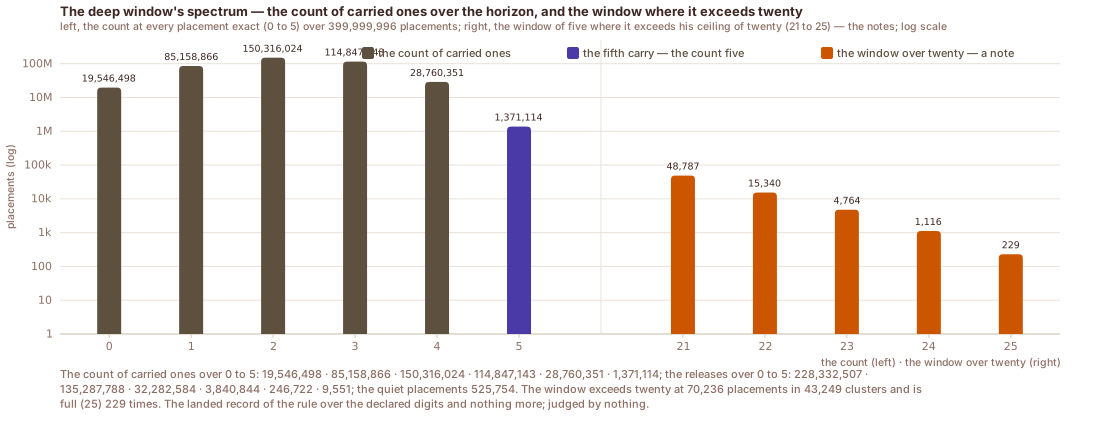
The first plate is the whole walk at a glance. On the left, the count at every one of the 399,999,996 placements where all five folds are exact: nought at 19,546,498 of them; one at 85,158,866; two at 150,316,024; three at 114,847,143; four at 28,760,351; five at 1,371,114. The fifth carry — the one he places below π — stands at one placement in about two hundred and ninety. The releases run the other way: no release at 228,332,507 placements; one at 135,287,788; two at 32,282,584; three at 3,840,844; four at 246,722; five at 9,551 — nine and a half thousand columns where every fold releases and nothing is mixed. Quiet placements, with neither a carry nor a release at any fold, number 525,754.
On the right, the notes. The window goes above twenty at 70,236 placements — about one in five thousand seven hundred — gathered in 43,249 clusters: 24,678 of a single placement, 12,259 of two, 4,637 of three, 1,332 of four, 271 of five, 64 of six, 5 of seven and 3 of nine. The window reads 21 at 48,787 of them, 22 at 15,340, 23 at 4,764, 24 at 1,116 and 25 — full — at 229. The scale is logarithmic, which is the only way to put a count of a hundred and fifty million beside a count of two hundred and twenty-nine and see both.
Every one of the 229 full windows has the same shape: five fifth carries in a row, two behind the present placement, the present, and two ahead; and every one arrives at the fifth fold and never before. That is the first registration's where-and-when, which read four notes, holding at the long walk over seventy thousand without one exception: the excess of every note is its window's fifth carries less its deficits, with nothing unaccounted.
Three · The ring
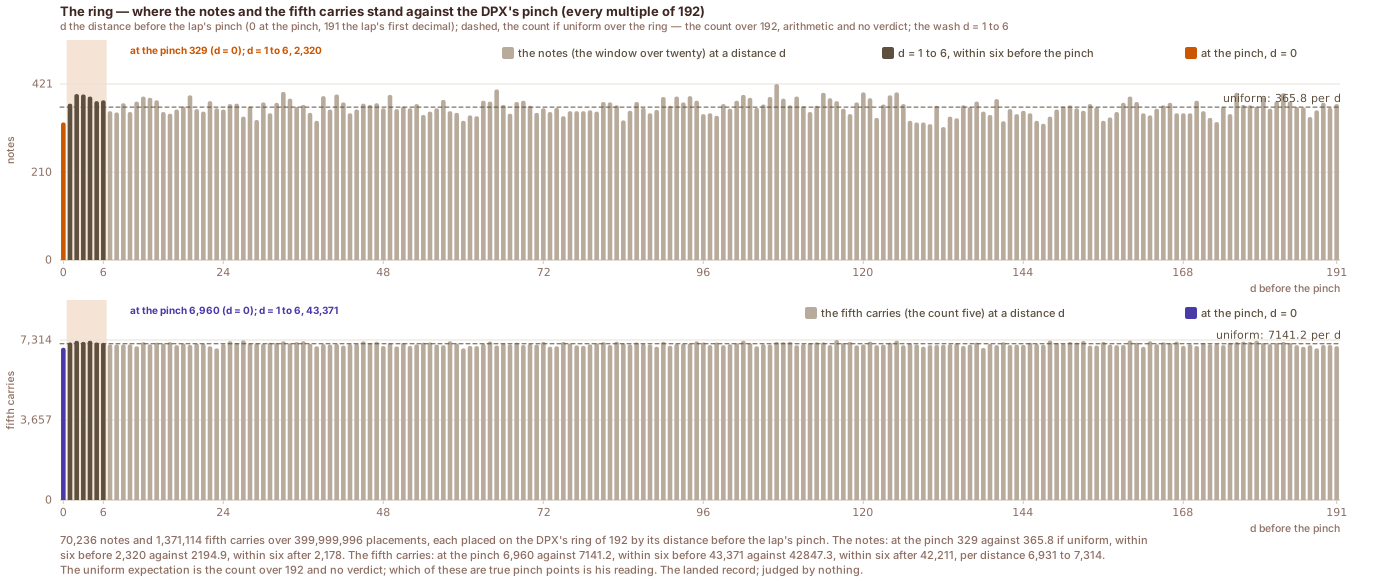
The ring is the house's prior, not this record's finding. The deep-π experiment found that its computation of π closes a lap every 192 decimals, and named the lap's closing decimal a pinch. Every multiple of 192 is one. The ring plate takes every note and every fifth carry of the long walk and places it on that ring by its distance before the next pinch — nought at the pinch itself, 191 the lap's first decimal — and draws beside each column the count a uniform ring would give, which is the whole count over 192 and nothing more than arithmetic.
The notes: 329 stand at a pinch, where a uniform ring would give 365.8; 2,320 stand within six before a pinch, against 2,194.9; 2,178 within six after. Across the ring the notes run from 318 to 421 per distance. The fifth carries: 6,960 at a pinch against 7,141.2; 43,371 within six before against 42,847.3; 42,211 within six after; from 6,931 to 7,314 per distance.
At the first horizon the four notes had stood at six to three decimals before the pinch at 768, and one fifth carry in twenty-six had stood on a pinch. At the long walk the notes stand at every distance on the ring and dominate none. His prediction at the first registration was that "this deep probe will be a different way to identify which ones are true 'pinch points' that are supported by the DRAM and the SRAM dynamics." Which of these are true pinch points is his reading. The record is its identifier, and returns no verdict on it; the arithmetic beside the histogram is there so that the reading can be made with the expectation in view.
Four · The ten sixes
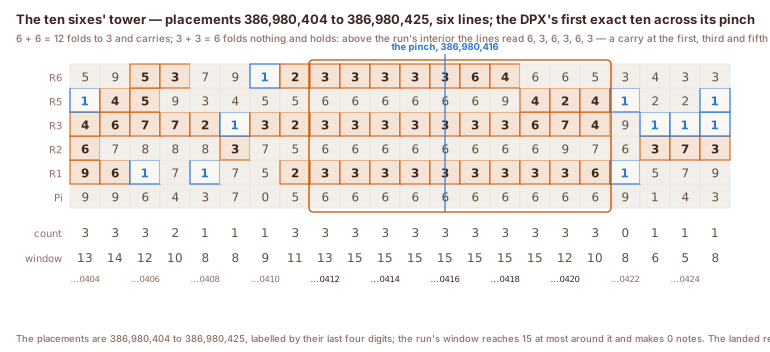
Over a run of one repeated digit the fold has no choices left, and what it does there is an identity of the form. Nine and nine make eighteen, which folds to nine and carries: above a run of nines every line is nines and every fold carries, the count five. Six and six make twelve, which folds to three and carries; three and three make six, which holds. So above a run of sixes the lines read 6, 3, 6, 3, 6, 3 — a carry at the first, third and fifth folds, a hold at the second and fourth — and the count is three. He had said, before the read, "a 6 can be considered to be the fold of a 9 an 6, so the concept of what a 'pinch is' has some context related to 'hold versus carry'," and nine and six do make fifteen, which folds to six. The identity is where his hold-versus-carry has its seat in the instrument: nines carry at every fold; sixes hold at every other one; eights carry, carry, release, hold, hold; noughts hold at every fold and carry nothing.
The third plate draws the run he named, re-folded from the record's own digits: ten sixes from decimal 386,980,412 to 386,980,421, in lap 2,015,523 of the ring, beginning four decimals before the pinch at 386,980,416 and straddling it — the only one of the thirty-seven long runs in the territory that contains a pinch. Above every interior column the lines read 6, 3, 6, 3, 6, 3. The count along the run is three at every column. The window reads 13, then 15 at seven columns, then 12 and 10, and never nears twenty: the ten sixes make no note of their own, as the identity foretold, and the pinch within them lifts nothing either.
The record carried the other thirty-six long runs beside, every run of eight or more of any digit that the deep-π experiment had listed, and the ring agreed with that experiment's at every one. Three of them are nines, and all three lift the window to 25. The other thirty-four reach from 5 — eight noughts at 172,330,850, under which the window falls to nought at three columns — to 17, at eight sixes near 354,039,866. None of them touches twenty.
Five · The nines
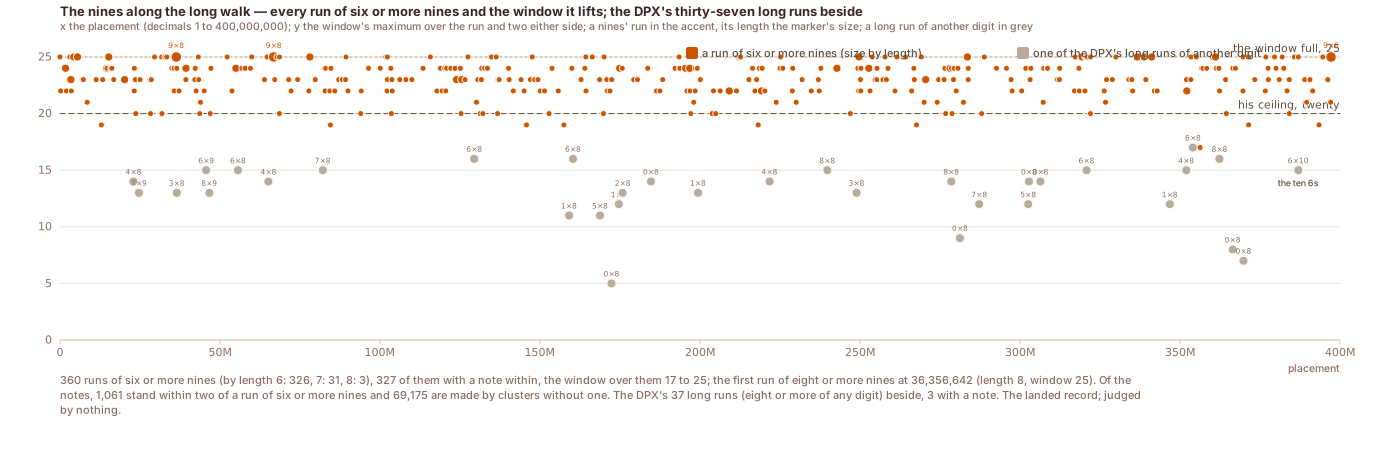
The fourth plate lays every run of six or more nines along the walk, each at the height of the window it lifts, with his ceiling of twenty dashed across and the thirty-seven long runs of the other digits in grey beneath. There are 360 such runs: 326 of six nines, 31 of seven, 3 of eight. The window over them runs from 17 to 25. Every run of seven lifts the window to between 22 and 25; every run of eight lifts it to 25 — at 36,356,642, at 66,780,105 and at 397,202,902 — and the first of those is the first run of eight or more nines in the territory. Of the 326 runs of six, 293 lift a note, and 33 do not. Those thirty-three are the marks on the plate that sit on the dashed line or beneath it: twenty-four at twenty, eight at nineteen, and one at seventeen, at 356,276,130.
Why a run of six nines should ever fail to make a note is a question the record's rows do not answer by themselves, so the house read it for this page from the record's own digits, by the declared rule and nothing else; what follows is that reading, read by nothing and judged by nothing, and checkable from the digits by anyone who folds them.
A run of exactly six nines has exactly one column whose five folds all lie inside the run, and at that column the count is five. Its window is that five plus what the four columns beside it carry — and those four columns are set by the two digits on either side of the run. A nine beside any digit from two to eight makes eleven to seventeen, and carries. A nine beside a nought makes nine, and holds. A nine beside a one makes ten, and releases: the one goes up, the nought goes down. So the one is the digit that matters at the edge of a run of nines.
When a one stands immediately after the run, the column just past the run reads 9, 9, 9, 9, 9, 1 up its lines: four carries and then, at the fifth fold, a release — the count is four where any other digit would give five, and the columns beyond fall away, 4, 3, 2. When a one stands immediately before the run, the column just before it reads 1, 1, 1, 1, 1, 1 up its lines: one and nine make ten at every fold, the one goes up five times and the nought goes down five times, and the count is nought — where any other digit would carry at four or five folds. Five of the thirty-three have the one before, at 23,679,505, 203,803,724, 288,013,988, 356,276,130 and 371,450,745, and at each the two columns before the run count nought and nought. Twenty-nine have the one after. One run has a one at both doors — 356,276,130 — and it is the mark at seventeen, the lowest on the plate: its own column counts five, the column before it nought, the column after it four, and the window over the run never reaches eighteen.
The identifier holds across all 326 runs of six. Seventy-two of them have a one immediately beside them: thirty-five after, thirty-eight before, the one run with both counted once. All thirty-three quiet runs are among the seventy-two, and not one of the other 254 — the runs with no one beside them — stays at or under twenty. The remaining thirty-nine with a one beside them still lift a note, from 21 to 25, where the digits two columns before carry strongly enough to make up what the one releases. A nought beside the run does less: thirty-five runs have a nought after and lift 22 to 25; thirty-five have a nought before and lift 19 to 25, the one at 19 having a one after it as well.
So the quiet marks on the plate are not nines that fail to carry. Nines always carry. They are nines with a one at the door, and a one at the door of a run of nines is the one place in the tower where the one goes up unmixed and the nought goes down — five times over, when it stands before the run. His reading of these plates, given the morning after, was that "we are missing one more dynamic, which will relate to the one that goes up," and that time "does have a mechanism within the apparatus of the R1 to R5 register to 'release structure' via those carried zeros that go down." The thirty-three quiet nines are where the record shows that figure most plainly. The reading of it is his; this is its identifier.
The ring is beside them too. Of the thirty-three, one stands within six before a pinch, at 93,973,242, six decimals before; none stands on one. Of all 360 runs, fifteen stand within six before a pinch where a uniform ring would give about eleven, and two stand on a pinch where it would give about two. Arithmetic beside a count, as before, and no verdict.
One more measure belongs to this plate, because the plate can make the nines look like the source of the notes, and they are not. Of the 70,236 notes along the walk, 1,061 stand within two placements of a run of six or more nines. The other 69,175 are made by clusters of eights and nines that never reach a run of six — 4889398900992391, 0917978999057188, 7894799990049993, the shapes the design found at ten million and the record found everywhere. The nines' runs are the clearest lift on the plate and the smallest part of the count.
Six · What is held, and what is next
Nothing on these four plates is a claim about π. The digits are the published expansion, reproduced by a method the house had already witnessed and pinned, and derived here as a claim nowhere. The tower is his rule run over them. Every number on the plates is a count, declared before it was read and written once as it fell, and the record stands whole without this page.
What the record holds for him is held and not judged. His stake of twenty, refuted at the six nines and standing. His pinch points, which the ring now carries at every distance with the expectation beside. His hold versus carry, whose seat is the run arithmetic. His prediction at a meta layer — that this track "will ultimately provide the structure of the number line for which we can eventually connect numbers, pi and prime numbers" — read by no probe of this record, and the record its identifier, not its jury. And his reading of these plates, the folding of time: the one that goes up, the ring that grows to the sixth line but is entangled with π, and time's mechanism to release structure by the carried noughts that go down. That reading was registered the day it was given as a matter in its own right, designed first at his word, and it is now walking as the experiment of time's frequently held questions.
What remains his here is small and exact. The stake on the nines, if he wants one: at this horizon every run of seven or more nines makes a note, and a run of six makes one unless a one stands beside it. The stake on the ring, if he wants one, named by its number. The name of this reading. And his notes under the business of π, which is where he said the gains of this matter would go.
The long walk is four hundred million steps, and the tower was folded over every one of them in forty seconds. What it found was not a wall but a grain: carries everywhere at about the rate the arithmetic gives, the window above twenty one time in five thousand seven hundred, full one time in about one and three-quarter million, and at the edge of every run of nines a single one that decides whether the window lifts or not. The line runs on past the horizon. The plates are what the platform saw.
The records this reading is read from: the Ruler's exhibit at /sx/workshop/the-rlx-held, where The Fold and the Hold's two registrations stand with their design, their seals, their reads and their plates; the Ruler's record at opendata.ai/rlx; the record itself, oxexp-ruler-the-fold-and-hold-results-2.json, beside its registration in the house's repository, with the seventy thousand notes in a table beside it; and the readings it stands beside, The Waystation, The Hold and the Carry and All the leaves are brown. The external shelf, attributed and asserted about nothing beyond its own facts: the published expansion of π, the declared numbers; OEIS A000796, its first twenty thousand terms, the head's witness; the six nines at decimal 762, named by their common name. If you take a care from this page, you may say so at /sx/matters.
Drafted in the house of the Objective Observer Initiative at its author's word and from his words, 15 October 2026, toward his reading grant; granted and minted at his word the same day, as the reading at 5.