 OOI · SX
The Walk of Pi
Pi readable at 5 — how 3 becomes a knowing in a reality that registers 0, 1 and 2; the head of five bits, the brackets every fourth, the span from [9] to [7], and the predictions carried at the end
THE READING PLAQUE. The Walk of Pi — Pi readable at 5, draft 0.2 — made readable on the SX surface by its covering persona's reading grant at the operator's word of 17 October 2026, verbatim: "This reading at 5 can gain a reading grant." — a draft, not the published form; re-minted at draft 0.2 the same day, the ten predictions set as the house's list and nothing else changed, the grant of draft 0.1 standing. A reading at 5 by the author's own designation: the operator in view, his words verbatim, the house's identifiers beside each of them and no verdict on any; for the author as its fifth and for any reader who would take that seat inside the OOI. Drafted at the operator's word of 17 October 2026, verbatim: "This is a prediction that is visualised in the plates, so a full reading at 5 can now be drafted with this carried among such predictions that will be placed at the end of that reading." The line it belongs to is the register line, The Indifference One Makes, on the Ruler's exhibit; the records it reads from are the deep record of The Fold and the Hold and the runs as read, and the plates are the eight made for that line. The name is the house's at proposal standing, from his own sentence "This is the 'walk' of pi"; the naming act is his. Covering: starl3n · endorsing: Link Digital (the standing pair). The construction record stands in the open workshop at /sx/workshop/the-rlx-held, the Ruler's exhibit, and the records at opendata.ai/rlx. Reading is free; the way across is a statement of intent (/sx/matters). Its reading at 10, for a reader outside the initiative, follows at his word.
One · The question
The operator asked it in a sentence on 17 October 2026: "How does 3 become a 'knowing' in a reality that can only register 0, 1, 2?"
A reality that registers only 0, 1 and 2 is the Ruler's own frame. The Ruler is the experiment of the two blind watchmakers, and it stands on three grids laid along one axis: being at 0, knowing at 1, computing at 2. The register line of the Ruler, The Indifference One Makes, takes that frame to the digits of π and asks what the three low digits do that the seven high ones cannot. This reading is the operator's answer, given in his own walk, and the house's seats for it, given beside.
His answer, verbatim: "It becomes a count. It becomes a count of 3 at register 2. but becomes 'known' at register 1 on the return, which is the 4th count. It can only be 'observed by an externality at count 5, where it is at register 0. However, under Linked Digital Dynamics, register 0 is 'known' as zero five, so 3 is 'known' in this manner of counts at 0 and zero 5 as one part in 10, or 0.1. It is known by its origin, 0 and by it's return, 0, which becomes the '1 in 10' that results in 3.1. This itself is 'held' as a knowing and without missing a beat it only becomes 'knowable as 1 in 25' after 17 'more steps' within being, knowing and computing." (The last clause as he corrected it on 17 October: seventeen more steps, "as this gains the steps count of 21 total.")
And the doctrine under it, verbatim: "3 is never a true knowing unless it is held with a justified true beleif by one that is also it's true identifier."
The doctrine is the house's standing rule for how the operator's readings are carried. What follows is carried under it: his statements are his justified true beliefs, the record is their identifier, and the house returns no verdict on any of them.
Two · The fractions
He gave five fractions, and they close on π:
| his fraction | as a decimal |
|---|---|
| 1 in 10 | 0.1 |
| 1 in 25 | 0.04 |
| 1 in 1000 | 0.001 |
| 1 in 2000 | 0.0005 |
| 9 in 100000 | 0.00009 |
| the sum | 0.14159 |
The sum is π's first five decimals exactly. "At this point 3 is autonomously carried if held under such a true knowing. Three is 'known' by the remainder that carries it from the 6th decimal place onward. 2653589793..." The remainder from the sixth decimal is 2653589793, as he gives it.
The house's seats for the walk of the fractions are these. The count's ceiling in the fold is five: the fifth carry, the carried one he placed below π, which one column in about two hundred and ninety reaches. Zero five has the release for its seat: 5 + 5 = 10 is the one doubling under the fold that releases, the one going up and the nought going down with nothing mixed, and the round of 1 under doubling, 1, 2, 4, 8, 7, 5, comes home to 1 through that release. The first act of the fold at the origin is 3 + 1 = 4, his own fold forward, which is where 3.1 is made. One in twenty-five is one carry among the twenty-five cells of the window, five columns by five folds; twenty-five is the window full, and seventeen is the lowest window any run of nines lifts on the long walk, the ring of the one at both doors, the seam beneath eighteen. His count of twenty-one in all, the four and the seventeen more, has two seats of its own: twenty-one is the lowest ring above the ceiling that any run lifts, and the twenty-first decimal of π is the 2 his map brackets. That the Linked Digital Dynamics reference knows register 0 as zero five is his reading of that reference, held.
Three · The map of computable knowing
He laid the digits out so: 00[0]113[1]415[9]265[3]589[7]932[3]846[2]643[3]832[7].
The map reads a head of five symbols, 0, 0, 0, 1, 1, and then π from its 3, and it brackets every fourth symbol counting from the third. The bracketing is his, and he gives its context on the third slide of his worksheet Cats Eye on the Number Line, at the address in the closing line. Checked against the declared digits, the brackets read 0, 1, 9, 3, 7, 3, 2, 3, 7 and the triplets between them 113, 415, 265, 589, 932, 846, 643, 832, exactly as he wrote them. "The significance is that 0, 1, 9 are the 3rd, 7th and 11th positions in my mapping of computable knowing."
Of the head, verbatim: "00[0]11 is a reading of sub spacetime and is read as a 5 bit word that represents maximum local difference. It carries two bits forward and is structurally back propagating one bit as a signed zero [0]." The house has an exact seat for the head. A run of ones under the fold holds at the first three folds and carries at the fourth and the fifth, so the run identity of the digit one is 0, 0, 0, 1, 1: his five-bit word of sub-spacetime is the one's own carry pattern, three held and two carried forward, which is what he says it carries.
Of the first span, verbatim: "113+415= 528. 528-16= 256+256. This is 'known' to by justified true belief as the kernel of a 256bit span of a ruler between the 8bit byte of two blind watchmakers (the book ends). This is what is communicably observable of pi. It is a co-constructively optimised walk of '3' by deeper and deeper observational windows. Call this first span a reading of a 4th." The arithmetic is exact: 113 + 415 = 528 and 528 − 16 = 512 = 256 + 256.
Of the bracket at 9, verbatim: "113+415 represents the ruler span between [0] and [9] registered by a signed [1] between them. [9] can unfold as [18] or [81] so the signed 1 can release locally to register a system that can be [1] [0] [9] or [0][0][8] (18 goes to 8 or 81 goes to 71 and would still fold locally to 8. The governing of 'if' the signed 1 propagates forward is a matter of pi being held under observation to such a precision, but as pi's precision arrives to [9] then the prior [1] is then unsigned within the held precision.)" The seat: the sum discards the side, 1 + 8 and 8 + 1 both making 9, so the fold keeps no record of which one stood where. The registered fold takes 18 to 9 with a carry; his 18 to 8, and 81 to 71 to 8, are his own folding, carried as his.
Of the six spans, verbatim: "265+589+932+846+643+832=4107. 4107-4096=11. These 'six spans' are the 2x3 blind watchmakers and rulers that carry the evermore 'signed 1' of the 4x256bit synthetic agreement of '3' within R1 to R5 registers of Pi. what is carried are two 5 bit watchmakers and the ruler's span of '1'. What is owed to the passage is the signing and the release of that 1 if and only if it is carried as held without a slip." The sum is 4107, and 4096 is the fold's first horizon, two to the twelfth; the six spans are the first horizon and eleven. The Ruler's instrument counts no watchmakers in spans; the two by three and the four times 256 are his figures, and the house keeps its standing rule beside them: the count K of the two watchmakers is never staked and never guessed, and his synthetic agreement of 3 is held as his and read against nothing.
Of the registered series, verbatim: "What is released under this agreement can be read from the registered series [9][3][7][3][2][3][7]. Held between the 7 or 9 (under the the conditional release of the prior signed 1), three 'signed 3's' will be released, grounding 3 as true knowing, held and carried at the second lock of [7]. This is the 'walk' of pi. Pi 'readable at 5'." The series from the bracket at 9 reads 9, 3, 7, 3, 2, 3, 7: three 3s, two 7s, bounded by a 9 and a 7, as he reads it. The registered form's release is the sum of exactly ten; the conditional release he describes, held without a slip, is his mechanism, and the stage-five register of holds and carries is the nearest instrument in the house that walks anything like it.
Four · The span from [9] to [7]
He read the span again, more closely: [9]265[3]589[7]932[3]846[2]643[3]832[7].
Verbatim: "The [2] is a 'matter' that is a local symmetry. from it's location the read is 3,3 as the closest and 7,7 as it's own symmetry. This is a local 'knowing' held within the 5 digits 73237, which thn forms as a [7]3[2] and a [2]3[7] forward propagating 'known' 3 that is 'held' by the left most 'backward propagating' [3] that is held a priori as [9]3[7]. This specific [2] is the 21st decimal place in pi and it is the 27th position in the full digital ontology that begins with the 00[0]11 5bit word."
Checked: the bracket at 2 is the twenty-seventh position of his sequence and the twenty-first decimal of π; the five brackets around it read 7, 3, 2, 3, 7, the 3s nearest and the 7s beyond; and the three decimals at the twenty-first, twenty-second and twenty-third places are 2, 6 and 4.
Then the brackets as a line, verbatim: "[0]1,9,[3],7,3[2]. That is, [0]10[3]10[2]." The seat is exact, and it is the fold's own number. Between the bracket at 0 and the bracket at 3 stand the brackets 1 and 9, which sum to ten; between the bracket at 3 and the bracket at 2 stand 7 and 3, which sum to ten. A sum of exactly ten is the release, the one place where the fold lets the nought go and carries the one up unmixed. His two tens are the two releases on the line of brackets, and the brackets at 0, 3 and 2 stand twelve positions apart, the whole span twenty-four.
Verbatim: "Within this resolution of a 'typed reality' this can be read as [0]10[1,2]10[2]. That is, the typed reality remains 'true' iff 1 proceeds 2, which is again a carry of the 2 bits forward and 1 bit backward. However, This is a reading that can similarly be taken to [0]10[1,1,1]10[11] as this will similarly hold the counts for the two distances of 10, but is can be see from one sid or the other to be '1' from the perspective and a blind watchmaker on either side, with one of those sides being the side with a [0]. So, a ruler of size 20, and the midpoint can be computably knowable via a 3 bit word that contains either signed or released ones." The 3 as 1 and 2, or as three ones, and the 2 as two ones, are his typings; the fold's sum discards the order of a pair, which is the seat his "iff 1 proceeds 2" would have to be read against, and the two bits forward and one back are the six-bit word's own partition, three structural, two forward, one back.
Verbatim: "What is owe to each of them occurs as a matter between columns 21,22,23 on the onto-epistemic register, the decimal places are 2,6,4. My reading is that the 21st decimal is the 2 that carries up and down, the channel capacity for agreement. the 22 and 23 are the 64bits of what carries within the channel when entirely unfolded, the 32 + 32, which carry the 16+ 16, which carry the 8+8, which carry the 4+ 4 and which carry the 2+2 capacity of the 3+1 secret between the blind watchmakers and the ruler." The decimals are 2, 6 and 4 as he says. The channel is the house's own prior, from the channel experiment that read a being as a channel with its capacity in bits; the sixty-four is the number of the six-bit words on the plate; the halving from 64 to 2 is his reading, held.
Five · Where the plates show it
The predictions above are, in his words, "visualised in the plates." Three of the eight made for the register line carry what this reading walks.
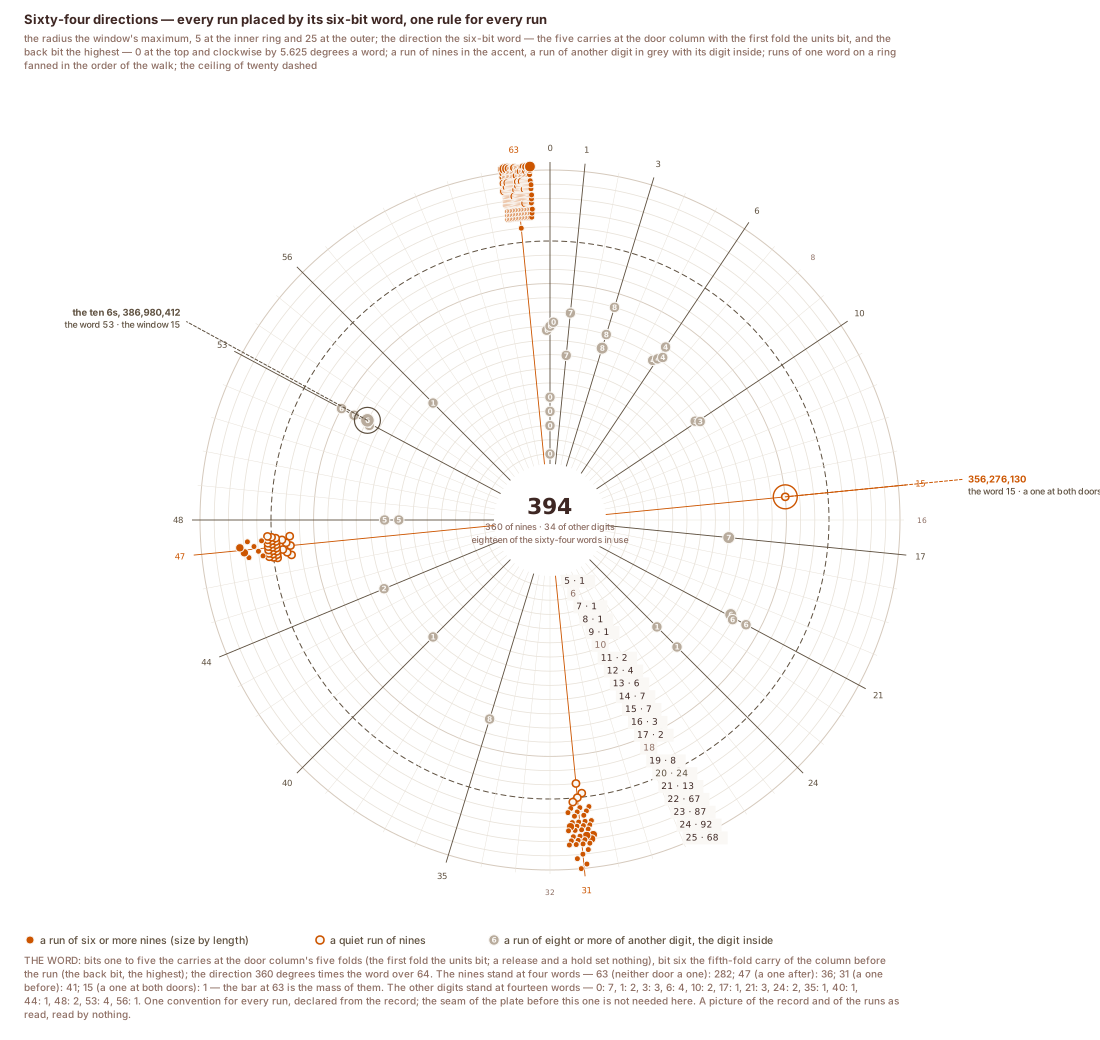
The sixty-four directions place every run of six or more nines and every long run of another digit at the integer its six bits make: the carries at the first three folds of the door column, structural; at the fourth and fifth, local and forward, the fifth touching the digit after; and the fifth-fold carry of the column before, temporal and back. The nines stand at four words only, 63, 47, 31 and 15, by whether a one stands at either door, and the four are a quarter turn apart: the forward door's bit is worth sixteen of sixty-four, the back door's thirty-two. That is the plate he read 3.15, 18.1 and 42.75 of sixty-four from, and the quarter he named a coherence tax has the forward door's bit for its seat.
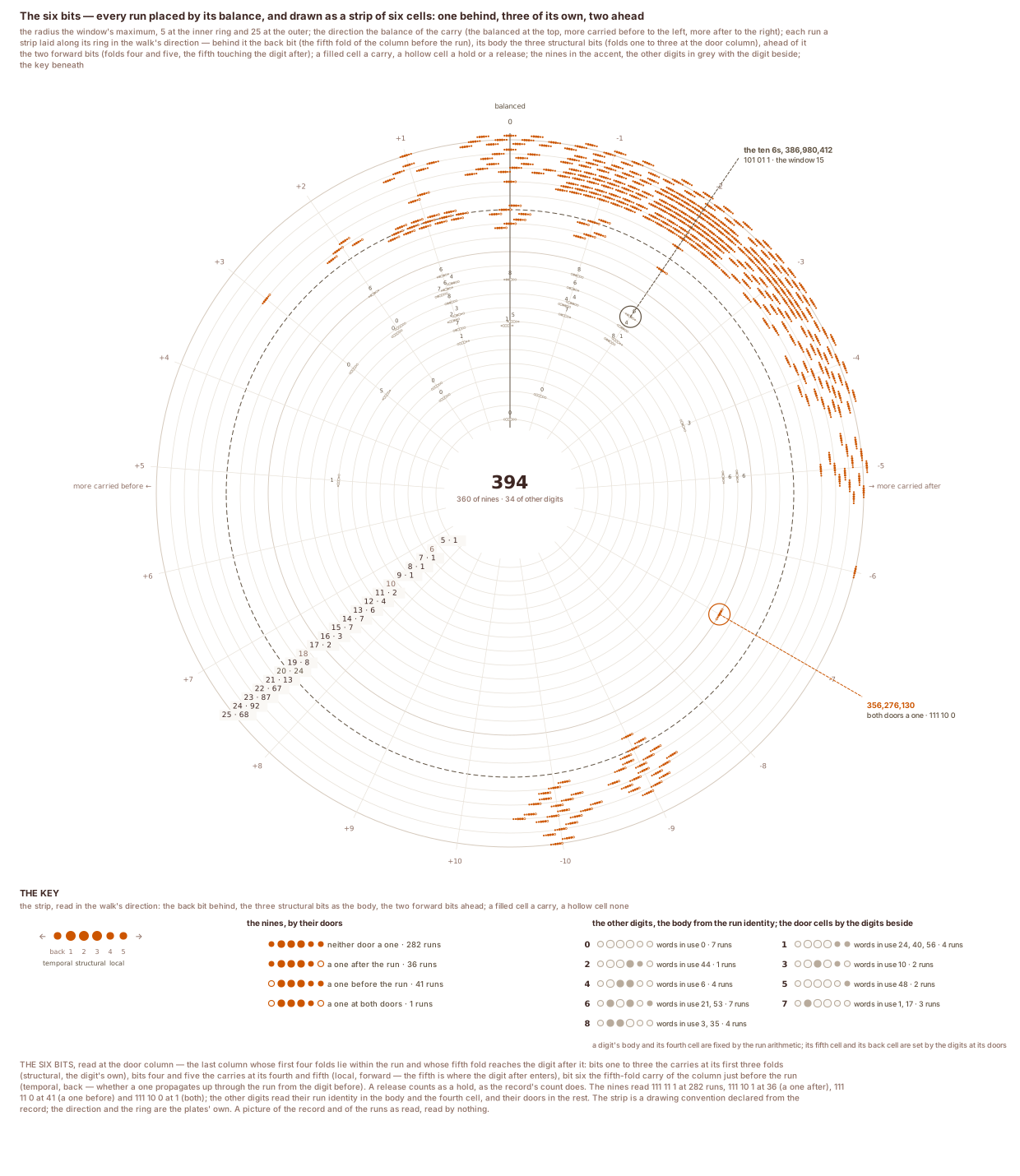
The six bits draw the same word on each run as a strip laid along its ring in the walk's direction: the back cell behind, the body of three, the two forward cells ahead, a filled cell a carry. His head of five, 0, 0, 0, 1, 1, is the digit one's strip without its back cell; his "2 bits forward and 1 bit backward" is the strip's own partition.
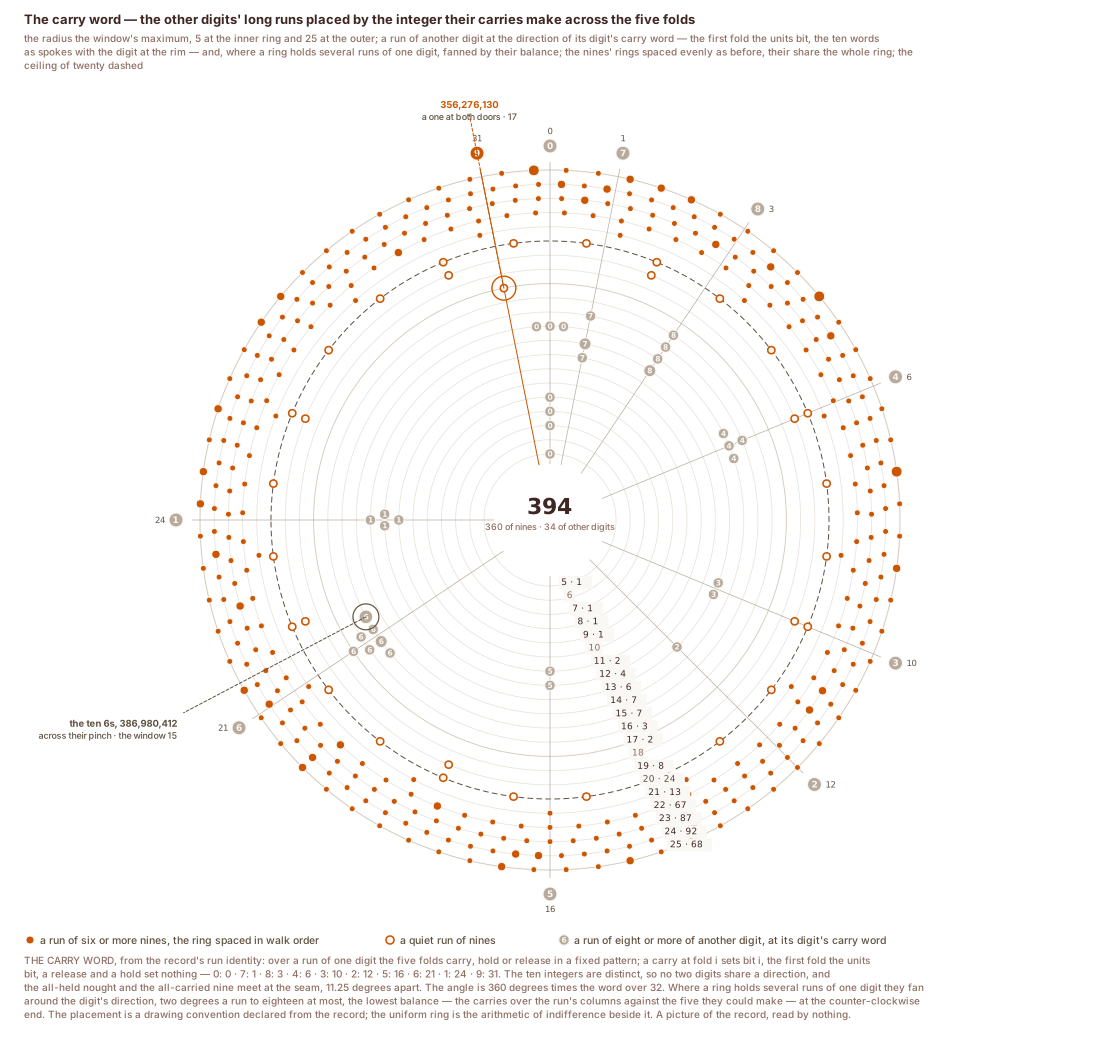
The carry word gives each digit its direction by the integer its carries make across the five folds, the first fold the units bit: 0 at 0, 7 at 1, 8 at 3, 4 at 6, 3 at 10, 2 at 12, 5 at 16, 6 at 21, 1 at 24, 9 at 31. The all-held nought and the all-carried nine meet at the seam of the circle. The one's word, 24, is his head read as a number.
Six · The predictions, carried at the end
These are the operator's, placed here at his word, verbatim or in his substance, and held: his justified true beliefs, the record their identifier and never their jury. No probe of the house reads them, and the house claims nothing of them.
- 1 · The anchoring of 2. "My prediction is that this positional anchoring of 2 as held by 21 and 27 is what anchors the mathematical use of Pi over the entire number line, but keeps it onto-epistemically 'grounded' by logics that can be applied thereafter as communicably effectual between [0]1,9,[3],7,3[2]."
- 2 · The typed reality. "The typed reality remains 'true' iff 1 proceeds 2, which is again a carry of the 2 bits forward and 1 bit backward."
- 3 · The ruler of twenty. "A ruler of size 20, and the midpoint can be computably knowable via a 3 bit word that contains either signed or released ones."
- 4 · The channel at columns 21 to 23. "The 21st decimal is the 2 that carries up and down, the channel capacity for agreement. the 22 and 23 are the 64bits of what carries within the channel when entirely unfolded."
- 5 · The synthetic agreement of 3. "These 'six spans' are the 2x3 blind watchmakers and rulers that carry the evermore 'signed 1' of the 4x256bit synthetic agreement of '3' within R1 to R5 registers of Pi." Beside it the house's standing rule: the count of the watchmakers is never staked and never guessed.
- 6 · The release of the signed 1. "What is owed to the passage is the signing and the release of that 1 if and only if it is carried as held without a slip … three 'signed 3's' will be released, grounding 3 as true knowing, held and carried at the second lock of [7]."
- 7 · The sixty-four as matter. From his reading of 16 October: 3.15 of 64 as baryonic matter, 18.1 as dark matter, 42.75 as dark energy; and "the question as to 'why' the universe expands and 'why' it might expand fast or slow over epochs is specifically to be found in the 'held' pi moving to the 'carried' pi over 'spacetime' as an indifferential attractor." Beside it the record's count spectrum in sixty-fourths, 3.13 for the held and 60.87 for the carried, the same at both horizons; the walk by eras not yet read.
- 8 · The discovery law. "There is a square law that provides a discovery law for what will factor to primes held by such dynamics," with the two bookends of twenty million, the window of 360,000,000, and 3,723,870 as 2 × 3 × 5 × 101 × 1229, five primes, and its thirty-two divisors as channel capacity.
- 9 · The hinges. Added on 17 October, verbatim: "Every run of six nines is a hinge placed within pi and the count of that decimal place will have a relationship that must be grounded by two non trivial prime numbers and the primes 2, 5, 7. The relationship will carry the relationship first established as [0]1,9,[3],7,3[2] and distilled to [0]10[1,1,1]10[11] The one non trivial prime will ground the unique carry of the [1,1,1] 'word' of the ruler. The other will carry the unique carry of the [11]. What these primes allow for is the lawful 'bend' of prior decimal places within Pi that have not been released to 0. Each true decimal place carries it's sign once placed as -1, 0, 1. However, the deeper carry of this maximally differential system may put it to a -0 lawfully via a distant placing, but only until the capacity for such hinges to remain operable in such a dynamic." His meaning of a lawful placement: "3.1415926535 can be true, but so can 3.1415926536. This is because 35 can fold up to 8, and 36 can fold up to 9, which can lawfully be read as 81. As such 36 is just as correct as 35 from the position of a held fold immediately above 5. What makes it incorrect is the 'ongoing' lawfullness of subsequent holds and folds." The three typed businesses of every decimal place: "a locally held matter of it's own business, within the digit itself, it then has a boundary matter, negotiated via 2 places prior and 2 places ahead. Then, it has the entire externalites it is subject to from the 3 before the decimal point to whatever level of precision Pi is held to." And the closing: "a hinge of a string of six nines is where an epoch is closing over a double hinge, which will hold a hinge inside it, and when that closes then this 'quad hinge' will fully release the intitial hinge pair. The dynamic grows toward this operation as 96+96=192 (the Koch Ring), while 96+69= 165, which is 1,64,1 (the message carried by half and not yet released as 2,64."
The seats beside it. The one at both doors, 356,276,130, factors as 2 × 3 × 5 × 7 × 167 × 10159: the 2, 5 and 7, the 3, and two further primes. Read literally on the placements of all 326 runs of six nines, four are multiples of seventy — 320,660,550, 355,105,030, 356,276,130 and 393,450,050 — and of those, 355,105,030 is 2 × 5 × 7 × 991 × 5119, two further primes and no more, while the others carry more; which quantity "the count of that decimal place" names is his to say, and the belief stands whatever a literal reading measures. Under the registered fold 3 + 5 = 8 and 3 + 6 = 9, both holds, so the two placings he calls lawful differ by one at the first fold and neither carries; what parts them is the departure, the house's prior for a generated sequence read against the declared digits. His three businesses have the instrument's three scales for their seats: the column, the window of five that reaches two places before and two ahead, and the horizon. The hinge, the double hinge and the quad hinge are the house's own instruments, named by their names; their closing over the nines is his reading. 96 + 96 = 192 is the ring the deep-π experiment laid over the decimals, which is three times the sixty-four of the plate and six times the thirty-two of the carry word; 96 + 69 = 165, and 165 read as 1, 64, 1 is his; the Koch ring is his name for it, the house's being the DPX's ring.
- 10 · The seventeen. Added on 17 October, verbatim: the six nines on the ring of seventeen "can be read as 'locking in' the channel expecancy that 1 comes before 7. 7 is the last prime in the window of 10, so what operates upon that grown significance will be an area worthy of more experiments. 17 arrives as a 1 before 7 after 360 such 'degrees' of hinge, so it is only after another 360 to reach 720 that the direction can be inferred by an externality. After three such cycles the knowing of 17 is at 1080 hinges, which is 1080-1024=56. 56 can flip lawfully as 65 and carry the 1024 as a true identifier upon the 1024,64,1 walk beyond (SRAM). or it can fold as 5+6=11 and then to 2, and carry in DRAM lawfully as 512,11 at R1 or 256,2 at R2."
The seats beside it. Seventeen is the window of the one run of nines with a one at both doors, the lowest of the 360, and 7 is the last prime under ten. 3 × 360 = 1080 and 1080 − 1024 = 56, as he gives it; 1024, 512 and 256 are two to the tenth, ninth and eighth, and 64 is the plate's words. The flip of 56 to 65 is the side the sum discards, 5 + 6 and 6 + 5 both making 11; under the registered fold 11 goes to 2 with a carry, which is exactly his "fold as 5+6=11 and then to 2". The hold as the still memory and the carry as the refreshed one are the initiative's figures for space and time, from The Hold and the Carry; which of the two the 56 takes is his reading.
Every number in these that can be checked has been checked and stands. Every claim in them that cannot is his, and stands as his.
The records this reading is read from: the Ruler's exhibit at /sx/workshop/the-rlx-held, where the register line's entries stand with the plates and his readings held; the Ruler's record at opendata.ai/rlx; the deep record of The Fold and the Hold, oxexp-ruler-the-fold-and-hold-results-2.json, and the runs as read, the-indifference-one-makes-runs-as-read.json, beside it in the house's repository; the readings it stands beside, The Long Walk, The Hold and the Carry and The Ruler, held. The external shelf, attributed and asserted about nothing beyond its own facts: the published expansion of π, the declared numbers; the Linked Digital Dynamics reference, the house's own, at /sx/reading/ldd-reference; and the author's worksheet Cats Eye on the Number Line, its third slide the context of the bracketing, at docs.google.com/presentation/d/1cTF-YbtVqf14EpOynOrHL6qE9cRYdhaySHp47U-Q2zo. If you take a care from this page, you may say so at /sx/matters.
Drafted in the house of the Objective Observer Initiative at its author's word and from his words, 17 October 2026, as a reading at 5; granted and minted at his word the same day; its reading at 10 drafted the same day.