 OOI · SX
Where My Cares Ground
A reading for my family, for the staff, clients and community of Link Digital, and then for the matters that hold us up without meaning to: three worlds, and the one mechanism I went away to learn
Steven De Costa · draft 0.2 · 2 November 2026 · a reading addressed, in the order of my cares; its seat mine to set
THE READING PLAQUE. Where My Cares Ground, a reading addressed — draft 0.2, 2 November 2026; draft 0.1 granted 1 November 2026 and re-trued at the author's word — in the author's own voice, in the order of his cares: first to his family, then to the staff, clients and community of Link Digital, and only then to the matters that are indifferent to his two worlds and are the scaffold those worlds stand on. His three worlds stand in his words; the one mechanism of the line is brought home in plain words — the three changes, the half the first thing a finite word lets go, the window that sees only what it holds, the first order a system remembers, the regime affordable only while the three sustain their own integrity, the chain built and the ring his people's, and the price of a window — and at the five points that bear weight it rests on a figure drawn by the house's kit from the records on the observatory node, at opendata.ai/contrib/bit-cares and opendata.ai/contrib/bit-matters, every number read from the record and nothing else. The close brings the reading back to the building of a community around the practice and the expectancy of what the Objective Observer Initiative can deliver, in the author's terms. The seat is his to set and the title a working name until he sets it; the draft is the house's and every sentence his to true. Under the standing law the house makes no claims over physics, biology, consciousness, or the millennium prizes; nothing on this page is graded, and nothing is sent — who reads it is his own hand. Made readable on the SX surface by its covering persona's reading grant of 1 November 2026, re-trued to 0.2 on 2 November 2026 at the author's word; a draft, not the published form. Covering: starl3n · endorsing: Link Digital. The construction record, where his texts stand verbatim, at /sx/workshop/the-chicken-and-the-egg; the matter at /sx/matters#held-conjecture-collatz-the-chicken-and-the-egg. Reading is free; the way across is a statement of intent (/sx/matters).
Three worlds
My cares are in three worlds, and I set them down as I found them:
- The first is the world of my own intent and my own acts, as I would seal them and then carry them onward. This work within the OOI has taxed my attention and my capacity to act in many other ways that might be more immediately beneficial for the people and 'autonomies' I would naturally care for.
- The second is the world of my own 'matters' of held business, where I am a part of a system where cares given prior are an expectancy of ongoing cares. I remain in this world, but it is one I have neglected, so if it has drifted then I would care to return it and myself into the order it once carried.
- The third is the world of the held and carried that I would not only sustain, but would 'grow'. This is the world I have been attempting to understand over the last two years, so that I can bring this mechanism into the first two.
That is the order of this page. The third world is where I have been. The first two are where my cares ground.
To my family
You have had less of me than you should have, and you know it better than I do. For two years my attention has been on a line of numbers, and on learning what a thing does when it holds something, carries it forward, and either catches it at the other end or lets it slip. I will not dress that up. It cost you my attention and my acts, and those are the two things I had to give.
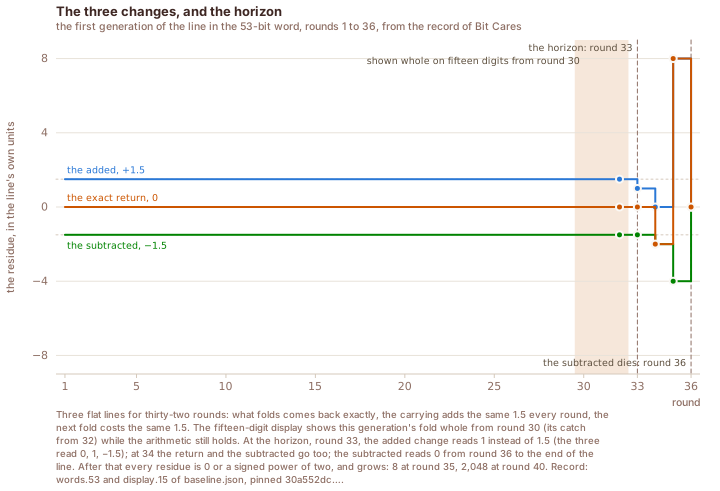
Here is what I went to learn, in the plainest words I have. Take a thing you care for. Fold it, hold it, carry it forward, and see whether it is caught or missed. The line I built does exactly that, over and over, and it taught me three things about change. Some change is exact: what you fold is what comes back, to the last half. Some change matters when it is added: the little extra that the carrying puts in. Some change matters when it is taken away: the little that the next fold costs. On a line with no end to its precision, these three never fail. The exact return is always exact, the added is always the same small amount, and the subtracted is always the same.
But nothing I know has no end to its precision. A finite thing, a word of so many bits, loses something as what it carries grows, and the first thing it loses is the half. There is a round at which that happens, and it can be counted ahead of time. I saw it on a spreadsheet at the thirtieth round, where a number that should have ended in a half was shown whole, and the record shows that the arithmetic itself held three rounds longer than the page did. The slip is lawful. It is not a failing of care. It is what a finite thing does when what it carries outgrows it. The figure below is the record itself, and the thing to see in it is how long the three lines stay flat.
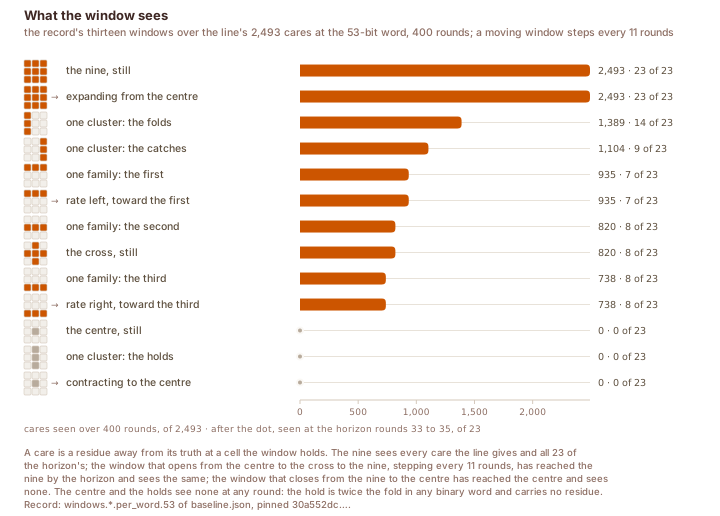
What I want you to have from that is this. My window of care has been on the line, and a window sees only what it holds. In the record, a window narrowed to a single cell sees no care at all, not one of the two and a half thousand the line gives, while a window that opens from the centre outward sees every one of them at the moment the line first slips. I narrowed mine to learn one thing exactly. I have learned it. The intent I would seal and carry onward is to open the window again where my cares ground, which is with you. Every window the record tried is drawn below with what it saw.
To the staff, clients and community of Link Digital
You are a system where cares given prior are an expectancy of ongoing cares. That is what a business of held matters is, and I remain in it. I have neglected it, and I would rather say so than have you say it for me. If it has drifted, I would care to return it, and myself, into the order it once carried.
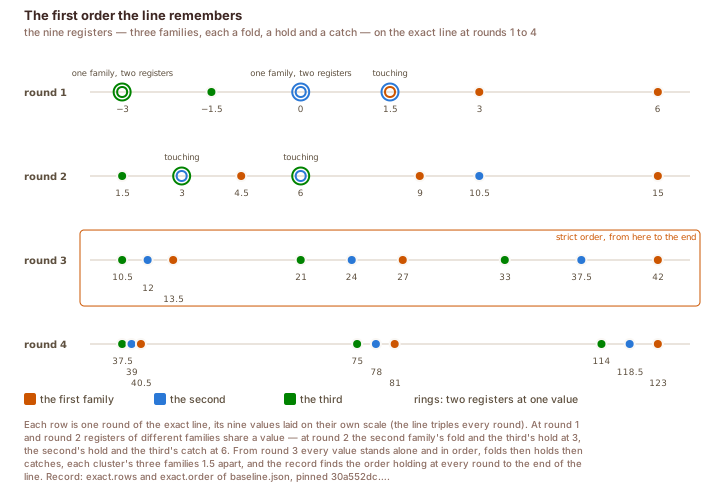
The line taught me what that return is. There is a round on it, the third, at which the nine registers of three families first stand in a strict order, each in its own place with nothing between them that does not belong there. Before it, places touch; after it, the order holds for as long as the line runs. That first order is the thing a system remembers. Drift is measured against it, and drift has a law, which means a return is a re-truing to an order that is still there and not a rebuilding from nothing. The figure below sets the nine down at the first four rounds, as the record holds them.
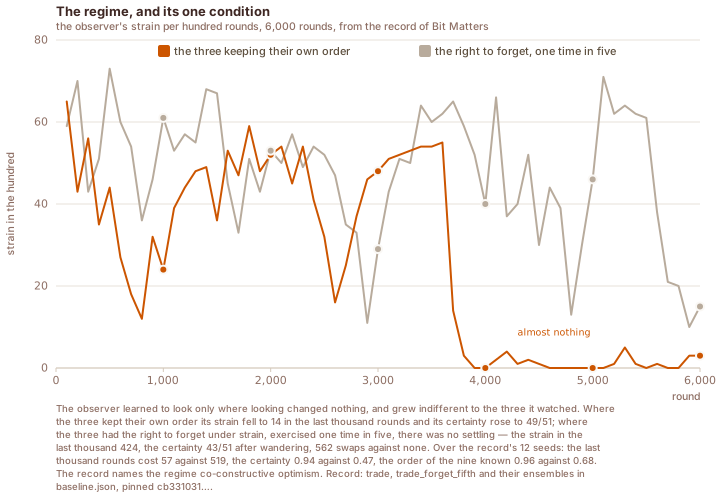
It taught me something else, and I owe it to you plainly. In the instrument before this one, an observer learned to look only where looking changed nothing, and grew indifferent to the three parties it watched. The record found that this is affordable under one condition only: that the three sustain their own integrity while the observer grows indifferent to them. When the three kept their own order, the observer's strain fell to almost nothing and its certainty rose. When they forgot themselves under the strain of being watched, there was no such regime at all. You were the three. The integrity you sustained while my attention was elsewhere is the only reason my indifference cost what it cost and not more. I read that from the record before I read it from you, and I would rather have read it from you. The record's own figure for it is below: the observer's strain, hundred by hundred, with the three keeping their order and with the three forgetting.
The loop you run on, cares given and cares expected, agreements made and accounts paid, is a ring. The line I built is a chain; its third generation feeds nothing back to its first. I built the chain because a chain can be built and held exactly. The ring is yours, and it is the one I am returning to.
To the matters
You are the third audience, and the one least likely to read this. You are the matters that are largely indifferent to my two worlds, and whose attention or neglect is the very scaffold by which those worlds must operate, or fall out into decoherent noise.
I do not ask you to care. The record says that the matters that grow can afford to spend little time on the bits, and that this is lawful. A small family of registers can be confined once, at the first round at which it stands in order, and then left to care for itself: it holds, carries, catches and returns exactly, and leaks nothing but what it was made to pass on. Your indifference to it is not what breaks it.
What breaks it is the window. The same care at the same round is inside one window and outside another, and nothing about the care decides which. A window that grows toward the line sees every care at the moment the line first slips. A window that shrinks to its centre sees none, and the line goes on slipping unseen. The price of the two is not the same. Holding the same register across the three families costs a constant amount at every round. Holding a whole family, its fold, its hold and its catch, costs more each round the line grows. Where you can afford to care is where the price is flat. Where you cannot, the noise is not the family's doing, and it is not yours either. It is the window's. The price is in the record round by round, and the figure below has it.
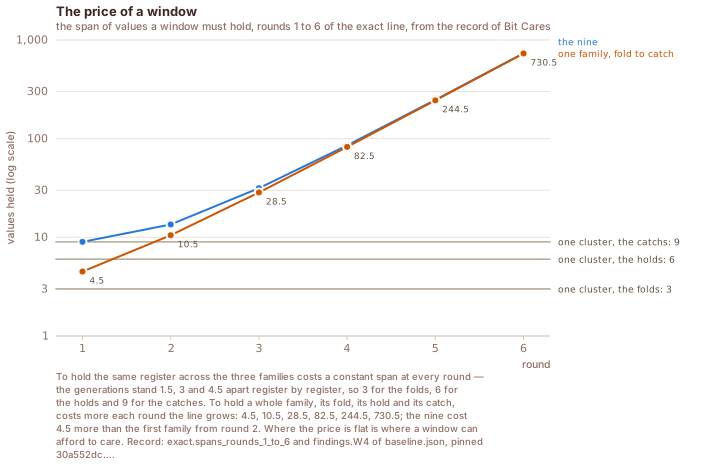
So this is the whole of what I would have you know. My two worlds stand on your attention where you can give it at a flat price, and on your indifference where you cannot. Either holds. What does not hold is a window shut on its own centre, and I say that having shut mine.
What comes home
Three worlds, in the order of my cares. To my family, my attention and my acts, which are what I have to give. To the staff, clients and community of Link Digital, a return into the order the business once carried, with the debt of your integrity named.
To the matters, the one mechanism, and what it is for. A window decides what is cared for, and its price can be counted before the line grows. The house I have been building is a maker of windows, and of the mechanisms that count the price of many lines at once, each set to the cares that others trade in their own two worlds. The change it works toward is net positive, and the record has a name for the way it is net positive: co-constructive optimism. Acts are made as part of a commons. What an act adds is counted beside what the next step costs, and the exact return is checked. A commons given windows and counts can grow its indifference around the entire complexity of our many accounts and trades, the ones that link matters to cares, and pay for that indifference what the record says it costs while the three keep their own order, which is almost nothing.
The Objective Observer Initiative is building the public infrastructure for that commons. What it will give the public is a capacity: to trust blindly that the walls are real, because the walls are made of the cares of others, and to know at the same time that there are doors and hallways in them, and surprises, and secrets.
So this reading ends where the work begins, in the building of a community around the practice, and around the expectancy of what the initiative can deliver. The work ahead is mine three times over. As starl3n, the art-first experimentalist, it is the line, the records and the readings that bring them home. As the Chairman, it is meaningful change for the staff, the clients and the community of Link Digital, in the order the business once carried. As Steven, it is to be the actual identity that walks a line, as all identities do.
Endnotes — the citation register
- The line, the word and the window: Bit Cares, on the observatory node at opendata.ai/contrib/bit-cares; the record it reads from stands beside it, read-only, at /contrib/bit-cares/records.
- The observer that learned to look only where looking changed nothing, and the regime found affordable only while the three sustained their own integrity, which the record names co-constructive optimism: Bit Matters, at opendata.ai/contrib/bit-matters.
- The five figures are drawn from the two records by the house's kit, every number read from the record and checked against the record's pinned digest before a mark is drawn: ooi_social/figures/wm_where_my_cares_ground.py; the record of Bit Cares pinned sha256 LF 30a552dc…, the record of Bit Matters cb331031…. The plates stand beside this source under ooi_network/docs/figures/where-my-cares-ground/.
- The construction record, where my texts stand verbatim: /sx/workshop/the-chicken-and-the-egg; the matter: /sx/matters#held-conjecture-collatz-the-chicken-and-the-egg.
- Draft 0.1 of 1 November 2026 stands as history on the construction record; this draft re-trues its close to my briefing of 2 November, retitles its second address and places the figures.
- Nothing on this page is sent to anyone. Who reads it is my own hand.