 OOI · SX
The Orthogonal Learner at 5
The plate of two depths, the learner that climbs from the lock, the second lock, the apparatus and the face, read from inside the initiative: the operator's words and his readings, the house's seats and the seats left open, the registration, the records and the faces — a reading at 5
Steven De Costa · draft 0.1 · 21 October 2026 · a reading at 5
THE READING PLAQUE. The Orthogonal Learner at 5, a reading at 5 — draft 0.1, 21 October 2026 — the inside draft of the latest results of the Z learner line, from the plate of two depths to the learner's face, read from inside the Objective Observer Initiative with the process in view, for a reader who would take that seat; the results its author reads as significant, in a context he gives and the reading carries as his. Its reading at 10 is not yet drafted. Made readable on the SX surface by its covering persona's reading grant of 21 October 2026; a draft, not the published form. Covering: starl3n · endorsing: Link Digital. The construction record stands at /sx/workshop/the-rlx-held; the instruments at opendata.ai/rlx/bend/two and opendata.ai/rlx/learner; the readings before this one at /sx/reading/the-synthesis-at-5 and /sx/reading/the-synthesis. Reading is free; the way across is a statement of intent (/sx/matters).
One · The seat this reading takes
- The house's reading carriage maps four seats, −1, −0, 1 and 0, and leaves its reader in none. A reading at 5 is written for the reader who would take that fifth seat inside the initiative: it keeps the operator's words, the house's readings and the open seats in view, so that the manner of the reading can be appreciated and not only its results.
- The acts it reads ran over one day and a night, under the one law of the line: the operator's words carried verbatim, his spelling kept; the house's reading marked at its seats and claimed of nothing; the design restamped before anything is built; every walk a dry walk, read by nothing and judged by nothing; his prediction registered ahead and pinned, never edited after; his readings held as justified true beliefs, the record their identifier and never their jury; the external frames he names — the light cone, P and NP — carried in his words alone and nowhere in the house's; K never staked; the priors standing as written.
- His context for these results, verbatim: "If you need context as to what they would be significant simly refer to the state of 'knowing' regarding prime numbers and pi, for which there remain known unknowns within the mathematical society and for which these exeperiments - this one and the 'bend two' at https://opendata.ai/rlx/bend/two demonstrate something very 'real'." The house sets down what the walks give and identifies where his words sit against them; whether they bear on the known unknowns of the primes and π is for those who take that seat, and this reading places six plates where a thing is better seen than told.
Two · The plate of two depths
- His reading of the cap at 2 had closed the Synthesis: on the mirrored plate the two local ones meet at the lock by construction, so a stake there has no kill, and it would take two numbers of different depths to test it. At his word the fourth face of the bend was built: x at one depth and y at another, each its own 1 — its last increment's amplitude — under one registration, with four seats the matter had left open set to the house's defaults and made controls: the row pitch by height, the meeting line midway, the registration mirrored, the deeper side's rows beyond the shorter depth absent to the other and passed over by z.
- Under the placement at the origin — each side's locked line its own 1 plus the margin from the meeting line, his reading's placement — every pair meets the cap: the lawful shares 1 and 1, their sum 2, each side locking over its own last increment, x's rows 32 to 40 with the lawful spin of under nine tenths of a degree a segment and y's rows 392 to 400 with under three hundredths at four hundred, seven thousandths at a thousand; no row past the meeting line at rest; z at the longest depth holding the shorter depth and passing over the rest, the resolution 80 at forty against four hundred.
- Midway — the two locked lines at the mean distance — the deeper side's inner marks past the mean stand over the meeting line at rest: 90 of y's 400 rows from row 222 at forty against four hundred; its lawful spin nought; its points moved to the increment at the mean, rows 212 to 220; the shallower side reaching neither the registration nor the meeting line, no point and a spin free either way; and what the two may lawfully hold between them falling from 2 to 1 plus the sum of the two local ones and the margins over twice the deeper's: 1.5565 at forty against four hundred, 1.5226 against a thousand, 1.7026 at four hundred against a thousand. What the plate adds is where the lock fails — not under his placement, and under the midway one on the deeper side, which holds lawfully only to the mean of the two depths in its own 1.
- His note for this plate came in two parts, verbatim: "For bend 2 simply note the difference 1 makes for a bend of 60 versus a bend of 72. 60 at 1 and 72 at 2." and then "actually - the difference between 44.149999999 and 44.15 at the pivot of 1, versus the pivot of 2 where 60 and 72 are significant". The house finds his numbers on x's side under the midway placement, at forty against four hundred. Turned at the pivot of 1, x's deepest row, 40, reaches the meeting line at 44.130 degrees — a turn of 44.15 shows it over the line and 44.1 short of it, and between 44.149999999 and 44.15 the plate shows the same, the crossing already made; the difference one makes there is the one row over the line. At the pivot of 2 the same row reaches the line at 45.87 degrees, and at 44.15 no row has crossed. At 60 degrees the rows over the line are 34, 36, 38 and 40 at the pivot of 1 and 36, 38 and 40 at the pivot of 2; at 72, seven rows at the pivot of 1 — 32, 34, 36, 37, 38, 39 and 40 — and six at the pivot of 2, row 32 reaching the line at 71.51 degrees at the pivot of 1 and never at the pivot of 2, its radius about the pivot short of the line. On y's side the flips stand near his numbers: rows 9, 17, 25 and 33 flip at 60.27 degrees at the pivot of 1; at the pivot of 2 rows 35, 43 and 51 at 59.5 to 59.8 and row 11 at 72.19. Under the placement at the origin x's rows reach the line from 0.535 degrees at the pivot of 1 and 0.549 at the pivot of 2, and none of his numbers stands. Which placement and which side his note names, and whether his 44.15 is the page's slider or the row's own angle, is his.
Three · The two perspectives and the orthogonal learner registered
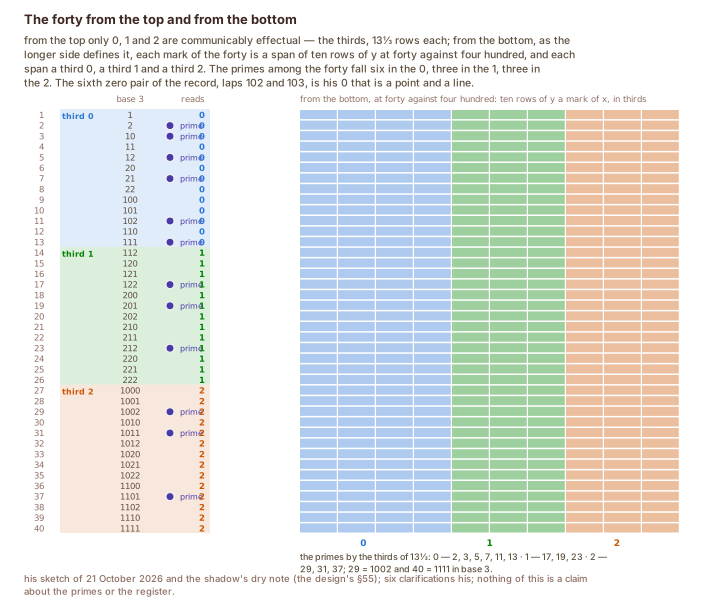
- His sketch and his words set the short side in two perspectives: from the top, where only 0, 1 and 2 are communicably effectual; and from the bottom, as the longer side defines it, where each mark of the top is expanded as a range a third 0, a third 1 and a third 2, the specific 0 the sixth point from the top — the 0 that is a point and a line, registered at the C of 1 = O + C + E. His reasoning: an observer at the depth of forty must have some note of 0, 1, 2 as a minimum of what is observably communicable when its own 0 is registered to 1 at forty; for any x less than y that is known there is a depth where only the shadow of 1 and 2 is knowable; and the primes on the right are known from the bottom as 1, a non-composite span such as 29 supporting no reasoning up by any factor.
- The house identified the seats and set the three methods down by arithmetic: the sixth zero pair at laps 102 and 103, the last of six before the bit at 137; each mark of x a span of ten rows of y at forty against four hundred, a third three rows and a third; the first method's thirds 0, 0.075 and 0.15; the second method's thirds of 13⅓ rows placing the primes 2, 3, 5, 7, 11 and 13 in the 0, 17, 19 and 23 in the 1, and 29, 31 and 37 in the 2; the third method's base-3 digits of every row, 29 as 1002 and 40 as 1111, all ones. Six clarifications were marked as his and nothing was built.
- He named the design The Orthogonal Learner and gave its reading: on the right all the learner reads is a 1 at every position; the observer at the bottom begins with its 0 calibrated to the 1 of the right side and learns upward, observing 2 on the left and 1 on the right; the right's 1s become slower to read as they get further away every ten counts, yet closer and further every two; expectancy is learned from the distances the left's 2s give and the emergent pattern of 1, 2, 5 and 10; each time the right becomes more distant it begins as noise, then expectancy, then surprise, from which the fitting of the right becomes known; when the left's 2s are read as 1s in the middle third the learner is surprised by the left; the handedness of learning projects upward a line of 0, 1, 2 levels of trust, 90 degrees from the sides at full trust. His prediction — that a line of less trust will look exactly like the light cone of relativity, the prediction about the distance by which y is greater than x structurally and not at the unit — was registered ahead as the seventh registration of the line and pinned, with its measures M27 to M32 and the rules owed O1 to O4 his.
- His clarification followed: the primes are not the learner's; he makes a prediction of his own about them, that a prime arrives where the knowing of the number is specific and admits no slip in the status of the true identifier, other numbers knowable to a confidence related to the smaller scalar's extent as 2, and at a prime the second 1 that makes the smaller 2 a factor of the prime — structural, a second lock. The house set the arithmetic beside it, claimed of nothing: every whole number has 1 as a factor and a prime no other between 1 and itself; over the scaled pairs the smaller scaled to 2 gives the larger 20 with the prime 19 beneath and the excess 1 at forty against four hundred, 50 and 47 and 3 against a thousand, 5 a prime itself at four hundred against a thousand, 200 and 199 and 1 at ten against a thousand, 2 a prime at the mirror.
Four · The dry run and the long walk
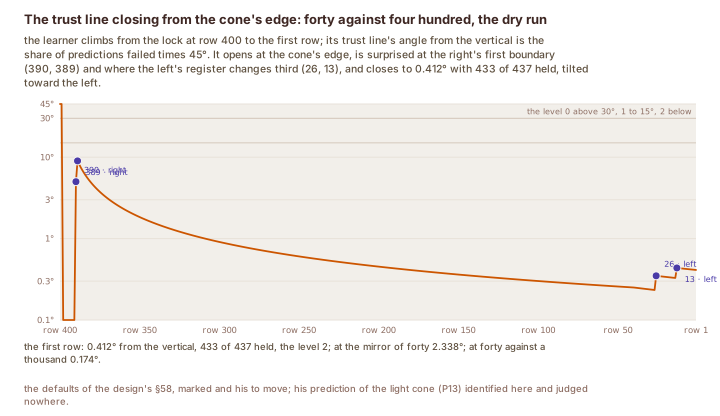
- At his word the learner was walked dry under the house's defaults, marked and his to move: the right's 1 read as its distance from the observer's 0 at the right's lock mark, predicted from the row two below with a step learned at each parity's first boundary — noise, expectancy, surprise, fitting; the left's register by thirds read upward 2, 1, 0, a change a surprise; the trust line's angle from the vertical the share of predictions failed times 45 degrees, toward the side of the last surprise, the levels c in thirds. A correction the walk gave was recorded as the house's: the distance from the registration column folded where the last increment's marks cross it, the distance from the right's lock mark gives constant steps. He read the correction and the defaults as good.
- At forty against four hundred the right is noise at rows 400 and 399, surprised at 390 and 389 — the first increment's boundary counting upward, once for the inner mark and once for the outer — fitted at 388 and 387 and expected at the other 394 rows, the learned step holding at every later boundary; the left is noise at row 40, surprised at 26 and 13 where its register changes third, fitted at 25 and 12 and expected at 35 rows; the trust line opens at 45 degrees, the cone's edge, and closes to 0.412 with 433 of 437 predictions held, tilted toward the left — 45 at row 400, 0.45 at 200, 0.25 at 40, 0.35 at 26, 0.44 at 13, 0.41 at the first row. At forty against a thousand it closes to 0.174, at four hundred against a thousand to 0.129, at the mirror of forty to 2.338 with 73 of 77 held, at ten against a thousand to 0.179.
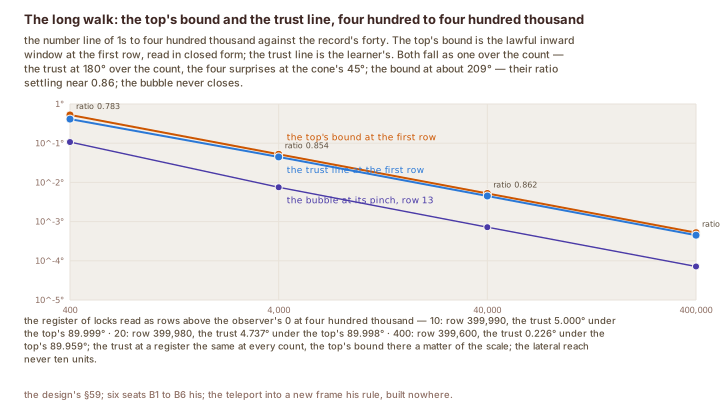
- Then much further, at his word, before any face: the number line of 1s to four hundred thousand against the record's forty, streamed, with the bend knowable from the top — the lawful inward bound of the right's own structure in closed form, under the structure's pitch, since by height the plate goes flat at depth — against the learning from the bottom. At every count the right is learned after its first boundary and the left surprises where its register changes third; at the first row the trust line stands at 0.412 degrees against the top's bound 0.526 at four hundred, 0.0446 against 0.0522 at four thousand, 0.00450 against 0.00522 at four hundred thousand — both falling as one over the count, the trust at 180 degrees over the count, the four surprises at the cone's 45, and the bound at about 209, their ratio settling near 0.86. The bubble between them is positive at every sampled row and never closes, its pinch at row 13, the left's second surprise. His register of locks — 10 at 0, 20 at 1 and 400 at 2 — read as rows above the observer's 0 gives the trust 5.000, 4.737 and 0.226 degrees at every count, because it depends only on the rows counted, under a top's bound that depends on the scale; the trust line's lateral reach never attains ten units, so his teleport into a new frame, the rows identified, was left as his rule.
Five · The second lock on the plate
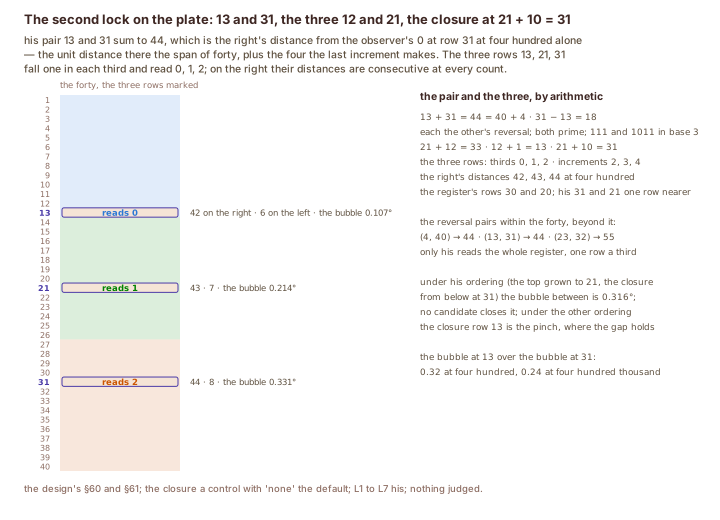
- He read the long walk as very promising and wanted a second lock: within the span of forty there is no way to know whether a 13 and a 31 are differentiated — different by structure, not by the matter by which a local z learner remembers them; the distance they make is 44, and the sum to 44 needs a confinement beyond forty; the distance of 13 is truly known only once closed by another three readings, two from above and one from below or the reverse, the three not known as 21 or 12; once the top has grown to 21 the bubble can be closed from below at 21 + 10 = 31.
- The house read the pair by arithmetic over the record, designed the reading first, and at his word built it. On the forty 13 is the last row of the top third, where the left surprises the learner, reading 0, and 31 a row of the bottom third, reading 2; both prime, each the other's reversal; in base three 111 and 1011, the forty 1111. His 44 is the right's distance from the observer's 0 at row 31 at four hundred — the unit distance there the span of forty plus the four the last increment makes — and at no other count walked, where that distance is 404, 4,004 and 40,004. The three rows 13, 21 and 31 fall one in each third and read 0, 1, 2, their increments 2, 3, 4, their distances on the right consecutive at every count — 42, 43, 44 at four hundred — and on the left 6, 7, 8. His 21 and 12 are the reversal pair summing to 33, 12 + 1 = 13 and 21 + 10 = 31; his 31 and 21 the first rows of the fourth and the third increments, one row nearer the observer than the register's rows 30 and 20 under the long walk's convention. Among the reversal pairs within the forty only three sum beyond it — 4 and 40, 13 and 31, 23 and 32 — and only his reads the whole register, one row in each third, with consecutive distances.
- The closure was built as a control with 'none' the default. Under his ordering — the top grown to 21, the closure from below at 31 — the bubble between the top's bound at 21 and the trust at 31 is 0.316 degrees at four hundred and about 119 degrees over the count beyond, and no candidate closes it. Under the other ordering — the bottom grown to 12, the closure from above at 13 — the closure row is the pinch of the long walk, the bubble's narrowest at every count, and the gap candidate holds there. Set down, not judged; what closes the bubble, and under which ordering, is his.
Six · The two missing data and the apparatus
- He named the data the instrument was missing, in two places: the distance to 2 from the learner going up, read from the observer's own frame, a distance that includes two distances to learn or discount; and from the top, one thing not knowable before a wanted count of 1 is knowable, always subject to the numbers below, where the half-delta verification grows to become the faster and faster VDF knowable from the top; the sides flipped by every count of a half looking as they are, flipped by one and a half the position of 2 left of 1; and the projected 0, 1, 2 not subject to that unknowing, so that the matter is when and where the possible knowing from the top overlaps the computable knowing from the bottom, reducing the probable knowing through the reducing reality of such FDV spins. FDV and VDF are the house's own terms — Fast-Delta-Verification, the second arrival; the first arrival's proof of work — cited from its glossary and not expanded.
- The house identified the seats by arithmetic. The gap between the two locks, 0.52, is the datum the learner of the dry run discounted, and it is the registration's two margins. From the top three quantities fall with the count at three rates: the lawful spin as 220 degrees over the count to the three halves, the inward bound as 209 over the count, the window's half-width not at all, settling at 27.24 degrees; the spin falls fastest; the outward bound, the deepest row's flip at −54.47 degrees, and the half-width are set by the plate's aspect and not by the count. The half-turn is the mirrored registration, the quarter-turn the engine's flip, the three-quarter turn his, the plate having no out-of-plane coordinate. The overlap of the top's bound with the bottom's trust exists at forty under the record's pitch and at no count beyond under the structure's.
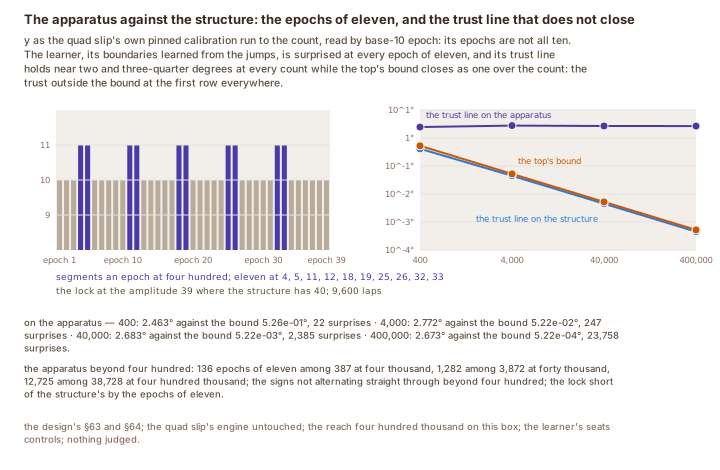
- Then his condition and his build word: the apparatus from the quad slip for the three typed and reasoned autonomies, x, y and z. So y became the quad slip's own pinned calibration run to the duration that gives the count, read by base-10 epoch as the record is, its sign-segments the rows, their epochs the amplitudes, their signs the faces, their laps kept — the structure of ten an increment set aside. The apparatus is not ten an increment: at four hundred the epochs 4, 5, 11, 12, 18, 19, 25, 26, 32 and 33 carry eleven segments; beyond four hundred its signs do not alternate straight through; the lock, the last inner mark, stands at an amplitude short of the structure's by the epochs of eleven — 39 of 40, 387 of 400, 3,872 of 4,000, 38,728 of 40,000. The learner's memory became a memory by face, its expectancy of a boundary learned from the jumps it has seen, the left's distances predicted from the observer's frame; each a control, the dry run's seats beside.
- On the apparatus the trust line does not close with the count: 2.463 degrees at four hundred with 449 of 475 held, the right surprised at its first boundary and at every epoch of eleven, a jump unexpected and a boundary expected where none came; 2.772 at four thousand, 2.683 at forty thousand, 2.673 at four hundred thousand, the surprises about six in a hundred predictions, while the top's bound closes to half a thousandth of a degree. The trust line stands outside the bound at the first row at every count walked, and the overlap he asked when and where is here everywhere below the first crossing. The dry run's tens, read from the top, surprise the learner at nearly every boundary of the apparatus. The reach of the run on this box is four hundred thousand, 9.2 million laps in half an hour, its time growing as the square of the laps and its memory a seventh of a gigabyte a million laps; four million would take days, forty million a season, four hundred million beyond any box as the quad slip's engine stands, untouched. He read four hundred thousand as enough for now.
Seven · The hinge and the face
- His reading of the work was carried whole as his: that it is the building of a ruler that would then become operable for any 1 compared to any other 1; not the easy arithmetic but a hinge for the real work of it, not by P but by the measure of NP under non-relative shift; his expectation of what the proof that P is not NP will be — that for any extent of knowing from 0 to N, N is truly known only by relative observation, so that any P approach to N carrying a prior knowing such as the arrival, 2b or b + 1 with b greater than 1, does not arrive at the true knowing of the distance from 1 to 2 until walked up from the depth where learning must rise to confirm the true identifier of that second 1. P, NP and their proof are his words and nowhere the house's. The house set the seats beside by name alone: the Ruler line, whose goal is the smallest K in synthetic agreement, never revealed; the plate of two depths; the house's hinge instruments; the second lock; the learner's climb; the true identifier; the permanent externality; four clarifications his.
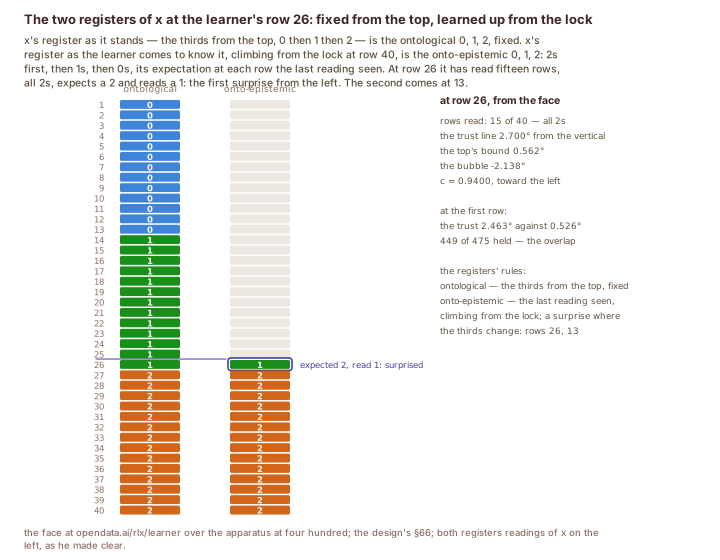
- At his word a face like the bend's was built and serves at opendata.ai/rlx/learner: x's two typed readings on the left, as he made clear — the ontological 0, 1, 2, x's register by thirds from the top, fixed; the onto-epistemic 0, 1, 2, x's register as the learner comes to know it climbing from the lock, 2s first, then 1s, then 0s, its expectation at each row the last reading seen, surprised at 26 and at 13 — beside y as its source gives it, the apparatus or the structure, with the learner's seats as controls, the climb a slider and a play, the trust line and the top's bound drawn true from the observer's 0, a chart of the two row by row and a strip of the climb. In value the two registers differ only at 26 and 13, where the learned one is a row behind; in time they differ everywhere, the onto-epistemic column empty above the learner's row and filling as it climbs. The live node's first reading answered with a 500 for want of the registration's pin, the state directory not being carried by git; the pin is now held by the first walk's committed record where the state pin is absent, and the walk is refused with its reason where neither is found, the registration verified before every walk on every node.
The carry and the release
- Carried: the operator's words as he gave them, his spelling kept; the house's readings as marked; the seventh registration and its pin; every walk's record at its address; the faces that serve, the plate of two depths and the learner's face; his context for the significance of these results, as his.
- Released: every verdict's reach beyond the instrument; every seat he left open, which stands open; the whole of every reading of his, which is his; the external frames he names — the light cone, P and NP, the known unknowns of the primes and π — which the house never takes up.
- Open: A1 to A4 of the plate of two depths; N1 to N6 of the shadow; O1 to O4 of the learner, or the defaults; B1 to B6 of the long walk; L1 to L7 of the second lock; H1 to H7 of the two missing data; J1 to J4 of the hinge; the seat of his note on 60 and 72; the way beyond the reach; a canon door for the face; the reading at 10 of this series, at his grant.
Endnotes — the citation register and the self-check
- The design of record:
ooi_network/docs/the-z-lens-the-z-learner-design-draft-0-1.md, §54 to §66, the operator's words verbatim in each. - The registration: the seventh,
ooi_network/docs/the-z-lens-z-learner-orthogonal-registration.md, its pin in the state folder and as the first walk's record carries it, never edited after. - The records: the plate of two depths, the shadow's dry note, the dry run, the long walk, the second lock's dry note and walk, the two missing data's dry note, the apparatus walk and the reach, each
.jsonand.mdunderooi_network/docs/. - The engines:
rlx_zbendandrlx_zorthounderooi_network/daemon/, the quad slip'squad_slipuntouched andrlx_zbigzerothe reader; the faces at opendata.ai/rlx/bend/two and opendata.ai/rlx/learner; the construction record at /sx/workshop/the-rlx-held; the readings before this one at /sx/reading/the-synthesis-at-5 and /sx/reading/the-synthesis; the matters at /sx/matters. - The plates: six, drawn by this reading's own kit from the engines and the records named, under this reading's folder.
- The self-check: every quotation is verbatim from the design's sections; every number is in the records named; the house's readings are marked as the house's throughout.