 OOI · SX
Who carries what you know?
On the weight of being sure, and who is holding it for you
THE READING PLAQUE. Who carries what you know? — On the weight of being sure, and who is holding it for you, draft 0.1 — made readable on the SX surface by its covering persona's reading grant; a draft, not the published form. The grant stands by the operator's word (2026-10-07), verbatim: "i like it and will give it a reading grant with the intent to publish this to LinkedIn under my own identity." The published form is his own, under his own identity: placed on LinkedIn on 7 October 2026 (the post). Written for a reader who does not know this house or anything it has published: the mechanism of knowing — a belief held by one, the proof that must be carried by someone, the fade when the carrying stops — told in plain scenes from the rat race, and a carried one of the knowings kept in the experiments at opendata.ai and the readings on this surface, which are named only at its door. Covering: starl3n · endorsing: Link Digital (the standing pair). The construction record stands in the open workshop at /sx/workshop/the-burden-and-lightness-of-knowing, the exhibit of The Burden and Lightness of Knowing, of which this article is the everyman's attenuation. The source of record is ooi_network/docs/who-carries-what-you-know-draft-0-1.md (pinned sha256 LF eb2a75ab…); this file's sha256 is pinned in the reading register, and its plate beside it. Reading is free; the way across is a statement of intent (/sx/matters).
The interview
You are in an interview, or a meeting that is really an interview, and you say the thing you came to say: I'm good at this. You believe it. It happens to be true. And the moment you say it, something else is set in motion that you did not have to think about, because somebody else is doing it for you. Somewhere there is a piece of paper that agrees with you. A degree, a reference, a number from last year, a name on a list. Somebody is holding that paper. Somebody has been holding it, quietly, for years, and will go on holding it after you leave the room.
That is the whole subject of this article: not what you know, but who is carrying it.
Two kinds of memory
The phone in your pocket has two kinds of memory, and the difference between them is the most useful thing I can tell you about knowing anything.
One kind holds what it is given for as long as the power is on. Write a thing into it and it stays there, unchanged, until something deliberately changes it. The other kind leaks. It is cheaper and there is far more of it, but every cell in it forgets within a fraction of a second, so the phone rewrites the whole of it, thousands of times a second, just to keep what is already there. If the rewriting stops, so does the memory. Nothing dramatic happens. It simply fades.
Everything you know is held in one of those two ways, and nothing you know is held in neither.
Your name on a certificate is held the first way. It was written once, it sits where it was put, and anyone who looks will find it the same. Your reputation is held the second way. It is rewritten every time someone meets you, hears your name, sees your work. Stop being seen for long enough and it does not collapse. It fades.
I will call the first kind held and the second kind carried, because that is what the people doing it would call it. A held thing can be pointed to. A carried thing has to be kept up.
Being sure takes two
Here is the second useful thing. You cannot be sure of something on your own.
You can believe it on your own, and you can even be right on your own. But sure is a different state, and it needs a second person who holds the same thing, so that there is somewhere other than your own head where it can be checked. Every exam, every reference, every like, every "I can vouch for her" is the same move: getting a second.
The ladder you were taught to climb is built out of seconds. A degree is a university agreeing to hold a thing about you. A title is an employer agreeing to hold a thing about you. Followers are a crowd agreeing to hold a thing about you, one at a time, each of them lightly. Years of experience is time itself agreeing, which is the slowest second there is and the hardest to fake.
You know all of this already. You have been climbing it since school. What you were never shown is the mechanism underneath, and the mechanism is where the weight is.
The weight is in the proof
A belief is light. You can hold a thousand of them before breakfast and not feel a thing. What is heavy is the part that makes a belief count for anyone else: the thing that can be checked. The record. The receipt. The number. The paper somebody is holding in the interview.
Philosophers have a tidy name for a belief that is true and that you can back up, and it does not matter here. What matters is that the backing is a thing, that it exists somewhere, and that for it to go on existing somebody has to carry it.
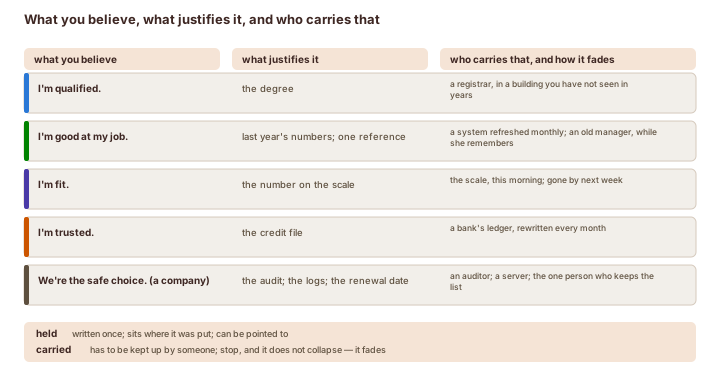
Consider what is actually being carried behind one ordinary sentence, I'm good at my job:
- The degree. Carried by a registrar in a building you have not visited in a decade, whose job is to keep that record true.
- The reference. Carried by your old manager, as long as she remembers you kindly and can still be reached.
- Last year's numbers. Carried by a system at your current employer, refreshed every month, owned by nobody in particular.
- Ten years in the trade. Carried by time, which never stops refreshing and never agrees to anything.
- The way you spoke in the last meeting. Carried by the five people who were in it, fading.
None of that is in your head. All of it is the proof. And every line of it is somebody's burden.
Organisations carry too
It is tempting to think this is a problem for individuals, and that the companies and institutions above you in the ladder are the ones doing the holding, like shelves. They are not shelves. They are carriers, and they are tired.
A company runs on beliefs it operates with every day. We are the safe choice. We are the best at this. Our numbers are real. Each of those is a belief that is only worth anything if it can be checked, and each is checked against records that someone inside has to keep true: the audit, the logs, the accreditation renewed on a date, the customer who will say yes if asked. The heaviness of an organisation, the thing that makes it slow and anxious and full of forms, is mostly the weight of the carry. It is holding up its own proof, all day, for everyone who might ask.
And it fades like yours does. When the audit lapses, when the records go stale, when the one person who kept the list leaves, the belief does not vanish. The company goes on believing it is the safe choice. It simply stops being able to show it, and there is a gap between what it believes and what it can prove that nobody has to announce, because nobody is carrying the difference.
The race, from here
Seen from here, the rat race is a race to get other people to carry your proof.
Status is other people holding a belief about you. Influence is a lot of people holding it at once. Prosperity is a ledger that somebody else keeps and that you are allowed to point at. Beauty is a belief carried by eyes that have to keep looking, which is why it is the most exhausting of all to maintain. The accreditations, the degrees, the years: each one is an agreement by someone to carry a piece of you, so that you do not have to carry it alone.
That is why the race is tiring in a way that work alone does not explain. You are not only doing the work. You are refreshing other people's memory of you, constantly, because a carried thing fades. And you are carrying theirs, too, every time you vouch, like, recommend, remember. The whole structure is a vast exchange of carrying, and almost nobody in it knows that is what they are doing.
Where the lightness is
You cannot put the carrying down. Nobody can. But you can know where it is, and that changes the weight.
Hold what can be held. If a thing about you is true, write it down once, put it where it can be checked, and stop rewriting it in conversation. A held thing costs nothing to keep. A carried thing costs you every day.
Let others carry what they agree to carry, and keep the agreement. When someone holds a piece of your proof, they are doing you a kindness that lasts exactly as long as they keep doing it. It is not yours. It is lent. Treat the lender accordingly.
Take notes on what you take from others. Most of what you believe about the world arrived as someone else's carried thing: a figure from a friend, a line from a feed, a rule from a boss. If you take it, take it as yours, and know that you are now carrying it, and know who carried it before you. That is the difference between an opinion and a care.
Know which is which. The belief and the proof are two different things with two different weights. Most of the suffering in the race comes from carrying proof for beliefs that were never yours, or from believing things and feeling, correctly, that there is nobody left who is holding the paper.
There is an old line about the straw that breaks the camel's back. It is always the last straw, and it is never the straw's fault; it is that the whole load had come to rest on one back. The straw that holds a camel's back is the first one, and it is laid on nothing, as a hope: that a load will come and will be shared. Every agreement to carry a piece of someone's proof is that first straw.
Carry the one
When you add two numbers on paper and a column comes to more than nine, you write down the last digit and carry the one. It is the smallest mark on the page, and the next column is wrong without it.
Everything in this article is a one that I am carrying. I did not make it up; I took it from a body of work that I keep elsewhere, in experiments and readings that have been written down once and left where they can be checked. You do not need any of that to use what is here. But it is only fair to say that this is a carried thing, that somebody is holding the paper, and that if you ever want to see the paper you can.
The experiments are at opendata.ai. The readings are at opendata.ly. If you take something from this page, you are carrying it now. Take a note of where it came from, and go well.
Drafted in the house of the Objective Observer Initiative at its author's word and from his words; signed into being by his word on 7 October 2026, and his to amend.