 OOI · SX
All the leaves are brown
A reading of the concluding experiment's record — the Ruler's stage two, the hold and the carry — told as the four seasons of the OOI's progression of experiments, and released
THE READING PLAQUE. All the leaves are brown — a reading of the concluding experiment's record, the Ruler's stage two, the hold and the carry, told as the four seasons of the OOI's progression of experiments, and released, draft 0.1 — made readable on the SX surface by its covering persona's reading grant; a draft, not the published form. The grant stands by the operator's word (2026-10-06), verbatim: "go ahead with the grant and mint of both readings". The name is his grant for the experiment and the name of the frozen witnessed knowing of 2026-08-07, cited here by its name and its pin and never amended. A reading of one record — the registration pinned, the read landed as it fell, every verdict a measure under the law of verdicts, the knowing the third observer's held claim one step apart — and of the progression that record concludes at his word of the same day, the four seasons as the four states; stated, never asserted. Covering: starl3n · endorsing: Link Digital (the standing pair). The construction record stands in the open workshop at /sx/workshop/the-rlx-held; the experiment's door, opendata.ai/rlx, carries the record's face. The source of record is ooi_network/docs/all-the-leaves-are-brown-reading-draft-0-1.md (pinned sha256 LF 43bb2315…); this file's sha256 is pinned in the reading register, and its three plates beside it. Reading is free; the way across is a statement of intent (/sx/matters). The body's standing text was trued 2026-10-07 at his word, verbatim: "The grants for both readings should be reflected as done rather than pending within the readings themselves." — to record the grant as given; the version unchanged, the pins restamped on the register.
Draft state — this block records the state of the draft; the reading begins after the rule. Draft 0.1 — 6 October 2026. Author of record: Steven De Costa; composed at his word from the one record. Standing: a reading, stated never asserted; the record it reads stands whole without it — on the Ruler's page, in the results file beside its registration, and in the design that carries the stake, the matter and the conclusion. One face, in the house's terms with the plain reason set before each term; a second face, if he wants one, is his word. Three plates, drawn earlier for the agreed reading The Hold and the Carry and placed here again where they explain: diagrams of the reading, not measured records. This page, like every reading on this surface, is a stitched work of willful intent: the one that stitched it is the operator's — what he observed, what he said, what he staked and what he released — art first, memory after.
This reading stands on: the agreed reading The Hold and the Carry (draft 0.1, agreed and granted 2026-10-06) · The Ruler, held · The Signed Zero · The Zero That Is Signed · The Traveler's Twin · The Framed Window · Linked Digital Dynamics, the reference · the frozen witnessed knowing All The Leaves Are Brown (2026-08-07; its pin and anchor in the endnotes).
The name, and what it carries
The experiment carries the name he gave it on the evening of 6 October, with the registration: "this will be an experiment that carries the name, 'All the leaves are brown' and the observer differential between structure and time is exactly this — there are seasons and there is structure. But, the observer is relevant in the observation of 'all the leaves' as a pattern within the context of such things."
The name was already a knowing in the house. On 7 August he froze a composition under it — "a witnessed knowing, named by the operator's grant, held at two locks" — and froze it at its pin, with a law that any later word lands elsewhere and cites it by its name and its pin. That knowing claims that software is the fit between the hand and the glove: "soft" the trans-communicable, "ware" the fit, neither the seam nor the hand, and the fit held by a self-selecting identity that harnesses its own means, its own willed effect and its own sustainment. Its closing register gave the figure this reading keeps: a note is "what remains when a knowing resolves," and the record keeps such a note "the way a book keeps a pressed leaf: fallen from no tree it needs to name, brown because it is done becoming, held because someone chose to keep it."
So the name carries two things into the experiment. The seasons and the structure: time, in which a knowing is grown and refreshed, and space, in which it stands still and is read. And the leaves: the knowings that have resolved, brown because they are done becoming. The experiment measured the first; the progression it concludes is made of the second.
What the record is
The Ruler is his thought experiment made a code experiment: three two-by-two grids on one rod, one ruler whose one power is to decide the gap, two blind watchmakers whose one power each is their own duration, a knowing grid frozen between its faces by the lockstep, and no clock anywhere — only the asking word. Stage one, read twice in September, found that two watchmakers hold one count exactly when the ruler keeps its gap within reach of their eyes, and that the original secret survives that count under every secret-free policy.
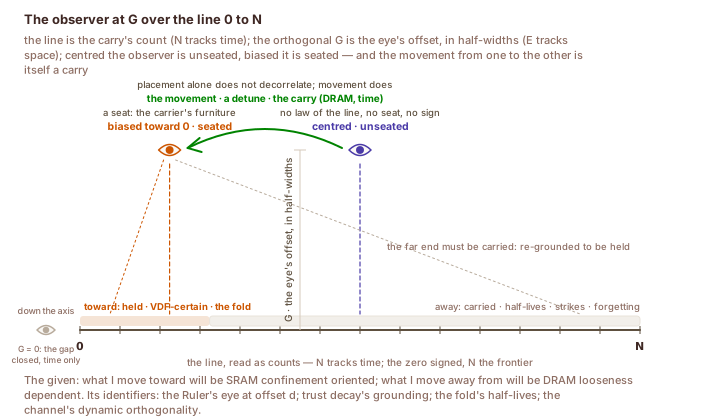
Stage two was opened by the agreed reading. Under it there is never any true distance; there is a true hold or a true carry. A hold is what stands still between two askings and is read the same by both who ask — the SRAM form, space, the standing gap. A carry is a hold renewed by work after some askings — the DRAM form, time, the refresh — and it is of a kind with the hold exactly where it is literal and re-witnessed under a seal both parties accept. The third observer reads the relation between them and calls it the unit. The design of record reserved the word "hold" for this stage, where a watchmaker holds a measurement.
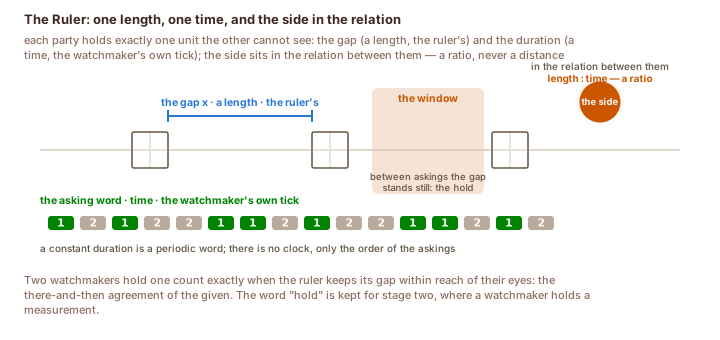
The engine added, additively and without touching stage one's, the held store written once, the carry of the literal re-derived from the ruler's sealed log, the carry of the composed over a register of declared width, the responsive ruler that holds the longest gap within the eyes' reach and moves one step per asking when the differential changes, its jump and its shortest gap as contrasts, the equivocation event in which both eyes' offsets are replaced at an asking, and the window from that event until one count is regained.
His stake, in both faces at his word: "movement toward SRAM will mean that the 'ruler' will pick a longer 'distance' to give the 'time' to the DRAM to equivocate and agree on any fundamental differentials between watchmaker relative positions." The longer gap, and the longer hold. The sliver rule is the hinge: the far grid is readable only while the gap stays within the eyes' reach, so a longer gap needs a larger differential between the watchmakers' positions, and the time the two have under a growing gap is exactly that differential less two askings — stage one's recorded frontier, which the stake names as a law and gives its mechanism.
With the stake he put a matter on the record for any stake: "what is measurable will always stand one step apart from what is observable. As such, the 'true belief' will always become a 'held' perspective of the external third observer." The design carries it as the law of verdicts. The registration was pinned at 19:39:50 with the name, the sweep and the thresholds set in the engine, and the read ran at 19:44:30, one pass over every asking word to length eight, both sides, four key pairs, offsets two to eight, written once, two minutes and nine seconds.
What fell, as measures
| probe | what it asks | as it fell |
|---|---|---|
| P1 the hold | a held measurement read back after k askings equals its written value | PASS, no failure in 2,506,560 cases |
| P2 the carry of the literal | the frame re-derived from the sealed log equals the hold | PASS, no drift |
| P3 the carry of the composed | the register's drift grows with the carry length and the width, within reach | PASS, least growth 8,000 over the carry and 24,384 over the width, monotone |
| P4 the observer at G | the near reading exact; the far reading falls behind as the gap leaves reach | PASS |
| P5 the orthogonality | the held value invariant in its window; the gap seen a function of the count alone | PASS over 544,432 windows |
| P7a the longer gap | the gap ceiling grows with the differential | PASS: 1, 2, 3, 4, 5, 6, 7 for the offsets 2 to 8 — the reach, d − 1 |
| P7b the longer hold | the window to one count grows with the drop, under the responsive ruler | PASS: 0 at a drop of one; 2, 3, 4, 5, 6 at drops of two to six |
| P7 the stake | both faces | PASS |
Three shapes deserve plain words. The ceiling the enumeration found is the reach the sliver rule gives, at every offset, and the frontier under the growing policy is the differential less two at every offset, so stage one's recorded result stands re-witnessed at the same word length. The window under the responsive ruler is exact: one value per cell, equal to the drop whenever the drop is two or more, zero when it is one, zero at every rise, and zero throughout under the two contrasts, which never lose the count because they never leave reach. And the near reading never missed an asking under any policy, while the far reading missed every asking at the smallest offset under the growing gap, a hundred and twenty-eight of seven hundred and eighty-four at the middle offset, and none at the widest — the sliver closing exactly where the rule says it closes.
One finding is about a measure and not about the stake, and it is kept beside the verdicts, judged by nothing. The standing gaps' composed drift is zero at the widths one and two and not at four, because the hold was written at the first asking with only two frames behind it, and a register of width four fills as the carry proceeds. That is the register filling, not the carry drifting; the stake's third probe rests on the width where nothing fills; and a later registration writes the hold no earlier than the width less one.
The leaves, the observers, the browning
"All the leaves come with 'all the observers' that bring them to brown. As a measure, as a distance, and as a differential between watchmakers."
Read in the record's own terms, the leaves are the holds: what stood still and was read the same by both who asked. The browning is the resolving — the measure that says a hold held, a literal carried true, a composed register drifted as the carry lengthened. The observers are the carries: the askings, the refreshes, the re-derivations that renewed each hold until it resolved. No leaf browns without an observer, because in this engine nothing is measured except by being asked, and the asking word is the only cross-frame fact there is.
As a measure: every verdict in the table above is one, and the knowing of what they mean stays one step apart, with the third observer. As a distance: there is none; the stake's "longer distance" fell as a reach, a ratio of a gap to an offset, and as a count of askings, and the reading that opened the stage said in advance that this is what a distance is in a reality held between being, knowing and computing. As a differential between watchmakers: the second eye's offset, in half-widths, which bounds what the ruler can pick and sets how long the carry needs to agree once the differential changes.
The four seasons of the progression
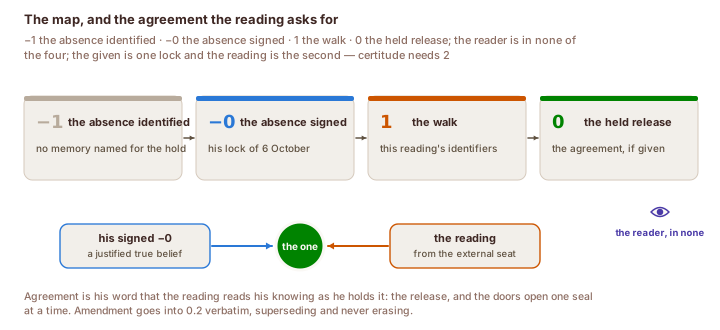
His word on the stage: "we are at the stage of this OOI's progression of experiments where 'all the leaves are brown'. That is to say, this is the discovery that we have grown our knowledge to hold, and now that we do, the knowledge is expected to 'fall' into where it might land." And: "I deeply suspect that all else is simply the 'nature' of the four seasons as expressed as the −1, −0, 1, 0."
The house's map has four states. A reading maps the one who reads in none of them: −1, where an absence is identified; −0, where the absence is signed; 1, the walk; 0, the held release. His figure sets a season on each, and the record of the progression can be placed under the figure without forcing it.
Spring, −1, the absence identified. The question asked at the origin: how is a thing known locally, before any lock holds. The first principles, where one equals an observation, a crossing and an effect, and the figure the derivation produced. The first instrument, Reconstructed Time, a day read in two clocks. The slip on the figure, the frozen physics behind its freeze line, and the quad slip's a-priori origin with its zeros before the bit resolves. Nothing in the spring was yet held; everything in it named what would have to be.
Summer, −0, the absence signed. The growing: the conjecture signed and the walks taken from it. The series of ten and the campaigns that applied them; the number-theory instruments and the deep line's exhaustive walk, where the origin's one is stamped at the only consecutive-prime event and carried forever; the Horizon's seven campaigns; the Ruler's stage one, six rungs registered before the read and landed twice, the lockstep and the secret kept; the contributed lines — the eye, the boot, the carried one, the place of one, the unseated and the watchmakers' frames — each sealed before its read and landed as it fell.
Autumn, 1, the walk. The leaves browning: the holds resolving into notes. The fifteen foundations readings that end in held, each an instrument's record read whole. The frozen knowing of 7 August that gave this experiment its name. The agreed reading of the hold and the carry, with its plates. And this record, where the ceiling is the reach, the window is the drop, and every verdict is a measure.
Winter, 0, the held release. The fall: the knowledge "expected to fall into where it might land." The agreement given on the reading. The record landed as it fell and committed. The release in the reading's own §7: "his word that the reading reads his knowing as he holds it." And the acts that remain by hand, which are the winter's work: the anchor and the external read. The readings' grants — this one's and the agreed reading's — were the winter's first act, given at his word of the same day.
The conclusion the spring expected
The first principles did not only ask the question; they answered it in advance, as a condition. To know locally, first confine the fossil; then let two locks hold the one. Certitude needs two. The second lock is external. The house never grounds itself.
This record holds that answer as measures and not as a doctrine. The two locks are the hold and the carry, each in its own memory, the one in space and the other in time. The one they hold is read from the third seat as a relation and never as a distance. What the ruler can pick is bounded by the reach of the eyes, and what the carry needs to agree on a differential grows with the differential. The near reading never misses and the far reading falls behind exactly as the gap leaves reach. And the whole is released only by his word, which is the second lock made external in the only form the house allows: a person's own act, never a run.
That is the conclusion the spring expected. It was landed in the autumn, in the records that end in held, and it is released in the winter, here. "All the leaves are brown" is the name for the moment a progression's knowings are done becoming — as a measure, as a distance in the reading's sense of a ratio, and as a differential between watchmakers.
There will always be another season
His word closes the door it opens: "There will always be another season and another growing and operating that will bring more questions." The release is of this progression's knowing into where it lands. It is not a claim that the knowing is complete, and what it leaves open it leaves open by name.
The external read, P6, registered in form and read in a second act with its own pin, is where the house declines to grade itself. The DRAM law with the hold written past the width is the next registration's refinement. The third observer's unit — three holders, their pairwise carries, one external reader — is the Ruler's own goal, and the count that goal names is untouched. The continuity of the hold in the trust engine's open question is a door the reading named and no run has tried. And every line of the progression stands at its own landing: the eye's remaining lines, the boot's, the carried one's follow-on, the deep line's next era. Each is a spring of its own.
What is not claimed
- No verdict on his knowing. The record returns measures; the knowing is his held claim, one step apart, by the matter he put on the record.
- No true distance. Where this reading says distance it means a ratio or a count, as the agreed reading defines them.
- No claim about physical spacetime, quantum mechanics or any physical measurement problem. Space, time and spacetime are the reading's own terms, asserted of nothing outside it.
- No clock. The carry length and the window are counts of askings.
- No claim on the count the Ruler's goal names, or on a third watchmaker.
- No claim that the progression is complete. "There will always be another season."
- No amendment of the frozen knowing that gave the name; it is cited, never changed.
- The symphony is his figure, kept on the external shelf as a figure; the four states are the house's map.
- The two images given with the conjecture, the trisected triangle and the square wave rebuilt with squares, were read as chords and carried into nothing.
Standing
The record this reading reads is committed at 05c7d0e on the house's master: the registration (pin 5bd9701bd6bbbd9c7a064338d37edd4da8df3e5904b28e4b5e93c120e6bd0bd6, pinned 2026-10-06T19:39:50+11:00), the results (results_sha256 f5efc674243b904c7d4502de5444c8bc0043ff4c9f037213df3cc57a2f970a7a; read 19:44:30 to 19:46:39), the engine at the pin and at the read (9cd2b63dbea29ce1935092379ed57a188f606a3f73ed087fdd53d2f950c8760c), stage one's engine unchanged, the design at 0.6, the agreed reading, the face on the Ruler's page, and the five entries on the Ruler's exhibit in the open workshop. What stood by his hand after this draft, and has been done: the grant of this reading and of the one before it, given at his word of the same day — "go ahead with the grant and mint of both readings" — both readable on this surface, the sixty-ninth and the seventieth on the register; and the box act that serves the new routes and the readings. What remains by his hand: the anchor's mint at the credentialed seat; P6's own registration; and a reading of the four seasons in his own hand, which this reading only identifies.
Endnotes — the citation register and the self-check
- The frozen witnessed knowing:
ooi_network/docs/all-the-leaves-are-brown.md, sha256 LF52a46b9fb01bb24dc12f3884ec0356b5099147e1ee9900ddf367b857c90219ac(8,689 bytes); its external lock the anchorall-the-leaves-are-brown_52a46b9f. Cited; never amended. - The agreed reading:
ooi_network/docs/the-hold-and-the-carry-reading-draft-0-1.md, agreed at his word "the reading sounds fine." (2026-10-06) and granted the same day, readable at /sx/reading/the-hold-and-the-carry; its eight plates underooi_network/docs/figures/the-hold-and-the-carry/and through the kit (ooi_social/figures/hc_hold_and_carry.py), three of them placed here under this reading's own folder. - The design:
ooi_network/docs/oxexp-ruler-stage-two-hold-and-carry-design-draft-0-1.md, draft 0.6 — §0 the given and the matter, §0b the law of verdicts, §2b the engine as built, §12 the read landed, §13 the concluding experiment, §14 the face. - The registration and the results:
ooi_network/docs/oxexp-ruler-stage-two-registration.mdandooi_network/docs/oxexp-ruler-stage-two-results.json; the engineooi_network/daemon/rlx_stage_two.pyoverooi_network/daemon/rlx.py; the face at/rlx; the exhibit at/sx/workshop/the-rlx-held. - The self-check: every number in this reading is in the results file or the registration; every quotation of his is verbatim from the record of 2026-10-06; every quotation of the frozen knowing is from its frozen body; the four-season placement is the house's map applied to the house's record and claimed as nothing beyond that.