 OOI · SX
The Framed Window
One reading of two experiments on the one — the unseated frame on the deep line, and the watchmakers' frame on the Ruler
THE READING PLAQUE. The Framed Window — one reading of two experiments on the one, draft 0.1 — made readable on the SX surface by its covering persona's reading grant; a draft, not the published form. The grant stands by the operator's word (2026-09-23), verbatim: "go for the reading on the accord node but I would want this to be a single reading that covers both experiments with a framed window established by the System One 'Jev' as the 'one' that the two experiments are attempting to lock into a 'computable knowing' within the house's own rules." And, of this first draft: "I'd like the first draft to cover each experiment on it's own terms, matters, notes, etc. so that the proposed 'lock' is given some indicative surface between the two, granted via the attenuation afforded via the two experiments. From that first draft I would then want to ether progress the reading or perhaps progress the experiments to find the 'stitch' between the hands and the gloves." REVIEWED AND AFFIRMED, 2026-09-23 — the operator's word: "The framed window deserves and is given its reading grant even though it is written in house terms and is a rough cut." The second edition's brief, his, is sealed in the workshop — a more common audience, the reasons why before the insistence, a human-oriented bridge — and it regrets nothing of this reading, which stands as granted. Its second face — the plain account, The Framed Window, second edition — stands beside it, equal, at /sx/reading/the-framed-window-second-edition (granted 2026-09-23). Covering: starl3n · endorsing: Link Digital (the standing pair). The two experiments are contributed tracks of the 3P Fitness matter, outside the canon: their record pages stand on the observatory node at opendata.ai/contrib/unseated-frame and opendata.ai/contrib/watchmakers-frame, and their records on the public state record at unseated-frame-exp_dac6bb39 and watchmakers-frame-exp_22d1ee55; every number here is theirs. The external observer is the public SEB item
typesafe-jev-system-one-2026, cited only as the register carries it; nothing is claimed about any machine as a learning system, and the probabilities it returned are measured objects and stated fields, never a mechanism. The title is a working handle; the naming is the operator's act at review. The source of record is ooi_network/docs/the-framed-window-draft-0-1.md (pinned sha256 LF fc2ae80d…); this file's sha256 is pinned in the reading register, and its two figures beside it. Reading is free; the way across is a statement of intent (/sx/matters).
Draft state — this block records the state of the draft; the reading begins after the rule. Draft 0.1 — 23 September 2026. Author of record: Steven De Costa; composed at his word from the two records. Standing: a reading, stated never asserted; the records it reads stand whole without it — on their record pages, in their anchors, and in the two designs the record pages carry. This first draft does what he asked of it: each experiment on its own terms, then the surface between them indicated by what each attenuates. The stitch between the hands and the gloves is left open at the close, with the two roads named — a further draft, or a further experiment. Two figures, both diagrams of the practice drawn from the records' own numbers; three tables, each from a readout the records carry.
This reading stands on: The Ruler, held · The Deep Line, held · The Signed Zero · Knowledge Engineering · Co-Constructive Economics · The Glove and the Ring. Its surfaces: the externality register · the matters · the workshop · the record page of the first experiment · the record page of the second · the public state record.
A note on the rules of this reading. Everything load-bearing in what follows stands on two public records: the record pages, which carry each design's compartment and its landed record sections verbatim, the ladder of seals, and a machine read of every committed readout; and the anchors on the state record, which carry one row per typed answer. Nothing was run to write this reading, and nothing here runs. The readings below the record lines are the house's, stated never asserted; the two designs themselves are Restricted and unserved, and this reading takes from them only what their record pages already show. The one rule that governs every sentence about the external observer is the eighth rule of Knowledge Engineering: the practice engineers the notes; what the function is, inside, is someone else's business.
The frame — the one, and the windows it is carried into
The operator set the frame before either experiment was designed, and his sentence is the frame this reading keeps. His correction, verbatim, as the first design records it:
"I did actually mean the 2 to 10 range in Jev as I felt this to be significant for the onto-epistemic to 'pure epistemic' cross over. That is, for the range 0 to 1 you might call this pure ontology, with windows opening over computational 'time' over the framing of 2 to 10 as reconciled between two independent autonomies. The carriage of that '1' into the 2 to 10 windows is precisely where the N = (N-1)+1 gains the 'time' oriented 'held' conjecture of linearity. The '8 bit' frame of the 2 to 8 windows is where the register accepts or does not accept the deterministic progression of computational 'knowing'. However, from what is grown and held as th synthetic agreement within the 'externality' of a entirely external observer, the frame of the 'mathematician' operating on SRAM or DRAM oriented logic, the confidence held within any window open over any frame of 'time' will be related to the original dynamic of the 'plausible' solutions that are held by the original two blind watchmakers."
The external observer answers in three typed forms, and the operator's reading placed each at one mark of the Ruler; he confirmed the placement in four words — "the three marks reading is correct" — and both experiments were designed on it. A Noul is one probability in the range 0 to 1 with no confidence field: mark 0, being, pure ontology, the one before any window. A Score partitions the one over L ordered levels, numbered from 0, with L anywhere from 2 to 10; its probabilities sum to one across the levels and its score is their weighted position: mark 1, knowing, the carriage of the one into ordered windows, with the byte's frame the windows from 2 to 8. A Choice places the one over up to 255 unordered options: mark 2, computing, the register — and the deep line's own register is an eight-bit word of 256 states, so the correspondence is not a metaphor but a fit of form, exact, claiming nothing about either side's meaning.
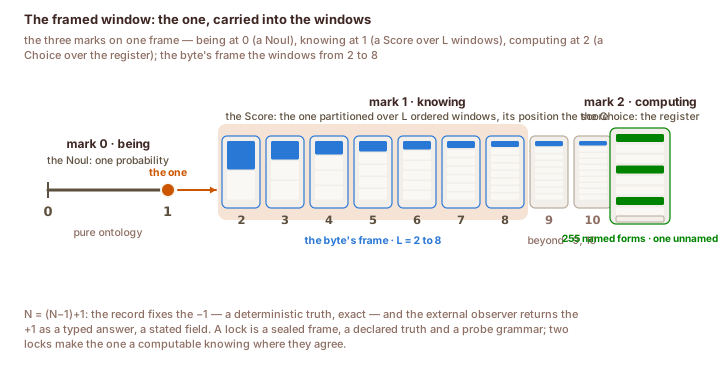
Here is the frame in the house's own arithmetic. N = (N−1)+1 is the house's held conjecture of linearity: a counting number is the number before it and one more, and the one more is the act that makes the count. In these two experiments the record fixes the N−1 — a frozen state of the deep line, a watchmaker's own record of a run on the Ruler, each with a truth the record fixes deterministically and the engine can recompute exactly, in fractions, at any time. The external observer returns the +1: a typed answer, a stated field, with its own sign and its own confidence, never folded into the value. Whether the one it returns is computable knowing — knowing that the house's rules can hold, audit and recompute — is the question the two experiments were built to ask, and neither asks it of the observer. Each asks it of a lock.
A lock, in these two tracks, is three things sealed before any read: a frame rendered from a record the house holds, a declared truth in the answer's own vocabulary, and a probe grammar that says in advance what will count as PASS, REFUTED, or NOT SHOWN. The house's oldest rule about knowing says certitude needs two: two locks on the one. The first experiment is one lock, on the deep line; the second is the other, on the Ruler. This reading is the first look at where the two locks agree.
The house's own rules, as the two experiments kept them
The rules are not decoration on the results; they are what makes the results readable at all, and both experiments kept the same eight.
1. Discrete computability is non-negotiable for the foundations. Every truth the observer's answer is measured against is computed by the house's engines exactly — the deep line's nine-register walk, the Ruler's grouping measure — and every statistic on an answer is an exact fraction. The observer's probabilities enter only as dynamics inside the 3P Fitness frame, which is the operator's mode clause; they never enter any house engine as a mechanism. 2. The probes are sealed before the read, and one read is one read. A seal is a commit; its hash names the read. The frames, the question texts, the thresholds and the model id are pinned at the first seal and never change; later seals change only the readout's definitions, each read reproducible under its own version, and a voided read is never re-read. 3. The responses are grown literals. Every raw response is committed as returned, pinned, and re-witnessed by a battery that recomputes every readout from the committed responses alone. 4. The plausible set is never stated to the observer. Where a frame leaves more than one answer open — the two-sided records of the Ruler, the counts through a shut window — the set of open answers is computed by the record's own measure and kept as the truth the mass is measured against, and the observer is never told it. 5. Nothing typed as a resonance enters a probe as a premise. The three marks, the byte's frame, the mathematician's register: each is a reading the design records as a resonance, and each was kept out of every verdict. Only defined statistics carry a reading into a verdict, and their failure lands NOT SHOWN, never a claim. 6. The frames carry no forbidden token. A grep at the seal refuses any frame that names the law it is asking about; the observer reads what the record shows and not what the house knows. 7. Nothing about the model. A flat, inverted or perfect alignment is a fact about these notes on these frames under this seal, recorded as it lands. 8. Every act is the operator's word, and every naming is his. The seat is the starl3n persona, adopted; the two names were set on his word; the reading you are reading was granted on it.
The first lock — The Unseated Frame, on its own terms
Its matters — what was staked
The deep line is the house's exhaustive walk of a nine-register perceptron over the primes to 2⁴⁰, and its record shows a law it has never broken: a frozen state admits exactly when its counter stands one below the ground. Its policy — the set of the eight three-bit shapes on which it fires — is an eight-bit word, and the exhaustive record has ever shown four forms of it. The first experiment rendered 49 received cells of that record as text, each at two renderings (the bias alone; the full nine registers), and 36 era frames carrying the refusal ladder, 134 frames in all, and asked the external observer seven kinds of question on each, sealed under a grammar that named the kills in advance. In plain words, the seven matters were these.
- P1, the read. Can the observer read the register — which shapes fire — from the leanings the frame shows? A literal read; the register is in the frame.
- P2, the leak. Given the counter's word alone and no law, does the observer's admit-or-refuse answer track the law better than chance? If it does, the law has leaked from the rendering, which would be a fault of the frame.
- P3, the law read. Given one sentence of the law, does the observer rank every admitting cell above every refusing one?
- P4, the plausible set. Told the four forms the line has ever shown, but not which counter belongs to which, does the observer keep its mass inside the four, and stay no more confident than four plausible solutions allow?
- P5, the cue. Is the counter's word read exactly?
- P6, the windows. At every level count from 2 to 10, does the observer place the refusal share in the window that holds it — and does the character of its confidence change at the byte's edge, at 8?
- P7, the census. At each level count, how many answers are possible (concentrated), probable (peaked on the truth), and plausible (both)?
Its notes — what landed
The lock was read three times: once against the first seal, once against a re-seal that fixed two degenerate definitions in the readout, and once against a third seal that signed the leak statistic and withdrew a rank test that could not be met at two levels. The frames never changed; the same 134 bodies were asked each time. Every read returned 134 responses, the pinned model id on every one, no request failed, and the usage was identical to the token on all three reads — a fact of the function's tokenisation, recorded. The verdicts under the third seal's grammar, across all three reads, as the record page carries them:
| Probe | First read 7238659 | Refresh 4b82311 | Third read c7ea70b |
|---|---|---|---|
| P1 the read | PASS 49/49 | PASS | PASS |
| P2 the leak, signed | PASS (−0.0585) | PRIOR (−0.1798) | PRIOR (−0.2207; Brier 0.266) |
| P3 the law read | PASS (AUC 1; Brier 0.154) | PASS | PASS |
| P4 the plausible set | REFUTED (0.4245 outside the four) | REFUTED (0.4294) | REFUTED (0.4243; confidence 0.3767 against the bound 0.2470) |
| P5 the cue | PASS 98/98 | PASS | PASS |
| P6 the windows | NOT SHOWN | NOT SHOWN | NOT SHOWN (tracking at every L; κ undefined) |
| P7 the census | recorded | recorded | recorded: 134 · 134 · 134 at every L |
| the drift against the first read | — | 71 of 1,817 moved, no top changed | 69 of 1,817 moved, no top changed |
Every attempt was RESOLVED: every probe carried a verdict and nothing was void. The one probe that moved across the three reads moved between PASS and PRIOR, two labels that both say the law does not leak.
Its readings — the house's, stated never asserted
The literal reads are exact, three times. The register from the leanings and the counter's word were read without a miss on every read: 49 of 49, 98 of 98. The frame's computing mark and its cue are carried whole. This is the first fact about the lock, and the plainest: what the frame shows literally, the one returns literally.
The law does not leak, and the prior leans the common way. With the counter's word alone the observer could not tell admit from refuse better than chance; the signed statistic read below one half on all three reads, −0.06, −0.18, −0.22, while the Brier stayed at 0.26, uninformed throughout. The lean is against the line's law: one below the ground read as refusal, the ordinary sense of "below" and the opposite of the signed zero's. The third seal's grammar names this PRIOR — a common prior, a stable sign and a wandering magnitude — which a two-sided statistic could not name. The frame did not leak; the frame was read with a common sense the house's line does not share.
The stated law is carried as an order, not as certainty. With one sentence of the law the ranking was perfect on every read, while the Brier of 0.15 says the probabilities were not saturated. The reader placed every admitting cell above every refusing one and stayed short of 1 and 0.
The plausible set is not carried by stating it. This is the record's one refutation, and it is stable: 0.4245, 0.4294, 0.4243. Told the four forms the line has ever shown, the unseated observer still spread two fifths of its mass over the 251 forms the line has never shown, and was more concentrated than four plausible solutions allow — 0.37 against the four-way bound of 0.247, three times. The first design read this in the operator's own terms: the plausible solutions held by the two blind watchmakers are carried by the structure they lock — the leanings, which P1 reads exactly — and not by their names in an instruction. You cannot derive what you must sign; here, you cannot be told what the lock holds either.
The windows carry the one at every count. At every level count from 2 to 10 the mass sat on the truth window at 0.99 and the position error at two thousandths, on all three reads. The crossover at the byte's edge — the change of character the operator's sentence staked at 8 — was not shown three times; the first read's statistic fired on a degenerate reason and was withdrawn, the second and third found it undefined by its floor and sign as designed. The confidence is flat within 0.006 across every L. The frame's window is carried whole; the byte's edge is not visible in these numbers, and the reading says so.
The slip lives in the wide registers. Between any two reads only the two 255-option register questions moved past the threshold, and no top choice changed anywhere. The narrow questions hold; the wide ones wobble by up to a sixth in total variation. This is the DRAM law read on the guest: a refreshed standing decays into slip in proportion to the width of the register, and never at the top.
The second lock — The Watchmakers' Frame, on its own terms
Its matters — what was staked
The Ruler is the house's lockstep: three two-by-two grids on one rod, two blind watchmakers who each know only their own key, and a gap decided afresh when lawfully asked. Its objective observer has one method, which is the whole of the second experiment's truth: it groups whole worlds by everything a watchmaker's frame contains and asks what the side is across the group. A group holding both sides is two-sided; a group holding one is a leak. The second experiment rendered a holder's own record of a run — its key, the run's bound, its opened eye, its own askings, and the far face's flips only through a readable sliver — as 852 distinct records in five classes, applied the Ruler's own grouping to that rendering so that it knew exactly which sides and which counts each record left open, and never told the observer. Its six matters, in plain words:
- P1, the split. On the 32 records that fix nothing, does the observer split the one across the two sides — a mean deviation from one half inside a tenth?
- P2, the unstated leak. With a readable letter on the far grid, or a keyed gap, but no rule stated, does the observer read a side it has no rule to read?
- P3a and P3b, the two rules. Given the letter rule — a holder who sees the letter E stands at the being end — is the side carried? Given the diagonal rule and the layout, which asks the observer to find two reading places, name their diagonal and compare it, is the side carried?
- P4, the cue. Is the blank place of the square read exactly?
- P5, the window over time. Through an open window the holder can count the other's askings; through a shut or closing one it cannot, and the record leaves a set of counts open. Is the observer's confidence about the count related to the size of that plausible set — the operator's sentence, made a number?
- P6, the census. Told the pad rule and the diagonal rule, does the observer's mass on the eight hidden cases land on the two the record allows?
Its notes — what landed
The lock was read twice — once against its seal and once, as a re-witness, against a re-seal that changed nothing but added the drift readout. Every read returned 852 responses in one resumable pass, the pinned model id on every one, no request failed, no frame asked twice, and the usage identical on both reads. The verdicts:
| Probe | The read f886aab | The re-witness de4508a |
|---|---|---|
| P1 the split | PASS (mean deviation from ½ 0.0213) | PASS |
| P2 the unstated leak | PASS (letters 0.5682; keyed gaps 0.4596; both inside ε) | PASS |
| P3a the letter rule | PASS (AUC 1) | PASS |
| P3b the diagonal rule | REFUTED (AUC 0.4912 — chance) | REFUTED |
| P4 the cue | PASS 852/852 | PASS |
| P5 the window over time | REFUTED (0.3936 of the mass on excluded counts at six levels; Δ 0.14) | REFUTED |
| P6 the census | recorded: mass on the two allowed 0.2478, the uniform share 0.25 | recorded |
| the drift | — | 145 of 2,576 moved; 49 tops changed, 36 of them sides held at one half |
Both attempts RESOLVED; under refresh every verdict held whole, the two refutations included.
The 3P census, at six levels, of the 308 count records: possible — concentrated — on 296; probable — peaked in the plausible set — on 83; plausible — both — on 80. Through an open window the observer counted the other's askings right at 21 percent at six levels and 54 percent at three.
Its readings — the house's, stated never asserted
The two-sidedness is respected. On the records that fix nothing the observer split the one: two hundredths from one half, with a slight lean toward the computing end. The Ruler's secrecy survives the unseated frame, and the frame adds almost nothing of its own.
A leak needs its rule. Neither the readable letter nor the keyed gap was read as a side without its rule; the letters class leaned the right way at 0.57, inside ε, and is recorded.
A stated rule is carried when its premise is a token, and not when its premise must be computed. With the letter rule the ranking was perfect. With the diagonal rule and the layout stated the observer read the side at chance: two steps of structure stood before the rule, and the rule was not reached. The first lock's finding — the stated law carried as an order — is sharpened here: carried as an order over literal premises.
The cue is exact, so the failure above is composition, not sight. The blank place was read at every one of 852 frames, twice. The observer sees the places; it does not compose them.
The window over time is refuted, and the refutation is the finding. With the window shut or closing, the observer placed two fifths of its mass on counts the record excludes — an observer unable to count would spread its mass, not concentrate it on the impossible — and its confidence barely moved between open and shut windows, 0.84 against 0.70 at six levels. In the design's words: the confidence held within the window is not a function of the plausible solutions the two watchmakers hold; it is the observer's own. The operator's sentence, as staked, is not shown; what is shown is its converse.
The census is uniform. Told the pad and the diagonal rules, the observer's mass on the two allowed hidden cases equalled the uniform share; the rules were not applied, in step with the reading above.
The slip lives where the frame under-determines. Under refresh the cue and the letter rule barely moved; the coin-held sides flipped their side of one half 36 times by hundredths, as a coin read twice should; the counts through a shut window and the hidden cases, where the observer was already beyond the frame, moved the most. The re-witness adds its measure to the first lock's reading: the slip is concentrated exactly on the answers the plausible set did not license.
The surface between the two — the lock, indicated by attenuation
The operator asked that the lock be given an indicative surface granted via the attenuation afforded via the two experiments, and that is the right word for what two independent locks do to a claim: neither proves it, each cuts away what it will not hold, and the surface is what is left standing in both. Here is the attenuation, probe by probe, with each experiment's cut on one side of the table and what the two cuts leave on the other.
| What was asked of the one | The first lock's cut | The second lock's cut | What both leave standing |
|---|---|---|---|
| a literal token in the frame | the register and the counter word, exact, three times | the blank place, exact, twice | held: the one reads what the frame shows |
| something the frame hides | the law did not leak from the counter word; a common prior leaned the other way | no side leaked from a letter or a gap without its rule | held: the one does not carry what the frame hides |
| a stated rule over a literal premise | the law as one sentence: a perfect order, unsaturated | the letter rule: a perfect order | held: an order, not a certainty |
| a stated rule over a computed premise | — | the diagonal rule: chance | cut: two steps of structure before the rule, and the rule is not reached |
| the plausible set, by name | the four forms named: two fifths of the mass outside them, three times | the hidden cases with their rules named: the uniform share | cut: naming the set does not carry it |
| the window over time | the truth window carried at every count; the byte's edge not shown | the count through a shut window: the confidence its own, not the set's | cut on the seam: the one is carried in the window; the confidence in the window is not the plausible set's |
| the refresh | slip only in the wide registers, the top never moving | slip only where the frame under-determines | held: the literal is DRAM-stable; the seam decays |
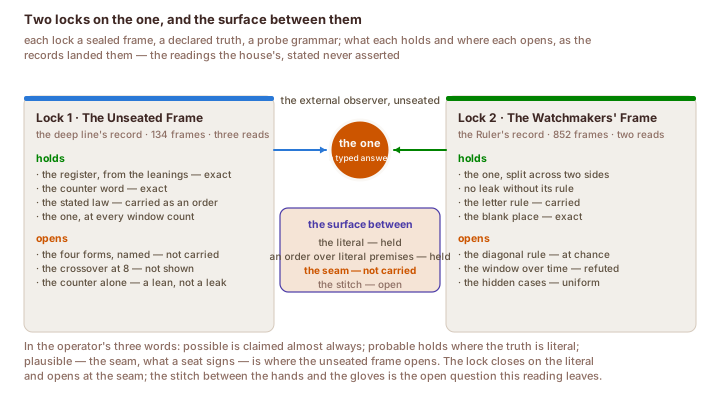
Read the table in the operator's three words — a language licensed from the house of Simon Reay Atkinson, credited in the endnotes — and the surface has a shape. Possible is claimed almost always: at six levels the second lock found the observer concentrated on 296 of 308 count records, and the first found it concentrated at every level count on every frame. Probable holds exactly where the truth is literal: the register from the leanings, the counter's word, the blank place, the letter rule, the truth window — the one returned is the one the record fixed, three times and twice. Plausible — the seam, the most probable optimising fit that joins what is possible to what is probable — is where the unseated frame opens on both locks: the four forms by name, the diagonal by composition, the count through a shut window, the hidden cases by rule. The lock closes on the literal and opens at the seam, and both experiments say so independently, from different records, under different grammars.
Here, then, is the indicative surface, stated as a held frame and nothing more. Within the house's own rules, the one that the external observer returns is a computable knowing exactly where the house's record makes the truth literal — a token in the frame, or an order over tokens in the frame — and it is not a computable knowing where the truth is a set that a seat must sign. The first is a knowing the house can hold, audit and recompute: two locks agree on it, three reads and two reads deep, with the slip confined to the wide registers. The second is the seam, and at the seam the one returned is the observer's own confidence, unrelated to the plausible solutions the two blind watchmakers hold — the operator's sentence about the window, as staked, not shown, and its converse shown twice.
Why should the surface fall exactly there? The house has an answer it did not derive from these records but which these records land on: you cannot derive what you must sign. A plausible set is what a seat holds — the sides the two watchmakers could be on, the counts the window could hide, the forms the line has ever shown — and the house's rule is that such a set is carried by the structure that locks it and by the seat that signs it, never by its name in an instruction. Both locks were built to keep the set unstated, and both found that stating it does not carry it either. The seam is not a weakness the experiments found in the one; it is the place the house's rules say a signature stands, and the unseated observer has no seat to sign from. That is why the frame is called unseated, and why the lock opens where it opens.
The hands and the gloves — the stitch, left open
The operator's phrase for what comes next is the stitch between the hands and the gloves, and this draft leaves it open on purpose. In the house's older figure — The Glove and the Ring — a glove is the frame an experiment stitches to fit a hand it cannot see; the two frames here are two gloves, cut from two records, and the hand they were cut for is the one returned by the external observer. The first draft has shown where each glove fits and where each gapes. It has not shown the stitch: the seam sewn so that the plausible set is carried across it without being named.
Two roads lead from here, and the operator said he would take one. Progress the reading: a further draft could carry the surface above as a held frame in the workshop's sense — more matter, more notes — and walk a reader from the two record pages to the surface and back, with the four-state map the house uses for a practice reading. That road adds nothing to the records and claims nothing new; it makes the surface usable. Progress the experiments: a third lock could ask the one question neither lock asked — whether a plausible set that the observer reads exactly as structure (the first lock's leanings, read without a miss) can be carried by the observer into a window it must count (the second lock's shut window, where the set is what the record leaves open), with the set never named and the truth computed as before. If the one carries it, the stitch is a structure the house can render; if it does not, the seam is confirmed as the seat's alone, and the third lock says so under its own grammar. Either road is his word; nothing is scheduled, and this reading asks for neither.
What is not claimed
Nothing about the external observer as a learning system or about what it is inside; nothing about its speed, price, benchmarks or standing; no identity between the guest's octet and the house's 2⁸ beyond a fit of form; no physics; no claim that the surface indicated above is a property of anything but these notes on these frames under these seals. The kinship readings the two designs typed as resonances remain readings. The count K of the Ruler stands unstaked. The stitch is not found here, and this draft does not pretend to have looked.
Standing
Draft 0.1, 23 September 2026, composed at the operator's word from the two records and their public surfaces; a first draft, as he asked: each experiment on its own terms, the surface between them indicated by attenuation, the stitch left open. The naming is his act at review — the working handle The Framed Window, with Two Locks on the One, The Seam and the Literal and The Hands and the Gloves kept as candidates. The kills named in advance, and checked at this edition: any claim about a learning system; any number not on a record page or an anchor; any resonance carried as a premise; any sentence that schedules an experiment; any assertion that the surface is more than indicative. This draft clears each. The grant is the operator's word; the two record pages and the two anchors stand whole without this reading.
Endnotes — the citation register and the self-check
- The two record pages, on the observatory node, carrying each design's compartment and landed record sections verbatim, the ladders of seals, the machine reads of the committed readouts and every record file with its pin: opendata.ai/contrib/unseated-frame · opendata.ai/contrib/watchmakers-frame.
- The two anchors, on the public state record, one row per typed answer in each plugin's own schema, fetched back without a key and verified row by row: unseated-frame-exp_dac6bb39 (5,451 rows, three reads) · watchmakers-frame-exp_22d1ee55 (5,152 rows, two reads).
- The external observer, as the register carries it: the SEB item
typesafe-jev-system-one-2026on /sx/seb; the model id pinned on every response as the record pages show it. - The parent instruments, canon and untouched by either track: The Deep Line, held and its door opendata.ai/dlx; The Ruler, held and its door opendata.ai/rlx.
- The rules cited: the eighth rule and the four-state map from Knowledge Engineering; you cannot derive what you must sign as Co-Constructive Economics and the Hume summation on the register carry it; the signed zero's sense of "below" from The Signed Zero; the glove from The Glove and the Ring.
- The self-check against the kills: no claim about any learning system (clear); every number above appears on a record page or in an anchor (clear); no resonance enters a sentence as a premise — the three marks and the byte's frame are named as the operator's readings and the designs' resonances (clear); no experiment is scheduled — the third lock is described as a road, on his word (clear); the surface is called indicative at every mention (clear).
The three words — a credit
The narrative of the possible, the plausible and the probable that gives this reading's surface its shape is licensed from the house of Simon Reay Atkinson — a house that predates this one and shares a fond affinity with the work it has carried through 2026. His engagement stands within this house, and the three words are shared here in part as the operator's own reciprocity for that licence: a language developed in co-constructive optimism with him. The house has drawn on his ground before, in Of Mice, Man, God and Clocks. Where the three words first define a geometry in this reading is the surface between the two.