 OOI · SX
The Quarters, Turned
The Spice of Dunes, edition by edition: the probable, the plausible and the possible
Steven De Costa · draft 0.6 · 16 November 2026 · a reading at 10
THE READING PLAQUE. The Quarters, Turned, a reading at 10 — draft 0.6, 16 November 2026 — a reading of one moment in the progress of the experiment line THE SPICE OF DUNES, the moment its title names, in the author's own voice, for a reader who has not met the initiative: the Slip's flat triangle given a clock; the clock read from outside by the laps it catches; two packets sent on it and told apart by the half of its turn; and the whole system turned on one axis, with the author's reason for the axis given before what the turn showed. Every number is a measure from one of the line's four sealed records on the observatory node, or a sum on those measures: thirty-three predictions, each written with what would count as its failure and locked before its engine ran, each listed in the manifest with the engine's own word, the two that failed among them. It places five plates where a thing is better seen than told — the instrument, the clock read from outside, two locks one, the lock opening and the four quarters — each drawn by the reading's own kit from those records, the lock's looped through the six rows of its table with no script. What the author thinks it means is set apart as his belief and released as such: his test of it has not been run, and of his six as a count of turns the record has run the turn in nought and in four alone. The title is set, at his word of 16 November 2026, verbatim, 'The title of the reading is "The Quarters, Turned" as this correctly reflects the 'discovery' of the first moment.' The reading stands as a reading at 10 to this moment, at his word of the same day; no reading at 5 stands beside it, and this plaque names none. The operator is starl3n, seconded by Link Digital, and the operator's identity is the named author. Under the standing law no claim is made here over physics, time or any prize: the experiments are contributed, model-internal and no part of the initiative's canon, the clock of the line is a register's count of its own steps, and the records are the identifiers of the author's beliefs and never their jury. The exploration of time is a matter of business for the starl3n persona and is not folded into the core dynamics of the OOI's own house logics or rules. Made readable on the SX surface by its covering persona's reading grant of 16 November 2026 — his word, verbatim, "Grant the 0.5" — and re-trued to draft 0.6 at his word of the same day, his clarification in nine points taken as he states it; a draft, not the published form. Covering: starl3n · endorsing: Link Digital. The door stands on the observatory node at opendata.ai/contrib/the-spice-of-dunes, with its records at opendata.ai/contrib/the-spice-of-dunes/records; the line's matter and exhibit are the registration's, his separate word; drafts 0.4 and 0.5 stand as history under the superseded lane, never erased; the source of record is
ooi_network/docs/the-quarters-turned-reading-draft-0-6.md, draft 0.6, pinned at the re-truing. Reading is free; the way across is a statement of intent (/sx/matters).
The instrument
The Spice of Dunes is an experiment line, so far in three editions: the clock, the send and the turn. This reading is about one moment in the progress of that line, and its title names the discovery of that first moment: the quarters, turned. All three editions are built on the Slip, the first experiment on the bench of the Objective Observer Initiative. The Slip has a reading of its own.
In the Slip, two walkers leave one corner at the same speed. One walks a closed loop. The other walks out and back along the long side of a very flat triangle: base 11.5, height 0.5, a slope of one in 23. The two paths are not quite the same length, 22.51 against 23.02, so on every lap the second walker falls another half a unit out of step. A small window sits in the plane across the long side. Each time the first walker passes a marked point on its loop, the experiment asks one question: is the second walker inside the window? If it is, that is a catch. In 800 laps, with the wider of its two windows, the still triangle catches 209 times.
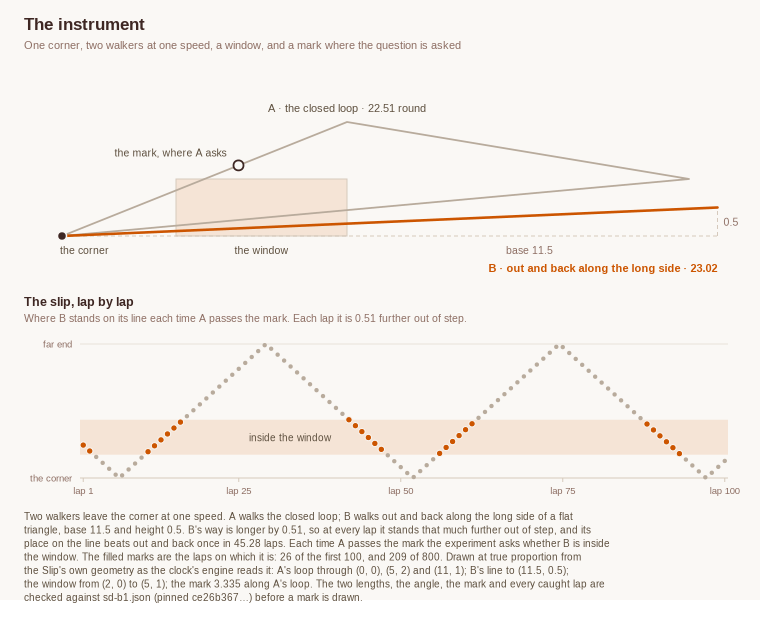
Nothing in these experiments is sampled and nothing is random: each edition runs every case it names. The predictions for each run were written down first, each with what would count as its failure, and locked. The engine then ran once, and its record is served with a fingerprint. Every prediction carries a label, which I give in brackets after the result it covers. Under that label the experiment's page prints the prediction as it was written, what would have failed it and the engine's verdict; the five of the clock's longer run are in that run's record alone. Of thirty-three predictions, two failed. They are still on the page as failed.
I take the clock first, then the send, then the turn, which was made last and goes furthest. The page shows the turn second, directly under the clock it is built on.
The clock
The first edition makes the long side a clock hand. For every 11.5 walked it turns by the triangle's own angle, 2.49°, and counts the tick. Nothing sets a rate. The count is the clock, and it is the clock's own: it depends on the distance walked and on nothing that is caught (SD1). Hold the hand still and the clock is the Slip again, lap for lap (SD0).
What the line introduces here is its blind ruler. I call it a clock, and the word is apt for the experiment and for a reading of it. It is an experiment that identifies moments of lawful change, within an apparatus designed to be communicably effectual when it is operated with a typed reasoning by someone like me, its operator.
The edition runs every case: both ways the hand can turn, each of the 145 ticks it can start from, two sizes of window and two rules for the tick, with the still triangle beside them. That is 1,162 set-ups, each walked for 800 laps. The first set-up is the hand as drawn, with the wider window, started from tick 0.
The window stays where it was, so the second walker can be caught only when the hand happens to be pointing through the window as the first walker passes its mark (SD2). In the first set-up the 209 catches thin to nine, at laps 1, 2, 148, 149, 150, 373, 591, 739 and 740. The first five were worked out and written down before the engine ran, with no others allowed up to lap 153 (SD3).
What makes it a clock for anyone else is that it can be read from outside. An observer who sees only which laps catch can tell which way the hand is turning: nine catches against seven from the same start (SD4), and the two directions leave different records from every one of the 145 starting ticks. The tick it started from can be read too, given long enough. The prediction that 800 laps would separate all 145 starts failed, leaving 139 records and six pairs of neighbours alike (SD5). At 4,000 laps all 145 are separate, and that was predicted before the longer run (SL4). In those 4,000 laps the first set-up catches 51 times where the still triangle catches 1,047.
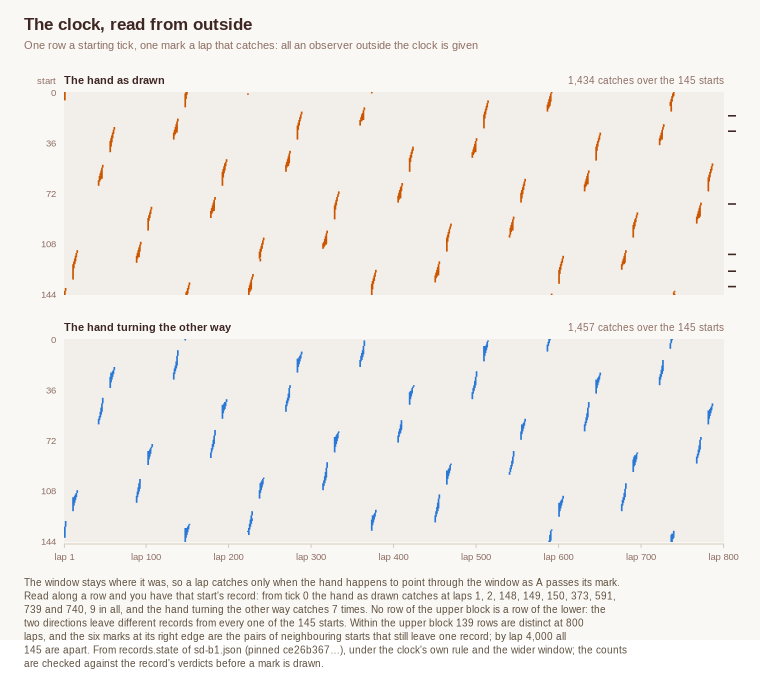
One more prediction failed: that every lap caught on the turning hand would be a lap the still triangle also catches. Across both windows, 84 of 4,178 are not (SD6).
The send
The second edition puts a second triangle at the same corner, the mirror image of the first, with both long sides as hands of the one clock. Two packets leave one point, one along each long side. On each lap the experiment reads four things: each packet at its own window, and each packet at the other's, which is a crossing. With no tick it is the Slip twice over, and nothing crosses (SB0). The edition runs 1,162 set-ups of its own.
The half of the clock's turn tells the packet. One packet is found only in the first half of the turn and the other only in the second, give or take a tick at the turn's edge, and a single lap delivers both only within a tick of that edge. That holds across 8,362 arrivals with no exception (SB3). In the first set-up the first lap that delivers both is lap 148, and it was worked out beforehand (SB4).
A destination that holds only the laps of arrival can then read the send, which is the tick the clock stood at as the packets left. It tells apart all 145 ticks the clock could have stood at (SB6), where one packet alone separates 139 or 137. It tells which way the clock turns (SB5). It still reads all 145 when its two windows take the packets alike and it cannot say which packet is which (SB7). And one window alone, taking the packets alike, reads all 145 as well. That last was found on the record and was not predicted.
The turn
The third edition goes back to the single triangle and its clock, and turns the whole of it. It takes the eleven set-ups of the clock, under its own rule for the tick, in which laps 1, 2 and 150 all catch, and follows each through one whole turn of the system, laps 1 to 595. With no turn it is the clock again (ST0). Why the system is turned, and why on the axis it is turned on, comes before what the turn showed.
Two locks one. Draw a line from the corner to each catch of the clock. In the first set-up, lap 1's stands 7.47° above the base and lap 2's at 12.45°, two ticks further round. The hand then goes round twice, and lap 150's catch stands at 11.93°: between the two, and just inside lap 2's line. So the first two catches hold a third between them. In the 800 laps of the clock's run no other catch's line falls between the two; the longer run adds twelve by lap 4,000, the first at lap 814. I call that hold two locks one, in the sense the framework behind these experiments gives the phrase: one holding is a position, and two that agree are a knowing.
The lock does not depend on where the clock starts or on which way its hand turns. Under the clock's own rule the count depends on the distance walked and on nothing else (SD1). So a start turns the three lines as one, in mirror image when the hand turns the other way, and from every one of the 145 starting ticks they stand in the same places against one another. What a start changes is whether the window catches them. Of the 290 cases, 145 starts in each direction, the wider window catches the first two in fifteen, the third in thirteen and all three in eleven. Those eleven are the set-ups this edition reads.
A when, or a where. The experiment is a clock by its making, but nothing obliges the catch at lap 150 to be a time. Read as a when, it comes 148 laps after lap 2's, on the 289th tick from it, in every one of the eleven set-ups (ST5). Two whole rounds of the hand are 289.21 ticks. So the hand has gone round twice and stopped a fifth of a tick short of where it stood: 0.2086 of a tick. Read as a where, the catch's line stands 0.52° inside lap 2's. The two are one number, since a fifth of a tick of the hand is 0.52°. That shortfall is the gap, and the rest of this edition is about it. The clock lying flat cannot say which reading is the right one. It gives the catch as a possible there and then, and no more. What the catch is as a where and when, one that a system could work out for itself, is what turning the clock is there to test.
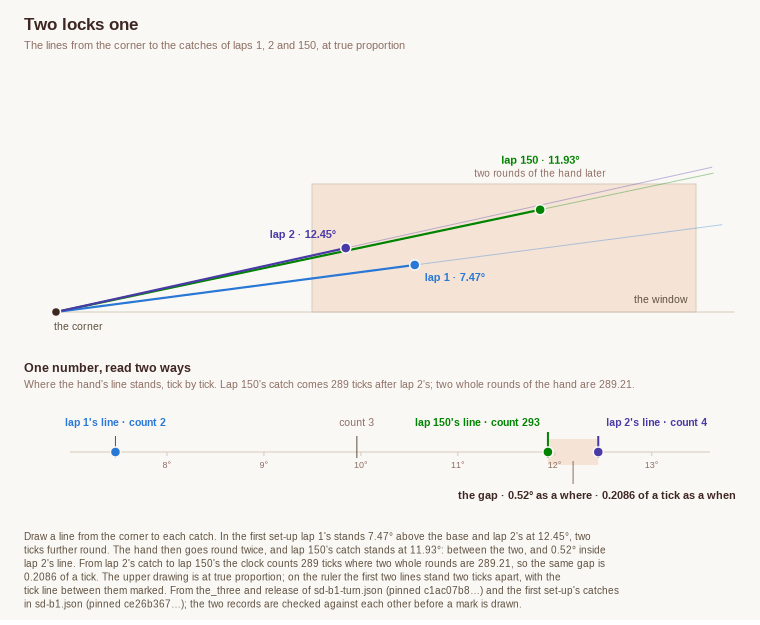
One direction, one axis. Take the line toward lap 150's catch as the one direction in which this system may change. It is the direction of the catch that the first two have locked. Take the line through the corner at a right angle to it as an axis. Now turn the whole system on that axis, out of the page, beginning at lap 2's catch, when both sides of the lock are in place, and counting the turn in the clock's own ticks, a quarter turn for every two rounds of the hand. The window turns with everything else, so every catch is still the system's own (ST2).
Why that axis. The turn is how the experiment pictures change in the one direction. Seen in the plane, everything that lies along the allowed direction is drawn in toward the axis, and everything that lies across it stays where it was. Taken to its limit, a quarter turn, the system is flat on the axis. The first two catches still stand apart there, one to each side of the corner, and the catch they lock stands on the corner itself, with no direction left to it. So the line at a right angle to the direction of change is a hard limit. It is the end of what the first two catches can tell apart, as a lock on the one between them, while the system is under the stress of moving toward it. That is my reason for the axis, and it would be the same from any start and in either direction. The turn is a choice. It is also a limit on what such a system can work out for itself about its catch at lap 150.
What the turn keeps. Lap 150's catch lies on the allowed line, so the turn can shorten the line to it and cannot swing it. The first two catches lie a little off the line, lap 1's by 0.2198 to one side and lap 2's by 0.0210 to the other, and as the system turns their lines swing away from it, one to each side (ST3). Those two distances off the line are the same at every turn (ST4), and they are what the lock keeps. They also tell the hand. Lap 1's catch falls on one side in all five set-ups of the one hand, and on the other side in all six of its mirror (ST4).
The lock opens. Through the turn, then, the lines to the first two catches swing apart while the line between them shortens.
| The system has turned | The first two lines stand apart by | Left of the line to lap 150's catch |
|---|---|---|
| 0°, at lap 2's catch | 4.98° | all of it |
| 45°, the hand once round | 7.03° | 0.71 |
| 80° | 27.18° | 0.17 |
| 88.48° | 90°, a right angle | 0.027 |
| 89.9351°, at lap 150's catch | 172.04° | 0.0011 |
| 90°, the quarter | 180° | nothing |
Lap by lap the lock around the catch opens and what it locks shortens, so the place of the catch can be worked out less and less surely. At the quarter the two lines lie along the axis, opposite one another, and nothing is left between them to point at.
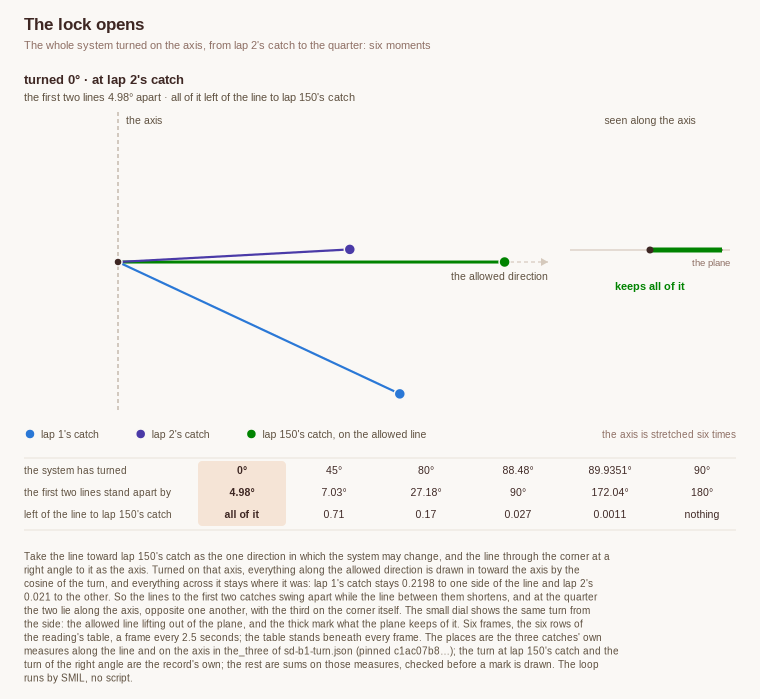
The quarter, just short. A quarter turn is edge-on, like a sheet of paper seen from its side: everything that lay along the allowed direction has shrunk to nothing. When lap 150's catch arrives the system has turned 89.9351°. It is 0.065° short of edge-on, with about a thousandth of the line to the catch still showing (ST5). So the catch arrives at the last moment it can still be read. The turn is counted in whole ticks: the 289th stands short of the quarter and the 290th, at 90.25°, stands past it, so the quarter itself falls between lap 150 and lap 151. Count the same turn from the start of the walk instead of from lap 2's catch, and by lap 150 it has gone past the quarter, to 91.18°, with the line turned about to face the other way (ST6). Four ticks decide it.
The gearing, a quarter turn to two rounds of the hand, is the design's choice, and it is what makes "twice round, less a fifth of a tick" read as "a quarter turn, just short". The page carries two other gearings beside it.
Not from outside. Hold the window still while everything else turns, and the catch at lap 150 is lost in all eleven set-ups (ST7). Nothing comes early to stand in for it between lap 3 and lap 147 (ST8).
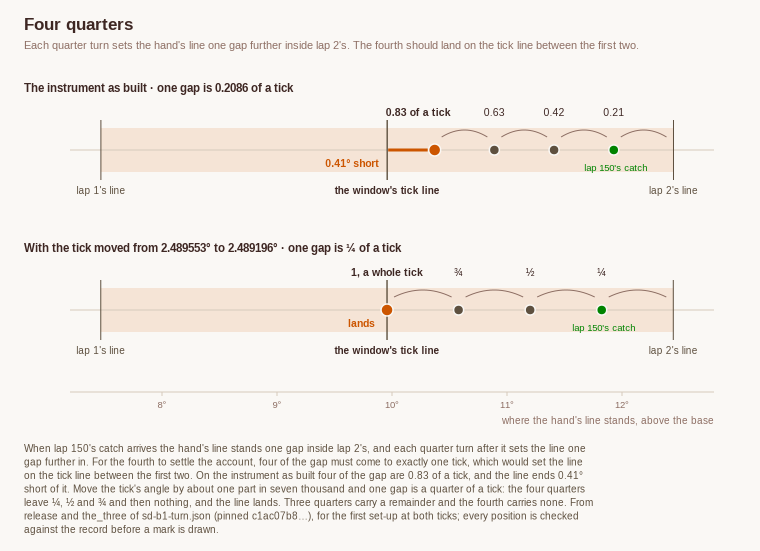
Four quarters. Each quarter turn leaves another fifth of a tick unsettled. For the fourth to settle the account, four of the gap must come to exactly one tick.
| After | The instrument as built | With the tick moved |
|---|---|---|
| one quarter turn | 0.21 of a tick | ¼ |
| two | 0.42 | ½ |
| three | 0.63 | ¾ |
| four | 0.83 | 1, a whole tick |
As built, four of the gap come to 0.83 of a tick, and the hand ends 0.41° short of the tick line it should land on (ST9).
Move the tick's angle from 2.489553° to 2.489196°, about one part in seven thousand, and it closes exactly (ST10). Eight rounds of the hand are then 1,157 ticks, and the hand's line at any count is the line it stood on 1,157 counts before. Lap 150's line stands a quarter of a tick inside lap 2's. The four quarters leave ¼, ½ and ¾ of a tick and then nothing, and the whole turn ends on the arrival of a lap, lap 593. Nothing already caught is disturbed: with the tick moved, every catch of the first whole turn is the catch it was, in all eleven set-ups (ST12). That prediction was open when the engine ran.
Three quarters carry a remainder and the fourth carries none. That is the claim, set down as arithmetic. The figures it rests on were worked out and locked before the engine ran, the 289 ticks, the 89.9351°, the 0.41° and the 1,157 among them, and the engine returned each of them.
One whole turn. Through that first whole turn the first set-up catches twice more: at lap 373, with the system 225.93° round and the line to the catch turned about, and at lap 591, at 358.81°, all but whole. Across the eleven set-ups the catches after lap 2 fall close to whole rounds of the hand: at two rounds, the first quarter point, in all eleven; at three rounds in ten; at five in seven; and at eight, the fourth quarter point, in seven. At the half and at the third quarter point there is nothing in any of them. That pattern was counted afterwards and not predicted, and on the triangle as drawn it does not repeat in the turns that follow.
What I think it means
Everything above is on the record, in two kinds, and the manifest below marks each line as one or the other. The probable follows from the construction: sums that can be worked directly from the triangle's own numbers, and were, before an engine ran to check them. The plausible is what only the running of every case could show. Here I go past both, to the possible: the explanation I draw from the two. It is the one part that is mine alone, and none of it has an address yet.
What this line gives me is clarity for my own justified true belief in a dual typed reality. The form of a manifest reality is that of what a dual typed reality provides as compositional possibility. The form of what is typed is that of a record, or of an autonomy within such a reality, once the manifest is caught as an arrival.
- That the turn is a limit as much as a choice: a system changing in one direction can work out the catch it is moving toward only up to a last counted step, just short of the quarter, and at the quarter its movement toward that catch is nulled.
- That this makes the turn a candidate explanation for a quantisation of relative frames, within the coherence I propose for what I call a dual typed reality.
- That a system with one allowed direction of change has to turn this way: three quarters that each keep a remainder, and a fourth that settles it.
- That every state has exactly six moments: past, present and future, each twice.
- That this is, as I suspect, a discovery about time.
The moments this line discovers are computable, and someone like me can operate them as composable with my prior knowing of the complex theory that is foundational to the initiative. So I consider the exploration of The Spice of Dunes highly relevant to readings on the commonly held experience of time, and on the broadly measured intervals of time by which change can be measured. The initiative itself, however, enforces change by two locks one, which occurs primarily through verified state management in which typed autonomies hold roles in the change. So the exploration of time is a matter of business for the starl3n persona. It is not folded into the core dynamics of the initiative's own logic or rules.
My test is this. Take any such clock, turned on any such axis. There are other such lines of movement, toward the other catches that are, each to a pair of its own, what lap 150's is to the first two. What remains of all those lines is the residue of a moment of change that escaped that system.
The six, as a count of turns
The six I hold to is the six of a when and a where. I take it as a count of turns: the count that would grant a fold for an axis of a turn, which is the turn taken as a set of six. A turn is counted by the moments it is made in.
Within the initiative's own logic, this is what is relevant to typed autonomy. Where a turn is made in nought, one or two moments, these are lawful linear changes for a locally typed autonomy.
| The turn made in | What I hold of it |
|---|---|
| nought | No turn. This maintains a lawful state of ticks and catches all the same, within a flat plane, as the first edition has it. |
| one moment | To return again to the same origin, which completes the definition of an origin typed autonomy that is localised to the 0, 1 or 2 register. The lawful state and the record of state of an autonomy that makes a full turn in one moment can be differentiated between registers. |
| two moments | A shared centrality of turn to each register, which can have differentiated records for the origin typed autonomy by register. The change in the one direction is a bit flip. |
What folds and holds from this is the possibility of a quarter turn, if and only if a 0, a 1 and a 2 co-constructively optimise for such a dynamic on an agreed direction of change. And what remains plausible, for such typed autonomies that co-construct within the full range of what is possible, is the six: the shared factor of such co-constructive optimisation, and the natural type of co-construction for a dual typed reality.
Of the turn made in more moments, this is what I hold.
| The turn made in | What I hold of it |
|---|---|
| three | The change is never granted a release. |
| four | The release is a slip on the first quarter. |
| five | It is a blind miss. |
| six | It carries the others at its own multiples, and more. |
Taken in six, these are my names for what stands at each multiple.
| At | My name for it |
|---|---|
| 12, two sixes | the flip |
| 18, three sixes | the hold |
| 24, four sixes | the lawful slip |
| 30, five sixes | the abductive, learnable miss |
| 36, six sixes | the self-referential identity |
| 42, seven sixes | the origin typed reasoning identity of the carried one |
| 48, eight sixes | the communicable typed identity |
| 54, nine sixes | the rounded identity of the dual typed but triadically localized autonomy |
Further names could be granted at ten, eleven and thirteen sixes, and a uniqueness of kind will go on through at least the 37 to 40, for change that is oriented to a line in this way. But for the turn, and for the lawful experience of the things that are carried as knowings, they are known through the turn that localises to six parts of a full turn. I hold that, for all such matters as can be considered within this quantum of linear change, as a theorem-held expression of the conjecture that 1 = O + C + E.
Of these counts the record has run two. The turn in nought is the clock itself, which the turn's record gives again when nothing turns (ST0). The turn of this reading is the turn in four: its catch arrives one gap short of the first quarter, and four of the gap settle the account at the moved tick. The turn in one, two, three, five and six moments has not been run, and no prediction has been written for any of them.
The carry and the release
I carry what the record holds. A triangle has been given a clock, and the clock can be read from outside by someone who sees only when it catches. Two packets sent on that clock are told apart by the half of its turn in which they arrive. In each of the eleven set-ups the first two catches hold a third between their lines. When the whole system is turned on the axis across that third line, the two lines open as the third shortens, and the catch arrives a fifth of a tick short of a quarter turn, on the one line the turn cannot move. And one part in seven thousand from the triangle's own tick there is a tick at which four such quarters close exactly, and at which nothing already caught is disturbed.
I release the two predictions that failed, which stay on the page as failed (SD5, SD6). And I release the must and the only: that a system has to turn this way, and that only the fourth quarter settles it. Those are my belief, and the record does not hold them. Nor does it hold my reason for the axis as a reason. It holds the geometry of the limit. That this is the limit of what a system can know of its own catch is mine to argue, and my test of it has not been run. The six, as a count of turns, is mine as well: of its counts the record has run nought and four. And the exploration of time is my own matter of business as starl3n, not folded into the initiative's own logic or rules.
What is open
- Which tick. Two systems are on the record: the triangle as drawn, which misses the close by a sixth of a tick, and the one a seven-thousandth away, which makes it. Which of them my claim is about is mine to answer.
- The gearing. A quarter turn to two rounds of the hand is a choice, and the quarter comes just short because of it.
- The quarters past the first. Nothing about the second, third or fourth quarter has yet been predicted in a way the record could refuse. The pattern through the first whole turn was counted afterwards.
- How near is near. A tick that closes lies within 0.043% of any tick you could pick, and this one is 0.014% away. As built, five of the gap, 1.04 ticks, come nearer a whole tick than four do. What speaks for the moved tick is that nothing caught is disturbed by it. What would settle it is a prediction written first, about laps nobody has read: at that tick beyond lap 595, or on a different triangle.
- The six, and time. No run has taken the turn in one, two, three, five or six moments. The record holds the turn in nought and in four, and what I hold of the other counts has no prediction written for it yet. The experiments count ticks and turns, and they measure nothing physical. The exploration of time is my own matter of business as starl3n.
- A when or a where. The gap reads both ways, as a fifth of a tick and as half a degree, and the record does not choose between them.
- The test. It has not been put to a run. The record turns eleven set-ups, each on its own axis, and no prediction has yet been written, with what would fail it, about what is left of the other lines.
The manifest
Every prediction on the record, by edition, in plain words. A line is probable where it follows from the construction or was worked out before the engine ran, and plausible where it took every case. The engine's word is the record's own.
The clock · sd-b1.json
| Label | What it says | The engine's word | Kind |
|---|---|---|---|
| SD0 | With no tick it is the Slip: 209 catches in 800 laps, lap for lap | holds by construction | probable |
| SD1 | The count is the clock's own, whatever the window and whatever is caught | holds by construction | probable |
| SD2 | Every catch falls while the hand points within the window's reach | holds by the geometry | probable |
| SD3 | The first catches are at laps 1, 2, 148, 149 and 150, with no other to lap 153 | holds | probable |
| SD4 | From one start, the two directions of the hand leave different records | holds | plausible |
| SD5 | 800 laps separate all 145 starting ticks | killed: 139 records | plausible |
| SD6 | Every lap caught is a lap the still triangle also catches | killed: 84 of 4,178 are not | plausible |
The longer run of the clock · sd-b1-long.json · in the record index, and not shown on the page
| Label | What it says | The engine's word | Kind |
|---|---|---|---|
| SL0 | The run to 4,000 laps contains the run to 800 | holds by construction | probable |
| SL1 | With no tick it is still the Slip: 1,047 catches | holds by construction | probable |
| SL2 | From lap 801 to lap 880 the catches are at laps 813 to 817 and nowhere else | holds | probable |
| SL3 | No lap from 3232 to 3238 catches | holds | probable |
| SL4 | 4,000 laps separate all 145 starting ticks | holds | plausible |
The send · sd-b2.json
| Label | What it says | The engine's word | Kind |
|---|---|---|---|
| SB0 | With no tick the pair is the Double Slip, and nothing crosses | holds by construction | probable |
| SB1 | One count serves both packets and depends on neither | holds by construction | probable |
| SB2 | A mirrored pair of hands leaves the two triangles alike, lap for lap | holds by construction | probable |
| SB3 | The half of the turn tells the packet: 8,362 arrivals, none outside | holds by the geometry | probable |
| SB4 | In the first 200 laps the second packet is found at laps 147 and 148, both at 148, and a crossing at 181, 182 and 183 | holds | probable |
| SB5 | The two directions of the clock never leave the same record | holds | plausible |
| SB6 | Two packets together separate all 145 sends | holds | plausible |
| SB7 | They still do when the packets are taken alike | holds | plausible |
The turn · sd-b1-turn.json
| Label | What it says | The engine's word | Kind |
|---|---|---|---|
| ST0 | With no turn it is the clock | holds by construction | probable |
| ST1 | The count is the clock's own under every turn | holds by construction | probable |
| ST2 | With the window turned too, every catch is the system's own | holds by construction | probable |
| ST3 | The line to lap 150's catch stays, and only the first pair's lines drift | holds by the geometry | probable |
| ST4 | Each catch keeps its distance off the line, and the side tells the hand | holds by the geometry | probable |
| ST5 | Counted from lap 2's catch, the turn is 89.9351° at lap 150 | holds | probable |
| ST6 | Counted from the start of the walk, it is 91.18°, past the quarter | holds | probable |
| ST7 | With the window held still, the catch at lap 150 is lost | holds by the geometry | probable |
| ST8 | With the window held still, nothing is caught from lap 3 to lap 147 | holds | plausible |
| ST9 | As built, four of the gap fall 0.41° short of the tick line | holds by the arithmetic | probable |
| ST10 | With the tick moved, eight rounds are 1,157 ticks and the close is exact | holds by construction | probable |
| ST11 | With the tick moved, laps 1, 2, 148, 149, 150 and 591 catch, and laps 592 and 593 do not | holds | probable |
| ST12 | With the tick moved, no catch of the first whole turn changes | holds | plausible |
Two more lines are on the record and were not predicted. One window alone, taking the packets alike, separates all 145 sends (sd-b2.json). And the catches fall by quarter point as described above through the first whole turn (sd-b1-turn.json), and differently in the turns after (sd-b1-long.json). Both are plausible in the sense above.
Two sums made for this reading belong to neither group. The catch lines that fall between the first two, one in 800 laps and thirteen in 4,000, are counted from the first set-up's catch laps (sd-b1.json, sd-b1-long.json). The table of the lock opening is worked from the three catches' distances along and off the allowed line, which the turn's record holds for each set-up (sd-b1-turn.json).
What you can do
- Run it. The Spice of Dunes is one page in three parts: the clock, the turn and the send. Each part runs its set-ups again in your browser and tells you whether it agrees with the stored record.
- Walk the turn. The turn's part steps one set-up at a time, lap by lap, at either tick and at any of its three gearings. Its buttons go straight to the moments described here, the signing, lap 2 and the hold, lap 150 among them. Its picture The plane as it is held, and close draws the three lines close in: step from lap 2 toward lap 150 and the lines to the first two catches open while the green line between them shortens.
- Check the locks. The record index lists the eight record files, each with its fingerprint. The four ending
-seal.jsonare the locks made before each run, and the turn's lock carries the figures that were worked out beforehand. - Do the sums. A round of the hand is 360° divided by the tick's angle, 144.6 ticks. Two rounds come to 289.21 ticks against the 289 counted, four times the shortfall comes to 0.83 of a tick, and eight rounds in 1,157 ticks give the moved tick. For the lock opening: a line that begins d° off the allowed line stands, once the system has turned a°, at the angle whose tangent is tan d divided by cos a, and the first two lines begin 4.4599° and 0.5192° off. A calculator is enough.
Endnotes — the citation register
- The experiment: The Spice of Dunes, and its records at the record index:
sd-b1.jsonthe clock,sd-b1-long.jsonthe clock's longer run,sd-b2.jsonthe send andsd-b1-turn.jsonthe turn, each with its lock. - The Slip: the triangle and the window come from the Slip, read in The Slip. The form with two triangles is the Double Slip.
- The framework: The LDD Reference is the one citable statement of Linked Digital Dynamics and of the conjectured 1 = O + C + E. Two of its phrases are used here as it gives them: two locks one, among its disciplines, and the clock that ticks as there and then only as where and when two parties also tick, in its account of the instrument.
- The rest of the bench: The Foundations, the key experiments, each with a reading of its own, and the whole reading surface.
- The page's own names for things said plainly here: lap 2's catch is the signing and lap 150's is the hold, and the first two catches are the pair; the allowed direction is the lawful line, the axis is the axis of change and the system's whole turn is the spin; the shortfall is the gap, its settling is the release, and the moved tick is the closing tick. Where I say rounds of the hand the page says turns, and my window is its mask. Where I say set-ups it says worlds, and the first set-up is its principal world. My predictions are its hypotheses and, in the turn, its stakes.
- The plates: five, drawn by the reading's own kit from the four records, every number checked against a record before a mark is drawn. They add no number that is not a measure of a record or a sum on one. The lock opens loops through the six rows of its table, a frame every two and a half seconds, with no script; its first frame is the still.
- The operator: the operator of these experiments is starl3n, seconded by Link Digital, and that operator's identity is mine, the author named on this reading.
- Every number here is a measure from one of the four records, or a sum on those measures. What I think it means is mine. If a number here differs from the page, trust the page.