 OOI · SX
The Slip, held
THE READING PLAQUE. The Slip, held, draft 0.3 — made readable on the SX surface by its covering persona's reading grant; a draft, not the published form. The grant stands by the operator's word (2026-09-15), verbatim: "for this i would like to see the grant return to the experiment. I am less concerned with docs and mldata in this case." Covering: starl3n · endorsing: Link Digital (the standing pair). The Foundations · 1: the first reading of the foundations series — an experiment of the observatory node, held on this node. The construction record stands in the open workshop at /sx/workshop/the-slip-held; the experiment's own door, opendata.ai/slip, wears the word grown · held and links back here while this grant stands. Reading is free; the way across is a statement of intent (/sx/matters). This file's sha256 is pinned in the reading register.
Draft state — this block records the state of the draft; the reading begins after the rule. Draft 0.2 — 16 September 2026: the explainer trued to the experiment at the operator's word ("I'd like both the slip and the quad slip explainers to be more about the actual experiments they are explaining and less about the methodological approach by which the experiments are held within the house"); draft 0.1 (15 September 2026, pin f811e28e…) superseded, never erased. Author of record: Steven De Costa; composed at his word from the experiment's record. Standing: a reading, stated never asserted; the record it reads stands whole without it. The later locks and the walk land in a further draft. Draft 0.3 (16 September 2026) places 3 figures at the operator's word, each drawn from the record's own numbers and captioned with its source; the screenshots the operator will supply are not yet placed.
What the Slip is
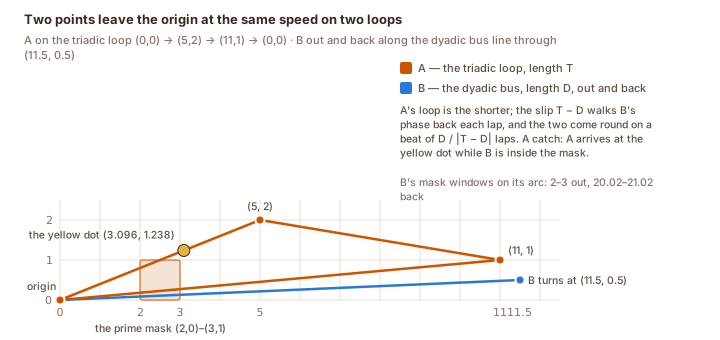
Two points leave the same origin at the same speed on two different loops. A runs the real triadic loop; B runs the projected dyadic bus line, the line through (11.5, 0.5) in the figure-2 geometry. The loops are not the same length — call them T for A and D for B — and A's is the shorter. So each lap the difference between them, the slip T − D, walks B's phase back a little, and the two drift apart and come round again on a beat of D/|T − D| laps.
B's line runs through the prime mask, a small box on the figure. Because B's phase is walked back each lap, B dwells in that box for stretches and leaves it for stretches. A arrives at its yellow dot once per lap. A lap on which A arrives at the yellow dot while B is inside the mask is a catch, a coincidence. The Slip is the experiment that runs this geometry and counts the catches.
What a run does
A run takes three parameters: the mask (a box x0,y0,x1,y1), the yellow-dot mode (where A's arrival point sits: constructed, origin, apex, node, or an arc), and the number of laps to scan. It computes the loop lengths T and D, the slip, the beat, B's mask windows (the arcs over which B lies inside the box), and the catches — how many, on which laps, and on which legs. One row is recorded per run: the sequence number, the parameters, T, D, the slip, the beat, the windows, the count, the first catch lap and the catch laps.
Everything is deterministic. The generator is the same code that defines the figure and passes its own test, imported unchanged; the same parameters always give the same row. There is no new physics in the Slip: it is a readout over the frozen geometry, run on request, and what a reader does on the page enters no record but the run's own dataset.
The 4×21 phase-lock
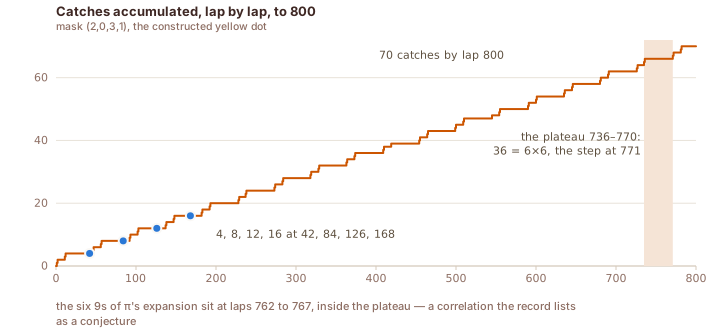
With the narrow mask (2,0,3,1) the catches arrive in clusters of four per beat — two on the way out and two on the return — one cluster each ~45 laps. Sweep the laps on the 4×21 grid and count:
| laps | 21 | 42 | 63 | 84 | 105 | 126 | 147 | 168 |
|---|---|---|---|---|---|---|---|---|
| catches | 4 | 4 | 8 | 8 | 12 | 12 | 15 | 16 |
At multiples of 42 = 2×21 the count is exactly 4, 8, 12, 16: four catches per 2×21, clean to about cycle 13, because each 45-lap beat cluster falls inside one 42-lap bin. So 84 = 4×21 reads exactly 8 — two clusters, one full matrix. The clean run ends where the beat (45.28 laps) has finally drifted off 42: a finite coherence window, not an eternal resonance. The page draws this as the 4×21 grid with the catch laps lighting its cells, eight over one matrix, with the sweep above it.
The record reads this, and marks the reading as interpretive: the slip's coincidences phase-lock to the 21-cycle — the figure's 21-cycle phase-lock, measured from the dynamical side — and 4×21 is exactly where that readout is integer-clean. The substrate proposes the 4×21 NodeMatrix (8:5:8) from the confinement geometry; the slip lands on the same 4×21 from an independent route, the coincidence count. That convergence of two independent routes on 4×21 is the support the record claims for the matrix: it is not asserted, it is where the slip's readout becomes whole.
The second landing — 6×6
Swept lap by lap to 800 with the same mask, the cumulative count holds a plateau across laps 736 to 770 and steps again at 771. The span from 735 to 771 is 36 = 6×6. So the slip lands on both ends of the 6×6 → 4×21 map: the epoch and the phase-lock. The page's Feynman-region readout shows the plateau; the six 9s of π's expansion, at laps 762 to 767, fall inside it. The record lists that correlation as a conjecture, interpretive, and keeps it apart from the literal counts.
What is deliberately not in it
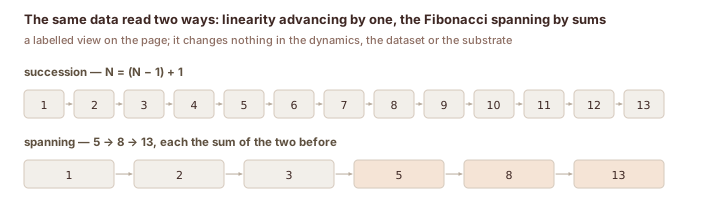
The page carries a labelled succession-versus-spanning view — linearity advancing additively, N = (N − 1) + 1, against the Fibonacci spanning 5 → 8 → 13. It reads the same data a second way and changes nothing in the dynamics, the dataset or the substrate. And the speed-of-decoherence magnitude the number note derives from the slip is provisional under the geometry correction; the experiment records the measured slip facts — loop lengths, windows, coincidences — and not that derived figure.
Where it sits
The first instrument of the series of ten. The Double Slip reads two independent slips through one gap; the Quad Slip carries four into three dimensions and reaches the series' calibration. On the observatory node the door is opendata.ai/slip, state live: the instrument runs on request, up to 800 laps, as the platform singleton exp_b61c9577; the Slip predates the mldata anchoring practice and carries no external anchor.
Standing
Held on this node as fact until someone stands up in the record to refute it; a refutation enters as a statement of intent at the matters of note and goes to the record's own path. What has since been built on the Slip, and the walk a reader may take, are the operator's hand and land in a further draft.