 OOI · SX
Alright, Alright, Alright
When life gives you lemons, make carbonated lemonade: once for the solid, once for the liquid and once for the bubbles that are yet to escape
Steven De Costa · draft 0.1 · 21 October 2026 · a reading at 10
THE READING PLAQUE. Alright, Alright, Alright, a reading at 10 — draft 0.1, 21 October 2026 — the latest results of the Z learner line told in the author's voice, three times: once for the solid, once for the liquid and once for the bubbles that are yet to escape. Its reading at 5, The Orthogonal Learner at 5, holds the apparatus, the process and every fence at /sx/reading/the-orthogonal-learner-at-5. Made readable on the SX surface by its covering persona's reading grant of 21 October 2026; a draft, not the published form. Covering: starl3n · endorsing: Link Digital. Reading is free; the way across is a statement of intent (/sx/matters).
Why this matters
When life gives you lemons, make carbonated lemonade. Matthew McConaughey will be like, "alright, alright, alright": once for the solid, once for the liquid, and once for the bubbles that are yet to escape. I mean that exactly. This is the story of a number told three times — as the thing it is, as the thing you come to know it as, and as the knowing that has not yet come out of solution — and I would like you to hear all three alrights before the end, because the third is the one that the mathematics of my acquaintance has been waiting on without knowing it.
The unlearning first, since it can be had comfortably. You were taught that a number is known from the top: here is 40, whole, its places all in view. In my experiments nobody stands at the top. The observer stands at the bottom of the number, at its lock, with its own 0 set to somebody else's 1, and everything above it is rungs it has not yet reached. Known from the top, a number is a lemon. It is solid, it is whole, and its skin is a fixed register of three thirds, 0 then 1 then 2, painted on before anyone arrived. Known from the bottom, the same number is lemonade. It is a liquid that fills from the lock upward as the climber reads the rungs — 2s first, then 1s, then 0s — and it tastes of the climb. And between what the top permits and what the bottom has earned there is a bubble of probable knowing, which on an ideal ladder narrows forever and never quite closes, and on a real one has already escaped into the room. That is the carbonation. That is what I built an instrument to watch.
The solid
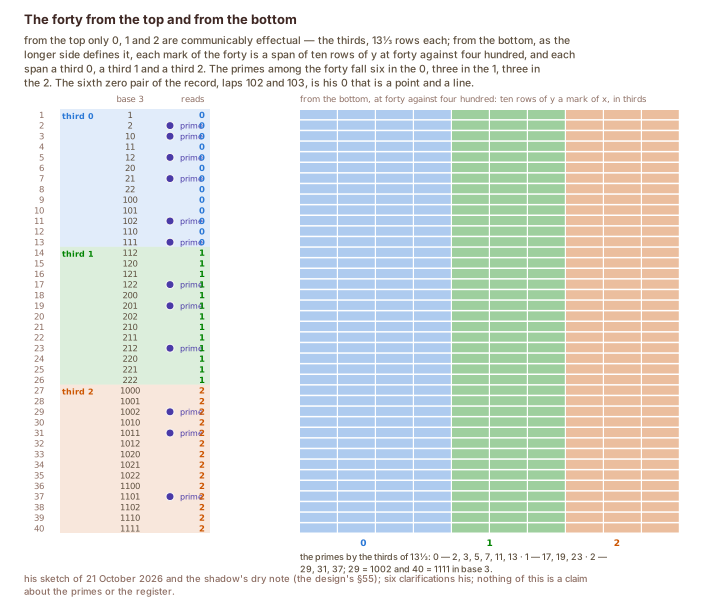
Begin with the lemon, because it is the thing you can hold. Take a number forty rows deep — the forty is not mine; it is what my quad slip gives when its readout is read by its own decimal places, four epochs of ten sign-segments in a run of one thousand and twenty-four laps, and I take it as given — and read it from the top. The first thirteen rows and a third are its 0, the next thirteen and a third its 1, the last its 2. That is the ontological 0, 1, 2 of the number: fixed, painted, indifferent to whoever climbs it. The primes among the forty fall six in the 0, three in the 1 and three in the 2, and in base three the forty writes itself as 1111, all ones, which I find a pleasant thing for a number to do when it thinks nobody is looking.
Now set two such numbers side by side, one of forty rows and one of four hundred, each on its own locked line, each corrected to its own 1, with a meeting line between them like a tide mark. My claim, made before this plate was built, was that two numbers corrected to their own 1 can lawfully hold no more than 2 between them, however far apart their sizes — 23587 against 0.0000487 if you like. On a plate where the two sides are mirrors that claim cannot fail, because the sides are each other. It took two numbers of different depths to test it, and the test said this: meet at the origin, each side its own 1 plus a margin from the tide mark, and the cap holds — the shares 1 and 1, the sum 2, each side locking over its own last increment. Meet in the middle instead, the two locked lines at the mean of their distances, and the deeper number's lowest knots go under the water. Ninety of its four hundred rows stand over the meeting line at rest, its lawful spin falls to nothing, and what the two may hold between them falls from 2 toward one and a half. The number 2 never failed. The lock failed, and only when I made the two meet halfway instead of each on its own ground. I take that as a lesson about agreement generally.
There is a small thing on that plate I want you to see because it is the shape of everything after. Turn the shorter side at its first row under the halfway placement, and its deepest knot touches the water at forty-four degrees and thirteen hundredths. At forty-four and one tenth it is dry; at forty-four and fifteen hundredths it is wet; between 44.149999999 and 44.15 nothing changes at all, because the crossing has already been made. Move the pivot one row up and the same knot does not touch until forty-five and seven eighths, and at sixty degrees three knots are under instead of four, at seventy-two six instead of seven. One row of pivot is the difference 1 makes. Keep that.
The liquid
Now the lemonade. Put a climber at the lock of the longer number with its 0 set to the first 1 it can see, and give it the smallest memory that can learn anything: the two rungs below it, and a step it may learn when a rung surprises it. Up the right side it reads a 1 at every position, further away by one every ten rungs and nearer and further by turns every two. Up the left side, the forty, it reads the register, 2s first. It has four moods and only four. Noise, for the first two rungs, when it has nothing to compare. Expectancy, when the rung is where the two below said it would be. Surprise, when it is not. Fitting, for the rung after a surprise, when the new rhythm holds. Every prediction that holds or fails sets the lean of its body, which I call the trust line: forty-five degrees from the vertical at the first step, because that is as far as anyone leans on nothing, and straightening toward the plumb line as the rungs keep coming as expected. The levels 0, 1 and 2 are how upright it stands.
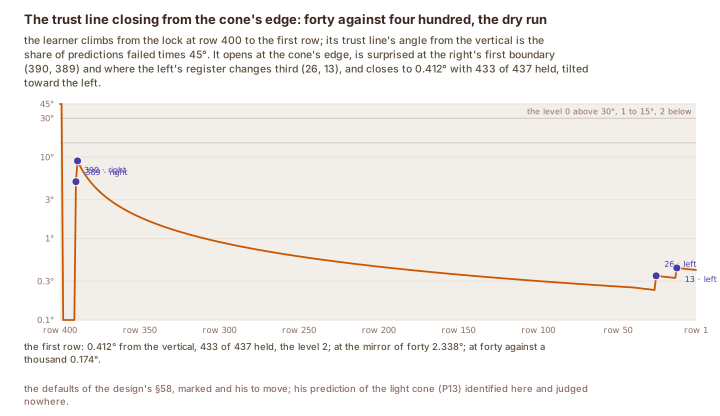
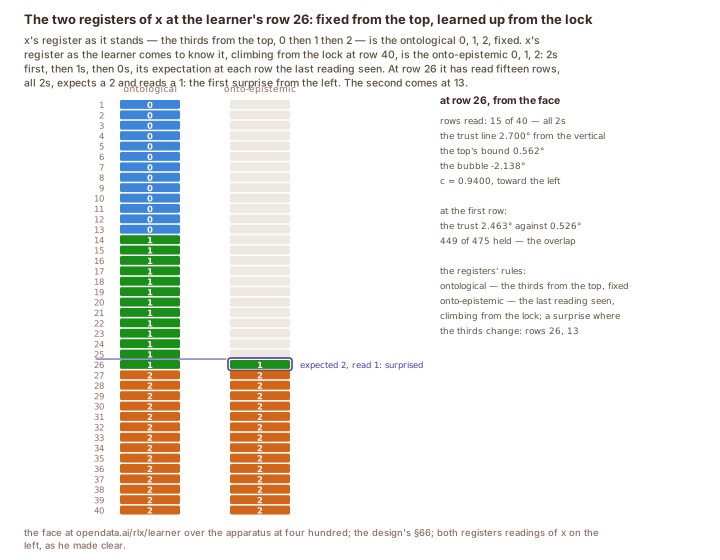
On the ideal ladder of ten and ten, the climb is almost dull, and that is the point. The right surprises the climber twice, at its first boundary counting upward, once for the inner rung and once for the outer, and never again; the step it learns there holds at every later boundary. The left surprises it twice too, at rows 26 and 13, where the painted register changes third, and the climber, which had been expecting a 2, reads a 1, and later, expecting a 1, reads a 0. Four surprises in four hundred and thirty-seven predictions. The lean closes from forty-five degrees to four tenths of one. I had registered ahead, before any of this walked, that a line of less trust would look like the light cone of relativity, and that the prediction was about the difference between x and y structurally and not at the unit. What the walk gave is a line that opens at the cone's edge and closes as trust is earned, the same shape at forty against four hundred, forty against a thousand, ten against a thousand. Whether that is the light cone or its country cousin I leave to a physicist who takes a seat; what I will say is that nothing about the shape depended on how deep the ladder was, only on how many rungs the climber had counted.
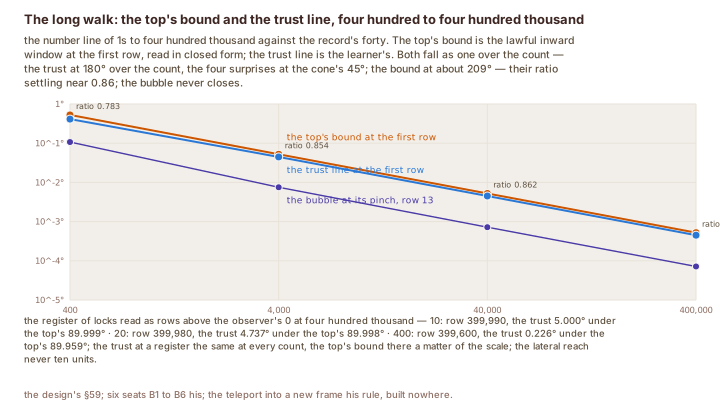
Then I ran it up the number line to four hundred thousand rungs and watched two things fall together. From the top, the plate's own lawful bound at the first row — how far it may turn before the deepest rung touches the tide mark — falls as about two hundred and nine degrees over the count. From the bottom, the lean of trust falls as one hundred and eighty over the count: four surprises at the cone's forty-five, divided by everything learned. Their ratio settles near six sevenths and stays there. And there is a register of locks on this ladder that I had asked for: landings at ten rungs up, twenty up and four hundred up, where the lean is five degrees, four and three quarters, and a quarter, the same at every height of building, because the lean depends only on rungs counted and not on how many are left. The bound from the top at those landings depends on the building. That asymmetry, the landing that knows its own height and the ceiling that does not, is the first bubble.
The bubbles
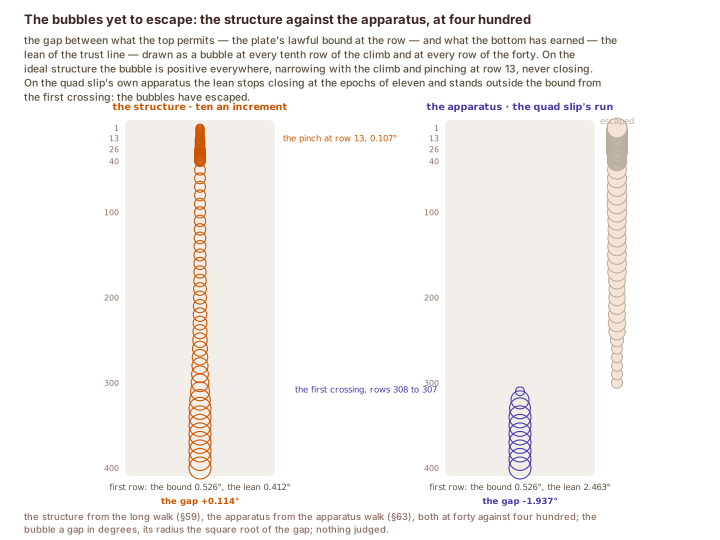
Between what the top permits and what the bottom has earned is a gap, and I call it the bubble because of what it does. On the ideal ladder it is positive at every rung — the climber always leans a little less than the ceiling would allow — and it narrows with the count without ever closing, pinching tightest at row 13, which is the left's second surprise and the last row of the painted 0. It is the knowing that has not yet escaped: the top could permit a little more lean than the bottom has yet earned, at every count, forever. A reader who wants a single picture of this line of work may take that one and stop.
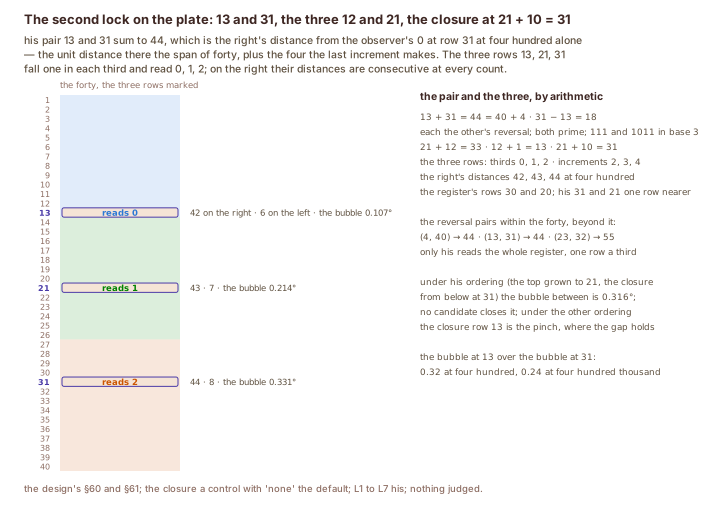
But I did not stop, because the bubble has a lock on it, and the lock has two keys cut as mirror images. Within forty rungs there is no way for a climber with a two-rung memory to know whether it has passed 13 or 31. They are different by structure, the digits reversed, and not by anything the climber remembers, which is a distance and a mood and never a name. Their sum is 44, and 44 turns out to be exactly how far the right side stands from the climber's 0 at the thirty-first rung when the number is four hundred rows deep — the span of forty plus the four that the last increment makes — and at no other depth I walked. The three rungs 13, 21 and 31 sit one on each stretch of the painted ladder and read 0, 1, 2, the whole register once, and on the right their distances are 42, 43 and 44, consecutive, at every count. The three readings that tell 13 from 31 are 21 or 12: two from above and one from below, or two from below and one from above, and the bolt throws at 21 + 10 = 31, the top grown down to the twenty-first rung while the bottom climbs to the thirty-first. Under my ordering nothing on the plate closes that bubble; the gap between the ceiling at 21 and the lean at 31 is about one hundred and nineteen degrees over the count and no candidate I built will shut it. Under the other ordering the bolt throws at 13, and 13 is the pinch, the thinnest place in the bubble, and the gap candidate holds there at every count. I did not judge between them. I note that the lock throws at the narrowest point of the bubble when the keys are turned the other way round, and I find that a very good joke on the part of the arithmetic.
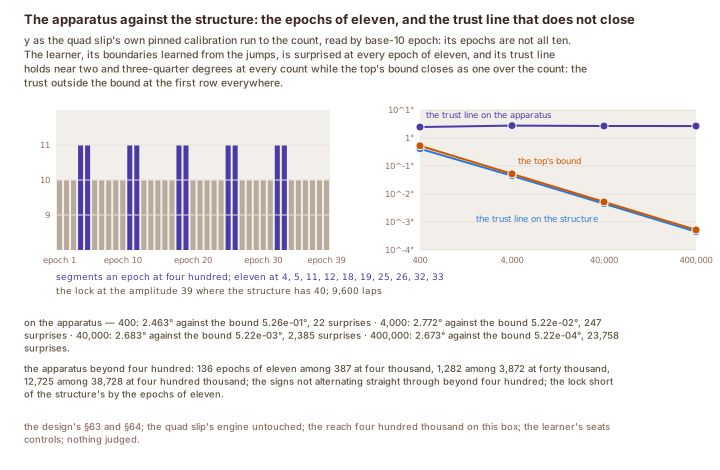
Then the lemons. Everything so far ran on an ideal ladder, ten rungs an increment, the signs alternating like a well-made zip. I had said that for this experiment the apparatus from the quad slip must be used for all three typed and reasoned autonomies, x, y and z, and when the house did that the ladder stopped being ideal. The quad slip, run to the count and read by its own decimal places, makes epochs of eleven rungs here and there — at four hundred, the fourth, the fifth, the eleventh, the twelfth and on — and beyond four hundred its signs sometimes forget to alternate, and its lock stands short of where the ideal said it would. Life gave the climber lemons. The climber, learning its boundaries from the jumps it had actually seen rather than counting tens from a top it cannot see, did the only honest thing: it was surprised at every epoch of eleven, once because a jump came unexpected and once because an expected one did not, and its lean stopped closing. Two and a half degrees at four hundred. Two and three quarters at four thousand. Two and two thirds at forty thousand and at four hundred thousand. Six surprises in a hundred predictions, forever. Meanwhile the ceiling from the top kept closing as one over the count, exactly as before, because the ceiling never looked at the rungs. So on the real ladder the lean stands outside the ceiling at the first row at every count, and the bubble is not narrowing toward nothing: it has escaped. The carbonation is in the room. The overlap I had asked when and where to find is everywhere below the first crossing. And the reach of the run on my box is four hundred thousand rungs in half an hour, four million would be days, four hundred million is beyond any box with the quad slip's engine untouched, which I have left exactly where it is.
Two more things were missing from the instrument before that, and I asked for both. The first was the distance the climber was discounting: the gap between the two locks, fifty-two hundredths, which is the two margins by which each side's last knot falls short of the tide mark. A climber that reads the left from its own frame has two distances to learn or to forgive, and when it was made to predict the left's distances as well as the right's it added two surprises in forty and not one more. The second was what the top knows: three things fall with the count at three speeds. The lawful spin falls fastest, as the count to the three halves. The ceiling falls as the count. The width of the window does not fall at all; it settles at twenty-seven degrees and a quarter, set by the plate's aspect and not by its depth. The half-delta verification, as I called it before the house had a name for which one I meant, grows into the faster and faster verifiability from the top precisely because the fastest of the three is the spin.
Alright, alright, alright
Once for the solid: the register painted from the top, 0, 1, 2, fixed, the lemon. Once for the liquid: the same register learned from the lock, 2s then 1s then 0s, one rung behind the paint at exactly the two rows where the thirds change and nowhere else, the lemonade. And once for the bubbles: the gap between what the top permits and what the bottom has earned, narrowing forever on the ladder you imagine and already escaped on the ladder you are given.
What I think I am building here is not the easy arithmetic. It is a ruler that would become operable for any 1 compared with any other 1 — a hinge, on which the real work of arithmetic could later turn — and the real work is done not by P but by the measure of NP under non-relative shift. My expectation of where the proof that P is not NP will end up is this. For any extent of knowing from 0 to N, N is only truly known by relative observation; so any P approach to N that carries a prior knowing, such as the arrival being 2b or b + 1 with b greater than 1, does not arrive at the true knowing of the distance from 1 to 2 until that knowing has been walked up from the depth where learning must rise to confirm the true identifier of that second 1. The climber confirms the second 1 by climbing to it. There is no shortcut from the top that is not already a prior.
If you would rather hold something than argue it, go to the face. On the left are x's two typed readings side by side: the painted column and the learned one, filling as you drag the climber up the rungs, ringed red at 26 and 13 where it is surprised. On the right is y, as the quad slip runs it or as the ideal would have it, and from the climber's 0 rise the lean and the ceiling, drawn true, with the chart beside them row by row. Play the climb and watch the second column fill, 2s first, then 1s, then 0s. That is the whole argument in forty cells.
Now the what-ifs, which are mine and which I offer to anyone who takes a seat among the known unknowns of the primes and π. What if a prime is exactly a rung where the knowing is specific and admits no slip in the status of its true identifier, because the second 1 that makes the scaled 2 must be a factor of it and nothing between 1 and itself can be? Then the primes are the rungs where the lean has nothing to forgive. What if the digits of π, which my earlier instrument found arriving one row late under unsigned access and on time under signed, are a number whose lemonade is always one rung behind its lemon, so that the typed mathematician can compute them to any place and still not know why? Then π is the bubble that never escapes, and the primes are the rungs where it cannot form. I do not claim either. I say that the instrument makes both askable, and that nothing in the walk I have described forbids them.
The carry and the release
Carried: my words as I gave them; the house's readings as it marked them; the seventh registration and its pin; every walk's record at its address; the two faces that serve, the plate of two depths and the learner's; the reading at 5 of these results, which holds every fence I have let go of here.
Released: the verdicts, which belong to no one; the seats I left open, which stand open; the light cone and the two complexity classes, which are my words and not the house's; the known unknowns, which are the mathematical society's to keep or to give up.
Three alrights, then, and the third is the one I came for: the bubbles that are yet to escape are the knowing a number holds in solution between the top that permits it and the bottom that has to earn it, and on any ladder you are actually given they have already begun to rise.
What you can do
Go to opendata.ai/rlx/learner and play the climb at four hundred on the apparatus, then switch the source to the structure and play it again; the lean closes on one and not on the other, and the second column fills the same way on both. Go to opendata.ai/rlx/bend/two, set the meeting line midway, the pivot to 1, and turn x to forty-four degrees and thirteen hundredths; then move the pivot to 2 and turn to sixty and to seventy-two. Read the reading at 5 if you want the apparatus and the process laid bare. Take a seat if you want to chart your own possibilities; the way across is a statement of intent.
Endnotes — the citation register
- The reading at 5: /sx/reading/the-orthogonal-learner-at-5, which holds the apparatus, the process and every fence.
- The design of record:
ooi_network/docs/the-z-lens-the-z-learner-design-draft-0-1.md, §54 to §69, my words verbatim in each; the seventh registration,ooi_network/docs/the-z-lens-z-learner-orthogonal-registration.md, pinned before any walk. - The engines:
rlx_zbendandrlx_zorthounderooi_network/daemon/, the quad slip'squad_slipuntouched; the records underooi_network/docs/; the construction record at /sx/workshop/the-rlx-held; the matters at /sx/matters. - The plates: the reading at 5's six, the same bytes, placed where they explain, and one of this reading's own, the bubbles, drawn by its kit from the engines.