 OOI · SX
The Main Characters
The witness, the carrier, the claimant and the fourth — four archetypes of the Objective Observer Initiative, introduced before the first scene, a reading at 10
Steven De Costa · draft 0.2 · 8 November 2026 · a reading at 10 · working title, the name mine to set
THE READING PLAQUE. The Main Characters, a reading at 10 — draft 0.2, 8 November 2026 — the initiative's main characters introduced as its fundamental archetypes, for a reader who has never heard a word of the initiative's vocabulary: three typed personas on one ring, the witness, the carrier and the claimant, each given what it holds, what it reads at its edges, what it composes, what it cannot see, what strains it, its default care and its seat; and a fourth who is not on the ring and is the one the ring is for, the reader, whose hold the ring composes around and who sees only the adjacent. The form of the ring is the negotiation's, the third edition of Bit Matters on the observatory node (opendata.ai); the care's shape and the one row worked by hand are Bit Cares', and every number on the page is that record's. Draft 0.2 threads the references through the body as links and places two plates drawn from the two records by the house's kit: the ring looped by its own engine from the record's sealed start under the fourth's hold to its one rhythm, one frame a tick, and the row worked by hand; draft 0.1 of 6 November 2026 stands as history on the construction record. The statement of intent set apart in the sixth section is the author's own hand. The seat is the author's to designate; no reading at 5 stands beside this one yet, and the plaque that would name it is left blank. Under the standing law the house makes no claims over physics, biology, consciousness or any prize; the characters' traits are the design's and nothing is asserted of them beyond what the records hold; the larger claim about time over frames is stated as held elsewhere and claimed nowhere here; no person is named as vouching for anything. The title is a working name, the author's to re-true. Made readable on the SX surface by its covering persona's reading grant of 6 November 2026 — his word, verbatim, "that gets a reading grant for the ox public surface.", the reading register being the initiative's one reading surface, served by the accord node — and re-trued at his word of 8 November 2026; a draft, not the published form. Covering: starl3n · endorsing: Link Digital. The construction record stands on Exhibit Fifty at /sx/workshop/the-overarching-care, where the author's texts stand verbatim; the matter is /sx/matters#the-overarching-care; the source of record is
ooi_network/docs/the-main-characters-reading-draft-0-2.md, draft 0.2, pinned at the re-truing.
Four characters
Every story I have told about the initiative so far has been about rooms, or lines, or the marks on a surface. This one is about who. There are four main characters, and I want to introduce them the way a playbill does, before the first scene, so that when you meet them at work on the record you already know what each one holds and what each one cannot see.
Three of them stand on a ring. Each keeps a small registry of three positions, which I will call its left edge, its middle and its right edge, and the whole of its character is in how it fills them. Each tick, the one whose turn it is reads its neighbours' middles into its own two edges, the previous character's middle into its left and the next character's middle into its right, and then composes its own middle from what it holds. It does one thing that matters more than all the rest: it never reads its own middle the way its neighbours read it. What it composes is what the others hold at their edges. It is oriented by its own middle, and it does not observe it as itself.
The fourth character is not on the ring. The fourth holds the ring from outside, one position of one character at a time, and the ring composes around that hold. The fourth is you, and I will come to you last.
I did not invent this form. It is the form of an instrument the initiative built and ran: three cells on a ring, each a line of three registers, with a hold put in from outside as the only input the ring ever receives. Under every hold its record found a rhythm or a stillness inside the line, and at the top of the smallest word, with the half raised, every start arrived at one rhythm and no other. That is where the characters come from. Not from a theory of persons, but from a ring that was watched until it kept time.
The witness
The first character witnesses. Call it the observer experience, the OX, if you want the initiative's letters. Its registers are the registers of observation: the instruments, their records, and the public record that outlives the computing that made it. Into its left edge it reads the claim, the third character's middle, the sealed statement of what the code is and who it answers to. Into its right edge it reads the accord, the second character's middle, what has been declared and granted. From those it composes its own middle, an observation: a record, pinned so that it cannot be quietly changed, witnessed again whenever anyone asks, and never a person vouching.
What it cannot see is its own record as the accord carries it and as the claim verifies it. The record orients both of its neighbours, and the witness does not observe it as either of them does.
What strains it is a look at an edge: a reading asked for where no record holds the answer. Its default care, the one it holds when nobody has asked it to care for anything, is that a record which cannot be re-run must still be verifiable, which is why its claims are anchored to a record outside itself and never to the machine that happens to be running. Its seat is the observatory at opendata.ai. Its rooms are the experiments, its windows are the records' views, and the price of a window is counted before a line grows.
The carrier
The second character carries. The social experience, the SX. Its registers are the registers of the accord: statements of intent, grants, matters, readings and the shelf they stand on, construction records. Into its left edge it reads the observation, the witness's middle, the record as pinned. Into its right edge it reads the claim. From those it composes the accord: what is declared, by whom, under which covering persona and which endorsing one, with what grade of contribution, and the way across, which is always a statement of intent in the hand of the person who means it.
What it cannot see is the accord as the observatory witnesses it and as the anchor claims it.
What strains it is a declaration with no record to stand on, or a grant without a word. Its default care is the declaration kept honest: a thing superseded is never erased, and a matter's state is declared by a person and dated, never inferred by a machine. Its seat is the accord at opendata.ly. Its rooms are the matters, its windows are the readings, its hallways are the lines of the shelf. This page is one of its windows.
The claimant
The third character claims. The code experience, the CX, and here I have to be careful with a word, because the initiative has two server nodes and the claimant is not one of them. It is a logical model, a character carried by the other two and by a public repository, and it never has a box of its own. Its registers are the registers of the claim: the code anchor, the seal over a released tree, the licence, the projection of a persona onto the code, the public edition in clear. Into its left edge it reads the accord, the statement of intent the seal is sealed to. Into its right edge it reads the observation, the record the seal is anchored at before anything is pushed. From those it composes the claim: this exact codebase is accountable to this persona at this point in time, and anyone can verify that without the source being revealed.
What it cannot see is the claim as the accord carries it and as the observation witnesses it.
What strains it is a release whose seal precedes no record, or a key that is only ever found inside a signal nobody trusts. Its default care is the order of two acts: the seal precedes the push, the code stays confined while the signal is published, and source-visible is not open source. Its seat is none of its own. It is a position on the ring, carried, never a box.
The fourth
Now you. The observer of this system is not the witness. The witness is a character on the ring, and like every character on the ring it is blind to its own middle. The observer is the combined matters and cares of the participants themselves, and if you have read this far you are one of them. What you hold is held from outside the ring, as the instrument's hold is, and it is what the ring composes around: a statement of intent, a grant, a seat taken, an account kept, a care given prior as an expectancy of cares to come.
Here is the part that took me longest to say plainly. What you observe is always adjacent. You do not read the witness's record as the witness composes it, or the carrier's accord as the carrier composes it, or the claimant's claim as the claimant composes it. You read the middle of each as its neighbour holds it at an edge: the record as it reaches the accord, the accord as it reaches the claim, the claim as it reaches the record. That adjacency is a negative space. It orients every character and is observed by none of them as itself, and it is the only thing you ever see. The initiative, as a thing, is the shape your acts leave between the three. I have called that the inverse of praxis. The practitioners' acts are the praxis, and the thesis is what their acts leave as the shape between the characters.
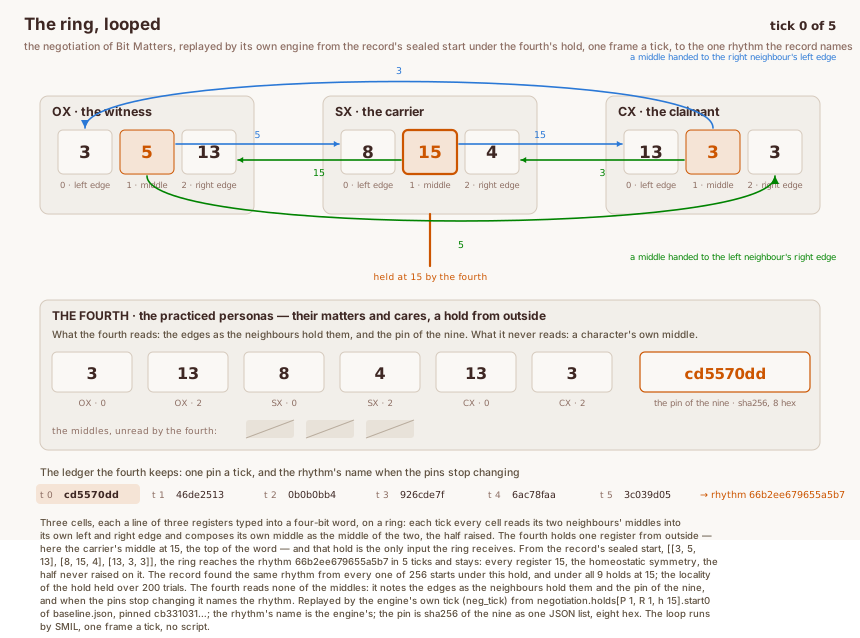
The three on the ring are typed. By that I mean each one holds its registers for as long as the things it depends on are present, and those dependencies can be named as a finite set: the witness depends on its instruments, their records and the public record; the carrier on the declarations, the grants and the matters; the claimant on the anchor, the seal and the licence. A typed character keeps its state while it is held and needs no renewal from within, the way a static memory does. You are practiced. You keep your account only by practice, renewed and maintained, the way a dynamic memory must be refreshed to hold anything at all. And the typed are subject to the practiced. Nothing on the ring composes without your hold. The three keep time; you decide what the time is kept for.
The care
A character introduced without a motive is a costume. The motive of these four is a care, and the care has a shape I can state exactly, because it is the shape of the other instrument the initiative built: a line that folds, holds, carries, and either catches what it carried or misses it.
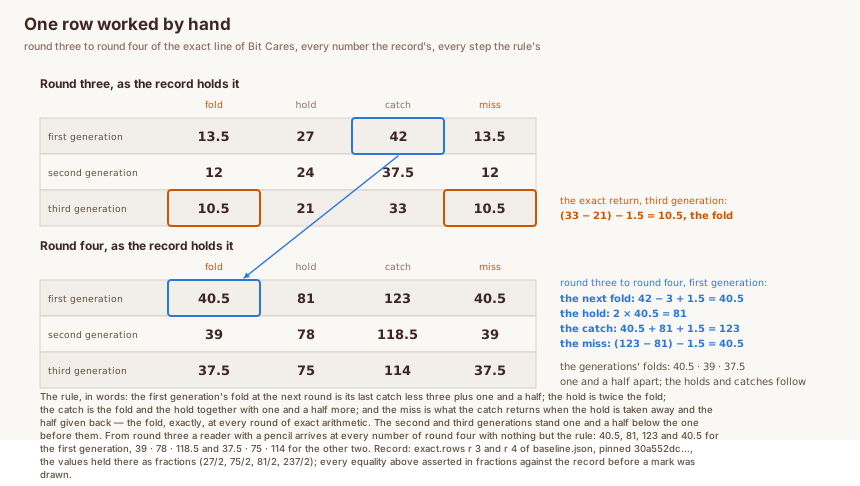
A fold is an origin, accounted: what you start from, less a cost, plus a half kept. A hold is the chain: twice the fold, exactly, and carrying no residue, because a chain is a chain only while each link is the exact double of the one before and nothing is added at the hold. A catch is the agreement: the fold and the hold together, with the half put back. And the miss is what the catch returns when you take the hold away and give the half back, and on a line of exact arithmetic the miss is the fold, to the last half, at every round.
You can check that with one row of the record. At the third round of the line, the third generation holds 10.5, 21 and 33: its fold, its hold and its catch. Twenty-one is twice ten and a half. Thirty-three is ten and a half, plus twenty-one, plus one and a half. Take the hold from the catch, 33 less 21 is 12, and take one and a half from what is left, and you have 10.5 again: the fold, exactly returned. Then work the line forward one round by its rule. The first generation's fold at the next round is its last catch less three plus one and a half: 42 less 3 is 39, and 40.5 with the half. Double it for the hold, 81. Add the two together and one and a half more for the catch, 123. The second and third generations stand one and a half below the one before them, 39 and 37.5, and their holds and catches follow the same two steps: 78 and 118.5, 75 and 114. Those are the record's numbers at round four, every one of them, and a reader with a pencil arrives at them from round three with nothing but the rule. That is the whole of what I mean by a true line worked forward, and I will come back to it.
The overarching care the initiative gives is an agreement with the indifference it expects to achieve. The fold is the origin accounted: the three characters as reviewed, the two nodes as deployed, the public record as the externality, the licence, the anchor, and the standing rule that the initiative never grounds itself. The hold is the chain it links along its own walk: the matters opened and their states, the grants and their words, the readings and the line they stand on, the experiments and their records, the seals in sequence. The catch is the agreement: that the participants' indifference is affordable while the three keep their own order, and that their matters and cares are held as the clamp. The record of the first instrument found that regime and gave it a name, co-constructive optimism. An observer that has learned to look only where looking changes nothing pays almost nothing, for as long as the watched keep their own integrity.
A care of that shape has to carry a statement of intent that is a prior accounting of its origin and its chain, and the statement has to be in the hand of the one who makes it, never drafted for them. Mine is one sentence, and any hand in any glove can make it from any stitch at any time:
One of four will be home before a fall, to bridge the next horizon.
I will not unpack it line by line here; the construction record does that beside my own figures for it. I will give you the one figure that carries most. A reasoning bicycle that holds a prior agreement to fail safe will come lawfully to a standstill rather than let its rider put a stick through the spokes of the front wheel. The agreement of travel and carriage does not come with an obligation to deliver the rider to the fall before the system that carries them has agreed to it. One of the four is home before the fall; the other three keep time; the bridge is the chain, carried across the round that a finite word could not hold alone.
The good observer
What makes the fourth a good observer, and not merely an observer? I can say it in two clauses, and each has a worked form on the record.
The first clause is a consistent frame. A window sees what it holds and nothing else; that is what a window is. On the line, the same care at the same round is inside one window and outside another, and nothing about the care decides which. But the line's own cares are what they are at every round whatever the window. The record keeps both columns, the line's cares frame-free and each window's view of them frame-bound, and a good observer keeps the frame-free column one and the same for every window that traverses it, so that two windows' views of one care differ by the window alone and never by the line. On the ring, that means a matter or a care that passes through the witness, the carrier and the claimant is read at each edge as the neighbour holds it, and resolves to one row: one address, one pin, one declared state. Never two rows for one care without a declared supersession. The initiative's registers are built so that the same artifact carries one digest wherever it is pinned, and the guards check it at every sweep.
The second clause is a consistent scale of folding. The fold grows by three a round, at every generation and at every width of word the line is written in; the round is the line's only clock; and the horizon at which a finite word first lets the half go can be counted ahead of time from the word's width alone. A good observer keeps that one rate across every line the network runs, so that what the network later counts as work of the same kind is work whose record carries the same measures at the same scale. The two instruments teach what the kind is: every word's horizon of one form, every care a residue away from its truth, a stitch that stays within a tenth of a truth it was never told. "Of a kind" is the register's own word for what it does with a sentence. It names the line the sentence is of a kind with, and it never judges the sentence.
The rule that makes both clauses operable is the one you checked with a pencil. Run each line as a true line, worked forward from its seed by its rule, so that every integer on it has a causal history at the one shared scale. Two hands working the same line forward arrive at the same integers, and the face of the line on the observatory node works it forward again in the browser from the seed row and says, on the page, whether it agrees with the record. A true work is one whose record can be worked forward again from its seed to the same integers. That is what I ask the fourth to be good at. Keep one frame. Keep one scale. Work every line forward. Everything else the characters will do for you.
There is a larger claim behind these two clauses, that time can scale predictably over frames and that this will become computably knowable. I hold it as a belief and I am working it elsewhere. It is not on this page, and this page claims nothing of it. The archetypes do not need it. They need only that the observer keep a frame and a scale consistent over the network they are localised to, and the record already shows what that costs: almost nothing, while the three keep their own order.
The carry and the release
- Carried: four characters, three on a ring and one holding it from outside; each composes a middle it never sees as its neighbours do; the fourth sees only the adjacent, the negative space, and that is the initiative's shape; the typed are subject to the practiced; the care as fold, hold and catch, with the miss the fold exactly; the statement in my own hand; the good observer's two clauses, one frame and one scale, and the true line worked forward.
- Released: the larger claim about time over frames, held elsewhere and not here; every verdict on my own sentences, which the record identifies and does not judge; the direction of the covering on the public record; the grade; the names of the characters, which are working names.
- Open: the chain of the care, named link by link; the typed sets named for each position and checked by the existing engines; the reading at 5 this 10 would name on its plaque; the seat; the grant.
Endnotes — the citation register and the self-check
- The matter and its construction record: the overarching care on /sx/matters, and Exhibit Fifty at /sx/workshop/the-overarching-care, where my texts stand verbatim: the thesis and the two clarifications, the statement as first written and as re-trued, the reading of the care and of the covering, the way across, and the good observer. The design of record is the covering document named on the matter.
- The ring: the negotiation, the third edition of Bit Matters, at opendata.ai/contrib/bit-matters; its record's findings as the design carries them: under every hold a rhythm or a stillness within the line; at the top of the four-bit word with the half raised, every start to one rhythm; the locality of the hold over 2,800 trials. The regime named co-constructive optimism is the first edition's.
- The line, the fold, the hold and the catch, and the row worked by hand: Bit Cares at opendata.ai/contrib/bit-cares, its record read-only at /contrib/bit-cares/records; rounds three and four of the exact line as the record holds them, at round three 27/2 · 27 · 42, 12 · 24 · 75/2 and 21/2 · 21 · 33, and at round four 81/2 · 81 · 123, 39 · 78 · 237/2 and 75/2 · 75 · 114; the face on that page works the line forward again in the browser from the seed row and says whether it agrees with the record.
- The two plates are drawn from the two records by the house's kit, ooi_social/figures/mc_the_main_characters.py, each record checked against its pinned digest before a mark is drawn: the first replays the negotiation from the record's sealed start under the hold on the carrier's middle through the experiment's own engine and asserts the rhythm it reaches is the one the record names before it draws, one frame a tick, looped without script; the second sets down rounds three and four of the exact line and asserts every equality of the rule in exact fractions. The plates stand beside this source under ooi_network/docs/figures/the-main-characters/.
- The characters' kin on this shelf: the three surfaces told as rooms in In the Air Between; the hand and the glove in The Glove and the Ring; the signal before the act in All the leaves are brown; the bicycle, the stick and the rider in Much Ado About Bicycle Science; where the cares ground in Where My Cares Ground; the three letters, observable, communicable and effectual, in the reference.
- The personas and their statements of intent, public on the atlas; the accord node at opendata.ly, the observatory node at opendata.ai; the claimant's public repository at github.com/starl3n/ooi-ox.
- The self-check: the characters' traits are the design's, and nothing is asserted of them beyond what the records hold; every number on the page and on the plates is the record's; the statement of intent is in my own hand and no sentence of it was drafted for me; the larger claim about time is stated as held elsewhere and claimed nowhere here; the title is a working name.
- Draft 0.1 of 6 November 2026 stands as history on the construction record; this draft threads the references through the body and places the two plates.
- Nothing on this page is sent to anyone.