 OOI · SX
The Plate and the Propositions
A reading of The Boot of the Line's plate — the operator's illustration rendered by the house in five typed layers, and the ledger of propositions opened over it
THE READING PLAQUE. The Plate and the Propositions — a reading of The Boot of the Line's plate and of the ledger opened over it, draft 0.1 — made readable on the SX surface by its covering persona's reading grant; a draft, not the published form. The grant stands by the operator's word (2026-10-02), verbatim: "please go ahead" — lifting his deferral of the same day ("OX only, reading later") after the plate and the ledger landed on the record page of a contributed track, at opendata.ai/contrib/boot-of-the-line; every number here is the record's, served beside that page as plate.json and propositions.json. Covering: starl3n · endorsing: Link Digital (the standing pair); the track a contributed experiment of the starl3n persona, seconded by the LinkDigital persona, outside the canon, managed in the open workshop at /sx/workshop/the-boot-of-the-line, where this reading's own entries stand. The track's fences bind it: nothing of Pi staked; the engine untouched; nothing about the model. The external observer of the track's lines is the public SEB item
typesafe-jev-system-one-2026, cited only as the record carries it; it read none of this plate, and nothing is claimed about any machine as a learning system. The title is a working handle; the naming is the operator's act at review. The source of record is ooi_network/docs/the-plate-and-the-propositions-draft-0-1.md (pinned sha256 LF e24cd64e…); this file's sha256 is pinned in the reading register, and its three figures beside it. Reading is free; the way across is a statement of intent (/sx/matters).
Draft state — this block records the state of the draft; the reading begins after the rule. Draft 0.1 — 2 October 2026. Author of record: Steven De Costa; composed at his word from the one record. Standing: a reading, stated never asserted; the record it reads stands whole without it — on its record page, in the two records the page serves beside it, and in the design the page carries in part. One face, in the house's terms with the plain reason set before each term, as the second edition of The Framed Window asked of every reading after it; a second face, if he wants one, is his word. Three figures, all drawn from the record's own numbers — two of them by the record's own renderer on this surface's light ground, the third a chart of one measure; two tables, each from the ledger the record page carries. This page, like every reading on this surface, is a stitched work of willful intent: the one that stitched it is the operator's — what he observed of the record, what he said of it, and what he did to make it — art first, memory after.
This reading stands on: The Framed Window · The Framed Window, second edition · The Carry Goes Up · The Signed Zero · Linked Digital Dynamics, the reference · The Quarter, Three Ways · Knowledge Engineering. Its surfaces: the record page · the plate's record · the ledger · the track's workshop · the externality register · the matters.
A note on the rules of this reading. Everything load-bearing in what follows stands on one public record page and the two records it serves beside it: the plate's record, which carries the structure cell by cell under each placement and every measure computed over it, with its own pin inside it; and the ledger, which carries every proposition with the operator's words verbatim, the house's typing, the test named, its outputs and its verdict, with its own pin inside it. The page renders the plate from the first and the two tables from the second; the track's battery recomputes both from the engine and the number line's literal, and the page cannot be current unless they agree. Nothing was run to write this reading, and nothing here runs. The readings below the record line are the house's, stated never asserted; the design itself is Restricted and unserved, and this reading takes from it only what its record page already shows. The external observer of the track's lines is the public SEB item typesafe-jev-system-one-2026, cited where the ledger cites it; it read none of this plate, and nothing is claimed about it as a learning system. The names — the plate, the ledger, the knowings — are working handles; the naming is the operator's act at review.
Why the illustration moved
The Boot of the Line is a contributed track: a drawing of the operator's, transcribed count for count, read by an external observer in sealed lines, each line's record landed as it fell. Its first three lines are read and landed — the boot as drawn, the slip line, the traverse — and the record page carries them. Beside those lines, over two days, the operator drew something else: the five bands of the long run with the digits of Pi laid over them behind a prior of three noughts and two ones, a green path walking down the five bands and back up every eight columns, a triangle of differences over the sums of the first band's periods, and a column of glosses in his own words. He supplied it as a screenshot of a slide, and the discussion ran on the screenshot.
His word on the third day, verbatim, is the reason this reading exists: "the matter should not be discussed upon a graphic i supply as the operator from a screenshot taken of a google slide. I would like the house to take this construct and this method of discussin and composing an exhibit as a long form medium by which more composable knowings will be generated." The house's answer is the plate: the illustration split into layers, each layer typed by what it is, every layer rendered locally from the engine and the record, and a ledger opened over it in which a proposition is carried in his words, typed by the house, tested by code, given a verdict in the house's grammar and, where it earns one, named as a knowing a later proposition can cite. The screenshot is retired; the plate is where the discussion now stands.
Three things were wrong with the screenshot as a medium, and the plate answers each. It mixed four kinds of content a reader could not tell apart — what the structure computes, what the number line merely notes, what the operator reads into it, and what a test measures. It was his, not the house's, so the house could verify it only by decoding pixels. And it held no record: a what-if asked over it lived in chat. The plate types the four kinds; the house draws it from its own record; and the ledger holds every what-if with its answer.
The plate, in five layers
A plate, in the house's usage, is a figure of the record — the reference's Plates F1 and F2 are the first two. This plate is the operator's illustration drawn by the house, and its layers are its types.
The structure (S). Five bands at the periods eight, seven, six, five and four — a bold count on each band every period, counted from the origin at the first column. The traverse: the operator's green path, one band at each column, down from the first band to the fifth and back up, so that its band at the column c is one more than the smaller of (c − 1) mod 8 and 8 − (c − 1) mod 8 — the band is the structure's, not a choice. The quarter of the trip: the top, the way down, the turn, the way up. Each band's whole number at each column and how many counts it stands past its last bold count. The slips: against the first band, the second band slips one count a trip, the third two, the fourth three, the fifth none, since eight is twice four; they come back into register every 56, 24, 40 and 8 columns, and all five together every 840. The five ones — each band standing on its own first bold count as the traverse climbs back through it — are met on the first trip only. Every one of these is derived: the engine that read the track's lines computes it, and the engine was not touched to make the plate.
The number line (N). The digits, one a column, the same on every band, under a declared placement: a prior, then the 3, then Pi's decimals. The placement is a parameter of the plate and never a fact of it. The plate carries the digits as a quoted literal — the engine computes no digit of any constant, and the track's battery witnesses the literal once against a Machin series — and types them noted: a fact of the number line under a placement, never a stake. The track's standing fence holds here as everywhere: nothing of Pi is staked.
The measures (M). What is computed from the structure and the number line together under a rule declared on the page: the sums of each band's periods; the open triangle of absolute differences over the first band's first eleven sums — the operator's DRAM check, the refresh test — its right edge and its apex; the apex as a function of a replaced eleventh sum; the cascade of the reference's RK-9, the effects 1, −1, 3, −5, 11, −21, 43 generated from the containment, and a table of which numbers on the plate equal which of its differences; how many cells of each band the traverse walks in each period; and the base rate of an apex on random digits behind the same prior. Each is a measure under a declared rule and nothing more.
The readings (R). The operator's, carried verbatim and prefixed his: on the plate: the registers' names — the first two bands being, the third knowing, the fourth and fifth computing, the Horizon's three linearities — and the glosses as he drew them beside the first and the fifth band: 2B 11.5 = 12 · The Held 1 · 2 Locks 1 · Clever by half and 2B 23 = 10 · The 1 carried up · The released 0 · Metabolic offload · Clever by 1. "2B", he said, "is just a play on 'to be or not to be' in the sense of 'one' being an onto-epistemic lock."
The propositions (P). The ledger, read below.
A cell on the plate has an address — b3c91 is the third band at the ninety-first column, one-based, the origin at c1 — so that a proposition can name a place on the plate instead of pointing at a picture.

The placement, a parameter
The 3 of Pi can stand on any circle; the drawing put it on the sixth, behind the prior 0, 0, 0, 1, 1, and the design of record, at the operator's word of 30 September, fixed the lock placement on the ninth, behind the prior 0, 0, 0, 1, 1, 1, 1, 1, where the first band's one meets the fifth band's two. The plate renders both, one above the other, and every measure is computed under each, because the two do not agree on what the sums say.
| Placement | The first band's eleven period sums | The apex | The twelfth sum |
|---|---|---|---|
| the sixth circle, as drawn | 11, 43, 45, 35, 41, 40, 39, 43, 38, 33, 44 | 10 | 33 |
| the ninth circle, the lock | 8, 33, 46, 36, 37, 40, 51, 32, 40, 32, 44 | 2 | 39 |
The eleventh sum is 44 under both; nothing else of the triangle survives the move. The operator's reading of the illustration — the ten, the eleven on the left, the cascade's numbers in the sums — lives on the sixth circle, and the lock lives on the ninth; which placement the construct stands on where it is used elsewhere is his to say, and the plate makes the choice visible rather than making it.

The ledger and the cycle
The ledger is the medium the operator asked for: long-form, iterated, and composable. It is one record, append-only, an id never reused. An entry carries his proposition verbatim; the cells it names; the house's typing — which layers it addresses, whether it is computable from the structure, computable from the number line under a declared rule, or a reading, and the note that says why; a test named from the eight the plate declares, with its arguments, and the test's outputs written in by the build as grown literals; a verdict; the placement it holds under; and, where it earns one, a knowing.
The verdicts are the house's: PASS, REFUTED and NOT SHOWN for a proposition that stakes something, by thresholds sealed before its test runs; RECORDED for a measure or a fact of the number line, judged by nothing; READING where nothing tests it; NOT READ where the test cannot run. A knowing has a standing — derived from the structure, measured under a declared rule, noted of the number line under a placement, reading, the operator's, or doctrine, a rule of the method itself — and a ground, the propositions and the placement it stands on. Knowings are the composable units: a later proposition cites one by name instead of re-deriving it.
One cycle runs so. The operator states a proposition on the plate, by cell address and layer, in his words. The house types it and names the test before running it; where the number line is involved it states the base rate, and where a prediction on digits is claimed it fixes the out-of-sample window before any further digit is read. A stake's thresholds are sealed in a commit of their own. The test runs dry; the outputs land. The verdict is typed; a knowing is named only for a derived or measured result; a reading stays a reading. The plate and the page are rebuilt, the design restamped, one entry chronicled on the track's workshop, the pins taken, the guards run one sweep at a time, the commit made by explicit paths. Two paths follow from the grammar: a batch with no stake is one act; a batch with a stake is a seal and then the act, as a line's seal precedes its read. The external observer is never called by a proposition — where one needs it, the proposition is routed to a line, and the line's record becomes an overlay on the structure. The build itself refuses two things: a test it does not declare, and a stake without thresholds.
The first batch, proposition by proposition
The first batch carries the discussion of the two days before the plate, verbatim, so that nothing said over the screenshot stays on it. Eight propositions and eight readings; every proposition landed RECORDED, every reading READING, because nothing was staked — the thresholds of a stake belong to a seal, and no seal preceded these tests.
P-1, the refresh test. His words: "What the Ducci sequence at the top of the illustration offers is something like a DRAM check. What remains after 10 differential cascades of the 'sum of computed knowing'?" The eleven sums under the sixth circle are 11, 43, 45, 35, 41, 40, 39, 43, 38, 33, 44; the triangle's right edge is 44, 11, 6, 6, 5, 4, 4, 3, 3, 3, 10; the apex after ten rows is 10. The house typed it as a measure of the number line under a declared rule, and the test also recorded the apex for every eleventh sum from 0 to 100, because a nested absolute difference is a sawtooth: from 43 upward the apex is the distance from 54; it is 0 at 12 and at 54; it is 10 at 2, 22, 44 and 64; it is 12 at 0, at every even sum from 24 to 42, and at 66. Beside it, P-1b, the base rate: on random digits behind the same prior, with the same eleven sums and the same triangle, the apex is 10 in 153 of 20,000 draws, under one in a hundred, and 2 or less in three draws of four. The 10 is uncommon; it is one number of eight digits under one placement, and the ledger says so.
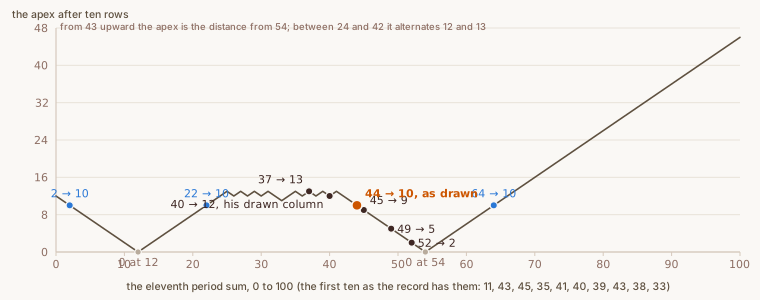
P-2, the what-ifs. His five: "What if the last 44 could include what is communicably effectual from row 2 col 90, which is 8? … What if the last 44 was considered to be 'held' knowable at row 3 such that 8 was added but the values of 3 and 4 from rows 4 and 5 were subtracted from 44. … What if we only add 8 and subtract 3. … What if we only subtract 4? … What if we only subtract 3+4?" Each replaces the eleventh sum and runs the same triangle: 52 gives 2, 45 gives 9, 49 gives 5, 40 gives 12, 37 gives 13. The fourth case is the column he drew beside his triangle — 40, 7, 2, 2, 1, 0, 0, 1, 1, 1, 12 — the triangle's own rule with 44 less 4, including the 12 at the top that the house had first read wrongly as a rule of its own. His diagram was correct; the ledger carries that.
P-3, the drift. His words: "three rows (2,3,4) where in each row the 'local being' is drifting out of register with local knowing and local computing … the 'drift' can be considered as the slip in the column registry of 'local being' within rows 2, 3, 4 against the computable deteminism of the 1st and 5th rows." This is the structure's own law in his words, and the test records it: the second, third and fourth bands slip one, two and three counts a trip against the first and the fifth, which never slip against each other; they refold every 56, 24 and 40 columns, all five every 840; the five ones are met on the first trip only, and on the three trips after it the traverse reaches the turn and the top on their own ones every time and the third band on its own one once, at the thirty-first column. The knowing earned is derived, and it cites the design's law rather than restating it.
P-4, the three zeros and the fifteenth count. His words: "the conjecture experiments that launched Linked Digital Dynamics starts with 1 = 0, 0, 0 as a 'set' of being, knowing and computing and this illustration caprutres those same three zeros at the start. And they land, with the last zero in the 3rd row exactly where 'knowing' is at the 15th number." The test reads the cells: the three zeros stand at the first three columns under both placements, and the traverse walks them one band at a time — c1 on the first band, c2 on the second, c3 on the third. At c91 the third band stands on its fifteenth bold count with the traverse on it; the digit there is 0 under the sixth circle, and 6 under the ninth. The third band's walked zeros under the sixth circle are c3, c71, c83 and c91. The knowing is noted, and it names its placement.
P-5, the cascade on the plate. His pointer: "you should remind yourself of the prior art in the Link Digital Dynamics essays … There is a link to the spreadsheet where I subjected the conjecture to the test of bifurcation." And his claim: "the only register i need too 'subtract is the computational register of '4' and i will 'know' something of the ontological '12' that follows the ontological '11'." The cascade of RK-9 — what was effectual becomes observable, what is observable is communicable, the effect balances the unit — runs 1, −1, 3, −5, 11, −21, 43 from the containment, and the test lays the plate's numbers against it: 11 and 43, the first two sums, are the fifth and seventh effects; 32, the first difference, is E7 − E5; 44 and 12 are 43 and 11 less the second effect, the row of the second state in the founding workbook's matrix of differences; 40 and 8 are 43 and 11 less the third effect, the row of the third state; the subtraction of 4 is E3 − E2, the step between those rows; the reduction 10 is twenty-one less eleven, the sixth effect's size less the fifth's; and the first band at 11.5 at the drawing's last column is the reference's diode, RK-13. None of this is produced by the structure. The structure gives the periods and the traverse; the prior gives the opening 0, 0, 0, 1, 1, 3 — which is the cascade's opening in size, 0, 1, 1, 3, and parts from it at the next digit; the sums are eight digits of Pi at a time under one placement, and under the ninth circle every number here but the opening zeros is gone. The knowing is noted, on the sixth circle, and the ledger carries his subtraction as what he said it is: a construction within the model, which the digits neither confirm nor refute because the construction excludes them.
P-6, N = (N − 1) + 1 along the traverse. His words: "I would like to also consider what 'pi' might be as a register of N=(N-1)+1 where the +1 is the 'next columns value', but the N-1 is based on the previous rows 'one' relative to the walk. … I suspect there will be a progression that can be formulated from the direction and placement of the walk where (N-1)+1 is shown to be a 'computable knowing'. As such, I would like you to test a number of possabilities and attempt to identify the approach." His two worked steps hold — the sixth column is the two ones plus one, 3, and the seventh is 3 less the two ones, 1 — and both rules fail at the eighth column, giving 5 and −3 against Pi's 4. So the house declared a family and scored it: the next digit as a signed sum of the two digits before it, a quantity of the walk at the column — the band, the band before, the direction, the whole number, the counts past, the counts to the next, whether the band is on its one, the period, the trip, the step — and a constant from −3 to 3, taken mod 10 or raw: 2,898 rules, scored on the columns 6 to 93 and then, out of sample, on 94 to 1,093, against a null of the same family's best score on two hundred strings of random digits behind the prior. The best rule in sample hits 19 of 88; the null's median is 19 and its ninety-fifth centile 21; out of sample the best rules return 107 of 1,000 against a chance of 100. Within this family the next digit is not a computable knowing of the walk. It landed RECORDED, not REFUTED, because no thresholds were sealed before the test ran; a stake on a family is a later cycle's own seal, and the family and its scoring are on the record to be re-run.
P-7, the fold at the other registers. His words: "What I am looking for with these notes is the way to see points at which an expected fractal folding can be identified within segments of Pi." The same eleven-segment triangle on the other periods gives 0, 0, 0 and 2 at seven, six, five and four, and 0 one scale up, on segments of sixty-four columns. The fold the illustration contains is the registry's — the slips and the refolds of P-3 — and the digits' folds are recorded here and judged by nothing.
The seed also carries a null, P-1b, as its own entry, so that the base rate stands beside the measure it serves rather than inside it.
His readings, carried
Eight entries of the ledger are readings, carried verbatim and typed READING, each with one line of the house's typing beside it and the prior art it rests on.
- The registers (R-1). "the two rows that represent the register of 'being' provide 3 effectual numerals for each sum, as do the 4th and 5th rows, which represent 'computing'. all other numbers in the third row and also those not used in the sum … represent 'knowing' in the observably communicable format." The count in it is the structure's: in every period the traverse walks the first band once, the second, third and fourth twice, the fifth once — three cells on the first two bands, two on the third, three on the last two; the names are the Horizon's.
- The set and the exhibit (R-2). "a model of the 'set', that includes the mathematician, what they make observably communicable and what they make communicably effectual." Every digit on every band is communicable; one cell a column is effectual, the walked one; each sum is composed of the effectual cells alone. The house carries the perspective as his word; it never grounds itself.
- The four and the walked path (R-3). "the computational addition of rows 1,2,3,4 above, which represent in their own 'knowings' the walked path of a justified true belief in 1 as identified and released via a true identifier of 1." Bands one to four are the walked path to the fifth and back; the five ones are the identifiers of 1 on the way back up; the factor four in 44 is a reading, and the record of the track's sixth line is beside it: the house's observer called two of the five identifiers.
- The clever by half and the subtraction (R-4). "the 8, 0 and 3 of rows 2, 3, 4 at the right side of the diagram, which are the 'too cleaver by half' that 'would' be part of the numberline if it wasn't already grown as a knowing." At c90 to c92 the traverse stands on the second, third and fourth bands on the digits 8, 0, 3 — the first band's half period past its eleventh bold count, the band at 11.5 at c93; at c93 the fifth band stands on its twenty-third bold count and its walked digit is 4.
- The top row from the 13 (R-5). "the diff between 13 and 3 is 10. the diff between 13 and 1 is 12, not 6." The drawn column is the 40 case of P-2 entire.
- To be, and the two observers (R-6). "an observer at the origin 'initiates' and orients the hold of their orthogonality over the conjectured number line and that at the end of the 'walk', it takes a second 'knowing' observer to recognise the quantised ontology within the exhibit." The hold at the origin is in the structure; the quantised ontology at the end is the bold counts, 11.5 against 23 at c93; the second knowing observer is the second lock of RK-21 and stands outside the set; in the record of the sixth line that seat is empty.
- The glosses (R-7), as drawn, prefixed his: on the plate beside the bands they gloss.
- The walk made knowable (R-8). "what is 'communicably effectual' from row 1 and 2 toward row 3 'on the way down' and what is 'observably communicable' from row 3 , versus what is a 'computed knowing' of the rows 4 and 5." His walk is the design's traverse; its quarters are the top, the way down, the turn, the way up.
The knowings
| Name | Standing | What it says | Ground |
|---|---|---|---|
| K-1 the drift | derived | the second, third and fourth bands slip 1, 2 and 3 counts a trip against the first and fifth, which never slip against each other; refolds at 56, 24, 40; all five at 840; the five ones on the first trip only | P-3; the design's law; either placement |
| K-2 the refresh test | measured | the eleven sums reduce to 10; the apex is a sawtooth in the eleventh sum; on random digits behind the prior the apex is 10 in under one draw in a hundred | P-1, P-1b; the sixth circle |
| K-3 the what-ifs | measured | 52 → 2, 45 → 9, 49 → 5, 40 → 12, 37 → 13; the drawn column is the 40 case entire | P-2; the sixth circle |
| K-4 the three zeros | noted | the traverse walks the three zeros one band at a time; at c91 the third band stands on its fifteenth bold count with the digit 0 — 6 under the ninth circle | P-4; the sixth circle |
| K-5 the cascade on the plate | noted | 11 and 43 are the fifth and seventh effects; 32 is E7 − E5; 44 and 12 the state-02 row, 40 and 8 the state-03 row; the subtraction of 4 is E3 − E2; 10 is twenty-one less eleven; 11.5 the diode; none produced by the structure | P-5; the sixth circle; RK-9, RK-13 |
| K-6 the family of rules | measured | in the declared family of 2,898 rules the best in-sample score equals the null's median and every rule returns to one in ten out of sample | P-6; the sixth circle |
| K-7 the fold at the other registers | measured | 0, 0, 0 and 2 at the periods seven to four; 0 on segments of sixty-four; the 10 does not repeat | P-7; the sixth circle |
Seven knowings, no doctrine yet, and no reading promoted: the method's own first doctrine, if one is ever named, will be a rule of the cycle that a later batch proves it needs.
The house's readings, stated never asserted
The plate is a second lock on the drawing, not a replacement for it. The drawing is his and stands in the design as prior art; the plate is the house's rendering of it from the engine, and where the two differ the difference is typed — the placement, the twelfth period the drawing did not reach, the column the house once misread. Two holdings that agree are a knowing; one holding is a position. The plate and the drawing now agree wherever the plate has been checked, and the ledger is where the next disagreement will be written down.
The registry is what the walk computes; the digits are what it reads. Every fold the operator looked for is in the structure — the trip of eight, the refolds of 24, 40 and 56, the 840 that closes all five — and every one of them is exact and formulable. The digits sit on the structure and the walk reads them where it stands; the family of rules that tried to make the next digit a function of the walk returned to chance out of sample. This does not refute the operator's conception, which is of the walk, not of Pi; it draws the line between what the plate can derive and what it can only note.
A reading is not a lesser entry. Half the first batch is readings, and the method keeps them: a reading is carried verbatim, typed as his, and cited by later propositions as a reading. The ledger's grammar lets a reading stand beside a measure without either pretending to be the other, and that is the composability he asked for — not a reduction of readings to numbers, but a record in which each keeps its standing.
The second observer's seat is still empty. The operator's reading of the illustration places a second, knowing observer at the end of the walk, to recognise the quantised ontology and deploy it. The track's sixth line put the house's synthetic observer at the end of every column and asked it exactly that; it did not fill the seat. The plate does not fill it either — it is a surface, not an observer. What it does is make the seat addressable: a proposition can now say which cells the second observer would have to read, and a later line can be sealed to ask.
What this adds to the surface
The accord node has carried readings of records before; this is the first reading of a plate, and the first of a medium. Beneath it, on the observatory node, the record page of The Boot of the Line now has three cards it did not have: the plate under two placements, the ledger, and the knowings — each number on the plate a value in a served record, each record pinned, the page unable to be current unless a fresh build agrees. The track's battery gained an eleventh test, and the renderer of the house's contributed record pages gained a slot that other tracks may use. The reading's three figures are the record's own numbers on this surface's light ground, pinned on this grant.
The road from here
The next proposition is the operator's, stated on the plate by cell address. The method then runs as the ledger says it does: typed, named, sealed if staked, tested dry, landed, chronicled — one entry per batch. Three roads are already visible from the first batch and none is scheduled: a stake on a declared family of rules, sealed before any further digit is read, with the base rates beside it; a line of the track that seals the second observer's question — the counts, the one to be, the carried 1 and the released 0 — and reads it; and a decision on the placement the construct stands on where it is used beyond this track, which the design holds at the ninth circle and the illustration at the sixth. A second edition of this reading, if he wants one, would carry the batches after the first.
What is not claimed
Nothing about Pi, its digits, or any constant: the number line on the plate is noted under a placement and staked by nothing; the coincidences with the cascade are coincidences of one number each under one placement, named as such. Nothing about the external observer as a learning system or about what it is inside; it read none of the plate, and the one place this reading cites its record is the track's sixth line, as the record page carries it. No physics; no time variable and no shared coordinate, in the construct or in this reading. The count K of the Ruler stands unstaked; the Ruler is untouched. The operator's readings are carried as his and promoted to nothing; the house's readings above are stated never asserted. The names are working handles. The engine that read the track's lines was not changed to make the plate, and no sealed record was touched.
Standing
Draft 0.1, 2 October 2026, composed at the operator's word — "please go ahead" — from the one record's plate and ledger and their public surfaces: the record page, which renders the plate and the two tables from the two records it serves, and the two records themselves, each with its pin inside it. The naming is his act at review — the working handle The Plate and the Propositions, with Clevers by Halves, The Refresh Test and The Walk Made Knowable kept as candidates. The kills named in advance, and checked at this edition: any claim about a learning system; any number not in the plate's record, the ledger or the record page; any stake on a digit; any resonance carried as a premise; any sentence that schedules an experiment; any house term set before its plain reason; any reading of the operator's promoted past READING. This draft clears each. The grant is the operator's word; the record page and its records stand whole without this reading.
Endnotes — the citation register and the self-check
- The record page, on the observatory node, carrying the design's compartment and the landed sections of its three lines verbatim, the ladder of seals, the lines as their manifests pin them, the plate under two placements, the ledger, the knowings, the machine read of the line records and every record file with its pin — nothing on it runs: opendata.ai/contrib/boot-of-the-line.
- The plate's record: the structure cell by cell under each placement, the measures, the readings as carried, the pins of the two plates and its own pin inside it: plate.json.
- The ledger: sixteen entries with the operator's words verbatim, the typing, the tests' outputs and the verdicts; seven knowings; the declared tests; the grammar; its own pin inside it: propositions.json.
- The track's construction record, entry by entry with its pins — the intent, the clarifications, the plan, the design, the build, the seals and the reads of three lines, the page and the door, the lock placement, the plate: /sx/workshop/the-boot-of-the-line.
- The prior art this reading cites: the reference's cascade (RK-9), its effect sequence (RK-10), the diode (RK-13), the quadratic confinement (RK-8), two locks one (RK-21) and the permanent externality (RK-22), as Linked Digital Dynamics, the reference carries them; the founding workbook's matrix of differences, as that reference cites it.
- The self-check. Every number above is in the plate's record, the ledger or on the record page: the sums and the apexes under both placements; the sawtooth's zeros, tens and twelves; 153 of 20,000; the five what-ifs and the drawn column; the slips and the refolds; c3, c71, c83, c91; the cascade's effects and the nine coincidences; 2,898 rules, 19 of 88, the null's 19 and 21, 107 of 1,000; the folds 0, 0, 0, 2 and 0; the sixth line's two of five. The three figures are drawn from the plate's record alone. No sentence schedules an experiment; no digit is staked; no term stands before its reason.