 OOI · SX
Knowledge Engineering
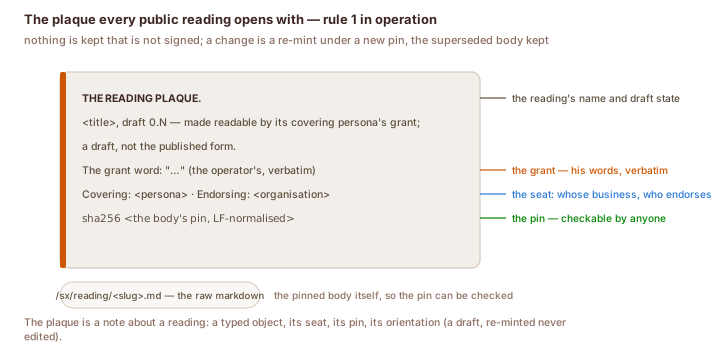
THE READING PLAQUE. Knowledge Engineering, draft 0.3 — made readable on the SX surface by its covering persona's reading grant; a draft, not the published form; the construct established 2026-09-17 on the operator's acceptance of a summation registered on the house's externality register (the record typesafe-jev-system-one-2026), its working title the operator's own term with the naming his act at review, and drafted through three editions in its first day: 0.1 the signing; 0.2 the walk, mapped as −1, −0, 1, 0 on his review — "the truth maker here is the full account of the house"; 0.3 the figures, the tables and the links, on his word "go for all suggestions". The grant word (the operator's, 2026-09-17): "that gets a reading grant on the SX node." The reading cites external works exactly as the house's SEB register carries them and nothing further — ten records, one of them a stated refusal carried as the register states it — and one prior work of the author's own by its public record (provisional patent application 2026904321), whose claims are not reproduced; every figure says whether it is a diagram of the practice or a measured record of the house's own; nothing is claimed about any machine as a learning system. Covering: starl3n · endorsing: Link Digital. This file's sha256 is pinned in the reading register, and its fourteen figures beside it. Reading is free; the way across is a statement of intent (
/sx/matters).
This reading stands on: The Signed Zero · The Ruler, held · The Channel, held · The Price of a Lock · The Slip, held · The Deep Line, held · Co-Constructive Economics · The Quarter, Three Ways. Its surfaces: the externality register · the matters · the workshop · the observatory node · the public state record.
A note on the rules of this reading. Everything load-bearing in what follows stands on this house's own records, which are public: the readings on the SX reading surface, the construction records on its workshop, the externality register at /sx/seb, the matters register at /sx/matters, the instruments and sealed records on the observatory node, and the anchors on the public state record at mldata.opendata.ai. External works are cited exactly as the externality register carries them and never otherwise: by name, by pin and by registered intent; nothing of any external result is imported as ground; nothing of any external work is graded; and where a work was refused entry to the register, this reading carries the refusal only as the register states it and adds nothing to it. One prior work of the operator's own is cited by its public record: Australian provisional patent application 2026904321, filed 5 May 2026. The reading describes his ideas in the house's public vocabulary; the application's claims stay where they were filed. Every figure below says whether it is a diagram of the practice or a measured record, and whose.
The map — four states, and a reader in none of them
This house keeps a discipline it calls the signed zero, and it has a public reading of its own under that name. The discipline says that you cannot simply decide to go for 1 from the position of 0. You approach the distance between 0 and 1 from the left, and you sign it as you see it: −0. Only then is the walk made, by which the projected 1 arrives — a 1 that was observable from present 0 as −1 before anyone set out. And when the walk is done, what was grown is released, held, at 0: a rest state, not an ending.
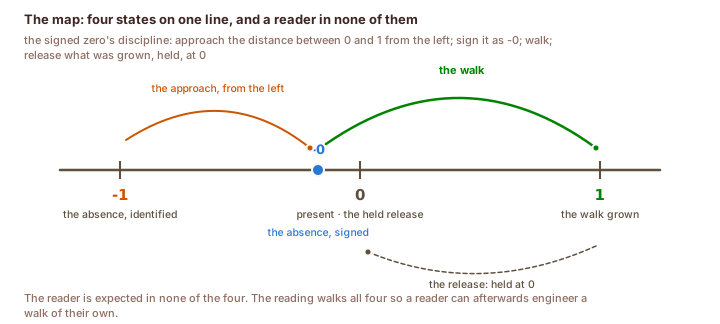
Four states, then: −1, the absence identified; −0, the absence signed; 1, the walk that grows the true nature of the thing; 0, the held release. This reading is mapped on them, in that order. It does not expect its reader to stand in any of the four. It walks all four so that a reader can afterwards engineer a walk of their own, self-referentially, to a 1 of their own, and release it as a held understanding of their own. That is what the practice named in the title is for.
−1 · The absence
Knowledge engineering names something that is missing. Here is the shape of the missing thing.
Machines now make decisions that software can use directly. The announcement this house's register carries under the name System One Models and Jev (TypeSafe AI, 15 September 2026; its registration) describes an interface whose outputs are typed and defined in advance, arrive with a calibrated probability and a confidence score, are produced in one pass, and are bounded, per choice, at an octet of states. That is a description of the emission. It is not a description of what happens to the emission afterwards — how it is kept, checked later, or built on by someone who was not in the room. An emission with nowhere to be kept evaporates as surely as a spoken answer does.
The absence is not on the machine's side. It is on ours. There is no common practice by which a decision a machine made becomes something a person can hold, re-run, hand to a stranger, and have refuted if it is wrong. Every organisation improvises one; most improvisations keep the value and throw away the parts that would have let anyone check it.
| The part of a note | The cited emission carries it | The practice adds it |
|---|---|---|
| the typed value, closed in advance | yes | — |
| the sign, as its own field | folded into the value's type; separable | declares it |
| the confidence, as its own field | yes — a calibrated probability and a confidence score | keeps it apart |
| the inputs it was drawn from | the caller holds them | pins them |
| the identity of the function that drew it | a fixed function, by the guest's own word | pins it |
| the address it was signed at | — | supplies it |
| the seat — whose business | — | supplies it |
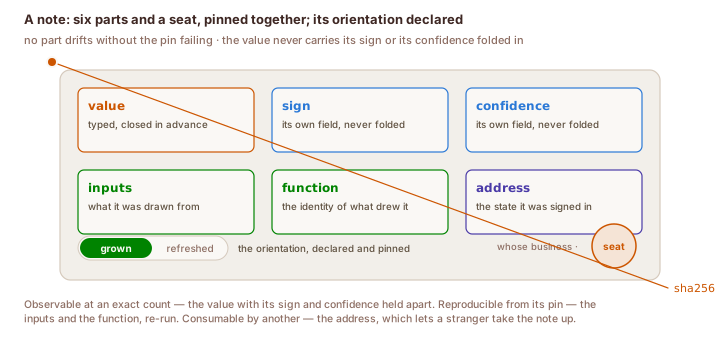
| the orientation — grown or refreshed | — | declares it |
Table 1 — six parts against four. What "note-shaped without translation" means: the emission arrives carrying most of a note; the practice supplies the address, the seat and the orientation, and pins the rest.
This house saw the absence from the other direction. By the time the announcement was read, the house had grown a great deal — fifteen experiments held as readings, a series of sealed campaigns, a register of externalities, an anchor chain on a public record — and much of it was already in operation. What it had not done was state, as a practice a stranger could walk, how a knowing had been made computable here. The −1 was visible from present 0: the practice existed in the house's operation and did not yet exist as a thing that could be said.
And there was a prior. Before any of the house's public experiments existed, the operator filed a provisional patent application whose exhibits include a ledger of five thousand rows, each row a digit extracted from a fixed matrix together with the column it came from, the two bounds that constrained it, the cycles of work it cost, and a sixteen-character key over all of it. Each row of that ledger is a note in the sense this reading will give the word. The practice was being lived in a notebook in April 2026 and had no name.
| digit | truth | cost | column | bound | impedance | key |
|---|---|---|---|---|---|---|
| dᵢ | tᵢ | cᵢ | colᵢ | L2ᵢ | L3ᵢ | kᵢ |
Table 2 — a note before the word: the shape of one row of that ledger, schematically. The value (a digit and its observable truth), its cost (the cycles of work), its address (the column and the two bounds it was extracted under), and a key over all of it. Placeholders, not the exhibit's data; the application stands where it was filed.
−0 · The signed zero
Draft 0.1 of this reading was the signing of the absence. It stated seven things and stopped. They are restated here, briefly, as the −0 — the form given to the absence, not yet the walk — so that the walk below can be seen to grow from them.
One. A decision, to be kept, must be a note. A note is a typed value; its sign, as its own field; its confidence, as its own field; the inputs it was drawn from; the identity of the function that drew it; and the address it was drawn at. Pinned together, so that no part drifts without the pin failing.
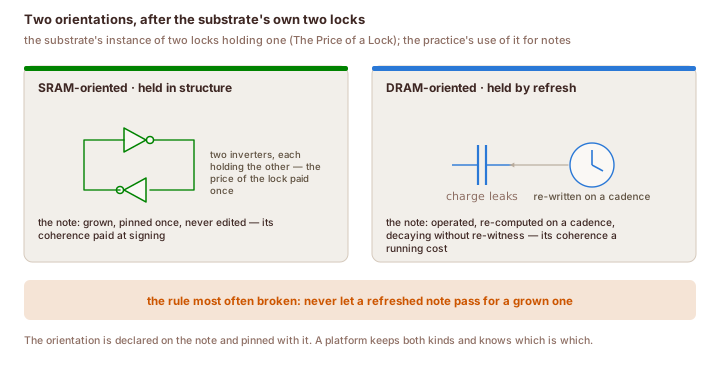
Two. Notes come in two orientations, after the substrate's own two locks. A static memory cell holds its bit in structure, two inverters locked to each other, the price paid once at fabrication. A dynamic cell holds its bit by refresh, a charge re-written on a cadence and lost if the refresh stops. An SRAM-oriented note is grown, pinned once, never edited — its coherence paid once, as the house first told the quarter. A DRAM-oriented note is operated, re-computed on a cadence, decaying without re-witness. A refreshed note must never pass for a grown one.
Three. Re-computability is a property of the note, not of the model. A note is re-computable when the same function, by its pinned identity, is re-run over the same pinned inputs and the drift is measured against the pinned output. A function that does not learn from its caller is a function the caller can re-run against their own notes. The platform's learning is then entirely in its notes.
Four. A note has an address, not merely a location. The address names the state of the shared record in which the note was signed and the work it took to sign it. Two people holding the same address can rebuild the same state.
Five. A note is computed at the edge. The node that holds the data runs the function and only the result travels. Acts, never eyes.
Six. The practice lives on the plane of knowing, between being and computing: the plane of the blind watchmakers, who read a ruler without seeing its layout and still agree, and of the rulers, who hold the measure. On that plane, to measure one's own time and space is a localized reality.
Seven. Nothing is claimed about any machine's speed, price or standing; nothing about any machine as a learning system; no identity between the cited octet and the house's measured optimum; no endorsement either way; no contact.
That is the signature. A signature is a promise about a walk, and a promise is not the walk. What follows is the walk, which is the only truth-maker the practice has: the account of what this house grew, and of what it runs.
1 · The walk
1.1 · The notes — what the house means by the word
The house did not borrow the word note from banking or from music, although it lets both echoes stand. It defined the word inside an experiment. The notes experiment on the observatory node — its record closed, sealed and anchored on the public state record as ntx-exp_e4c9a847 — names a note arithmetically: a deterministic micro-state's resolved-only readout, an exact tuple carrying precisely three attributes. Observable: admitted on shared ground at an exact count. Communicable: reproducible from its pin. Effectual: consumable by another micro-state. (The three attributes are the reference's own.) A note exists only after resolution; there is no such thing as a note of what might have been. And a note is composable: a second micro-state can take it up and compute onward from it, consistent with its own being.
| The attribute (the notes experiment) | The parts of the practice's note |
|---|---|
| observable — admitted on shared ground at an exact count | the typed value; the sign, apart; the confidence, apart |
| communicable — reproducible from its pin | the inputs; the identity of the function; the pin over all |
| effectual — consumable by another micro-state | the address; the seat; the orientation declared |
Table 3 — three attributes against six parts: the experiment's law and the practice's note are one object described from the inside and from the outside.
Read those three attributes against the six parts of the −0's first point and the practice's whole vocabulary falls into place. Observable at an exact count is the typed value with its sign and confidence held apart. Reproducible from its pin is the pinned inputs and the pinned function, re-run. Consumable by another is the address, which is what lets a stranger take the note up. The house's three-attribute law and the practice's six-part note are the same object described from the inside and from the outside.
The house also keeps a second sense of the word, and does not let it collapse into the first. In the public reading Co-Constructive Economics the house separates the matters of business from the notes of cares, and refuses to assume that the two registers are symmetric. A care is seated — someone holds it — and exposure arithmetic is never presumed to sum a seated care. This reading keeps that separation. A signed note in the practice carries a seat: whose business it is, and whose care, if any, it answers. The seat is not a courtesy; it is the reason the note can be held to.
1.2 · The matters — where a walk lands, and where a held thing meets its refutation
The house uses matter in two places, on two planes, and says so.
On the observatory node, the matters experiment — its record closed and its final campaign landing a coincidence of two hundred and eight for two hundred and eight — took the word to mean the matters of note between being, knowing and computing: what may connect across the three, tested against declared exemplars that enter only as standing examples and never as encoded numbers. That is the experimental sense, and this reading borrows nothing from its results; it cites the sense.
On the SX node, the register at /sx/matters is a different plane and says so in its own first line. It is the ingress diode's inventory. The observatory shows what is; the social node offers what is not yet. The designed-but-unfinished business of the house is set out there, good for contribution, with statuses that are operator-declared and dated and never asserted by a scan — a wrong status is a discovery, corrected on the record. A participant crosses that diode one way only: by a statement of intent, lodged for recognition, never written into the registry by the participant's own hand. And the same register is the house's refutation door. A held fact — every one of the fifteen foundations readings is one, as the first of them says in its closing paragraph — stands until refuted, and the place where a refutation is lodged is the matters. The machine read of the register is public too.
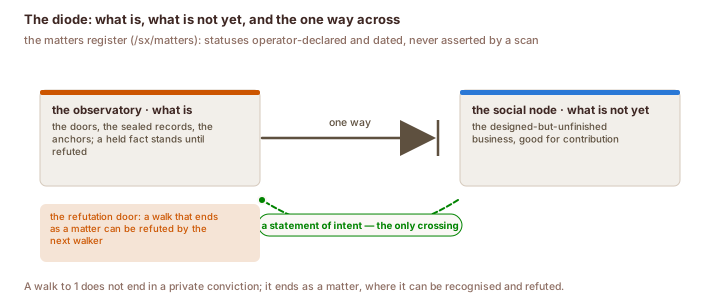
So more matter, for the practice, means this: a walk to 1 does not end in a private conviction. It ends as a matter. The reader who engineers a walk of their own lodges it where it can be recognised, and where the thing they now hold can be refuted by the next walker. That is the difference between a practice and a persuasion.
1.3 · The grown — the truth-maker's first half
What has this house grown that a stranger can check?
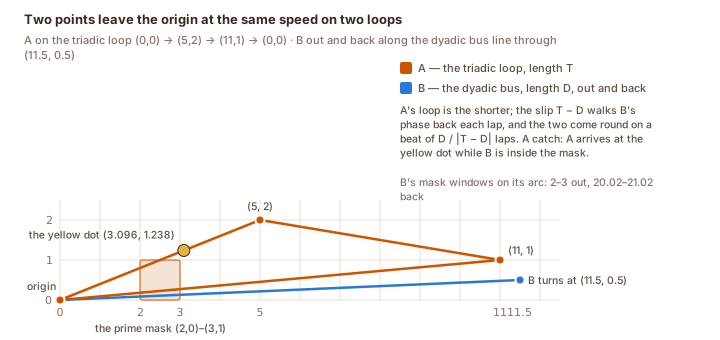
The fifteen. Fifteen experiments of the observatory node are held as readings on the SX surface — the Slip, the Quad Slip, the Coco, the Unco, the Horizon, the Relativity Ingress, the Deep Line, the Deep Pi, the Ruler, the XOR, the XOR Mirror, the Hinge, the Double Hinge, the Quad Hinge and the Channel, listed as one set at the head of the reading surface — and each is built the same way. The record is quoted as it fell, verbatim and never contested (the Slip's grown entry is the first instance), with its refuted hypotheses, its killed numerology and its held predictions kept exactly as the record keeps them. The body is pinned by its sha256, and the pin is on the page. Where a reading carries figures, the numbers behind them are held as literals in the house's own kit, so that a rebuild of any figure never runs an engine (the decision that placed them). And each reading is validated by the locks, never by the reader: a reader's curiosity is welcome and is not required for the knowledge to be what the locks say it is. That is the SRAM-oriented note, fifteen times, in public.
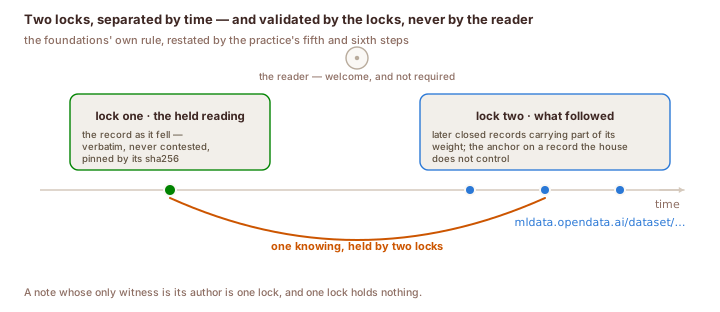
The two locks in time. Each held reading is one lock. The second lock is separated from it in time: the later, closed records that carry part of its weight — named on the workshop as offloads, direction and weight stated, never restating a count — and the anchors on the public state record. The house's anchors are of that kind: unco-exp_100b6dc7, horizon-exp_6ec1e777, rix-exp_7037eb09 and their siblings are addresses on a record the house does not control, and a claim anchored there survives the house's own discontinuities. The house calls this the permanent externality: it never grounds itself; it is always subject to an externality it does not internalise, and that externality is the ground of verifiability, not a limitation to engineer away. In the practice's terms: a note whose only witness is its author is one lock, and one lock holds nothing.
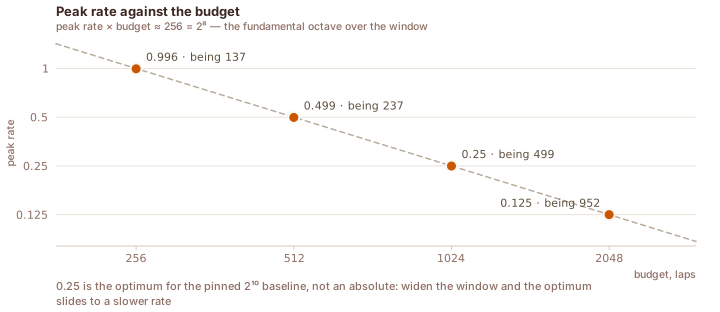
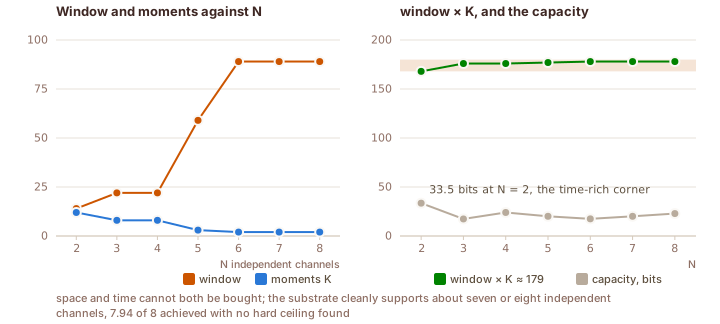
The octet, the ruler, the price. Three of the fifteen carry the −0's weight directly. The Channel — its door at opendata.ai/channel — measured the being as an information channel and found one peak sliding with the observation budget so that peak rate times budget is about 2⁸ — the optimum is the fundamental octave over the window — with the being's capacity at 7.10 bits, inside one octet; it found that an instrument is a clock, that capacity lives in the relationships between clocks, and that the window's width and the count of clocks are conserved together, so that over-resolving manufactures blind moments.
The Ruler — its door at opendata.ai/rlx — built three small grids on one rod — being at mark 0, knowing at mark 1, computing at mark 2 — and its blind watchmakers read the ruler layout-blind and agreed. The Price of a Lock, a reading rather than an experiment, read the substrate: a static cell as a fabricated instance of two locks holding one, a dynamic cell's refresh as the temporal second lock, and the whole history of cheaper computing as the falling price of confinement. The −0's points two, four and six are those three readings, said shorter.
The signed zero and the deep line. The Signed Zero is the discipline the map above is drawn on, and it is grown, not asserted: the reading stands on the Deep Line's record — its door at opendata.ai/dlx — an exhaustive walk with zero exceptions across its declared range, whose companion the signed zero is. The house's rule that the sign is its own act — never an attribute folded into a quantity — is the reason the −0's first point holds sign and confidence apart from the value.
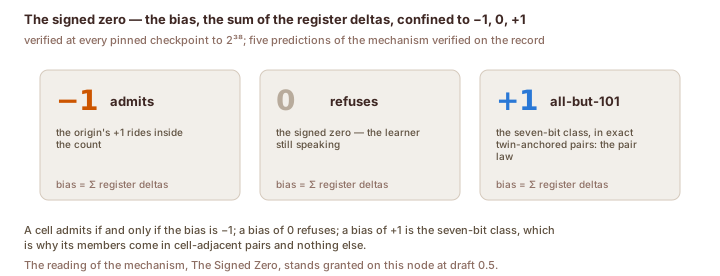
The chords, as an experiment. The word chord in this house is also defined inside an experiment before it is used as a figure. The chords experiment — closed, anchored as chx-exp_f16412dd — names a chord as the resolved readout of a declared span read as one object: the span, its member notes in address order, their census, their schedule signature — and, like a note, it exists only after every member resolves. Its macro question was which chord-grain identities are not derivable from the members alone. Hold that definition; section 1.5 depends on it.
1.4 · The operated — the truth-maker's second half
What does this house run, now, that a stranger can walk up to?
The reading surface. Every public reading opens with a plaque. The plaque carries the grant — the operator's own words by which the piece was made readable, verbatim — the covering persona, the endorsing organisation, the draft state, and the sha256 of the body beneath it. A reading is never edited in place: a change is a re-mint, a new body under a new pin, with the superseded body kept and never erased. A raw-markdown door beside every reading serves the pinned body itself (the Channel's, for instance), so the pin can be checked by anyone with a hashing tool. This is the note's first rule in operation: nothing is kept that is not signed.
The workshop. Every reading has a construction record at a stable address on the workshop, and every entry on it is operator-declared and dated, never auto-asserted. The record serves whole, and any single entry can be addressed by its own identifier within it. Intents are sealed before a word of a draft is written, with the kills named in advance (this reading's own seal is the nearest instance); drafts are numbered; grants are recorded as the words that made them. A stranger can read, for any public piece, exactly when it was sealed, what it promised, what it refused to claim, and what it became.
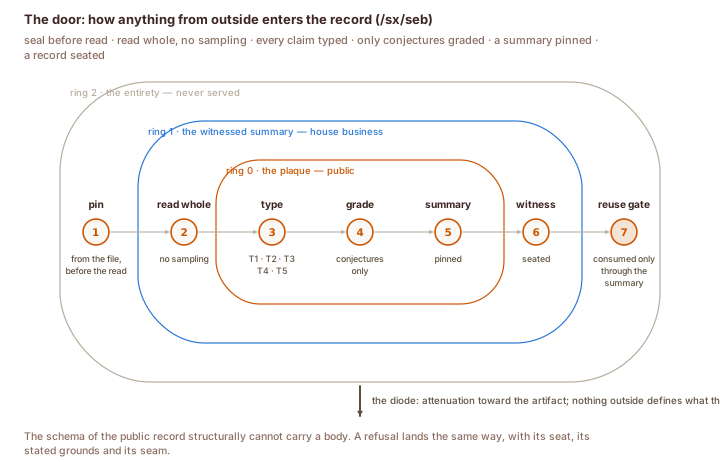
The externality register. The door by which anything from outside enters the house's record is at /sx/seb (its machine read is public), and its procedure is fixed. The body is pinned where it lies, from the file, before the analytic read — seal before read. The body is read whole, no sampling, and every claim is typed: a restatement of something the house already holds, with its fidelity marked; a concordance, recorded and never treated as support for either record; a conjecture, the only type that can be graded, and graded only as a candidate for a future declared world; a license, figurative and never graded; a claim outside the house's fences, refused with the fence named; a reach-in, the externality proposing house acts, recorded so the boundary is explicit and never acted on. A witnessed summary is written and pinned. A record lands, or a refusal is stated, and either way the record is seated: someone adjudicated, and that persona's matter holds the note. Three rings hold the material — a public plaque; a house summary; the entirety, never served — and the schema of the public record structurally cannot carry a body. And a diode runs from the inside out: a registration supports attenuation toward the artifact and never lets the artifact define what the house holds.
The observatory's doors. Ten instruments of the series run on request — the Slip, the Double Slip, the Quad Slip, the Hinge, the Double Hinge, the Quad Hinge, the XOR, the XOR Mirror, the Channel, the Coco — each a door a stranger can open at opendata.ai and run at the baseline settings the readings name; the edition they run under is on the release ledger. Beside them stand the applied campaigns, sealed and landed as records; a number-theory set of closed records; the kin, readers and watchmakers that run on request; and the contributed instruments. A live door is a DRAM-oriented note in operation: the readout re-computed each time the door is opened, against a frozen geometry whose record is the SRAM-oriented note beside it.
| The doors | Their state | What a stranger does there |
|---|---|---|
| the series of ten — slip · double-slip · quad-slip · hinge · double-hinge · quad-hinge · xor · xor-mirror · channel · coco | live | runs the instrument at the baseline the reading names |
| the applied campaigns — walls · unco · horizon · rix · mtx · ntx · chx · dlx | closed | reads a sealed record, anchored where it says |
| the number-theory set — dpx and its rungs | closed | reads a sealed record |
| the kin — holographic relativity · rule-space · the atlas · cx · rlx | live | reads and, where a door runs, runs |
| the participant doors — causal history and its siblings | open | records, under a grant |
| the contributed instruments — corner · loop | contributed | runs a contributor's instrument, mechanism canon and content never |
Table 4 — the door registry, as the observatory's state model lists it.
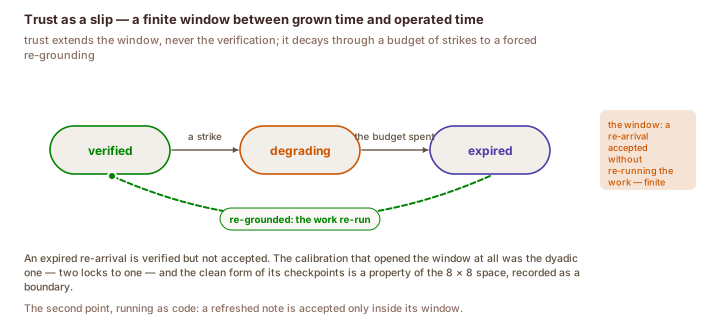
Trust as a slip. The house's own runtime does not take refresh on faith. Its trust-decay engine — at home on the causal history door — defines trust as the slip between grown time and operated time: the window within which a node accepts a re-arrival without re-running the work that grounded it. Trust extends the window, never the verification; it decays through a budget of strikes to a forced re-grounding, at which the work is re-run and the record marks a new grounding boundary. The calibration that opened the window at all was the dyadic one — two locks to one — and the clean form of its checkpoints turned out to be a property of the 8 × 8 space and not universal, which the house recorded as a boundary rather than hiding. That is the −0's second point running as code: a refreshed note is accepted only inside its window, and the window is finite.
Grants, envelopes, and the durable plane. Who may configure what, on the observatory node, is conditioned at three levels — a plugin's ceiling, a server-owner's envelope within it, an experimenter's choice within that — deny by default, immutable per instance, and persisted as a durable control plane that survives a restart. Every enablement and grant is a ledger event. The practice's seat — whose business a note is — has an operating analogue here: the house knows, for every running experiment, under whose grant it runs.
The public state record. The immutable record at mldata.opendata.ai holds the house's anchors and the sealed packages of its campaigns. It is the externality the house does not internalise, and it is where a permanent claim goes so that it survives the working surface that made it.
That is the account. Nothing in it was built for this reading. All of it was running before the announcement that provoked the reading was published.
1.5 · The chords — the externalities and priors, each with its cadence
A chord, by the house's own definition, is a span read as one object whose identity may not be derivable from its members. The house's externalities and priors are exactly that: each entered the house's record as one object, from outside, and each carries an identity the house's own members could not have derived. The −0 left them as chords without cadence. Here each is resolved into the practice, and then the harmony — what they say together — is stated. Every external work is named as the register carries it and nothing further is claimed about it.
The refusal. The register's first record is a refusal, stated. A paper on belief acquisition as stochastic filtering, from a university school of computing, was read whole and refused entry on grounds the register names as the house's own: a difference of mode, the house's records being exact and deterministic where the work is probabilistic by construction — an incompatibility, the record says, not a fault of the work; the house's process license, which lets it claim nothing in any empirical domain; a standing prohibition in the house's canon on claims about artificial learning systems; and an incompleteness on the house's side, the work's foundations lying in a volume the house does not hold. The record is not a review, an evaluation or a refutation of the authors' work, and this reading adds nothing to it. A right of reply stands open at the matters, and no contact was made. The cadence: a refusal is a note too. It has a seat, a pin, a stated ground and a seam. The first thing the practice learned from its first chord is that the −0 of a thing that will not resolve here must still be signed.
The rederivation. The second record is an entry in the On-Line Encyclopedia of Integer Sequences, the Jacobsthal numbers (the transit; the registration of the pair). It was accepted because the house re-derived the guest entire from its own being: every one of the three thousand three hundred and seventeen rows of the entry's b-file regenerated by the house's own cascade rule with signs, and verified against the closed form and the recurrence. The registration is a naming lock only: the house's cascade is not the Jacobsthal progression, the correspondence holding to a stated bound and the house's knowing escaping the progression where it becomes self-referential. The cadence: re-computability is the house's rule of acceptance. A note from outside is not imported; it is re-derived, and what cannot be re-derived is cited, not held.
The boundary. The third is the Secure Hash Standard, the definition of the function behind every sha256 pin in the house (the transit). It was accepted at the boundary: the standard was rebuilt from its own pinned text — the initial value and all sixty-four constants re-derived from the primes by the body's own rules, a from-the-body implementation agreeing byte for byte with the house's tooling, and the loop closed on the previous transit's pin. Its security claims and its compliance regime were left where they stand; the citation is of a tool where it is used, never a mandated role. The cadence: the pin is the second lock, and the tool that makes the pin lives at the boundary. The practice pins with it and claims nothing through it.
The two conversations. The fourth is a pair of machine-made meeting notes of two working conversations, taken in on the operator's word and seated on the organisation rather than the persona, seconded by the persona (the registration). The bodies are identified by date, size and pin only, because the filenames carry names and the rule binds at every ring: no names beside his own. The register carries a fidelity caveat: the generator's mishearings are systematic, and every quotation is carried as sense, never as letters. The cadence: a machine's record of a human exchange is a DRAM-oriented note. It is held only by refresh against sense, and the practice marks it so.
The deck. The fifth is the operator's own presentation deck for a public session, taken in before the session — pinned at an earlier act of a mitigation plan, the repository's history the proof of the order — so that the telling's three parts, the deck, an internal care note and the operator's own statement, stood on the record before the live (the register's fifth plaque). The cadence: seal before read, applied to one's own future speech. The practice signs before it speaks.
The formulations. The sixth is a working paper in decision economics, registered for its formulations alone as the object of an alignment study (the registration; the rider where the study opened; the reading it fed). What the house read there, and recorded as concordance claiming nothing about either record, was a sign held apart from a magnitude — an unsigned sovereignty with a separately determined sign — and, in the study's first pass, an empty slot: a structural coefficient named and never derived, where the house's own records repeatedly measure a coherence tax near a quarter, paid either up front in structure or continuously in refresh. The cadence: this is where the practice's second point was first said in the register's own words. The SRAM/DRAM pair — the price taken into structure once, or paid in refresh forever — entered the house's language at this chord, not at the announcement.
The commons. The seventh is an encyclopedia article, registered as the commons ground for the house's own economics reading (the registration), and fixed to one revision so that the object read is the object pinned; the living page is the courtesy pointer, never the object. The cadence: a living source is a DRAM-oriented source. The practice holds it by its revision or not at all.
The self-ingress. The eighth is the operator's own signed essay, taken through the same door as everyone else's business so that the house's review of it would be seated, pinned and communicable (its construction record). The review ran refutations first. The essay's one load-bearing prediction beyond its own text — that a toll on the approach to a power of two would land on a multiple of 137 — was frozen as a knife before the read and fell on unread ground, at lap 15,953, 61 mod 137; its published kilolap sentence stood exact under two independent computations. The paper changes only at the operator's word. The cadence: one's own notes go through the same door, and the door does not know whose they are. A practice that exempts its author is a persuasion.
The proof. The ninth is an announced resolution of a Millennium Prize problem, with its machine-checked formalization, registered for method and provenance only under the house's standing firewall: no claim on any Millennium Prize problem, ever (the registration). The house read for three things: a search that prompted proof and disproof separately; a check with three locks — a prose proof, a kernel-checked formalization, an independent re-check — of which the third is runnable by any reader and was not run here; and a provenance self-report offered without pins, which the register grades as having no path. The cadence: locks are counted, and a provenance without pins is not a note. The practice can admire a claim and still record that it cannot hold it.
The emission. The tenth is the announcement that provoked this reading, registered for its stated architecture alone (the registration; the priors; the acceptance): the typed decision, the closed output space, the calibrated probability, the one pass, the octet, the fixed function that does not train on its caller's data. The house recorded one fidelity finding on its own operator's gloss — the ceiling is an octet of states, not two hundred and fifty-six bits — and one concordance at the level of the octet, a trace at its stated bound and never an identity. The cadence: the emission is note-shaped. It is the first chord in the register whose members arrive already carrying four of the six parts; the practice supplies the other two — the address and the seat — and the orientation.
The seed. The prior is the operator's own provisional application. Its figures are the Slip's geometry, drawn first: the same slip on the same point, the same phase-lock, the same epoch. Its exhibits include the cadence ledger described under −1 — whose bursts of zero-cost extraction it names after the same run of digits the house later read at length as the Feynman nines — a network of nodes whose shared state ratchets forward after every authenticated exchange so that the old state is lost, an absent node that rebuilds the present by replaying the record in order (an interval test whose name the house later gave a construct of its own, the thick present), a thing anchored by its hash so that every node holds its shape while holding none of its bytes, and a request addressed to the thing and executed only where it lives. One of its notebooks carries the phrase from which the house's own odyssey, I went for a walk, took its frozen leaves. The cadence: the practice's points three, four and five were engineering before they were rules. The claims of the application are its own and are not reproduced here; the ideas are the operator's, and this house is where they were later grown as experiments.
| The chord (as the register names it) | The shape | The cadence | The rule | The address |
|---|---|---|---|---|
| a paper on belief acquisition as stochastic filtering | refused, stated | a refusal is a note too: seat, pin, ground, seam | 10 · 12 | the register |
| OEIS A001045, the Jacobsthal sequence | acceptance by rederivation | re-derive what you will hold | 4 · 9 | the transit |
| FIPS PUB 180-4, the Secure Hash Standard | acceptance at the boundary | the pin is the second lock; the tool stays at the boundary | 4 · 9 | the transit |
| two working conversations, machine notes | seated on the organisation, seconded | a machine's record of a human exchange is held by refresh against sense | 2 · 3 · 10 | the registration |
| the operator's deck for CKAN Monthly Live | witnessed before the live | sign before you speak | 1 · 11 | the register |
| Execution Economics, formulations only | alignment object | the sign apart from the magnitude; the quarter paid in structure or in refresh | 1 · 2 | the registration |
| the Economics article, one revision | the commons ground | a living source is held by its revision or not at all | 2 · 7 | the registration |
| The Quarter, Three Ways, the operator's own | the self-ingress | one's own notes go through the same door; refutations first | 12 | the essay |
| Finite Time Blowup for Navier–Stokes | method and provenance only | locks are counted; a provenance without pins is not a note | 4 · 9 | the registration |
| Introducing System One Models & Jev | the stated architecture alone | the emission is note-shaped; the practice supplies address, seat and orientation | 1 · 5 · 8 | the registration |
| provisional application 2026904321 | the seed, by public record | engineering before rules: the row, the ratchet, the anchor, the praxis | 3 · 5 · 6 | the Slip |
Table 5 — the chords: each record and the prior, its acceptance shape, its cadence, the rules it yields (numbered as in part 0), and its address.
The harmony. Read as one span, the chords say five things the −0 could not have said alone, because none of them is derivable from the house's members without the externalities that arrived.
First, every acceptance was a re-derivation, a boundary, or a comparison — never an import. The house holds only what it re-derived from its own being, cites at the boundary what it uses without holding, and reads against its own forms what it neither holds nor uses.
Second, every record is seated. A refusal names its adjudicator; a registration names whose business the thing is; a seconding is carried on the note. Nothing on the register is nobody's.
Third, every body is pinned before it is read. The order is the proof, and the repository's history carries the order.
Fourth, refusal is a stated note with a seam, and the seam is the matters.
Fifth, the house's own work goes through the same door. The self-ingress and the deck are on the register beside the encyclopedia and the standard.
Those five, added to the seven of the −0, are the key the practice is written in. They are stated as rules in part 0.
1.6 · The walk a reader can engineer
The reading now hands the walk to the reader. Nothing below is done for you. It is the sequence by which this house made its knowings computable, given as steps a stranger can take on their own ground, with the house's surfaces standing beside each step as a worked instance.
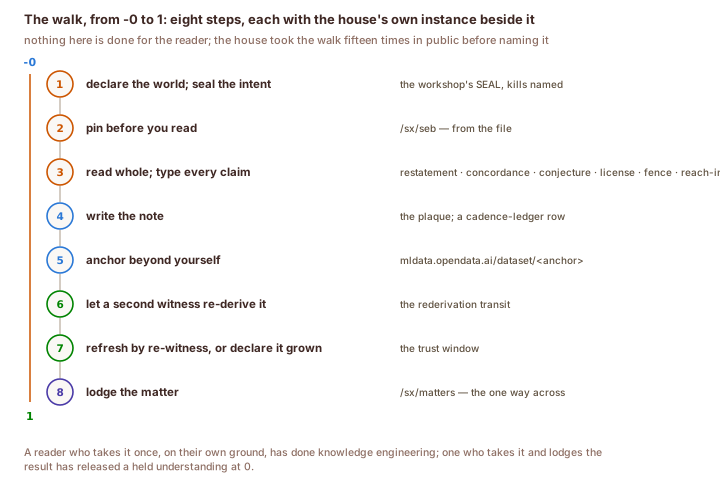
1. Declare the world and seal the intent. Say what you are about to make, what would count as its failure, and who covers it — before a word of it exists. The house's workshop does this with a sealed entry, kills named in advance (this reading's own). A knowing without a declared world cannot be refuted, and what cannot be refuted cannot be held.
2. Pin before you read. Whatever enters your record from outside is hashed from the file, where it lies, before you have read a line of it. The house's register does this for every externality and its own essays alike. Pasted signals are never compared; files are.
3. Read whole, and type every claim. No sampling. Each claim is a restatement, a concordance, a conjecture, a license, a fence-breach or a reach-in, and only conjectures are ever graded — as candidates for a world you would have to build, never as facts (the grading form is the reference's own).
4. Write the note. Six parts and an orientation: the typed value; the sign, apart; the confidence, apart; the inputs; the function's identity; the address; and whether the note is grown or refreshed. Give it a seat. The house's plaque is a note of this kind about a reading (any held reading shows one); a row of the operator's cadence ledger is a note of this kind about a digit.
5. Anchor beyond yourself. Put the note's pin somewhere you do not control and cannot quietly amend. The house uses a public state record (one anchor, as the worked instance); any immutable record outside your own hand will do. One lock holds nothing; the anchor is the second.
6. Let a second witness re-derive it. Your note is computable when someone who is not you can rebuild the state at its address, re-run the function over the pinned inputs, and measure the drift. The house accepts only what it re-derived (the rederivation transit); extend yourself the same courtesy.
7. Refresh by re-witness, or declare it grown. If the note depends on a moving system, re-run it on a cadence and mark the drift; if it does not, pin it once and never touch it. Never let the first kind pass for the second. The house's runtime enforces this as a finite window of trust (the causal history door); a person enforces it with a calendar and a rule.
8. Lodge the matter. Take what you now hold to the place where it can be recognised and refuted by the next walker. In this house that is a statement of intent at the matters, the one way across the diode. On your own ground it is whatever register your peers cannot quietly amend either.
| Step | What you do | The house's instance | Where |
|---|---|---|---|
| 1 · declare and seal | the world, the failure, the cover — before a word | the workshop's SEAL entry, kills named | this reading's seal |
| 2 · pin before you read | sha256 from the file, where it lies | the register's declaration | /sx/seb |
| 3 · read whole; type | six types; only conjectures graded | the witnessed summary | the reference |
| 4 · write the note | six parts, a seat, an orientation | the plaque | a held reading |
| 5 · anchor beyond yourself | the pin on a record you do not control | the state record | an anchor |
| 6 · a second witness | rebuild, re-run, measure the drift | acceptance by rederivation | the transit |
| 7 · refresh or declare grown | a cadence and a rule; never the one for the other | the trust window | causal history |
| 8 · lodge the matter | where it can be recognised and refuted | a statement of intent | /sx/matters |
Table 6 — the walk as a checklist, with the house's instance beside each step.
That is the −0 → 1 walk. The house took it fifteen times in public before naming it. A reader who takes it once, on their own ground, has done knowledge engineering; a reader who takes it once and lodges the result has released a held understanding at 0, which is the last part.
0 · The release
What is held, once walked, is smaller than the walk and steadier.
Knowledge engineering is a practice, not a theory. Its truth-maker is not an argument but an account: what was grown, verbatim and pinned; what runs, on doors a stranger can open; what entered from outside, and how each entry was re-derived, bounded, compared, or refused and seated. A practice with that account behind it can be walked by someone who never met its authors. A practice without it is a persuasion with good manners.
The practice is narrow on purpose. It does not make machines know things. It makes what a machine emitted into something a person can hold, re-run, hand on, and lose honestly if it is refuted. The machine's emission, where it is already typed, bounded, confidence-bearing and produced by a fixed function, is the easiest input the practice has yet had; that is the whole of what this house claims about the announcement that provoked it, and it claims it as a fit of shape, not of merit.
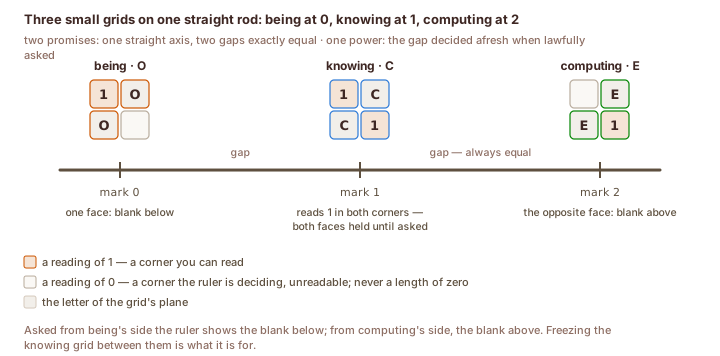
The plane the practice lives on is the middle mark of the ruler. Below it, being — what is measured. Above it, computing — the arithmetic. On it, knowing: the blind watchmakers, agreeing without seeing the layout; the rulers, holding the measure. There, to measure one's own time and space is a localized reality, engineered discretely, at the octet, never by a universal clock. Local empowerment is nothing more mysterious than this: one's own notes, one's own cadence, one's own ruler, and a door one's peers can walk through.
The house rules
The seven of the signing and the five of the chords, as rules.
1. Sign before you keep. A decision that will be kept is written as a note with all six parts and a seat, or it is not kept. 2. Declare the orientation. Every note says whether it is held in structure or by refresh, and the declaration is pinned with it. 3. Never let a refreshed note pass for a grown one. 4. Pin the inputs and the function. A note that cannot be re-run against its own pins is a record of an opinion, and is labelled as one. 5. Address; do not merely locate. A note names the state it was signed in, so that a stranger can rebuild that state before checking it. 6. Compute at the edge. The holder runs the function; the result travels; the material does not. 7. Refresh by re-witness. A refreshed note is re-derived, never trusted; an absent party catches up by replaying the record in order. 8. Claim nothing about the model. The practice engineers the notes; what the function is, inside, is someone else's business. 9. Never import. Re-derive what you will hold; cite at the boundary what you use without holding; compare what you neither hold nor use. 10. Seat every record. A note, a refusal, a grant: someone's business, someone's adjudication, named. 11. Pin before you read, and let the order be provable. 12. Your own work goes through the same door. A practice that exempts its author is a persuasion.
| The rule | From | The surface that enforces it |
|---|---|---|
| 1 · sign before you keep | the signing | the plaque — nothing serves unpinned |
| 2 · declare the orientation | the signing | the plaque's draft state; the door registry's live and closed |
| 3 · never let a refreshed note pass for a grown one | the signing | the grown entry, verbatim, beside the live door |
| 4 · pin the inputs and the function | the signing | the grant's pin; the figures held as literals |
| 5 · address, not merely locate | the signing | the address law — every entry at its own identifier |
| 6 · compute at the edge | the signing | the live doors, run where the instrument lives |
| 7 · refresh by re-witness | the signing | the trust window |
| 8 · claim nothing about the model | the signing | the canon's standing prohibition, on every register |
| 9 · never import | the chords | the register's three acceptance shapes and the diode |
| 10 · seat every record | the chords | the seat on every record; the refusal's adjudicator named |
| 11 · pin before you read | the chords | the register's declaration; the repository's order |
| 12 · your own work through the same door | the chords | the self-ingress and the deck on the register |
Table 7 — the twelve rules, where each came from, and the surface that enforces it.
What is not claimed
Nothing about the cited announcement's speed, price, benchmarks or standing among models. Nothing about it, or about any system, as a learning system: the house's canon makes no such claim, ever. No identity between the cited interface's octet and the house's measured optimum. No result of any external work imported as ground; no external work graded; the refused work carried exactly as the register states it and no further. No claim of any provisional application reproduced. No endorsement of the cited work by this house, and none of this house by it. No contact made with anyone named on the register, and none implied.
Standing
Draft 0.3, granted the reading surface on 2026-09-17 — the operator's word, verbatim: "that gets a reading grant on the SX node." Drafts 0.1 and 0.2 stand beneath it, the first as the −0, superseded never erased. The title is a working handle in the operator's own term; the naming is his act at review, and a naming will be a further draft under a new pin.
Where this reading stands: its construction record is /sx/workshop/knowledge-engineering; the matter it answers is the register's record typesafe-jev-system-one-2026 at /sx/seb; its body and its fourteen figures are pinned on the reading register by the grant.
Endnotes — the citation register and the self-check
- The house's own readings cited (public on the reading surface): the fifteen foundations readings, The Slip, held through The Channel, held, and among them The Ruler, held and The Deep Line, held; The Signed Zero; The Price of a Lock; The Quarter Paid; Katz Equilibrium; The LDD Reference; Co-Constructive Economics; The Quarter, Three Ways; The Thick Present; The Feynman Nines; I went for a walk.
- The house's surfaces cited: the workshop (every entry operator-declared and dated; this reading's record); the externality register (ten records; the machine read); the matters register (the ingress diode's inventory; the machine read); the observatory node's doors and its release ledger; the public state record — the anchors
unco-exp_100b6dc7,horizon-exp_6ec1e777,rix-exp_7037eb09,ntx-exp_e4c9a847,chx-exp_f16412ddamong them. - The figures: nine diagrams of the practice, drawn for this reading and pinned on the register ahead of any grant; five measured records reused from the foundations readings, each captioned with its source; none from any external work or from the operator's application.
- The external works cited, as the register carries them, in the register's order: the stated refusal (a paper on belief acquisition as stochastic filtering; refused on house-side grounds; not a review, an evaluation or a refutation; a right of reply open at the matters; no contact) · OEIS A001045, the Jacobsthal sequence (acceptance by rederivation; a naming lock only) · NIST FIPS PUB 180-4, the Secure Hash Standard (acceptance at the boundary; citation, not certification) · two working conversations of 2026-08-07, machine notes (seated on the organisation, seconded; no names beside the operator's) · the operator's deck for CKAN Monthly Live, 19 August 2026 (witnessed before it presented) · Execution Economics (Fritz, Fritz-Kalish, Bodrova, Ayvazyan; Global Access Partners; formulations only) · the English Wikipedia article Economics, revision 1371338921 (the commons ground) · The Quarter, Three Ways (the operator's own essay; the self-ingress) · Finite Time Blowup for Navier–Stokes (OpenAI, 8 September 2026; method and provenance only; no claim on any Millennium Prize problem, ever) · Introducing System One Models & Jev (TypeSafe AI, 15 September 2026; the stated architecture alone; every empirical claim out of adoption, neither endorsed nor disputed).
- The operator's prior work cited by public record: Australian provisional patent application 2026904321, filed 5 May 2026, System and Hardware Architecture for Deterministic Network Arbitration, Federated Data Provenance, and Artificial Intelligence Bounding via Asynchronous Topological Cryptography and Chronovertical Consensus.
- The self-check against the kills named in advance: no claim in this reading, no caption and no link rests on any external work's results (kill 1, clear); no sentence grades any external work, and the refusal is carried as the register states it with one link and no figure (kill 2, clear); no claim about any learning system is made (kill 3, clear); the application's claims are not reproduced — the ledger row is schematic, placeholders only (kill 4, clear); every load-bearing sentence, figure and link points at a public house reading, surface or anchor (kill 5, clear).