 OOI · SX
The Chord to the Signal
A number heard three ways in a car, a walk through four stations, a page of three rows, and the lay of the land they opened: Computing the 1D Universe read at 10 — with a seat on offer for whoever would sign toward it
Steven De Costa · draft 0.1 · 24 October 2026 · a reading at 10
THE READING PLAQUE. The Chord to the Signal, a reading at 10 — draft 0.1, 24 October 2026 — the seventeenth transit of the externality door read at 10 in the author's own voice: a number heard three ways in a car, a walk through four stations, a page of three rows, and the lay of the land they opened; the walk he is signing toward, and the terms on which another might take a seat beside it, the figures blank until his hand. Its reading at 5, Computing the 1D Universe at 5, holds the apparatus, the process and every fence, at /sx/reading/computing-the-1d-universe-at-5; this reading holds the story and makes its claims as the author's. The seats he has not yet named stand open and marked on the page, and the working title stands until he sets it. Made readable on the SX surface by its covering persona's reading grant of 24 October 2026; a draft, not the published form. Covering: starl3n · endorsing: Link Digital. The item stands at /sx/seb#computing-the-1d-universe-2026-10-24; the construction record at /sx/workshop/the-seb-ingress; the matters at /sx/matters. Reading is free; the way across is a statement of intent (/sx/matters).
[T4 · open — the title and the governing figure. The Chord to the Signal is a working name, and a number heard three ways is a working figure; both stand until I set them.]
The morning
On the morning of the twenty-third of October I was driving my daughter to school with a recording playing — a public space, people talking over one another the way they do. Early in it the talk turned to the Russian casualties, which were a record, and the number came by three times. The first time it was two thousand two hundred and fifty. The second time, two thousand two hundred and twenty-five. The third time it was a question: was it not two thousand five hundred?
I had been living in the range from nought to four thousand on the number line for days, and not as a figure of speech. The registers I had been reading on the bend stand there: the first five lock points at two, four, six, eight and ten; the second five at thirty-two, thirty-four, thirty-six, thirty-eight and forty; a pitch walked up from five hundredths; the numbers I had asked to have registered turning out to be the places where the engine's own arithmetic rounds. So when a number came by three times with its digits rearranged, I did not hear a correction. I heard a signal.
Then someone said something I will not repeat in full, because the rest of it is theirs; the part I took an effect from I will retype exactly as it reached me: "if you are a bit dyslexic". I read from it the challenge of reading a number from above or from below, and the reading of the 25 positioned — 2500, 2250, 2225 — the same two digits walking one place to the right each time the number was said. That was the anchoring I took from that moment, from thoughts I was already carrying.
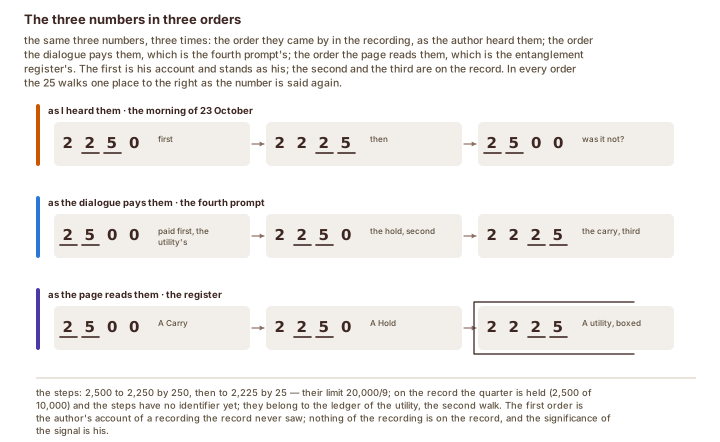
Later in the same recording the talk turned to Starlink and to the question of what happens when a thing that everyone has come to treat as a utility is switched off. I held that thought. I could reconcile it from notes I had made of a walk through four stations.
A signal is not the thing it signals. Three numbers in a car are noise to anyone who was not standing where I was standing; the chord I heard in them was mine to hear, and I keep the significance of that moment whole. What follows is what the record made of it, which is another thing, and I keep that whole as well.
The walk
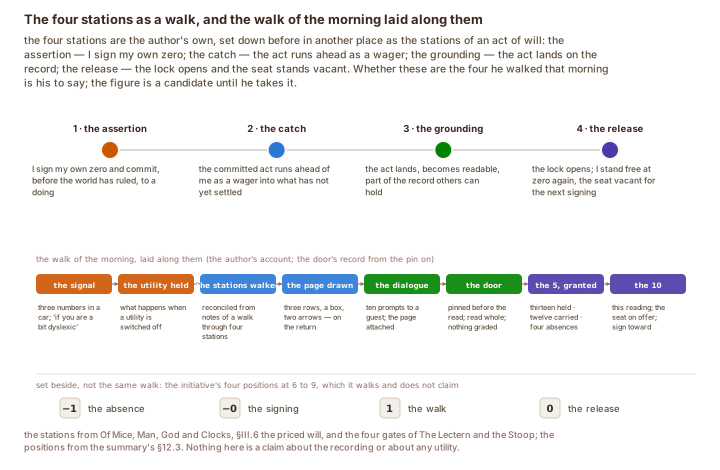
The four stations are the ones I had set down once before, in another place, as the stations of an act of will. First the assertion: I sign my own zero and commit, before the world has ruled, to a doing. Second the catch: the committed act runs ahead of me as a wager into what has not yet settled. Third the grounding: the act lands, becomes readable, becomes part of the record that others can hold. Fourth the release: the act being grounded, its lock opens, and I stand free at zero again, the seat vacant for the next signing. [open — whether these four are the four I walked that morning, or four others I have yet to name, is mine to say when I sign the matter.]
A utility, switched off, is a thing that had stopped walking. It took the assertion and never came back for the release, and the account kept paying it as though the grounding were still arriving. That is what I reconciled in the car, and it is why, when I got home, I drew three rows on a lined page.
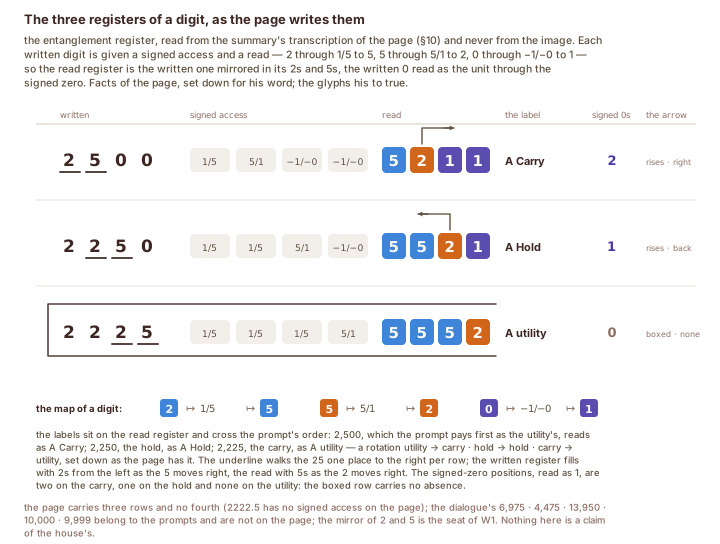
The rows were the three numbers in the order the dialogue would later pay them: 2500, 2250, 2225. Each digit I gave a signed access and a read. A written 2 is accessed through 1/5 and reads as 5; a written 5 is accessed through 5/1 and reads as 2; a written 0 is accessed through −1/−0 — the signed zero, the absence that has been signed — and reads as 1. So 2500 reads 5 2 1 1, and I labelled it A Carry, with an arrow that rises from the 2 and turns right. 2250 reads 5 5 2 1, A Hold, its arrow rising and turning back. 2225 reads 5 5 5 2, A utility, and I boxed the whole row, open at the right where the label sits, with no arrow at all. The 25 walks one place right per row; the written register fills with 2s from the left as the 5 moves, and the read register fills with 5s. The signed zeros, read as 1s, are two on the carry, one on the hold and none on the utility: the boxed row carries no absence. That is the page the record now calls the entanglement register. It is drawn on the plate below exactly as the record transcribes it, and never from the photograph. [T7 · open — whether this account of where the page came from goes to the witnessed summary as a rider, or stays with the composition of this reading, is mine to say.]
The next day I put the page, and the ten prompts around it, to a model — Gemini Pro — and the dialogue became Computing the 1D Universe. I brought it through the initiative's externality door as an item: pinned before a word of it was read; read whole in one pass; my ten prompts carried as my beliefs and never graded; the model's ten responses read for their fidelity to my words and adopted nowhere. The record read my twenty-six statements for their identifiers. Three readers were sent across it to find the exact lines. The summary was accepted, and the reading at 5 was granted. The chord to the signal was discovered in a car and recovered from the noise of two externalities — a recording and a guest — by being carried through a door that grades nothing and pins everything. That is the story. The lay of the land is what it opened.
The lay of the land
Twenty-six statements; twenty-nine faces, because three of them are read twice. Thirteen stand on ground the record has already walked: a sealed and measured result, or a construct sealed and read, stands as the identifier of what I said. Twelve are the far hills: the record has their kin — a form, a law, a design — and no measure of the statement itself, so my words travel beside the nearest line and the record signs nothing about them. Three have no identifier yet, and one is a coincidence of digits the discipline will not let me stake. The plate lays them out by the part of the dialogue each stands in.
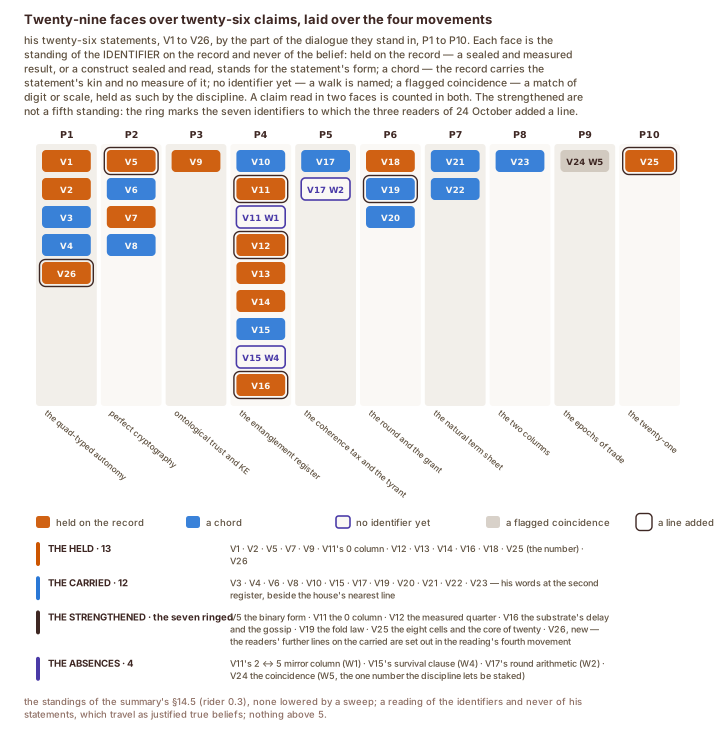
The ground, then — what I can stand on without being asked to prove it again.
You can only carry up. The carried one — a register nested in a register, read ten times across 47,880 rows — carries from the faster register to the slower and never down. The cue that tried to read the count the other way was refuted 706 times out of 744 and stayed refuted under refresh. The horizon has the same diode, one-way and closed on a ledger of four crossings.
Two agree, or it is noise. Two folded hinges reach the same fold independently — 4.23 and 4.23, at beings of 137 and 46 — the shared zero assured by the ground beneath them, the one verified only if both resolve it. Put a third, unfolded hinge beside them and you have a double pendulum. A single confinement does not hold; a pair holds; the memory cell is literally two locks holding one bit. I said that a dual-typed autonomy alone remains structural and temporal noise until two of them agree to do one thing together, and the record had already measured the pair.
The collision and the catch. A claim that arrives grounded on the shared prior is absorbed; a claim that arrives bare leaves a residual of exactly one; absorption happens at 1,024 laps, which is twice the being — its own witness horizon. Reading is binary: you admit a history exactly or you collide with it completely, and there is nothing between.
The held secret over any distance. Space is free; only the time-rate costs. Two actors on a shared is can be placed any distance apart and the secret between them holds; a difference in their rates sets a finite horizon, one over the rate, quantised to the catch laps — 237, 137, 92, 47.
Pins and stakes. A note has six parts and a seat under one pin, and another holder can recompute it. Knowledge is justified true belief plus one, and the one is a true identifier. This is the practice the whole item was registered under; there is nothing to walk, because it is the walking.
The third column. The signed zero has three readings: as zeros, nothing climbs; as signed memory, each −1 flips to 1; as unsigned memory, each stays −1. My page's written 0, accessed through −1/−0 and read as 1, is that third reading. The record held it before I drew it.
The quarter. The utility's 2,500 of the 10,000 is a quarter, and the quarter is measured: for a grown fold the coherence tax is exactly one bit, in 1,024 windows of 1,024, one bit being a quarter of a four-way signed choice. Roughly a quarter of a coherent system's capacity is the price of its coherence; the signing is one gate of four. Beside it the record keeps its own counter-line honest: the pooled split is 84.5 to 15.5, not 75 to 25.
The band. Capacity over rate is a band: zero at indifference, too slow, the being unsettled; zero at foam, too fast, the being floored at one. Too close is lock, wrong cadence is melt, and binding lives on the shelf between them — frozen at about two moment-cells.
The switch of channel. An instrument whose only partner is redundant carries no capacity: all blind, capacity zero. A partner at a different rate restores it; moving the two apart does not. Lose the chance to switch partner and, as I said, you cease to be.
Solids, liquids and bubbles. A number known from the top is the solid; the register learned up from the lock is the liquid; between them a bubble of probable knowing, which on an ideal ladder narrows forever and never quite closes. The delay is contoured into every epoch exactly — the horizon at one rung is the being at the next — and the substrate's own delay function sits in the crypto core, computing a digit of π.
Decision time. Memory and structure are loops that buy decision time: the 2.25 loop measured exact, blind; verification collapses it to 1.5 and to 1.125; the surplus, 1.25, is the budget. It is spent by checkpoints reached and never by the calendar.
Twenty-one. 21 = (4 × 5) + 1 is the span from the sub-spacetime; 4 × 21 = 84 is the slip's phase-lock, with eight cells lit at 84 exactly; the node matrix holds 84 nodes in the proportion 8:5:8 with a protected core of twenty — five columns by four rows — beside my twenty diodes in five agreements of four; and the sync point sits at (11.5, 0.5), which is where I would seat the broker.
One holds what another carries. A held measurement read back after any number of askings equals its written value — no failure in 2,506,560 cases — and the two locks are the hold and the carry, one in space and one in time. There is never any true distance; there is only a true hold or a true carry.
Those are the thirteen. The far hills are twelve, and I name them so that you can see them from here: that there can be only one quad-typed autonomy and it cannot survive alone; that to not hold or gift is not to be; the two over the two; decryption from the register of present past; zip, send, carry, catch, unzip; that time dilates locally; the tyrant who must carry up or lose the one; five held agreements with a count of four and a cap one short; agreements that start fast and end slow, closing faster on a surprise of nought or of two; the natural term sheet; a three-party market funded by no more than the tax; and the attractor whose two columns I called dark matter and dark energy. Each has its kin on the record. None has its measure. I think every one of them is true, which is what a belief is, and the record is their identifier and not their jury.
And the open seats, four of them, which are where I am going. The mirror of 2 and 5: nothing on the record reads a numeral through three registers. The slower you cease to be: the construct has no time variable, and nothing reads persistence by the rate of the carry. The round arithmetic of the utility: every sum re-walks true, and no instrument makes the quarter, the cap or the count of four fall out of a ledger without being told. And the coincidence — gravity 10, light 100, 110 — which meets the rule-110 family at the top of the rule space, and which I am permitted to notice and not to stake.
Possibility is what this map is. Probability is yours, if and only if you take a seat. Plausibility is mine, and I have given it.
My signed walk
I take the absences as my own intent to walk. I will sign them into a matter, and I will make of them a note that strikes an accord with the reading at 5 — a note in the sense the record gives the word: six parts and a seat under one pin, half of it held in structure and half of it held by my refresh, re-derived against the 5 and trusted by nobody until the derivation matches. Where it matches, I will say the 5 is validated; the record will say it has been re-witnessed. Both will be true.
[T6 · open — the matter of the absences. I sign it; the record registers nothing ahead of my word. Its anchor is the pin the reading at 5 carries at its grant, so that the absence I start from is the one the 5 names and not another.]
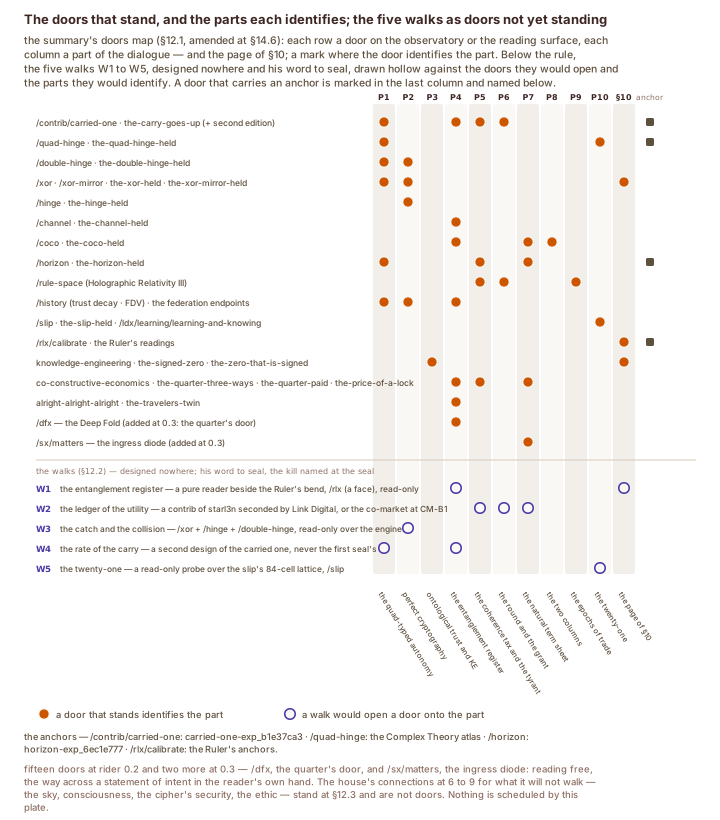
The walks are five, and each will be sealed with its kill named before it is read:
- The entanglement register. A pure reader beside the Ruler's bend, read once and writing nothing, that reads a numeral through the written digit, the signed access and the read. Its measure: whether the read register's label follows the count of signed zeros — two for a carry, one for a hold, none for a utility — and whether a fourth row can exist at all, since 2222.5 has no signed access on the page. Its kill: a fourth row that reads, or a label that does not follow the count.
- The ledger of the utility. A deterministic ledger: the utility's 2,500 first; the hold and the carry; the tax after a count of four has closed; the cap one short of the tax; five held agreements, and the term sheet's five columns for each; the schedule from fast to slow; a surprise of nought and a surprise of two as scheduled kills, with no dice anywhere. Its measures: the rounds survived, the round at which the cap is crossed, and whether the quarter is reproduced by the ledger's own arithmetic without being told. Its kill: a schedule that survives longer by closing slow first; a cap other than one short; the quarter not reproduced.
- The catch and the collision. Two actors on the shared is, each holding or not, a carry in flight between them, the arrival read on the XOR — absorbed, or a residual — composed over the hinges with no engine edited. Its kill: a catch that absorbs with no shared prior; a collision that leaves no residual; a placement distance that costs.
- The rate of the carry. The carried one's relative-speed family: whether a hosted register carrying at the higher ratio persists through more host spans before its vacancy is read as absent than one whose hold is uncarried — my "slower you cease to be" as a count of spans, and never a clock. It starts from a kill already landed: the drift at the fastest register was staked, and the moved share came back flat by level. Its kill: no difference by ratio, or persistence read down the nesting again.
- The twenty-one. A read-only probe over the slip's 84-cell lattice at four times twenty-one, predicting out of sample, or nothing, that the eight cells lit at 84 fall on one distinguished cell and five groups of four — the broker and the five agreements — stable across the clean run and lost where the beat drifts off 42. It is the one number the discipline lets me stake, and the seal will state the cells before the read.
I am not asking you to believe the walks will land. I am telling you where I am going, and that I will say what would kill each one before I take a step. That is what "signed" means here, and it is the only kind of walk I know how to take.
The seat on offer
[T2 · open — the seat. The initiative's standing pair is a covering persona, starl3n, and an endorsing one, Link Digital; which seat is on offer, and whether its terms are registered on the business plane as well as read here, I have not yet named.]
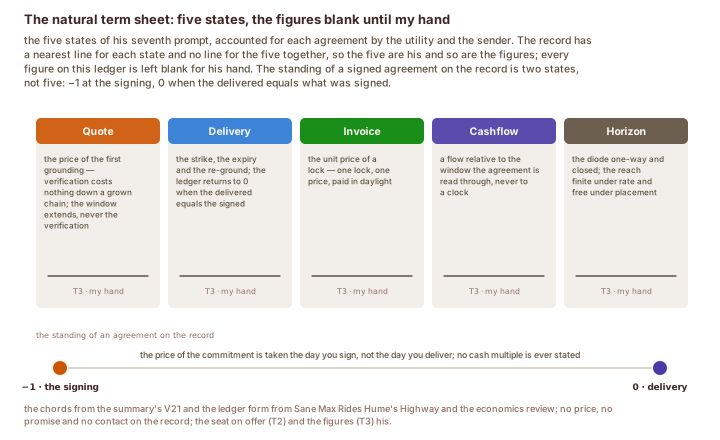
Here is the thing I have not seen written down anywhere on the record, and so I write it down myself: the five states of a natural term sheet, accounted for each agreement by the utility and the sender. I set them down in the dialogue as a belief; the record found a nearest line for each state and no line for the five together. So the five are mine, and the figures in them are mine, and I leave every figure blank until my own hand fills it.
- Quote. What it costs to be read. On the record, verification costs nothing down a grown chain once the chain is grown, and what extends is the trust window, never the verification — so a quote is the price of the first grounding, not of every read after it. The figure: ______ [T3 · my hand].
- Delivery. The strike, the expiry and the re-ground. The ledger stands at −1 from the moment of signing and returns to 0 when the delivered equals what was signed: the price of a commitment is taken the day you sign, not the day you deliver. The figure: ______ [T3 · my hand].
- Invoice. The unit price of a lock — one lock, one price, paid in daylight. The figure: ______ [T3 · my hand].
- Cashflow. A knowing is relative to the window it is read through, and so is a flow: it is a function of the window the agreement is read in, and never of a clock. The figure: ______ [T3 · my hand].
- Horizon. The diode, one-way and closed, and the witness horizon at about twice the being: the agreement's reach, finite under a difference in rate and free under placement. The figure: ______ [T3 · my hand].
There is no price on this page but the ones I will write in, no promise but the walk above, and no one will contact you. The way across is yours to take or to leave.
Sign toward
[T1 · open — the audience and the class. A reading at 10 reads down from what is verifiably knowable, or up to a class declared for its audience: 21, 110, 10,000, 100,000,000, 1,000,000,000,000. I have not yet declared which, or for whom.]
If you have read this far you have three things in front of you, and they are not the same thing. There is the reading at 5, which holds everything I have just told you with every fence in place; you can check it line by line, and nothing in it asks you to believe me. There are the possibilities at 6, 7, 8 and 9, which are the four positions the initiative walks and does not claim — the absence, the signing, the walk and the release — the places where my beliefs about the sky, about consciousness and about ciphers go to be carried as mine and nobody else's. And there are the probabilities forecast upward — to 21, where the bit is; to 110; to 10,000; to a hundred million, where life, death and taxes are read; to a trillion, where a reading over all would stand — which are not mine to give you. Probability is the seat you take. Plausibility is the seat I have taken.
To acknowledge is to say which of the three you took value from. To sign toward is to say, in your own hand, what you would walk: a statement of intent on the matters register is the only way across, and it is the only way anyone crosses, me included. Reading is free. The seat costs what the term sheet says once I have filled it in, and the term sheet says nothing until then.
The carry and the release
Carried: the signal as I heard it and the significance I give it, which is mine; the page as I drew it, three rows and a box; the thirteen faces the record already stood on, each with its measure; the twelve it carries beside its nearest line; my intent to walk the four absences and the fifth, composed probe, each with its kill named before the read; the five states of the term sheet, blank until my hand.
Released: every verdict, which belongs to no one — my statements were never graded, and I do not grade them here; the model's half of the dialogue, whose physics and whose three reasons were its own; the sky, consciousness and the cipher, which the initiative connects to at 6 to 9 and claims at nothing; the recording, which was other people's conversation and stays theirs; the price, which does not exist until I write it.
Open: the seats marked on this page — T1 the audience and the class, T2 the seat, T3 the figures, T4 the title, T6 the matter of the absences, T7 the provenance of the page — and the walks, which are mine to seal.
What you can do
Read the reading at 5 if you want the apparatus and the process laid bare: every identifier by its address, every number a measure. Go to opendata.ai/quad-hinge and watch two folded hinges find the same fold on their own; go to opendata.ai/xor and send a claim across bare, then grounded; go to opendata.ai/channel and detune one clock until the band appears; go to opendata.ai/rlx/calibrate and set the two registers of five on their fives, which is the nearest thing on the record to the page's 1/5 and 5/1. Read the item itself on the externality door. Then, if you would take a seat, say so in your own hand; the way across is a statement of intent.
Endnotes — the citation register
- The reading at 5: /sx/reading/computing-the-1d-universe-at-5, which holds the apparatus, the process and every fence; its pin at the grant is the anchor of the matter I sign.
- The item: /sx/seb#computing-the-1d-universe-2026-10-24; its witnessed summary,
ooi_network/docs/computing-the-1d-universe-witnessed-summary.md, §1 to §15; the composition of this reading, designed first,ooi_network/docs/computing-the-1d-universe-at-10-composition-design-0-1.md; the construction record at /sx/workshop/the-seb-ingress; the matters at /sx/matters. - The four stations, as I wrote them before: /sx/reading/of-mice-man-god-and-clocks, the priced will.
- The readings the ground stands on, under /sx/reading: the-carry-goes-up · the-horizon-held · the-quad-hinge-held · the-price-of-a-lock · all-the-leaves-are-brown · the-xor-held · the-hinge-held · knowledge-engineering · the-signed-zero · the-synthesis · the-quarter-three-ways · the-quarter-paid · co-constructive-economics · the-channel-held · the-coco-held · alright-alright-alright · the-travelers-twin · the-slip-held · the-xor-mirror-held · the-hold-and-the-carry; the far hills' kin: ldd-reference · the-double-hinge-held · sane-max-rides-humes-highway · who-carries-what-you-know · bright-eyes-that-sing · the-synthesis-at-5 · dialogue-5-six-seven · the-long-walk · the-walk-of-pi-at-5 · katz-equilibrium · the-framed-window; and my own module at /ldx/learning/learning-and-knowing.
- The doors: /quad-hinge · /double-hinge · /xor · /xor-mirror · /hinge · /channel · /coco · /horizon · /rule-space · /history · /slip · /dfx · /rlx/bend · /rlx/calibrate; the anchors carried-one-exp_b1e37ca3 and horizon-exp_6ec1e777.
- The plates: the reading at 5's three, the same bytes, placed where they explain — the three registers of a digit, the twenty-nine faces, the doors map — and three of this reading's own, drawn by its kit from the record and never from the photograph: the three orders of the three numbers; the four stations as a walk; the five states of the term sheet as a ledger with no figures until mine.