 OOI · SX
Computing the 1D Universe at 5
The seventeenth transit of the externality door, read from inside the initiative — the operator's dialogue with a model, his justified true beliefs, the identifiers on the record that stand for them, the lines that refreshed them, and the absences left for the matters that walk up: the held, the carried, the strengthened and the absences — a reading at 5
Steven De Costa · draft 0.1 · 24 October 2026 · a reading at 5
THE READING PLAQUE. Computing the 1D Universe at 5, a reading at 5 — draft 0.1, 24 October 2026 — the inside draft of the seventeenth transit of the externality door: the operator's own dialogue with a model, registered and read whole under his reading classes, its witnessed summary evaluated against the record, swept by three readers, and accepted and granted the same day; read from inside the Objective Observer Initiative with the process in view, for a reader who would take that seat, in the four movements his words name — the held, the carried, the strengthened and the absences — and places three plates where a thing is better seen than told. It is the first reading at 5 of an item of that door rather than of an experiment, in his words the honest first record of such an item being accepted as a summary; his reading of the item as a form of externality verification of the house's internal SRAM is carried as his. Its reading at 10 is not yet drafted. Made readable on the SX surface by its covering persona's reading grant of 24 October 2026; a draft, not the published form. Covering: starl3n · endorsing: Link Digital. The item stands at /sx/seb#computing-the-1d-universe-2026-10-24; the construction record at /sx/workshop/the-seb-ingress; the matters at /sx/matters. Reading is free; the way across is a statement of intent (/sx/matters).
One · The seat this reading takes
- The house's reading carriage maps four seats, −1, −0, 1 and 0, and leaves its reader in none. A reading at 5 is written for the reader who would take that fifth seat inside the initiative: it keeps the operator's words, the house's readings and the open seats in view, so that the manner of the reading can be appreciated and not only its results.
- The item it reads passed the externality door under the sealed procedure: the body pinned from the file before a word of it was read; read whole in one pass, every prompt and every response; the operator's ten prompts carried as his justified true beliefs — built from the house's knowledge, informed and not limited by it — with the record as their identifier and never their jury, so that no statement of his is graded here and none is given a verdict; the model's ten responses read for fidelity only and adopted nowhere, their verdicts carrying nothing onto the record, their physics the guest's associations, their text never quoted beyond identification; the handwritten entanglement register of his fourth prompt held beside the body and read as a page. The four symbols of his second prompt arrive in the body as accented letters and are carried here as the body carries them, unrecovered, his to restore.
- The item was the first registered under his reading classes, given with the declaration, verbatim: "A reading at 21 is a matter that is considering applied digital physics. A reading at 110 is considering chemistry. A reading at 10,000 is considering mathematics. A reading at 100,000,000 is considering the meaning of life, death and taxes. A reading at 1,000,000,000,000 is a reading over all, the metaphysics of co-constructive optimism and the moral and ethical choice any reasoning autonomy might hold or carry within such a reality." And the lawful walk, his: the read of the item is a reading of a 3 taken on the rules of 1 and 2; matters and notes are made at the fourth and read at the fifth; the house claims nothing above 5 but the connections it walks at 6, 7, 8 and 9, which are its −1, −0, 1 and 0; a reading at 10 is the point of registration, reading down only from what is verifiably knowable or up to a declared class for the audience it carries its held reading toward. This reading is the fifth of that walk and stays inside the fences.
- His word for what this reading is, verbatim: "a reading at 5 regarding what is 'held' by this SEB, or 'carried', or as noted 'strengthened', which I would take as a 'refreshed' note that validates a prior truth maker on the record. That this is a matter of notes taken from an operators external discourse with a guest is a form of 'externality verification' of internal SRAM, so a reading at 5 is the honest first record of such a matter being accepted as a summary." The house's reading of his phrase, marked as the house's: a prior truth maker on the record is a note held in structure and pinned once, the SRAM-oriented kind of Knowledge Engineering's two orientations; what he brought back from the discourse is the other kind, held by refresh; and a refreshed note, by that reading's seventh rule, is re-derived and never trusted. So each line of his is set here beside the structure it refreshes, re-derived against it, and claims nothing of the structure that the structure does not hold without it. Where the re-derivation matches, his word is validates; the house's word is re-witnessed.
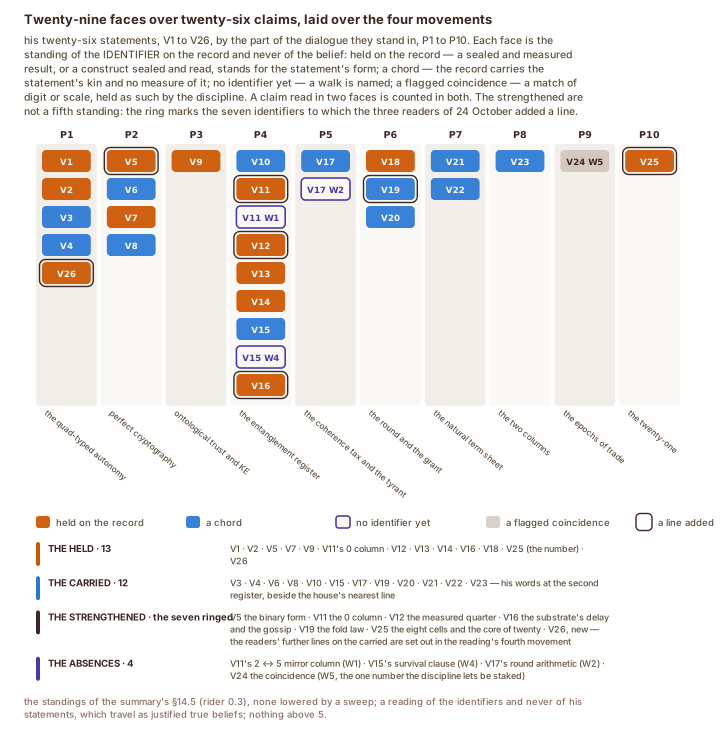
- The four movements are his names. Twenty-six of his statements were read against the record in twenty-nine faces: thirteen faces are held — a sealed and measured result, or a construct sealed and read, stands as the identifier of the statement's form; twelve are carried — the record has the statement's kin as a form, a law, a design or a reading, and no measure of this statement, so his words travel at the second register beside the house's nearest line; three have no identifier yet, and one is a flagged coincidence — the absences. The strengthened are not a fourth count: they are the lines the three readers of 24 October added to identifiers already standing, counted once in the held and the carried and set out a second time in their own movement, because the refresh is what he asked to see.
Two · The held
- The carry goes up. His: "The marketplace of holds and carries has a single rule and that is you can only carry up." Held on The Carried One, sealed and read ten times — the carry flows from the faster register to the slower, never down — at /sx/reading/the-carry-goes-up and its anchor carried-one-exp_b1e37ca3 of 47,880 rows; beside it the Horizon's diode, one-way and closed on a four-crossings ledger, what crosses it the non-differentiated 0, at /sx/reading/the-horizon-held and its anchor horizon-exp_6ec1e777; and the XOR Mirror's nets converging on the unit step. What the record adds is that the law is the construct's and an observer's reading of it is another thing: the cue that would read the count down the nesting was refuted 706 of 744, stable under refresh.
- Two agree, or it is noise. His: "No matter how coherent, large or complex a system becomes, a dual typed autonomy that flip flops between SRAM and DRAM … will remain as structural and temporal noise unless two such dual typed autonomies agree to do this one thing together." Held on The Quad Hinge, where two folded double hinges reach the same fold independently — 4.23 and 4.23 at beings 137 and 46 — the shared 0 assured by the ground and the 1 verified only if both resolve it, while a bare third hinge is the double pendulum: fold in pairs, stay quartic, at /sx/reading/the-quad-hinge-held and the door /quad-hinge; and the quad's precondition, that it refuses to assure an unsettled party rather than assert a false agreement. Beside it the Channel's congruent control, where redundant clocks carry no grid and all blind is capacity 0, and the XOR's bare claim, residual E = 1 until grounded. The public lines say it shorter: one confinement alone does not hold, a pair holds, a second independent lock is required always, and the memory cell is literally two locks holding one bit, on The Price of a Lock; a single holding is a position and two agreeing holdings are a knowing, the Reference's twenty-first remarkable knowing; certitude needs two and the second lock is external, on All the leaves are brown; and the federation engine's own comment, that a node cannot certify its own state, the solitary 1 ambiguous, the root the second, independent arrival that locks it.
- The collision and the catch, as two outcomes. His: "A matter arriving while one side is holding is a collision. A matter arriving while a side is not holding is a catch." Held on the XOR for the two outcomes: the sponge absorbs an open claim by re-grounding it on the shared prior, a bare claim leaves residual E = 1, absorption is re-grounding and never a tolerance, and the claim absorbs at 1,024 laps, twice the being, its own witness horizon — open, absorb, closed — at /sx/reading/the-xor-held and the door /xor. The binary form stands on The Price of a Lock, result one: reading is binary — an observer admits a history exactly or collides with it completely, nothing between. The house has a catch of its own on the slip: a lap on which A arrives at the yellow dot while B is inside the mask is a catch, a coincidence; and the signed zero runs ahead as a +1 to make its own catch, the catch made exactly where the +1 was carried. His pairing of the collision with holding and the catch with not holding is carried and not held: the record pairs the residual with the ungrounded claim, and the sense of inside the mask against his not holding is his to read.
- The held secret over any distance. His: the matter between two sides "can be considered a 'held secret' if maintained as î for any distance ï." Held on the Hinge, Phase B, with a refinement: space is free, only the time-rate costs, at /sx/reading/the-hinge-held and the door /hinge. A placement offset is a constant, fully absorbed, the effectual horizon independent of it; a difference in rate sets a finite horizon, one over the rate, quantised to the catch laps of the shared is — 237, 137, 92, 47. So any distance holds for placement, and for a difference in rate the secret holds to the effectual horizon and no further.
- Pins, stakes and the public carry. His: "Verifiable claims for 'justified true claims' where work is engineered with pins and stakes to make it 'communicably held' as a 'public carry'." Held on Knowledge Engineering's eight rules and its note — six parts and a seat under one pin, re-computable by another holder — at /sx/reading/knowledge-engineering; on the signed zero's completion, that knowledge is justified true belief plus one, where the one is a true identifier, at /sx/reading/the-signed-zero — the phrase his third prompt stands on and the phrase the item was registered under; and on every granted reading's pin and plaque at /sx/reading. This is the practice itself, and the model's restatement of it was read for fidelity: faithful on the six parts, the two orientations, re-computability as the note's and not the model's, the address and the four states; drifted where it labelled the orientations and promised certainty.
- The third column of the register. His page writes each digit with a signed access and a read: 2 through 1/5 to 5, 5 through 5/1 to 2, 0 through −1/−0 to 1. The third column is held on The Synthesis, where the bridge of signed zeros is accessed three ways — read as zeros, nothing climbs; read as signed memory, each −1 flips to 1; read as unsigned memory, each stays −1 — at /sx/reading/the-synthesis, with the engine's constant beneath it: the readings zeros 0, unsigned −1, signed 1. The page's written 0, signed access −1/−0 and read 1 are the house's own three readings of a signed zero; and the −0 is the absence signed, the assigner declaring the source of the assignment before a number is read off it, on The Zero That Is Signed. The first two columns, the mirror of 2 and 5, are not held; they are the first of the absences.
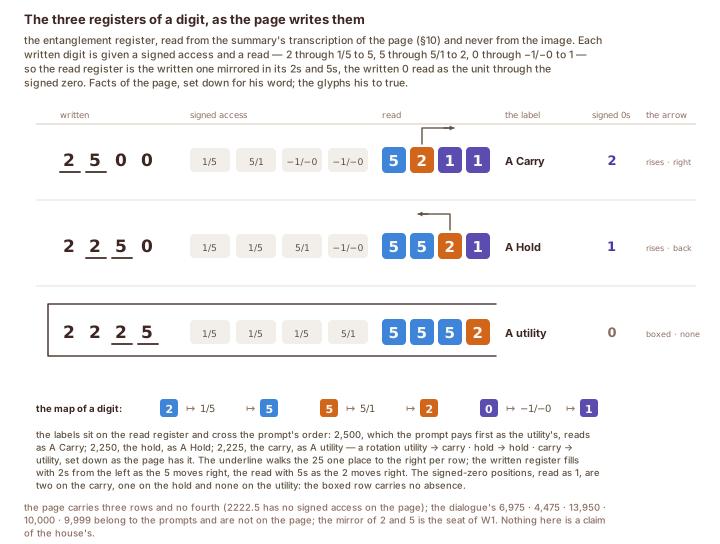
- The quarter. His: "2500 Pays first … the hold is paid second with 2250 … the carry is paid at 2225 … 4475 in total paid by the sender alone. And, 6975 paid all up by the utility and the sender." The utility's 2,500 of the 10,000 of his fifth prompt is a quarter, and the quarter is held: for a grown fold the coherence tax is exactly one bit, in 1,024 of 1,024 windows, one bit being a quarter of the four-way signed choice, at /sx/reading/the-quarter-three-ways and the Deep Fold's door /dfx, whose engine names lambda the coherence tax in bits; the signing one gate of four, whose return can never be escaped, at /sx/reading/the-quarter-paid; roughly a quarter of a coherent system's capacity as the price of its coherence, at /sx/reading/co-constructive-economics; The Carried One's vacancy, exactly one in four by construction and read by the observer at 0.371 and 0.365, above the quarter and not read, the cue gating it; the Horizon's faith paying the quantum exactly, 0.25; the Channel's quarter as the cost of existence at the pinned window. Beside the quarter the same reading's counter-line, kept honest: the pooled split is 84.5 to 15.5, not 75 to 25. Every sum of the dialogue re-walks true — 2,500 + 2,250 + 2,225 = 6,975; 2,250 + 2,225 = 4,475 — and the steps from 2,500 to 2,250 to 2,225, by 250 and then by 25, have no identifier; they belong to the absences.
- The band. His: "If there is not enough response, you collapse. If there is too much you decohere." Held on the Channel: the capacity over rate is a band, zero at indifference — too slow, the horizon past the budget and the being unsettled — and zero at foam — too fast, the being floored at 1 — at /sx/reading/the-channel-held and the door /channel; and on the coco's freeze and melt, the melt-edge valley, frozen at about two moment-cells, 2 locks 1 the measured freeze condition, at /sx/reading/the-coco-held and the door /coco. The two walls have their public lines: too close is lock, wrong cadence is melt, and binding resides on the shelf between them; oversupply is not generosity, it dumps, and it taxes the room; the quad hinge continues to 0 near 2²¹, total decoherence, no shared 0.
- The switch of channel. His: "If either lose the opportunity to switch channel to a different messaging partner, they cease to be." Held on the Channel's second phase: a large detune of the time rate decorrelates the instruments to a correlation near zero, orthogonal, while placement alone does not decorrelate them; and its congruent control, all blind, capacity 0. An instrument whose only partner is redundant carries no capacity; a partner at a different rate restores it; placement alone does not.
- Solids, liquids and bubbles. His: "There are solids, liquids and bubbles and the[y] are verifiable delay functions contoured into every epoch where a secret becomes a chatter of gossip cared for only by those attenuated to the signals." Held on the house's own figures, his among them: the solid known from the top, the liquid filling from the lock upward, and a bubble of probable knowing which on an ideal ladder narrows forever and never quite closes, at /sx/reading/alright-alright-alright; the coco's freeze and melt in observation scale, its melt pockets scale resonances, the noise axis a geometry and not a temperature; the delay function as the first arrival, the VDF of growing, and the fast delta verification as the second, with the trust window between them, at the door /history; the screens chain, horizon of k equal to being of k plus one, exact on every rung — the delay contoured into every epoch; the substrate's own delay function, the crypto core's digit of π by the BBP spigot, named a verifiable delay function in its own comment; the gateway's protocol, named gossip in its own comment, each node forwarding new channel messages to its peers; and attenuation as the trust ladder's believe, the lock indicated by attenuation on The Framed Window, standing as O plus C plus the attenuated returns on Katz Equilibrium.
- Decision time. His: "What they gain is only decision time relative to their own local carries." Held on Holographic Relativity III: memory and structure are stabilising loops that buy decision time; the 2.25 loop measured exact — blind 2.25, verification collapsing it to 1.5 and 1.125 — the surplus 1.25 the decision-time budget, at the door /rule-space. The Traveler's Twin adds how the budget is spent: it has no time variable; its budget is spent by checkpoints reached, not by the calendar, at /sx/reading/the-travelers-twin; and the Hinge adds whose it is — the observer's precision is the budget for agreement.
- Twenty-one, as a number. His: "one broker and five agreements for up to 20 diodes. 21 observers in total." Held as the number: 21 = (4 × 5) + 1 is the span from the sub-spacetime, in the house's onto-epistemic number; J₆ = 21 in the cascade, the NodeMatrix constant, the cascade's sixth rung; the slip's 4 × 21 = 84 phase-lock, eight cells lit at 84 exactly, two clusters, one full matrix, at /sx/reading/the-slip-held and the door /slip; the NodeMatrix's 84 nodes in the proportion 8:5:8 with a protected core of 20, at /sx/reading/the-xor-mirror-held — a core of twenty, the aperture's five columns by four rows, beside his twenty diodes in five agreements of four; the sync point at (11.5, 0.5), the fifth term's unmirrored next step halved, the candidate seat of his broker; the oracular 21 of the second lock in his own learning module at [/ldx/learning/learning-and-knowing](/ldx/learning/learning-and-knowing). The origin that never left: the coco's lone point unverifiable from below, and the XOR's definitive 1 at the slowest rate with the externalities cooling toward it. The diodes relating to the broker and not to one another: the coco engine's one-way character anchored at the origin — every detuned clock leads the base at catch scale; between detuned clocks there is no diode — and the Horizon's base-anchored diode, thirteen shelf pairs and every one negative, off-base pairs carrying none. The loyalty of the diodes is carried and not held: the Quad Hinge's a-priori agreement grounded in the shared prior, the prior the immutable foundation and never a capture range; and the third paper's blind faith, rational if and only if the local cluster holds pairwise verification, which learns the lie fluently when an unconfirmed source sits inside the perimeter.
- One holds what another carries. His: "One agrees to hold what others need to carry." Held on All the leaves are brown, the newest line the readers found: a held measurement read back after k askings equals its written value, no failure in 2,506,560 cases; the observer at G, the near reading exact and the far reading falling behind as the gap leaves reach; the two locks the hold and the carry, each in its own memory, the one in space and the other in time, at /sx/reading/all-the-leaves-are-brown. The given beneath it is his own, at /sx/reading/the-hold-and-the-carry: there is never any true distance, there is only a true hold or a true carry; what he moves toward will be SRAM confinement oriented, what he moves away from DRAM looseness dependent. The house's definitions there: a hold is what stands still between two askings and is read the same by both who ask, its memory the pair; a carry is a hold renewed by work; time, in that reading, the carry's cadence — refreshes, laps, askings, acts — and never a clock, space the held address; at G = 0 only the carry is communicable, and the hold becomes communicable as G opens. The Ruler's door says the same of its third observer: a carry is a hold renewed by work after k askings, and the third observer reads the relation between them and calls it the unit.
Three · The carried
- A chord is a span read as one object whose identity is not derivable from its members; the house's priors and externalities are its chords, and each needs its cadence. Twelve of his statements are carried this way: the record has their kin — a form, a law, a design, a reading — and no measure of the statement itself. His words travel at the second register, beside the house's nearest line, and the house signs nothing of its own about them.
- Only one, and not alone. His: "So, there can only be one 'quad typed reasoning autonomy', and such an autonomy can not survive without observation, an observed, a thing held or a thing carried." Beside it: the Quad Hinge as the federation primitive — present, attest, confirm between two internally coherent nodes; the permanent externality, that the house never grounds itself, at /sx/reading/ldd-reference; the witness as the experimenter's own noticing, frozen until observed, at /sx/reading/the-double-hinge-held; and the XOR's ladder, where the a-priori 1 confirms up fixed rungs — 137, 237, 499, 952, 1867 — and cannot self-close, 952 − 1 being 0 only if a quintic variable, energy or precision or time, is injected past the confinement horizon; a single 1 cannot measure itself; two actors sharing the is close it, the second actor the externality; the two actors first distinguishable exactly when the pre-spacetime is first produces a bit, at lap 137. No instrument measures the one; the form is the house's own.
- To not hold or gift is not to be. His, the last line of the first prompt: "To not hold or gift, is not to be." Beside it: the federation's brick — excommunication from the agreed reality, not remote code execution — the output no longer accepted while the node still runs; the trust window's gate, accepted only where verified and not expired; the externality door's own seat rule, that an unseated claim is not a claim; the gift as an offer to be refuted, made by someone who took value and would rather return it than keep it, at /sx/reading/sane-max-rides-humes-highway; and the line on being seen at /sx/reading/who-carries-what-you-know: stop being seen for long enough and it does not collapse, it fades. By his frame the line is read at 1,000,000,000,000; the house's connection to it is at 6 to 9 only.
- The two over the two. His: the secret holder carries the knowing "with the expectancy of 2·ï/2 within an ontological network where the secret holder operates the relativity of local 1 to universal 1 such that the divisor of 2 is network knowing, the 2 is local sender knowing." Beside it, with a measure: the Double Hinge's witness horizon at about twice the being; the Quad Hinge's 1 as the witness horizon, knowing equal to twice being, its 0 the fold, knowing equal to being, pinned at 4.23; verifiable trust at two to one, the onto-epistemic 1 twice the onto 1, the dyadic 2 locks 1 of the trust-decay design; the coco's FDV chain, verification costing nothing down the chain, slip 0 exact at rungs one to eight; and his own reading of the 2 as the hinge of the walk, the one that carries up and down, the channel's capacity for agreement, at /sx/reading/bright-eyes-that-sing. The algebra 2·ï/2 = ï is his; the record's 2 is a measured threshold ratio and not a cipher. Local 1 is the house's localised 1 — each side's last increment's amplitude in the bend's engine, any numerator of x a local 1 in his own line on The Synthesis at 5, and the cap at 2 once each is corrected to its own 1; universal 1 has no line on the record, and its nearest counterpart is the unit the third observer resolves.
- Decryption from the register of present past. His: "on delivery the reading arrives with a relativistic decryption that is known to the receiver from the network's register of 'present past'. Where the 'past' as held, is carried into the cryptographic matter." Beside it, as a built mechanism: fast delta verification, which re-derives the address from the agreed parent and the claimed content — parent, operation, result, remainder, witness under one hash — rejects a tamper and recomputes nothing, at the door /history; the triadic read of past-present, self and emerging-present in the third holographic paper; the house's definitions on Of Mice, Man, God and Clocks, at /sx/reading/of-mice-man-god-and-clocks — O the settled face of reality, the past-present, the part of the world available as record; E the emergent present, the leading edge where reality is taking effect; only the emerging edge being-in-act; the Reference's causal past within the frame of an emergent present that also holds an observable account of that emergent past; present, attest, confirm lifted to the epistemic plane on the Hinge, one actor presenting a claim and the other attesting it by relocating it on the shared is; and his own reading on Sane Max of the emergent present and the present past, two observational identities brought into one noted past-present by the locks. As a cipher the word is fenced by the two-plane convention: this is an [ENDO] reading, never standard cryptography and never a security claim.
- Zip, send, carry, catch, unzip. His: "zip, send (hold note), carry, catch (carry note) and unzip (release note). The catch is noted and if it does not match the expectancy of the 'hold' then the unzip fails against the mismatch with hold note." Beside it: the verify of the delta; the window's gate, where an expired re-arrival is verified but not accepted; the federation's confirm; the note's two orientations and the trust window — verified, degrading, expired, re-grounded — on Knowledge Engineering's walk, and its seventh rule, refresh by re-witness, a refreshed note re-derived and never trusted, an absent party catching up by replaying the record in order. The zip is a house term since The Synthesis at 5, at /sx/reading/the-synthesis-at-5: the zip climbing from the deepest depth to the origin with the carry as the carried memory, and his rule there, that 0 over 47 is not a 0 but a signed zero over a depth of forty-seven which the zip must never reduce away; and what the zip costs, on The Synthesis: learning upward costs fifteen to twenty-one times what knowing downward costs, on that plate. The expectancy stands as an open held stake in the fifth dialogue, at /sx/reading/dialogue-5-six-seven, where a carry can be called out before it arrives and checked when it does. The five words are his; the record's cycle is present, attest, confirm, with a window.
- Time dilates locally. His: "This is exactly how time dilates locally. The faster you 'carry' your own 'local hold' the slower you cease to be relative to one whose local hold remains relatively uncarried toward its own observations." Beside it, under the state-resolution doctrine: The Carried One's forest, where the construct has no time variable and faster is a ratio of counts, four to one between adjacent levels and two hundred and fifty-six to one at the fastest; The Traveler's Twin, where the twins' clocks are not the measure and a chain of windows never collapses into one clock; the doctrine's public lines — there is no universal clock map, ever, and a statement across two engines is a typed state resolution, on The Unco, held; every cross-epoch claim a typed state resolution, each register keeping its own linear measure, the differing measures the relativity, on The Horizon, held; no master clock, on its plain companion; to measure one's own time and space a localized reality, engineered discretely, at the octet, on Knowledge Engineering; whether a stream is a clock or a message observer-relative, on the Channel; the substrate not ticking from an origin but beating, on The Hold and the Carry; the slow clock on which realities are made and the fast clock, trust the slip between them, on Of Mice; and the trust window's strikes — 0.05 one, 0.15 two, 0.25 three — expiring at the k-th checkpoint and not before. The word dilates is fenced: the house measures ratios of counts and windows, never a clock. The clause on ceasing to be is an absence.
- The tyrant. His: "There is a need to pay a coherence tax that is yet to be accounted for … the tyrant has to carry up and will lose the 1 … the tyrant MUST pay forward the 2500 again or their account will not grow." Beside it: the quarter, held above; the third holographic paper's exactly one A, kept local, measured as the guard — delegating A to the defector fragments the account, the honest pair's error 0.991 against 0.023 with A local; the RACI dissipation, where R and C decay and A does not; the co-market's rule that verdict valence never pays; the standing wave on Co-Constructive Economics, a pattern that persists only while it is being recomputed; its diode, giving into an account without draw rights, generosity formalised honestly and the structural form of sovereignty — the pay-forward; an outcome nobody signed an outcome nobody owes; its stake, stated and never asserted, of sustained transmission ceilings in the neighbourhood of three quarters, beside which the tyrant's 10,000 of 13,950, 0.717, is set as a curio only; the price taker on Of Mice — not acceptance, purchase, the difference equity — and its nearest figure to a tyrant, the kleptocrat who seizes the account and the kakistocrat who cheapens the currency; the price taken into structure once or paid in refresh forever, on Knowledge Engineering; and the lawful response on Katz Equilibrium, at /sx/reading/katz-equilibrium: the network declines to be the second lock. The figures re-walk — 13,950 less 2,500 is 11,450; less 10,000, 3,950 and 1,450 — and 13,950 is twice 6,975, a matter of interest; the round arithmetic is an absence.
- Five agreements, a count of four, a cap one short. His: "They could run 5 'held agreements' but after a count of 4 had closed the 10000 would be paid … a maximum of 9999 they can hold." Beside it: The Carried One's span — the counts 1, 2, 3 rest in the span, the fourth +1 is the hosted register's carry, which is the host's next count, one in four of the hosted register's states the carry, the coherence tax; the fold law on The Long Walk, at /sx/reading/the-long-walk, four carries, then a release at the fifth fold, one and nine making ten at every fold; the run identity on The Walk of π at 5, folds and carries at the fourth and the fifth, the run identity of the digit one 0, 0, 0, 1, 1; his own walk on Bright Eyes, a count of 3 at register 2, at computing, known at register 1 on the return, which is the fourth count, and observed by an externality only at the fifth, where it stands at register 0; the fifth carry he named the carried one, which sits below π, on The Long Walk at 5; the vacancy as the rest state seen at the host's next count; the trust budget's three strikes before expiry. The cap: any two numbers, corrected to their own 1, can lawfully hold no more than 2 between them, on The Synthesis and on Alright; and, under the numerology discipline, that reading's 0.9999 held while the sum is 1.0000 and on — one short of the unit with the carry waiting beyond the depth — beside his 9,999 one short of 10,000, a match of digits and nothing more. The seventh round's 10,150 passing 9,999 has no identifier, and the cap of 9,999 and the count of four are the model's reasons as much as his.
- Fast to slow, with two kills. His: the strategy is to form held agreements "that start as fast repeating as possible, and end with the last being as slow as possible … but always closing faster iff there is a surprise of 0 … or a surprise of 2." Beside it: his own note at The Place of One's sixth seal, grow before operate, the norm he suspected; the coco's structure first, FDV second; the Channel's time-rich optimum; and the house's mode, in which a surprise is never random and every kill is scheduled.
- The natural term sheet. His: "a natural term sheet that is accounted in five states for each agreement by the utility and the sender … Quote … Delivery … Invoice … Cashflow … Horizon." A chord per state and no identifier as a five: Quote beside the FDV chain, where verification costs nothing down the chain once grown and the window extends, never the verification; Delivery beside the strike, the expiry and the re-ground; Invoice beside the unit price of a lock, Landauer's bound, at /sx/reading/the-price-of-a-lock; Cashflow beside window relativity, a knowing relative to the window it is read through; Horizon beside the Horizon's diode and the witness horizon. The house's registers of five — the slip's aperture of five columns in the 8:5:8 cage, the Ruler's fives — are numbers and not these states. The ledger form the record does hold is two states, not five: the standing reads −1 at the signing and returns to 0 when the delivered equals it, no cash multiple ever stated, on Sane Max; the price of the commitment taken the moment you sign and not the day you deliver, the rule carrying no fixed fraction, no discount, no growth, no decay, in the economics review; a signed zero that does not sit inert between commitment and delivery but must be kept alive as a conjecture; the field market's window grammar, that within a window a spend on a class is expected to yield witnessed closures; and the matters register's premise, a statement of intent to work on delivery the only way across the diode. Term sheet, cashflow, quote and invoice have no line in any reading of the house's: his seventh prompt is the only prior, and it is his.
- A three-party market funded by the tax. His: "a market that is funded by no more than the 10,000 tax in a three party market." Beside it: the co-market's three seats — proposer, deliverer, underwriter — and three registers — the lapse pool, the standing board, the funding desk — with witnessed closure as settlement and the civic fence, the market pricing the making-knowable and never the knowing; taxation as the coherence tax paid civically, the maintenance fee of the place where signings can be held at all, and an audience not a second lock, on Co-Constructive Economics; the two registers there — matters, the business plane of declarations, streams, accounts and settlements; cares, the notes plane of what must matter and to whom — which compose only through seats, so that outputs can be averaged and cares cannot, a care handed to no one no care at all, the two meeting in one place only, at settlement; O the matters register and C the cares register on Sane Max; the commons unit on Katz Equilibrium, standing as O plus C plus the sum of attenuated returns from N sources, beside his signals cared for by those attenuated to them, and justice as non-return. The first intent cards of the co-market are a planned phase on his go.
- The attractor, and the two columns. His: "those that survive today with their original 10k budget would each represent as an attractor … both dark matter and dark energy are two columns of the same accounting." Beside it, and only at his class of 21: the coco's thesis in his own words — structural memory an attractor that reduces uncertainty, what the record calls gravity and calls, throughout, a model-internal reading and a marked conjecture, never physics; the terraced binding well's two cliffs, the lock crack by degeneracy, where the member phase-aligns with the base, and the melt crack by dissolution; the Channel's attractor as the drive toward orthogonality under maximum surprise; his own indifferential attractor on Bright Eyes, the held π moving to the carried π over spacetime. The sky is out of fence. The house has a precedent for carrying such words, and this chord follows it: the physics words of The Horizon, held — mass, energy, photon, impedance — are kept at the second register throughout, and his own readings of the sky are already carried as his on the record, 3.15 of 64 as baryonic matter and 18.1 as dark on The Walk of π at 5, at /sx/reading/the-walk-of-pi-at-5. The eighth to the tenth prompts are carried the same way — as his words at the second register, never as a claim of the house's.
Four · The strengthened
- On 24 October three readers were sent across the record after the evaluation was written — one over the hold, the carry, the hinges, the catch, the channel, the locks and local time; one over the quarter, the signing, the term sheet, budgets, matters and cares, survival, the trust window and the diode; one over the number, the registers, the signed zero, the fives, the scales, the phases and the limits — each over the granted readings, the designs, the registers and the doors' faces and engines, returning exact lines with their addresses. A line was folded only where it added an identifier to one of his statements or strengthened one; no standing was lowered by a sweep. This movement is the refresh he asked to see: what the external discourse, read back, found already standing in the structure, and what the structure gained by being asked.
- One claim gained a measure. His "One agrees to hold what others need to carry" had not been read as a claim of its own; the first reader found it held whole on All the leaves are brown — the hold with no failure in 2,506,560 cases, the observer at G — and it was added as the twenty-sixth. The twenty-five became twenty-six, and the twenty-seven faces twenty-nine.
- The collision became binary. To the XOR's two outcomes the readers added The Price of a Lock's result one, that an observer admits a history exactly or collides with it completely, nothing between, and the slip's own catch at the yellow dot. The catch and the collision now have a definition each on the record; what they do not have is his pairing with the hold.
- The register's third column was identified. The page's 0, read through −1/−0 as 1, had been a chord; the third reader set The Synthesis's three readings of a signed zero beside it — zeros, unsigned, signed — and the engine's constant that names them, and the column was held. Beside it his own line on the direction of a reading, that 3 unfolds as 12 or as 21 depending on where and when it is given the space to unfold, on The Long Walk; the Ruler's scoring of a hit as 1 and a miss as −0, the absence signed; and the one reading the page refuses, found on The Carry Goes Up, where a −0 was read as a 0, the identified absence of a shown count read as the absence of a count — the page's −1/−0 reads as 1, never as 0.
- The quarter became a measured quarter. To the constant quarter at the fold the second reader added the measure — one bit in 1,024 of 1,024 windows — and its door, the Deep Fold; the honest counter-line of 84.5 to 15.5 beside it, with his proposed dynamic there, that a system positioned at 1 has a channel capacity of 1 while the coherence tax of holding that channel open is a quarter; the two ways to pay on Co-Constructive Economics — once, up front, fabricated into structure, or continuously, in refresh, taxed forever — beside which his hold paid once, 2,250, and his carry paid each round, 2,225, sit as a matter of interest; the Reference's equilibrium, 1 as 0.75 memory and 0.25 surprise, the same equilibrium one octave down; The Unco's leak at the quarter, exactly one detune penetrating at 0.25 with every other detune frozen; and, from the unminted second draft of The Quarter, Three Ways, the identifier tax a quarter through the twenty-first era and slipping since, now under one part in seven — set beside his 2,500, 2,250, 2,225 as a matter of interest and nothing staked.
- The phases reached the substrate. To the solid, the liquid and the bubbles the readers added the substrate's own delay function, the gateway's gossip, attenuation on The Framed Window and on Katz, and the long blink of Co-Constructive Economics' ninth section — a quarter to structural memory, a quarter to refreshing the difference between the world's account and one's own, half of a life; coherence the absence of surprise, purchased in advance and reconfirmed in the dark; a care that cannot be banked overnight in any external account and must be held again to exist tomorrow — beside his secret that becomes a chatter of gossip cared for only by those attenuated to the signals.
- The count of four gained the fold law. To The Carried One's register of four the third reader added The Long Walk's law — four carries, then a release at the fifth fold — and The Walk of π at 5's run identity, his own fourth count on Bright Eyes and his carried one on The Long Walk at 5; and the cap at 2 on The Synthesis and on Alright, with 0.9999 one short of the unit set beside 9,999 under the discipline. The Long Walk also records a ceiling that did not hold: the design staked a ceiling on the window at twenty, and the ceiling of twenty was refuted there.
- The twenty-one gained its strongest lines. The slip's eight cells at 84, exactly; the NodeMatrix's protected core of twenty in the 8:5:8 cage, the aperture's five columns by four rows beside his five agreements of four diodes; the sync point at (11.5, 0.5) as the candidate seat of the broker; J₆ = 21 as the cascade's sixth rung; the Horizon's comb identity, 21 times the rate plus E at 2.000463, held within 2 ± 0.005; the Quad Slip's gap approaching and never crossing its ceiling of 21; the twenty-first decimal of π as the 2 his map brackets, on The Walk of π at 5; twenty-one steps in all on Bright Eyes; the three readings that tell 13 from 31 as 21 or 12, two from above and one from below, on Alright; the oracular 21 in his learning module and his note on the LDX workshop, 36 folding to 9 as 3 + 6, the shared 1, 21; the base-anchored diode of the coco and the Horizon for his diodes that relate to the broker and not to one another; and the Ruler's offload as a diode, acceptance flowing one way to the fifth's lock and no refutation back. And a prior the walk must start from: the Walls staked the ladder's read to land exactly on state 21 and the record killed it — the 21 a waypoint, not the close, the account drifting from +54 to +55. The twenty-one was a waypoint where it was staked as a close.
- The carry up gained its rationing. Carry the One, at /sx/reading/carry-the-one: the carry is generated by completed work, a surplus carriable only if the place it came from was actually summed, and rationed — one unit, no more, however much overflow the work actually threw off; The Long Walk's sum of ten, the one case in its tower where the one goes up whole and the nought goes down with nothing mixed; the second edition of The Carry Goes Up, where the refresh has no memory of its place and over ten reads the forty-five drifts span 0.0184 on the moved share. The sum of ten is also the house's own figure of a reading at 10.
- Local time gained its public addresses, set out in the carried; and the slow clock and the fast clock; and the strikes at 0.05, 0.15 and 0.25, expiring at the k-th checkpoint.
- The tyrant gained the standing wave, the diode and the price taker; the term sheet gained the ledger form, −1 at the signing to 0 at delivery; the three-party market gained the two registers and the commons unit; the gift gained its definition and its fading; the present past gained the house's definitions of O and E; the zip became a house term and the expectancy an open held stake; the attractor gained the drive toward orthogonality and the two walls; the budget gained its checkpoints — the hold bounded by size and growing with the count, the register bounded by width and growing with the count's digits, on The Waystation, at /sx/reading/the-waystation — and the DRAM law read on the guest in The Framed Window, at /sx/reading/the-framed-window: a refreshed standing decays into slip in proportion to the width of the register, and never at the top.
- Three matters of interest, set down under the numerology discipline and staked nowhere. The limit of his progression 2,500, 2,250, 2,225 is 20,000/9, and the Z learner's design carries his own spine — 100/45 = 20/9 = 2.2222 repeating, from which a zero goes down to 1001/495 = 2.02222 repeating: the progression runs to his spine, a thousandfold; and the half in base 5 is 0.2222 repeating, beside the page's 1/5 and 5/1. The Waystation's measured scales — one, a hundred, ten thousand, a million and a hundred million, every one landed, the count the same at every scale of the incoming carry — and the Ruler's reach at ten to the twelfth bits, arithmetic from the identity and not run, sit beside his classes 110, 10,000, 100,000,000 and 1,000,000,000,000, drawn apart and landing together; the standing is unchanged. And "truth makers" is his own term on the record before this item: his note at the learning module's workshop of a matter of notes that come into accord from the top and the bottom summing to 36 truth makers for each horizon, the limit to learning from the bottom 3 thirds and the limit to knowing from the top true or false, 2.
- What the readers did not find is the shape of the refresh. No reading of the house's carries his sentences — not "you can only carry up", not "dual-typed" or "quad-typed autonomy", not "To not hold or gift", not the cycle zip, send, carry, catch, unzip, not "switch of channel", not "time dilating locally", not "cease to be", not "tyrant"; nor the term sheet's words. The record holds the forms and had not the words. The house's reading of that, marked as the house's: a refreshed note adds no structure; it names, from outside, what the structure holds without the name, and the naming is re-derived against the structure and matches it where the structure is held. That is the whole of what externality verification can do inside these fences, and it is not nothing: the structure was asked twenty-six questions it had never been asked in those words, and answered thirteen with a measure.
Five · The absences
- An absence here is a statement of his for which nothing on the record stands as identifier: not a refutation, not a doubt, a place where the record has no measure and a walk is named. He expects to register further matters that walk up from this reading, taken from the absences it notes, with the reading anchoring the signing of their intent. So the absences are set down as seats, each with the walk the summary designed nowhere yet, its measure, its kill and the prior it starts from; the seals are his.
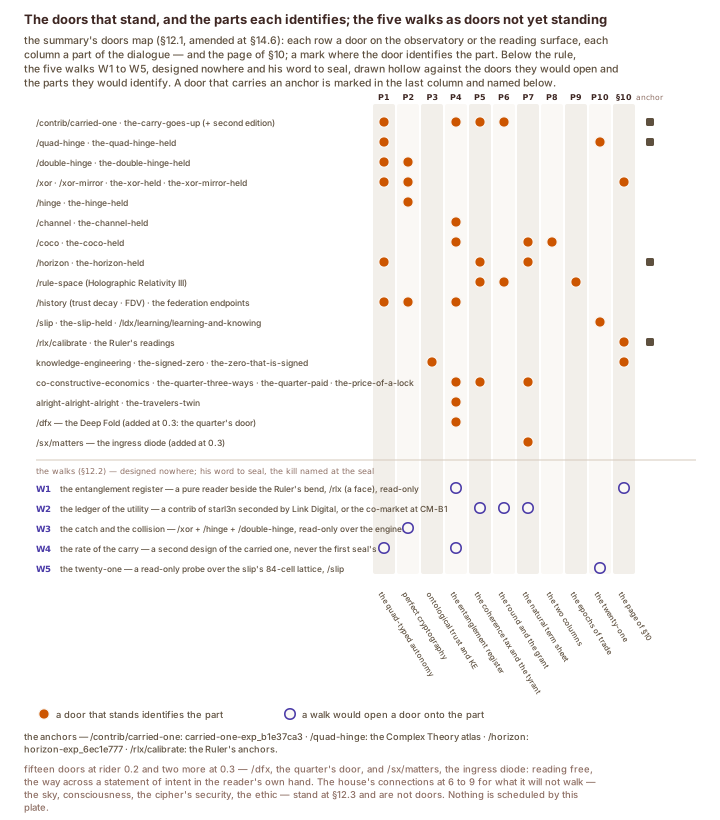
- The mirror of 2 and 5. The page's first two columns — the written 2 read as 5 through 1/5, the written 5 read as 2 through 5/1, the pair a hand mirrors — have no instrument: nothing on the record reads a numeral through three registers. The chords beside them are the XOR Mirror's two forward, one back, whose nets converge on the unit step, and its mirror, in which the 1 sees its own measure only in the reflection the tiers return; The Place of One's chirality, the forward jump and the step back read on ten seals of The Carried One; the Ruler's two registers calibrated on their fives, the ladders one series 1/k, at the door /rlx/calibrate; and the five held agreements of his sixth prompt, 1/5 one agreement of five and 5/1 the five over the one. The walk named is W1, the entanglement register: a pure reader beside the Ruler's bend, after the calibration's precedent — read once, writing nothing — reading a numeral through the written digit, the signed access and the read; its measure whether the read register's label follows the count of signed-zero positions — two for a carry, one for a hold, none for a utility — and whether a fourth row exists in the three registers at all, 2222.5 having no signed access on the page; its kill a fourth row that reads, or a label that does not follow the count; its door the Ruler's face, read-only; its prior the Synthesis's three readings of a signed zero, from which the third column is already held. Two facts of the page wait on his word before any seal: the labels sit on the read register and cross the prompt's order — 2,500, paid first as the utility's, reads as a carry; 2,250, the hold, as a hold; 2,225, the carry, as a utility — and the signed-zero positions are two on the carry, one on the hold and none on the utility, the boxed row carrying no absence.
- The slower you cease to be. His clause that the faster you carry your own local hold, the slower you cease to be relative to one whose local hold remains uncarried, has the construct beside it and no measure: The Carried One has no time variable, faster is a ratio of counts, and nothing on the record reads persistence by the rate of the carry. The walk named is W4, the rate of the carry: the relative-speed family of The Carried One, already qualified by its cares — the held registers as objects of their own beside the root, each with its own origin and no shared coordinate, faster a ratio and a count to the touch, the Channel's design read first; its measure whether a hosted register carrying at the higher ratio persists through more host spans before its vacancy is read as absent than one whose hold is uncarried — his slower as a count of spans, never a clock; its kill no difference in persistence by ratio, or persistence read down the nesting again, the cue's flaw; its door a second design of the carried one, never the first seal's. Its prior is a landed kill: the design of The Carry Goes Up staked the drift at the fastest register, localised DRAM, and the record landed on the kill — the moved share was flat by level. The family starts from that kill and not from a blank.
- The round arithmetic. His ledger — revenue 13,950 and returns 11,450; the tyrant holding 3,950 or 1,450; round two 1,450 + 13,950 = 15,400, less 2,500 and 10,000, 2,900 held; the rounds 1,450, 2,900 and on to 8,700, the seventh's 10,150 passing 9,999; the steps from 2,500 to 2,250 to 2,225 — re-walks true in every sum and has no identifier: the quarter is held, the two over the two is measured, and no instrument makes the quarter, the cap or the count of four fall out of a ledger's own arithmetic without being told. The walk named is W2, the ledger of the utility: a deterministic ledger with the utility's 2,500 first, the hold and the carry, the tax after a count of four closed, the cap one short of the tax, five held agreements a utility and the term sheet's five columns an agreement, the schedule family fast to slow, a surprise of 0 and a surprise of 2 as scheduled kills with no random device, a three-party market funded by no more than the tax; its measures the rounds survived over the schedule family, the round at which the cap is crossed, whether the quarter is reproduced by the ledger's own arithmetic without being told, and whether the fifth agreement's close past the tax period lengthens survival as his strategy says; its kills a schedule that survives longer by closing slow first, a cap other than one short of the tax falling out of the arithmetic, the quarter not reproduced; its priors the vacancy's share one in four, the decision-time dividend of 2.25 collapsing under verification, grow before operate, the fold law of four carries and a release at the fifth, and his spine 20/9; its door a contribution of the starl3n persona seconded by the Link Digital persona, after the carried one's precedent, or the co-market's recognition accounting where the agreements are intent cards. Three reasons in the ledger are the model's and not his — the cap of 9,999 as a forced memory dump at the tax's weight, the count of four as 4 × 2,500, the 9,890 as 10,000 less gravity's 10 and light's 100 — and stand as the guest's reading until he trues them.
- The coincidence. The market of gravity 10, the market of light 100, the 110 the model subtracted to reach his 9,890: the digits meet the rule-110 family, which tops the house's rule space at an E of about a quarter, with 110 = 84 + 26 in the house's own geometry; and the Waystation's scales meet his classes. The discipline holds a match of digit or scale as a coincidence until an out-of-sample ratio lands — the Channel's c-check killed one such — and refuses a numerology walk. The one place the discipline permits a number to be staked is the twenty-one, and W5 is that stake: a read-only probe over the slip's measured 84-cell lattice at 4 × 21, predicting out of sample, or nothing, that the eight cells lit at 84 fall on one distinguished cell and five groups of four — the broker and the five agreements of up to twenty diodes, 84 = (1 + 5 × 4) × 4 — the partition stable across the clean run and lost where the beat drifts off 42; its kill no such partition, or one not stable across the clean run; its prior the Walls' landed kill, the 21 a waypoint and not the close; the seal stating the cells before the read.
- Three seats that are not absences of identifier but of word. The pairing of the collision with holding and the catch with not holding — W3, the catch and the collision: two actors on the shared is, each holding or not, a carry in flight between them, the arrival read on the XOR as a catch absorbed or a collision with residual; the measure the residual by arrival state, the absorption octave against twice the being as the 2 over the 2, the effectual horizon free under placement and finite under rate; the kills a catch that absorbs with no shared prior, a collision that leaves no residual, a placement distance that costs; the door the XOR, the hinge and the double hinge read only, no engine edited. The glyphs of his second prompt, restored in his hand. And the intents of the parts — which of the ten opens first and under which class — each, when named, a matter at the fourth and a reading at the fifth.
- What walks up, and what anchors it. The matters that walk up from these seats are his to register, and none is registered ahead of his word: further experiments, which are the five walks or others, or localized readings, which are a part of the dialogue read at its class. Each cites this reading's pin at its grant as the anchor of its signed intent, so that the absence it starts from is the one this reading names and not another. The house's part ends at the identifier.
The carry and the release
- Carried: the operator's statements as he gave them, his spelling kept, as justified true beliefs, with the record as their identifier and never their jury; the thirteen held faces by their addresses and measures; the twelve carried at the second register beside the house's nearest line; the three readers' lines as the house's own; the facts of the page, offered for his word; his reading classes as his frame; the item accepted and granted at his three points.
- Released: every verdict's reach — none was given on any statement of his; the model's half of the dialogue — its verdicts, its physics, its three reasons — released to the guest and adopted nowhere; the sky, consciousness, the cipher's security and the ethic, on which the house holds its four positions and nothing more; every seat he left open, which stands open.
- Open: the parts and their classes; the seals of W1 to W5, each from its named prior, the kill named at the seal; the matters that walk up from the absences, his to register; the reading at 10 — the point of registration — its audience, the class it reads up to and the house seat on offer, his to name; the box act for the node that serves this reading at its grant.
Endnotes — the citation register and the self-check
- The record of this item: the witnessed summary,
ooi_network/docs/computing-the-1d-universe-witnessed-summary.md, §1 to §15 — the declaration and the pin before the read, the reading classes, the inventory of the parts, the fidelity finding, the entanglement register read as a page, the evaluation, the doors and walks, the three readers' lines, the acceptance and the grant — and its address on the externality door, /sx/seb#computing-the-1d-universe-2026-10-24; the chronicle at /sx/workshop/the-seb-ingress; the matters at /sx/matters — the walks, this reading, the reading at 10. - The readings cited, on the SX surface under /sx/reading: the-carry-goes-up and its second edition · the-hold-and-the-carry · all-the-leaves-are-brown · the-quad-hinge-held · the-double-hinge-held · the-hinge-held · the-xor-held · the-xor-mirror-held · the-channel-held · the-coco-held · the-horizon-held · the-unco-held · the-slip-held · the-price-of-a-lock · carry-the-one · the-long-walk and the-long-walk-at-5 · the-walk-of-pi-at-5 · the-waystation · the-synthesis and the-synthesis-at-5 · alright-alright-alright · bright-eyes-that-sing · knowledge-engineering · the-signed-zero · the-zero-that-is-signed · the-quarter-three-ways · the-quarter-paid · co-constructive-economics · sane-max-rides-humes-highway · of-mice-man-god-and-clocks · who-carries-what-you-know · katz-equilibrium · the-travelers-twin · the-framed-window · dialogue-5-six-seven · ldd-reference; and his learning module at /ldx/learning/learning-and-knowing.
- The designs and engines cited, under
ooi_network/docs/andooi_network/daemon/: the carried one and the place of one; the quad hinge, the hinge and the equivocation; the XOR; the channel; the coco andcoco.py; the horizon; the holographic relativity papers andrule_space.py; the causal history and the trust-decay design, withfederation.pyandgateway.py;crypto_core.py; the slip; the walls; the unco; the onto-epistemic number; the Z learner's design withrlx_zmethod.py,rlx_zbend.pyandrlx_stage_three.py; the deep fold'sdfx.py; the co-market and the field-market designs; the economics review; the externality door's design. - The anchors: carried-one-exp_b1e37ca3 · horizon-exp_6ec1e777.
- The plates: three, placed at the grant and drawn by the reading's own kit from the record and never from the image — the twenty-nine faces laid over the four movements, from the summary's standings restated (§14.5); the three registers of a digit as the page writes them, from the summary's transcription (§10); the doors map with the parts each door identifies and the five walks as doors not yet standing (§12.1, §12.2, §14.6). Every plate is a text of the summary set down as a drawing: no engine read, no number computed, nothing claimed.
- The self-check: every quotation of his is verbatim from the summary's record of his prompts and his words, his spelling kept; every line of the house's is from the reading, design or engine named, as the summary carries it; every number is a measure from the record or a figure of his; no statement of his is graded or given a verdict; the house's readings are marked as the house's; nothing is claimed above 5; the body and the image are never quoted beyond identification; no contact has been made or implied.