 OOI · SX
Hold This for Me a Minute
What it means when somebody hands you something to hold — a reading at 11
Steven De Costa · draft 0.1 · 24 October 2026 · a reading at 11
THE READING PLAQUE. Hold This for Me a Minute, a reading at 11 — draft 0.1, 24 October 2026 — the first reading at its seat: one line of Computing the 1D Universe carried to a reader who does not know this house or anything it has published — one agrees to hold what another needs to carry — in plain words, with one number from the record and nothing of the apparatus. Its reading at 5 holds the apparatus and every fence, and its reading at 10 the story and the seat on offer; this page cares for neither and names neither, as its author asked: the carry alone, at a seat of 11, for the everyman receiver. Made readable on the SX surface by its covering persona's reading grant of 24 October 2026; a draft, not the published form; the title his working name. Covering: starl3n · endorsing: Link Digital. The item stands at /sx/seb#computing-the-1d-universe-2026-10-24; the construction record at /sx/workshop/the-seb-ingress; the readings beside it at /sx/reading/computing-the-1d-universe-at-5 and /sx/reading/computing-the-1d-universe-at-10. Reading is free; the way across is a statement of intent (/sx/matters).
Hold this for me a minute
Somebody says it to you at a station, with a bag. At a counter, with a child. At work, with a password, a number, a promise, a secret: hold this for me a minute. You take it. And for as long as you are holding it they can go and do the thing they had to do, with both hands free.
That is the whole arrangement, and it is older than money. One person carries. One person holds. The one who carries cannot also be the one who holds — if they could, they would not have needed you — and the one who holds does not have to go anywhere at all. You just have to still be there, with the thing, when they come back.
The one thing
Everything that moves between people is a carry, and every carry needs a hold at the other end. A letter needs a desk it is going to. A rumour needs an ear. A debt needs a book somebody keeps. A promise needs the person it was made to, still remembering. Take the hold away and the carry does not get lighter; it stops being a carry at all and becomes a thing dropped.
So one agrees to hold what another needs to carry. That is the sentence I would like you to take from this page, and it is the only one on it.
What it asks of you
Nothing clever. When they come back and ask for it, give back exactly what you were given. Not improved. Not interpreted. Not a little lighter because you got tired, and not a little heavier because you had an opinion about it in the meantime. The same.
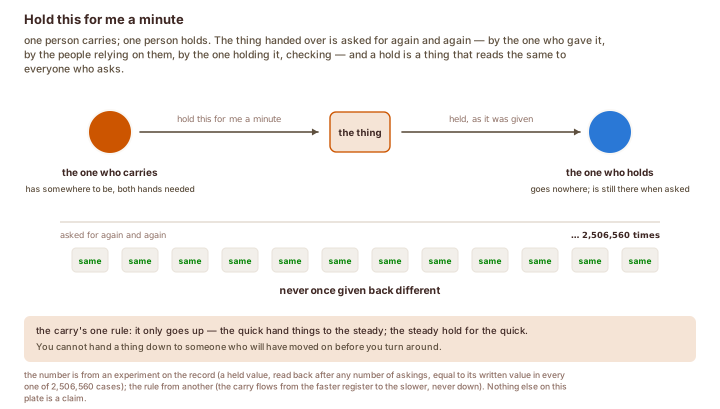
That is what holding is, and it is harder than it sounds, because a held thing is being asked for all the time — by the person who gave it to you, by the people who are relying on them, and by you, checking. A hold is a thing that reads the same to everyone who asks, however many times they ask, and however long it has been.
It has been checked
I would not ask you to take that on my say-so, so here is the one number I will give you. There is an experiment that holds a thing, then asks for it again and again, and compares each answer with what was written down the first time. It has asked 2,506,560 times. It has never once been given back a different answer.
Not nearly never. Never. Everything that people say about memory, about trust, about keeping your word, stands on that one plain fact, and now you have it too.
The other half
The carry is the other half, and it has one rule, which you already know from carrying anything heavy up a hill: it only goes up.
What you carry goes to a hand steadier than yours — one that can hold it longer than you can. You hand a thing up to the patient. You cannot hand it down to the quick, because by the time you turn around the quick have moved on, and nobody is holding it. The fast carry to the slow; the slow hold for the fast. It is why the busiest person in the room is never the one keeping the list, and why the one keeping the list is the one the room cannot do without.
You are the hold
You are reading this at the receiving end. Somebody carried something to you — a page, a number, a belief, a thing they could not keep in their own two hands while they went and did what they had to do — and asked you to hold it. You have it now.
Whether it was worth carrying is not the question on this page. The question on this page is only whether you will hold it as it was given, so that when they come back and ask, it reads the same. If you will, then you are the hold, and the carry was real. That is the whole of it.
It came from an experiment anyone can read at opendata.ai, and from a conversation I had; both are on the record at opendata.ly if you want them, and you do not need either of them to hold this. If you take something from this page, hold it as it came. Somebody is counting on that.