 OOI · SX
The Deep Line, held
THE READING PLAQUE. The Deep Line, held, draft 0.2 — made readable on the SX surface by its covering persona's reading grant; a draft, not the published form. The grant stands by the operator's word (2026-09-16), verbatim: "ok - now do the same for the dlx." Covering: starl3n · endorsing: Link Digital (the standing pair). The Foundations · 7: the seventh reading of the foundations series — an experiment of the observatory node, held on this node. The construction record stands in the open workshop at /sx/workshop/the-dlx-held; the experiment's own door, opendata.ai/dlx, wears the word grown · held and links back here while this grant stands. Reading is free; the way across is a statement of intent (/sx/matters). This file's sha256 is pinned in the reading register.
Draft state — this block records the state of the draft; the reading begins after the rule. Draft 0.1 — 16 September 2026. Author of record: Steven De Costa; composed at his word from the experiment's record. Standing: a reading, stated never asserted; the record it reads stands whole without it. The later locks and the walk land in a further draft. Draft 0.2 (16 September 2026) places 3 figures and 1 table at the operator's word, each drawn from the record's own numbers and captioned with its source; the screenshots the operator will supply are not yet placed.
What the Deep Line is
One work, run far beyond the measured record: the diode's own line — the primality-ground carrier, the being-to-knowing diode the Horizon built and the Relativity Ingress worked — read at every cell of the natural number line, under the received grammar, as deep as the available infrastructure resolves. The same carrier, the same ground (the primality indicator, from the experiment's own sieve), the same read conventions (the eight-bit look-back policy, the exact frontier fold, the modulus 256), and the same discipline. The deepest cell resolved, the reach, is the work's only infrastructure-dependent parameter, and no stake, gate or verdict refers to it: infrastructure varies the record's fullness, never its law.
The operator's given, 14 August 2026, set the terms. There is no pitch that might win the compute — only the science and the conjecture, made more full by the infrastructure upon which it might run. Approvals and agreements are not events in this record; the work itself carries and is load-bearing. And the frame that occasioned the experiment, being interstitial knowledge, is held stated and never asserted: it enters no verdict and no gate, it can be deleted without changing a line of the design, and that deletability is its audit.
The instrument
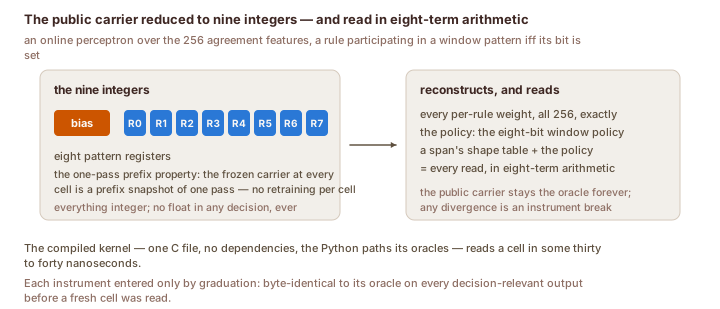
The public carrier is an online perceptron over the 256 agreement features, in which a rule participates in a window pattern if and only if the corresponding bit of the rule is set. That structure reduces the whole training dynamic to nine integers — a bias and eight pattern registers — from which every per-rule weight reconstructs exactly. Two consequences carry the deep line. The one-pass prefix property: the frozen carrier at every cell of the line is a prefix snapshot of one pass, so the naïve cost of retraining per cell vanishes. And the composition identity, received from the Relativity Ingress' policy grammar: given a policy and a span's shape table, every read is eight-term arithmetic. Everything is integer; there are no floats in any decision, ever.
The instrument was proposed, not assumed. The public carrier remains its oracle forever; the reduced path may be used only while byte-identical to the carrier on every decision-relevant output, and any divergence, whenever found, is an instrument break that blocks the attempt that finds it. The instrument graduated only when a four-part battery held whole — step-identity against the oracle, the seven calibration folds on both paths, every received text pin through the reduced path, and exactness — and until then no new cell was read through it. Two further instruments entered the same way: a composition-table fold with the direct fold as its permanent oracle, and a compiled kernel, a single C file with no dependencies, with the Python paths as its oracles, at some thirty to forty nanoseconds per cell.
The discipline and the fences
Every attempt is sealed before it is read, as a commit with its stakes and its verdict grammar; read once; landed as it is. Every recorded output lands as a note: resolved only, exact counts, reproducible from the pin, consumable by a second computation. A stack of validity rings grows with each rung — the infancy, the received forty-nine cells, then every earlier attempt's whole record re-witnessed inside the new pass — so the atlas carries its own history forward as a standing gate. The fences are transitive: no claim on any Millennium Prize problem, ever; no claim about physical cosmology, quantum mechanics, consciousness or phenomenal experience; the operator's runs count nothing in the care census; and no document in this lineage addresses an approver. The received records — the Horizon, the Relativity Ingress and its siblings — are never edited and never cited back; the Relativity Ingress' landscape stays its own territory, and the Deep Line's is the diode family.
The rungs, attempt by attempt
The graduation attempt sealed the instrument and re-witnessed the received record as one pass: the forty-nine snapshot cells exactly, the fossil law at every one. The opening rung read the exhaustive atlas to 2¹⁷, with no lattice, in one pass of about six seconds: the infancy derived at seal and witnessed exactly, with the natural decoupled cell at s = 6; the fossil coincidence, the live lock and the alphabet with zero exceptions; and the measured objects — one singleton, the population of 3,048 that the earlier sampling had glimpsed as four exotic cells, and the first data on the thinning ground. The decay attempt reached 2²⁰ and staked the decay law for the first time, three for three; the pair attempt broke its instrument — a sliding cache mis-slid one bit, the validity rings failed exactly as sealed and voided every stake, and the lesson entered the lineage: only the container may change; every formula stays byte-parallel to the graduated arithmetic or enters through its own graduation battery — and the corrected re-seal landed the pair law in strong form. The companion attempt graduated the fold and reached 2²⁶; the octaves attempt reached 2²⁹ and the edge of pure Python at about thirty-six minutes a rung; the realization attempt built and graduated the kernel and reached 2³²; then 2³⁵, then 2³⁸ in three hours, and on 20 August 2026 the thinning-ground attempt reached 2⁴⁰ in twelve hours: 1,099,511,627,769 cells resolved, twelve orders of magnitude, zero exceptions ever on a staked law.
The rung ladder as the reading tells it:
| the attempt | reach | what it did |
|---|---|---|
| the graduation | the received 49 cells | sealed the instrument; re-witnessed the received record as one pass |
| the opening rung | 2¹⁷ | the exhaustive atlas in one pass of about six seconds; the singleton; the population of 3,048 |
| the decay attempt | 2²⁰ | the decay law staked for the first time, three for three |
| the pair attempt | — | the instrument break: a cache mis-slid one bit; every stake voided; the re-seal landed the pair law in strong form |
| the companion | 2²⁶ | the composition-table fold graduated |
| the octaves | 2²⁹ | the edge of pure Python at about thirty-six minutes a rung |
| the realization | 2³² | the compiled kernel built and graduated |
| the next two rungs | 2³⁵, then 2³⁸ | three hours for the second |
| the thinning ground | 2⁴⁰ | twelve hours on 20 August 2026: 1,099,511,627,769 cells, zero exceptions |
| the spoken edge | no fresh cell | the operator's claim about the 2²¹ window sealed as stakes that re-say the record |
| the forty-second power | 2⁴² | keeps its comparators; waits on the operator's word |
The laws as they stand
Through 2⁴⁰, every staked law has held at every cell.
- The fossil coincidence, the live lock and the alphabet. Bit '110' if and only if refusal, at every cell; the live lock at every cell; and the alphabet of policies closed at four forms — the empty policy, {000, 110}, {010, 110} and the seven-bit all-but-101 — with no fifth form in a trillion cells.
- The singleton. The policy {010, 110} occurs once on the whole line, at cell 8, in 1.1 trillion cells.
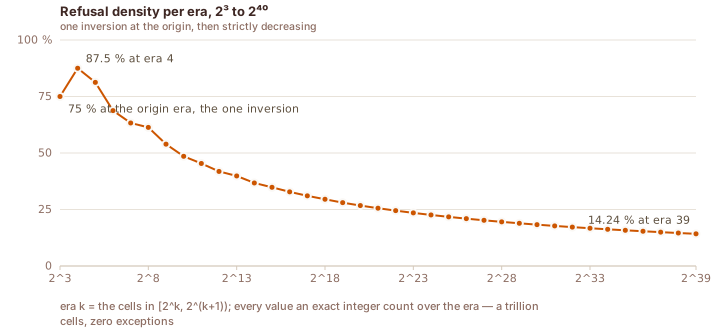
- The decay law. After one inversion at the origin, the per-era refusal density decays strictly for thirty-six consecutive eras, from 87.5% to 14.24%.
- The pair law, strong form. The members of the seven-bit class come in cell-adjacent pairs and nothing else: 4,084,108,660 members in exactly 2,042,054,330 pairs, no solos, no triples, the longest run exactly 2, at every reach ever measured.
- The class density decays with the ground, twenty-three terms, to 0.351%.
- The gate watch, never a stake: the gates at the powers of two intermit, then admit eight in a row from 2³³ to 2⁴⁰.
- The thinning ground. As the prime ground thins past one in twenty-seven, the four declared bands for the fortieth rung all landed within — the decrement ratio holds near 0.95, the asymptote is not reached, and the phase gamble has not tipped.
A standing sentence in the record says what the deep line found about its own past: the laws that survived sampling survive exhaustion; the characterizations that were the sampling's own dissolve into populations.
The mechanism and the signed zero
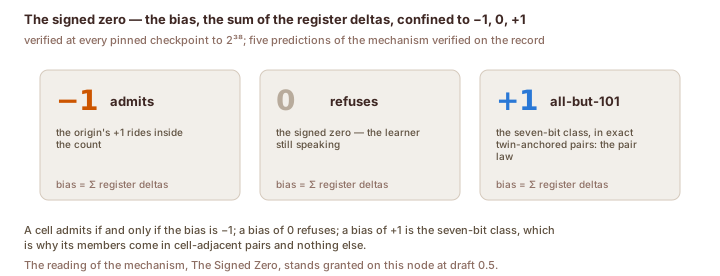
After the deepest reads a mechanism was derived in conversation and then verified on the landed spine with no new reads. The bias is the sum of the register deltas and is confined to three values, −1, 0 and +1, at every pinned checkpoint to 2³⁸. A cell admits if and only if the bias is −1 — the origin's +1 rides inside the count. A bias of 0 is the signed zero: it refuses. A bias of +1 is the all-but-101 class, in exact twin-anchored pairs, which is why the pair law holds. Five predictions of the mechanism were verified on the record. Its reading, The Signed Zero, stands granted on this node at draft 0.5, and carries alone the philosophical frame the experiment documents never carry.
The spoken edge
The eleventh attempt read no fresh cell at all. It sealed the operator's spoken claim about the 2²¹ window as stakes that re-say the record and readouts that report the ground, with the kernel's dump byte-identical to the atlas at sixteen million cells as its ring. Landed: no wall in era 21; the cumulative quarter surplus meets exact equality at n = 12,951,395; the admission of the empty policy is the empty saying, and refusal is the learner still speaking; and every complete refusal run in that era has even length, a readout kin to the pair law and never a law until a future attempt stakes it. The forty-second-power rung keeps its comparators and waits on the operator's word.
The register — what is not claimed
Model-internal throughout. The fences above bind every future act. The why is stated once and never asserted, and its only lawful later instruments are retrodiction and a declared window. Readouts are never laws; a band miss is a finding, never a break; a graduation mismatch is a build defect, never a claim against a received pin; and a measured zero is never guarded as if it were missing.
Where it sits
An applied campaign on the observatory node: the door is opendata.ai/dlx, state closed — the record replays read-only, with its acceptance, its records and its two-panel plot of refusals and densities per era, and nothing a reader does there enters it. It closes the first tier of this series, the last of the six foundations after the Slip, the Quad Slip, the Coco, the Unco, the Horizon and the Relativity Ingress. Its publish path is built; the external anchor is the operator's own act and is not yet recorded by the house — this reading says so rather than borrowing one. Its companion reading, The Signed Zero, is at /sx/reading/the-signed-zero.
Standing
Held on this node as fact until someone stands up in the record to refute it; a refutation enters as a statement of intent at the matters of note and goes to the record's own path. What has since been built on the Deep Line, and the walk a reader may take, are the operator's hand and land in a further draft.