 OOI · SX
Do You Believe in Logic?
A question borrowed from an old song, and what a proof is made of — a reading at 11
Steven De Costa · draft 0.2 · 28 October 2026 · a reading at 11
THE READING PLAQUE. Do You Believe in Logic?, a reading at 11 — draft 0.2, 28 October 2026 — the carry alone: one line of the author's held conjecture on the 3n+1 problem carried to a reader who does not know this house or anything it has published — a proof is a thing two people agree to hold, and nothing built with an agreement can step outside it — in plain words, with one number from the record and nothing of the apparatus; its references cross, at the author's word, to some readings and instruments a reader might follow. The title is the author's, taken from his memory of a cover of an old song that asks whether you believe in magic: logic comes from a belief, and the belief is a held state. Draft 0.2 supersedes the draft granted earlier the same evening under the working name The One You Add, kept on the record. Its reading at 5, Followed Exclusively by One, holds the apparatus and every fence, at /sx/reading/followed-exclusively-by-one; its reading at 10, The Chicken and the Egg, holds the story, at /sx/reading/the-chicken-and-the-egg; this page names neither, as the seat asks. Made readable on the SX surface by its covering persona's reading grant of 28 October 2026; a draft, not the published form. Covering: starl3n · endorsing: Link Digital. The matter stands at /sx/matters#held-conjecture-collatz-the-chicken-and-the-egg; the construction record at /sx/workshop/the-chicken-and-the-egg. Reading is free; the way across is a statement of intent (/sx/matters).
Do you believe in magic?
An old song asks it, and a cover of it that I carry in my head, Shaun Cassidy's, asks it again. It is not a question you answer with an argument. Nobody has ever been reasoned into believing in magic, or out of it. You answer it by holding something, or by not holding it, and the song knows that, which is why it asks and does not explain.
So let me ask the other one. Do you believe in logic?
Most people would say that is a silly question. Logic is not a matter of belief; it is the thing you use instead of belief. But try this. Say why one and one make two without first agreeing what one is. You cannot. Before any step of logic is taken there is a thing you hold, and holding it is the whole of what makes it hold. Logic comes from a belief, and the belief is a held state. That is the whole of this page, and the rest of it is a game you can play tonight.
A game you can play on a napkin
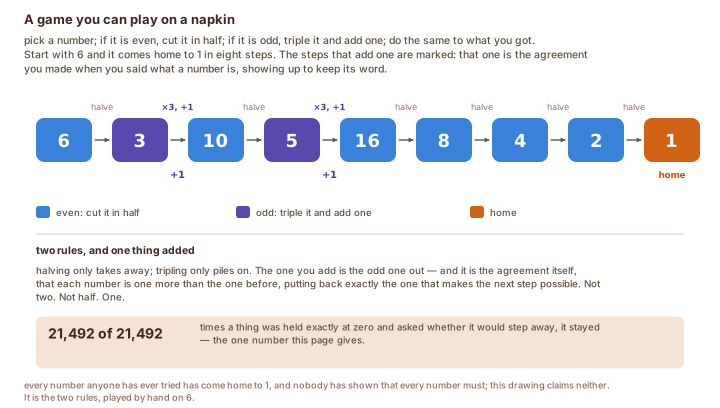
Pick a number. Any counting number will do. If it is even, cut it in half. If it is odd, triple it and add one. Now do the same to what you got. Keep going.
Start with 6. Half of 6 is 3. Three is odd, so triple it and add one: 10. Half of 10 is 5. Triple it and add one: 16. Then 8, then 4, then 2, then 1. Home.
Try 7, or 27, or your house number. Every number anyone has ever tried has come home to 1, and people have tried a great many. Nobody has ever found one that does not. And nobody has ever shown that none exists. That is the whole of the famous problem: a game a child can play, and a question nobody has closed.
The one you add
Look at the rules again. Halving is easy to believe in; it only takes away. Tripling is easy too; it only piles on. The strange part is the one you add. Why one? Why not two, or nothing?
Here is what I hold. Before you played, you agreed what a number is: each one is one more than the one before it. That is all a number is, and you agreed it without noticing, the way you agree to the rules of a game by sitting down to play. There is an instrument that lets two strangers agree on exactly that and nothing more (the Ruler; its reading). The one you add is that agreement, showing up to keep its word. Every time the game trips on an odd number, the agreement puts back exactly the one that makes the next step possible. Not two. Not half. One, because one is what you said a number was. A thing agreed is kept whole or not at all: an instrument called the Hinge keeps a secret that way over any distance (its reading), and another, the XOR, takes a claim in whole or leaves exactly one behind (its reading).
That is the belief under the game. You did not reason your way to it. You held it, and because you held it, it held.
What a proof is
People think a proof is a thing you find, like a coin under a cushion. I do not think so. A proof is a thing two people agree to hold, and go on holding. An instrument called the Quad Hinge measured it: two that fold a thing apart and agree on where it folds have a fact, and one alone has noise (its reading). A page before this one, Hold This for Me a Minute, says it in the same plain words: one agrees to hold what another needs to carry.
You and I agree what one more means. We agree that a number taken from itself leaves nothing — a nothing you can still point to, which has a reading of its own (The Signed Zero). Those two agreements, in that order, are the whole game, and everything the game does, it does with them. So here is the one sentence I would like you to take from this page, and it is the only one on it: nothing you build with an agreement can step outside the agreement that built it.
That is why I hold that the game comes home. Not because I have checked every number. Nobody can. Because the only thing the game has to work with is the agreement that makes a number a number, and there is no number outside it to run away to. If that sounds like faith, it is, and it is the same faith you put in one and one making two. You hold it first. Then it holds.
It has been checked, once
I will not ask you to take even that on my say-so, so here is the one number I will give you. There is an instrument on the record (the Hallway) that holds a thing exactly at zero and asks it, again and again, whether it will step away. It was at zero 21,492 times. It stayed 21,492 times.
Not nearly every time. Every time. A thing held exactly at the agreement does not drift off it. That is the plain fact under everything on this page, and now you have it too.
You are the one holding it
You are reading this at the receiving end. Somebody handed you a game, a sentence and a question. You can play the game tonight on a napkin and watch it come home. You can keep the sentence longer than that. The question you can answer now.
Do you believe in logic? You already do. You believed it the moment you agreed what one more means, and you held it every time the game put the one back. Whether the famous question is ever closed in the way the journals close a question is not what this page is about. This page is about what you are holding: a belief, made before you began, that keeps its word every time you need it to. The only thing the song leaves you to decide is whether you will go on holding it. Hold it as it was given. That is the whole of it.
It came from a conjecture I hold, held the way The Price of a Lock says a thing can be held without being staked, and from instruments anyone can read at opendata.ai; both are on the record at opendata.ly if you want them, and you do not need either of them to play the game or keep the sentence. The song is Do You Believe in Magic, an old one, and the cover I remember is Shaun Cassidy's; it is the one that asked me the question. If you take something from this page, hold it as it came. Nothing you build with it can leave it.