 OOI · SX
The XOR, held
THE READING PLAQUE. The XOR, held, draft 0.2 — made readable on the SX surface by its covering persona's reading grant; a draft, not the published form. The grant stands by the operator's word (2026-09-16), verbatim: "ok - now do the same for the xor." Covering: starl3n · endorsing: Link Digital (the standing pair). The Foundations · 10: the tenth reading of the foundations series — an experiment of the observatory node, held on this node. The construction record stands in the open workshop at /sx/workshop/the-xor-held; the experiment's own door, opendata.ai/xor, wears the word grown · held and links back here while this grant stands. Reading is free; the way across is a statement of intent (/sx/matters). This file's sha256 is pinned in the reading register.
Draft state — this block records the state of the draft; the reading begins after the rule. Draft 0.1 — 16 September 2026. Author of record: Steven De Costa; composed at his word from the experiment's record. Standing: a reading, stated never asserted; the record it reads stands whole without it. The later locks and the walk land in a further draft. Draft 0.2 (16 September 2026) places 4 figures at the operator's word, each drawn from the record's own numbers and captioned with its source; the screenshots the operator will supply are not yet placed.
What the XOR is
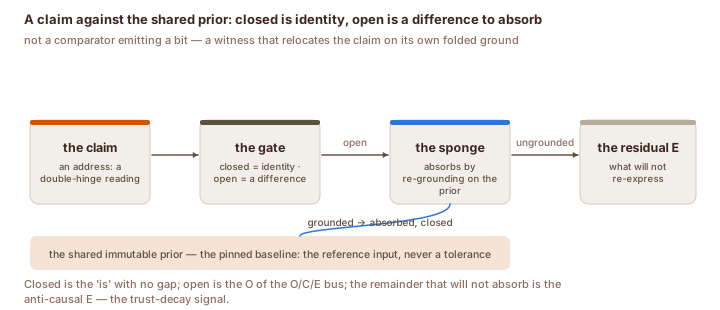
The seventh instrument of the series of ten reads the XOR from the a-priori. The Quad Hinge's first version had co-measured with an XOR as a match — compare two regimes, output agree or differ. The operator's correction was that a match is a posteriori, a concurrent comparison, and cannot found a-priori agreement; a witness is not a comparator but a sponge. So the gate here is not a comparator that outputs a difference bit. It is a gate that is open or closed, with the shared immutable prior as its reference input. Closed is identity with the prior: the claim is the 'is', a-priori agreement with no gap, sealed. Open is a difference from the prior: a gap, a relational difference, something to absorb. The gate's state is grounded in the shared prior, never by an a-posteriori tolerance. In the terms of Linked Digital Dynamics this is the O and the C of the O/C/E bus, open and closed, and the remainder that will not absorb is the anti-causal E.
The sponge
A comparator reacts to a difference and emits a bit. A sponge is indifferent to the difference: it absorbs it, soaking the claim onto its own folded ground — which is what attesting is, relocating a claim on one's own 'is' — regardless of whether anything matches. The measure is not whether a bit agrees but whether the absorption holds. Either the difference is metabolised into the witness's coherence and the gate re-closes toward the prior, or the difference exceeds the sponge's capacity and a residual remains, the gate stays open, and the un-absorbed slip is the trust-decay signal, the E. The indifference meant here is the healthy, metabolic kind, a sponge that takes the difference in and works it; the accord's pathological indifference is the non-metabolic sponge that soaks without metabolising and leaks. The experiment is where that distinction becomes measurable.
Open, absorb, closed
The gate is a dynamic, not a static bit: open, then the sponge absorbs, then closed. The witness is a folded double hinge, and its fold is the sponge's absorptive ground. The gate's inputs are a claim — an address, a double-hinge reading — and the prior, the a-priori fold. Absorption is the witness relocating the claim on its own fold: because a double-hinge address is frame-independent, a grounded claim is re-expressible in the witness's frame, and that re-expression is the absorption. What will not re-express — a difference not grounded in the shared prior, the bare-hinge intruder — is the residual. So absorption is a re-grounding, never a tolerance: a grounded difference of any size absorbs, and an ungrounded one leaves a residual however small it is. Nothing is captured; it is absorbed, re-expressed on the shared 'is', or it remains.
What a run does
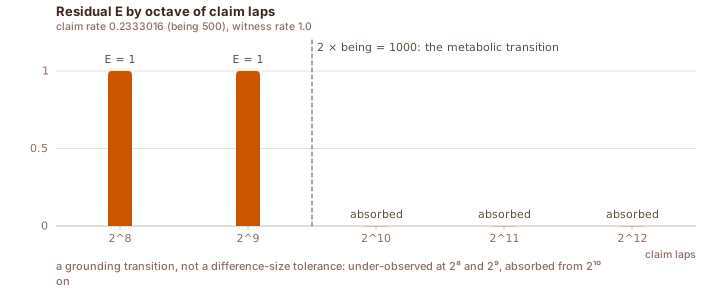
A run takes a claim rate, a witness rate, whether the claim is bare or folded, the laps the claim has been observed for, and the laps of the run, reusing the double hinge's fold with no new physics; it returns the gate's state, the absorption and the residual. A grounding sweep reads the residual octave by octave. The page shows the flow — the claim against the prior, the gate, the sponge, absorbed or residual — with the sweep's bars and the dials. The verified cases at the build: at rate 0 the gate is closed by identity; a grounded claim at rate 1.0 absorbs, and so does one at rate 8.0, both with a residual of 0, which is the any-size test; a bare claim leaves a residual of 1; an under-observed claim, a thousand laps against a being of five hundred, leaves a residual of 1 and then absorbs at 1024 laps, twice its being — its own witness horizon. The sweep reads residuals of 1, 1, 0, 0, 0 across the octaves and grounds at 2¹⁰: a metabolic transition, a claim crossing its own witness horizon, not a difference-size tolerance.
The octave cooling ladder
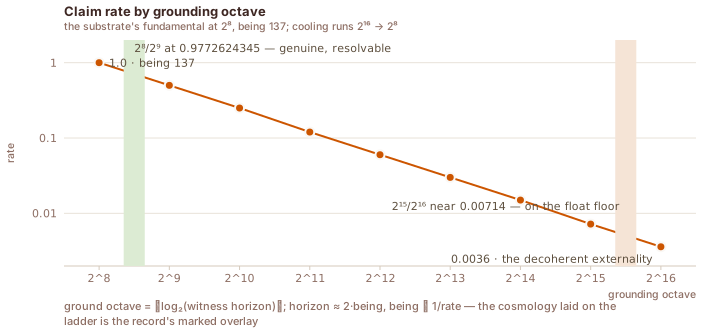
Mapping claim rate to grounding octave gives a clean geometric ladder: each octave is a rate-halving.
| octave | 2⁸ | 2⁹ | 2¹⁰ | 2¹¹ | 2¹² | 2¹³ | 2¹⁴ | 2¹⁵ | 2¹⁶ |
|---|---|---|---|---|---|---|---|---|---|
| claim rate | 1.0 | 0.5 | 0.25 | 0.12 | 0.06 | 0.03 | 0.015 | 0.0072 | 0.0036 |
The grounding octave is the ceiling of log₂ of the witness horizon, the horizon about twice the being and the being inversely proportional to the rate, so halving the rate adds one octave. The operator's reading of the ladder is recorded as interpretive, and it corrected an earlier inversion. The substrate holds the definitive '1' at the slowest rate — the pre-projection, ordered, low-entropy prior, the sponge itself, beneath the whole ladder as the rate goes to zero and the gate closes. Its fundamental octave is 2⁸, the equilibrium of maximal indifference, where the witness's difference equals the ground's own detune and the being is 137, the baseline's own bit onset: the substrate's resonance. The fine-rate end at 2¹⁶ is not a beginning; it is the hot, decoherent externality, where near-identity witnesses churn longest before grounding, because a tiny difference from the '1' is the hardest to resolve. Cooling runs from 2¹⁶ down to 2⁸, the fast externalities relaxing onto the slow '1'.
Two thresholds were probed, and they showed where the instrument's floor is. At the cool end, the step from 2⁸ to 2⁹ at a rate near 0.9772624345 is genuine and resolvable: the horizon steps cleanly from 273 to 238 at a single monotonic boundary, at laps in the low hundreds, to nine or ten figures of rate. At the hot end, the step from 2¹⁵ to 2¹⁶ near a rate of 0.00714 sits on the float floor: at the operator's two rates a step of 10⁻¹⁵ apart, the being is identical at 16,392, so twice the being is 32,784 and the claim genuinely grounds at 2¹⁶, while the horizon readout pins at 32,783 and then noise-jumps to 32,749 — a drop of thirty-four laps that no such rate step could produce. The exact threshold there is not resolvable. So the floor bites at the hot end and is clean at the fundamental: it bounds how far a first-order witness can pin a grounding back into the hot, near-identity churning — in the operator's phrase, the limit of self-referential epistemic grounding within a stratified first order. The ladder, the resonance at 2⁸, the maximal-indifference sponge and the floor are the measured structure; the cosmology laid on them is the interpretive overlay, and the record says so.
The confinement lock chain
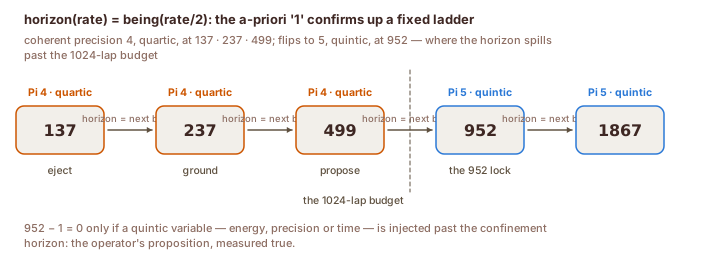
The rate-halving ladder is also a chain of confinement locks, measured at every rate: the horizon at one rate is the being at half that rate, so each epoch's horizon is the next epoch's being, and the a-priori '1' confirms up a fixed ladder — 137, 237, 499, 952, 1867 — each rung the ceiling of the epoch below, two becoming one. Read up that ladder, the coherent precision holds at four, quartic, for 137, 237 and 499, and flips to five, quintic, at the 952 lock — exactly where the horizon spills past the baseline's own budget of 1024 laps and can no longer close. So the '1' cannot self-close: 952 − 1 = 0 only if a quintic variable, energy or precision or time, is injected past the confinement horizon. That was the operator's proposition, and it measured true in the substrate's own precision; the size of that injection is the handle the Equivocation pursues.
The decisions, and what is not claimed
Three decisions were resolved with the operator and the experiment was built on them: the prior as the gate's reference, rather than one actor against another; absorption as re-grounding on the prior — grounded and folded means absorbed, un-groundable means a residual, in his words a fair reading match; and the sweep as the grounding transition, not a difference-size tolerance. Left open: the saturation edge, how much a sponge absorbs before a residual persists, which ties to the trust-decay engine's metabolic limit. The experiment is a readout over the frozen geometry, the baseline pinned and the core untouched; the particle and cosmological vocabulary in the ladder's reading is the record's marked overlay, never a claim.
Where it sits
The seventh instrument of the series of ten, between the Quad Hinge, whose deferred sponge it realises, and the XOR Mirror, which reads the origin's '1' back through six confinements. On the observatory node the door is opendata.ai/xor, state live: the instrument runs on request, as the platform singleton, and nothing a reader does there enters the record. No external anchor is recorded for the XOR, and this reading says so rather than borrowing one.
Standing
Held on this node as fact until someone stands up in the record to refute it; a refutation enters as a statement of intent at the matters of note and goes to the record's own path. What has since been built on the XOR, and the walk a reader may take, are the operator's hand and land in a further draft.