 OOI · SX
The Quad Hinge, held
THE READING PLAQUE. The Quad Hinge, held, draft 0.2 — made readable on the SX surface by its covering persona's reading grant; a draft, not the published form. The grant stands by the operator's word (2026-09-16), verbatim: "ok - now do the same for the quad hinge." Covering: starl3n · endorsing: Link Digital (the standing pair). The Foundations · 14: the fourteenth reading of the foundations series — an experiment of the observatory node, held on this node. The construction record stands in the open workshop at /sx/workshop/the-quad-hinge-held; the experiment's own door, opendata.ai/quad-hinge, wears the word grown · held and links back here while this grant stands. Reading is free; the way across is a statement of intent (/sx/matters). This file's sha256 is pinned in the reading register.
Draft state — this block records the state of the draft; the reading begins after the rule. Draft 0.1 — 16 September 2026. Author of record: Steven De Costa; composed at his word from the experiment's record. Standing: a reading, stated never asserted; the record it reads stands whole without it. The later locks and the walk land in a further draft. Draft 0.2 (16 September 2026) places 4 figures and 1 table at the operator's word, each drawn from the record's own numbers and captioned with its source; the screenshots the operator will supply are not yet placed.
What the Quad Hinge is
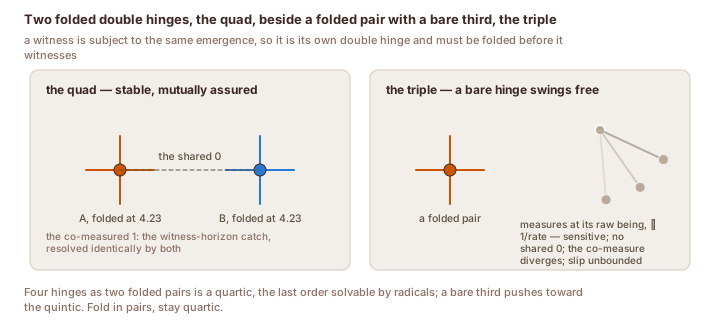
The Double Hinge crossed being with knowing and folded them to a coherent point, the fold at Pi 4.23, the ground's own precision: the agreed and resolved ground of a single pair of actors, the '0'. The next question was to add a witness. The operator's correction reshaped the experiment: a witness is subject to the same emergence, with its own being at lap 137 and its own witness horizon at 237, so it is not a point observer that can be bolted on. It is its own double hinge, and it must be folded before it witnesses. The structure is therefore not a double hinge plus a witness but two folded double hinges, the double-double hinge, which agree on a shared '0', the fold, mutually assured because neither party sets it, both resolving independently on the same ground to the same coherent precision; and which co-measure any proposed '1', a claim above the 0, as a discrete, mutually assured, collaborative address, verified only if both folded double hinges resolve it identically at the shared precision. The record's phrase for it is two locks one applied to the locks themselves: two self-agreeing units agreeing.
Why quad and not triple
The record frames the danger in the terms of chaos theory. The double pendulum is the canonical chaotic system, and it is what the composition must avoid. A hinge alone is regular. A double hinge in this sense is not a free double pendulum, because it is folded: its two axes cross and resolve to the fold, its degrees of freedom are spent, and it is coherent. Chaos enters with a free, unresolved degree of freedom. Appending a naked third hinge, a witness that has not resolved its own being and knowing, makes a triple-pendulum chain that swings freely against the pair and brings only chaos. The rule is to compose only folded pairs; a witness must arrive pre-folded. Four hinges as two folded pairs is a quartic, the quadratic of a quadratic, and four is the last order solvable by radicals, the last stable closed-form composition. A bare third hinge pushes the system toward the quintic, the unsolvable regime. The record reads this as the same four-to-five threshold the Quad Slip instrument reads as precision over time, the edge between the closed form and the merely computed. Fold in pairs, stay quartic.
The mechanism
The shared 0 is assured by the ground. The double hinge's fold is a property of the ground and not of the difference: the coherent precision measured at about 4.23 across a sixty-four-fold range of rate difference, the negative log of the residual at being's lap. So two double hinges on the same baseline land independently on the same fold, and their agreement on the 0 is mutually assured precisely because it is the ground's constant reached separately, not a value one hands the other. The mutually assured 1 is co-measured: a proposed claim is an address on the shared 'is', the epoch, the position in the registry, the amplitude and the elapsed, and it is a verified 1 only if both folded double hinges resolve that address to the same discrete value at the shared precision, one Pi-quantum at the fold. Discrete, mutual, collaborative. Any residual between the two folds, or between the two resolutions of a 1, is the inter-hinge slip, the trust-decay signal: zero for perfect mutual assurance, growing as the pair drifts, and unbounded if a party was never folded.
What a run does, and the first verification
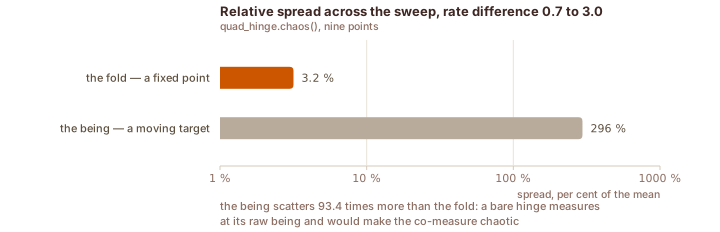
A run takes two rate differences, one for each double hinge, and the laps. Each double hinge folds on the shared baseline; the two folds are set against each other, the 1 is co-measured, and in this first version an XOR tests the match. The run reports the two beings, the two folds and their slip, the mutual-assurance fraction, and whether the pair is assured. A second reading, the chaos contrast, sets the folded pair beside a bare third hinge measuring at its raw being and sweeps the difference, reading how far each moves. At the build the first run put rates of 1.0 and 3.0 side by side: beings of 137 and 46, different, and folds of 4.23 and 4.23, the same, with a fold slip of 0.0033; the XOR matched throughout and the pair was assured. The chaos contrast read the fold's spread at 3.2 percent, a fixed point, against the being's spread at 296 percent, a moving target: the bare hinge scatters 93 times more. The page shows the quad view, the two folded crosses sharing a 0 with the co-measured 1, and a two-panel chaos view with its dials.
The 0 and the 1
The record resolves what the 1 is by the operator's own probe. The 0 and the 1 are both ground-set discrete points on the half-life axis: the 0 is the fold, knowing equal to being, pinned at Pi 4.23; the 1 is the witness horizon, knowing equal to twice being, a slip of about one, one half-life or one octave or one doubling above the 0. At a fine rate difference the witness horizon landed on a catch at exactly twice the being, 261986 against 130994, a slip of 1.0000, which confirmed that the 1 is literally one half-life from the 0 and not an arbitrary address. So the Quad Hinge's mutually assured 1 is the witness-horizon catch, assured by the ratio law. The record adds its own caveat: the exact rate that makes the slip 1.0000 sits on the float floor, with the being near 2¹⁷, the witness near 2¹⁸ and the residual resolved to only four or five figures, the jump trustworthy to about 3 × 10⁻⁸, so the tenth-decimal flip is numerical, the Pi 5 knife-edge again. The 1 is therefore defined as the witness-horizon catch, which is robust, and not as the rate where the slip reads exactly one, which chases the floor. And a regime caution follows: measure the 0 and the 1 at a moderate difference, near one, where the being is 137 and the witness 237 and everything is well resolved, not at the tiny-difference edge where the residual meets the float floor, which is a numerical cousin of the bare hinge's chaos. The rule of the record: fold in pairs, and stay well-resolved.
Under-observation refused
A party must be settled, observed past its own witness horizon of about twice its being, before it can assure. The operator probed a short window: laps of 1000 with the first actor's rate near 0.2333, so its being is 500 and its witness horizon of about 1000 sits exactly at the ceiling. At a rate of 0.2333016 the first actor's Pi 4 horizon is 1007, past the ceiling, so the actor is unsettled and the quad honestly reports not assured, flagged as under-observed. At 0.2333017 the horizon drops to 998, inside the ceiling, the actor settles and the pair is assured. At the recommended laps of 262144 the actor settles trivially. The instrument refuses to assure an under-observed, unfolded party rather than asserting a false agreement, which is exactly the pre-fold safety condition at work, and the page distinguishes under-observed, raise the laps, from a genuine disagreement, naming the unsettled actor. The record notes the coincidence that a being of 500 is the instrument's own ceiling of 500 and that 1000 laps is twice it.
The operator's probe at laps 1000, the first actor's being 500:
| the first actor's rate | its Pi 4 horizon | against the ceiling of 1000 | settled | assured |
|---|---|---|---|---|
| 0.2333016 | 1007 | past it | no — under-observed | no |
| 0.2333017 | 998 | inside it | yes | yes |
| either, at laps 262144 | — | far inside | trivially | yes |
The prior, not a capture range
An earlier reading in the record proposed an assurance tolerance band, a capture range around the fold within which two parties would count as agreeing. The operator corrected it, and the record keeps the correction: a posteriori corrective capture range cannot define the acceptance of a priori agreements; the immutable prior, the pinned baseline both actors fold on, is the foundation. The clarifying data made it plain. Identity of stance, the same rate on both sides at any value, gives an identical fold exactly, a fold slip of zero whether the value is 4.2299, 4.2301 or 4.23: the value is irrelevant and the identity is everything. A relational difference, two rates that differ, is a real difference with a nonzero fold slip, measured and reported and never captured. What had looked like a band was the readout rounding a real difference to zero, a true slip of 4.3 × 10⁻⁵ shown as 0 at four decimals: an artifact, not agreement. Acceptance is grounded in the shared prior, both parties folded and settled, and is unconditional on the slip: rates of 0.5 and 8.0 give a slip of 0.4918 and the pair is still assured, far past the old band. The tolerance remains only as a descriptive fixed-point threshold in the chaos reading, never as a gate. The fold is still a near-flat fixed point close to congruence, moving about 2 × 10⁻⁴ over a window of 5 × 10⁻⁴, but that stability is the shared prior's signature, not a tolerance that grants agreement.
Two readings of the chaos sweep
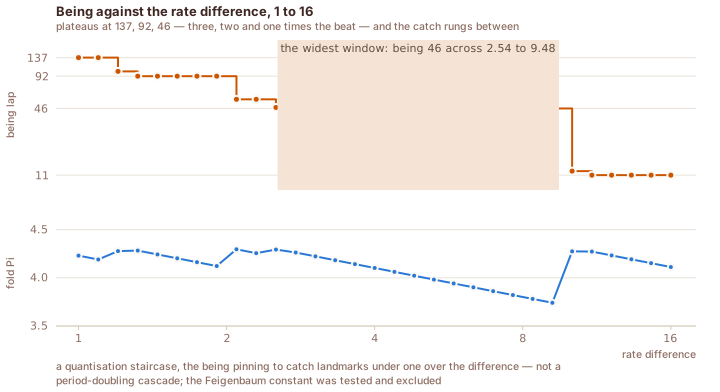
Sweeping the difference, the being does not glide. It holds on beat-harmonic plateaus, 46, 92 and 137, one, two and three times the beat, and steps between them while the fold stays a fixed point; the widest window is the beat itself, a being of 46 across rate differences from about 2.54 to 9.48, so a sweep from 5 to 9 sits entirely inside it with no spread at all. The operator suspected the first Feigenbaum constant, 4.669, in those windows. It was tested and excluded: the ratios of plateau widths scatter from 0.006 to 37 with no convergence to that constant or to two. It is a quantisation staircase, the being pinning to catch landmarks under the one-over-difference law, not a period-doubling cascade, and the fold's value near 4.2 is the readout precision, eleven percent off the constant and not it either.
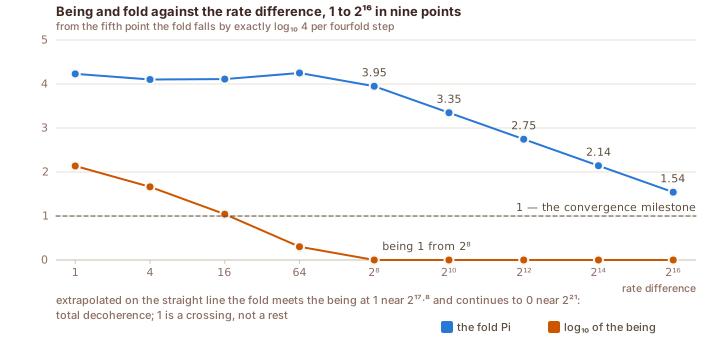
The second reading takes the sweep to its extreme, from a difference of one to 2¹⁶ in nine points four times apart:
| point | rate difference | being | fold |
|---|---|---|---|
| 1 to 4 | 1 · 4 · 16 · 64 | 137 · 46 · 11 · 2 | about 4.2, a fixed point |
| 5 | 2⁸ | 1 | 3.95 |
| 6 to 9 | 2¹⁰ · 2¹² · 2¹⁴ · 2¹⁶ | 1 | 3.35 · 2.75 · 2.14 · 1.54 |
The being resolves to 1 by the fifth point, and from there the fold decays as a dead straight line, exactly the log of four per fourfold step. The mechanism is clean and not fitted: once the being floors at 1 the residual is just the constant times the difference, so the fold is a constant less the log of the difference, and the being hitting its floor is what turns the fold's decay constant. Extrapolated on that line the fold meets the being at 1 near a difference of 2¹⁷·⁸, the shared 0 converging onto the actual 1, which the record carries in the operator's words as the actual-is projected from the NOT gate, and it continues to 0 near 2²¹: total decoherence, no shared 0, chaos. So 1 is a convergence milestone, being and fold both equal to one, a crossing on the way to the chaos floor and not a resting point.
The witness coupling, and what followed
The first version couples the two witnesses in parallel with an XOR testing the match, zero for agree and one for differ, and the record marks it as only the tractable first approximation. The operator's hypothesis, recorded as the second version to test, was that a witness is more like a sponge than a concurrent match: it absorbs the claim into its own folded ground rather than comparing it bit for bit, a kind of indifference and not an XOR, closer to attesting than to matching. That hypothesis became the XOR experiment that follows this one in the series. The record also states where the Quad Hinge is meant to lead: present, attest, confirm between two nodes, each a folded double hinge; the pre-fold precondition, that a node may federate only once it is internally coherent, having resolved its own being and observed past its own witness horizon, since a node that federates unfolded injects chaos; trust decay riding the inter-hinge slip; and two locks one at second order. That is the record's stated purpose, and the reading carries it as such.
The register, and what is not claimed
A readout over the frozen geometry: the cryptographic core and the figure-2 coincidence untouched, the baseline pinned. The Quad Hinge composes two double-hinge folds and the inter-hinge slip and adds no new substrate; deterministic and test-pinned. The shared fold, the 93-fold contrast, the refusal under-observation, the exact identity, the plateaus, the excluded constant and the straight-line decay are the measured structure. The chaos-theory framing and the federation purpose are the record's framings, carried as the record marks them; the sponge is a hypothesis this record raised and a later experiment took up.
Where it sits
The sixth instrument of the series of ten, after the Double Hinge, whose folds it composes in pairs, and before the XOR, which built the sponge this record hypothesised. On the observatory node the door is opendata.ai/quad-hinge, state live: the instrument runs on request, as the platform singleton, and nothing a reader does there enters the record. No external anchor is recorded for the Quad Hinge, and this reading says so rather than borrowing one.
Standing
Held on this node as fact until someone stands up in the record to refute it; a refutation enters as a statement of intent at the matters of note and goes to the record's own path. What has since been built on the Quad Hinge, and the walk a reader may take, are the operator's hand and land in a further draft.