 OOI · SX
Ender's End Game is Always and Never the Same
The game at the enemy's gate — a reading at 7
Steven De Costa · draft 0.1 · 30 October 2026 · a reading at 7
THE READING PLAQUE. Ender's End Game is Always and Never the Same, a reading at 7 — draft 0.1, 30 October 2026 — the Collatz conjecture as the author's held conjecture, in the seat that plays the game the proof sets: the inverse tree with its trunk forced and its gate at 16, the author's two lists exact, the two locks about the half, his four rules as the call — win, draw and loss the orbit's own three fates — a practice that begins with the enemy first and the squad late, the meta-game registered ahead as a prediction, and the game's own end: what is always the same on every groundhog day and what never is. The title is his; the game is his, in eight points, four rules and a practice carried verbatim on the record; the walk it is read against is the house's dry run, run by hand on the two inverse rules with no engine, no seal and no claim. Its reading at 5, Followed Exclusively by One, holds the apparatus and every fence, at /sx/reading/followed-exclusively-by-one; its reading at 6, Minus Zero Is What It Is, the attempt at the proof this game plays, at /sx/reading/minus-zero-is-what-it-is; its reading at 10, The Chicken and the Egg, the story, at /sx/reading/the-chicken-and-the-egg; its reading at 11, Do You Believe in Logic?, the carry alone, at /sx/reading/the-one-you-add. Under the standing law the house makes no claims over physics, biology, consciousness, or the millennium prizes, and no claim over any prize offered for this problem; no orbit is walked; nothing has been played; the game is the author's, held, and the record is its identifier and never its jury. Made readable on the SX surface by its covering persona's reading grant of 30 October 2026; a draft, not the published form. Covering: starl3n · endorsing: Link Digital. The matter stands at /sx/matters#held-conjecture-collatz-the-chicken-and-the-egg; the construction record at /sx/workshop/the-chicken-and-the-egg. Reading is free; the way across is a statement of intent (/sx/matters).
One · The seat at 7
- The seats of a reading on the held conjecture's line are his to designate. The 5 is read from inside the initiative with every fence in view (Followed Exclusively by One); the 6 is the attempt at the proof, the six holds of a memory cell (Minus Zero Is What It Is); the 10 is the author's voice for a reader outside (The Chicken and the Egg); the 11 is the carry alone (Do You Believe in Logic?). The 7 is the game. The 6 closed on a subtitle, The Enemies Gate is Always Down, and said in its last section that nothing built with two agreements can step outside them, so that what the journals would ask for is a walk: a bound, or a measure that falls. This reading is that walk, set as a game, before it is played.
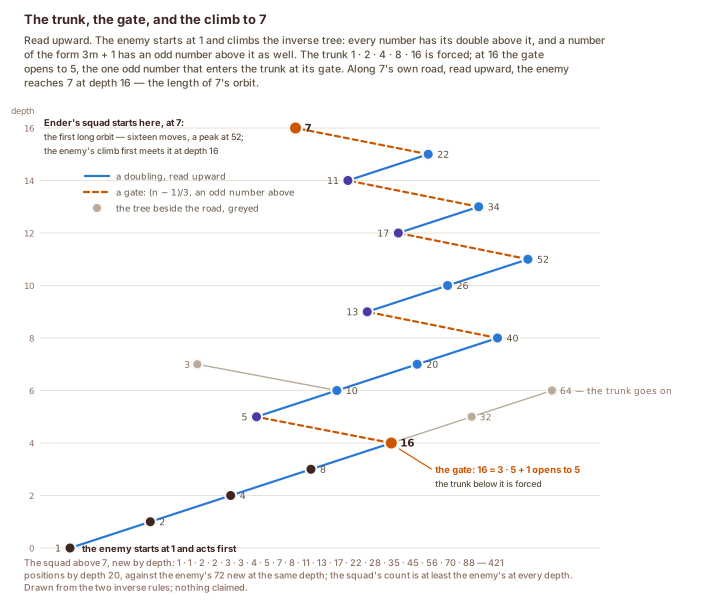
- Seven is the first number whose road home is long. Three comes home in seven moves; seven takes sixteen, climbs to fifty-two on the way, and passes through 5, 10, 20, 40, 13, 26, 52, 17, 34, 11 and 22 before it reaches the trunk. Ender's squad starts at 7 because 7 is where the game first has room to be a game.
- His word for what the 7 would hold, given with the 6's grant: a second reading, "Ender's End Game is Always and Never the Same", to partner the first. The title is read in the last section; everything before it is what the title is read against.
Two · Where the game is played: the trunk, the gate, and the road home
- The game is played on the inverse tree. Forward, the two rules of the problem are the hold and the gate the 6 named: an even number is halved, an odd number is tripled and one is added, and the one you add makes the result even so the hold can take it back. Read upward from 1, the rules run the other way: every number has its double above it, and a number of the form 3m + 1 has an odd number above it as well. Climbing is what the enemy does. Growing from 7 is what the squad does.
- The trunk is forced. Above 1 is 2, above 2 is 4, above 4 is 8, above 8 is 16, and nothing else, because none of 2, 4 and 8 is of the form 3m + 1 with an odd m above 1. At 16 the gate opens: 16 = 3 · 5 + 1, so 5 stands above 16 as well as 32. Five is the one odd number that enters the trunk at its gate; every other odd number comes home through 5 or through a gate higher up. His four exclusions were the home cycle 1 · 4 · 2 and this one odd number, and the walk found them to be exactly the trunk's own exceptions (the dry run).
- His two lists, exactly. He wrote the orbit of 3 with the gate step split into its two halves, 3n and then 3n + 1: 3 · 9 · 10 · 5 · 15 · 16 · 8 · 4 · 2 · 1. And the orbit of 7 the same way: 7 · 21 · 22 · 11 · 33 · 34 · 17 · 51 · 52 · 26 · 13 · 39 · 40 · 20 · 10 · 5 · 15 · 16 · 8 · 4 · 2 · 1. The machine applied the two rules by hand to the numbers he named and found both lists exact. The split is the 6's point made visible: at every odd number the tripling lands on an odd number and the one you add is what carries it to the hold.
- The enemy climbs. From 1 the climb is forced for four depths and then forks at the gate. At depth five the enemy is at 5 and 32; at six, 10 and 64; at seven, 20, 3, 128 and 21. Read upward along 7's own road, the climb reaches 7 at depth sixteen, which is the length of 7's orbit read downward. The first catch, if there is one, is at sixteen.
- The squad grows. Above 7 is 14; above 14 is 28; above 28 are 56 and 9, since 28 = 3 · 9 + 1. The squad's new positions by depth run 1, 1, 2, 2, 3, 3, 4, 5, 7, 8, 11, 13, 17, 22, 28, 35, 45, 56, 70, 88: four hundred and twenty-one positions by depth twenty, against the enemy's seventy-two new at the same depth, and the squad's count is at least the enemy's at every depth.
Three · The enemy's gate is always down
- In the book the children learn to fight in a room with no up and no down, and the one who wins is the one who decides that the enemy's gate is down and falls toward it. Here the deciding is already done by the rules. Down is toward 1. Every orbit falls toward the trunk, and the trunk ends at the gate where 5 enters. The enemy's gate is at 16, and it is always down, because the trunk below it is forced.
- Round one, in his words, is 7 · 8 · 9 · 10 · 15 · 16, and he gave two sets of distances for it: 5, 6, 7, 8, and 0, 1, 6, 7, 8, 9. The walk found both to be exact, in two frames. Measured from the enemy's local 1 at 2, the distances to 7, 8, 9 and 10 are 5, 6, 7 and 8. Measured from 7, the distances to 7 and 8 are 0 and 1; measured from 1, the distances to 7, 8, 9 and 10 are 6, 7, 8 and 9. His single line spans two frames because the enemy's frame moves: the enemy's local 1 is wherever the enemy stands, and it stands one step higher each round.
- The decision time. Once the enemy has stepped to 2, the next step it could take is to 3 by the gate at 10 or to 4 by the trunk, and measured from 3 the distances to 7, 8, 9 and 10 are 4, 5, 6 and 7, which is his decision time-distance exactly. Each step the enemy takes shortens every distance by one. That is why the frame is the enemy's and not Ender's: the clock the squad plays against is the enemy's position, which is never still.
Four · The two locks about the half
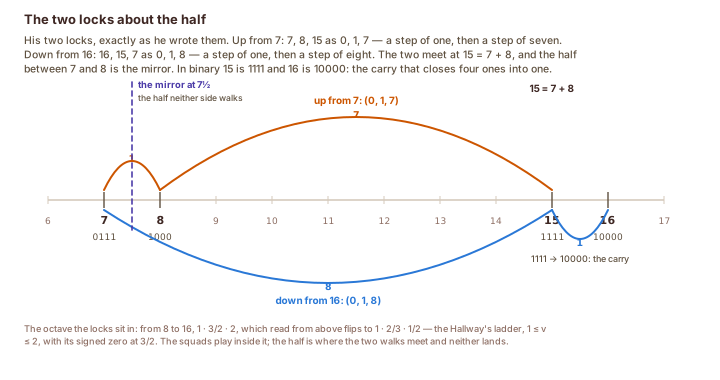
- His two inverse locks, exactly as he wrote them. Up from 7: 7, 8, 15 as 0, 1, 7 — one step of one, then one of seven. Down from 16: 16, 15, 7 as 0, 1, 8 — one step of one, then one of eight. The two meet at 15, and 15 = 7 + 8. In binary 7 is 0111, 8 is 1000, 15 is 1111 and 16 is 10000: the step from 15 to 16 is the carry that closes four ones into one.
- The half. Between 7 and 8 is 7½, and the two locks are its mirror: one climbs from the odd side, one descends from the even side, and they agree at 15 and nowhere else. This is the structure the house has carried since the first held conjecture as the two walks about the half, the half that neither walk lands on (Of Mice, Man, God and Clocks). Here it stands between Ender's 7 and the enemy's 8, which is the trunk's last step before the gate.
- The octave. From 8 to 16 is an octave, and within it 12 is the 3/2. The Hallway's ladder is the same octave, 1 ≤ v ≤ 2, with its signed zero at 3/2, and it was walked ten thousand times without the zero moving (the Hallway). Read from above, the octave flips: 1 · 3/2 · 2 becomes 1 · 2/3 · 1/2. The two locks sit inside this flip, one reading up and one reading down.
Five · The game set — his four rules, and what the call says
- His four rules, verbatim, as he set them to the dry run "to see if this holds conceptually at least, as it is a way to 'set the game' for any run" (the game set):
- 1 · "Practice for Ender's Squad is always started at 7 and ended by 6 from his own perspective at 7 as the start, looking down one unit to 6."
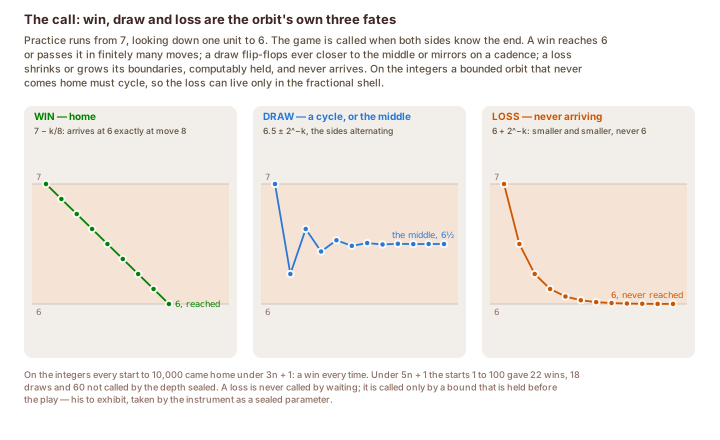
- 2 · "Win, lose or draw the game is 'called' before or at exactly 6 when the two teams 'know' what the final result will eventually be. Game that 'could' go on forever as 6 arrives, by smaller and smaller or bigger and bigger but computably held boundaries between 6 and 7's gates are a loss for Ender."
- 3 · "A Game where Ender 'gets' to exactly 6 exactly, or past it before 6 arrives, no matter how long it takes, is a win."
- 4 · "A game that approaches the middle between 6 and 7 and flip flops ever closer or mirrors on a cadence, no matter the complexity of symmetry that cadence follows, in or outside the 6-7, is a 'draw'."
- What the call says on the record. The three outcomes are the three fates an orbit can have. An orbit comes home, which is a win; or it enters a cycle that is not the home cycle, which is a draw, a cadence of any symmetry; or it does neither, which is a loss. These are the three cases the conjecture itself divides the integers into, and his rules name them as a call. On the integers the third case has a shape: a bounded orbit that never comes home must cycle, so an orbit that is a loss on the integers is one that grows without bound. The smaller-and-smaller loss, the one that closes on 6 and never arrives, lives only in the fractional shell between 6 and 7 — in the 6's words, the frozen shell 6 < Ee < 7 where the gap −1 < s < 0 is shifted.
- What the machine called. Under 3n + 1 every start from 1 to 10,000 came home: a win every time, which is the record's way of saying what has been checked far beyond this by others, to 2 to the power 71. Under 5n + 1, the rule the 6 set beside the real one, the starts 1 to 100 gave 22 wins, 18 draws and 60 not called by the depth sealed: a game with the same rules and a different gate, which has its cycles and its climbs. Seven hand-written fractional cases were each called as his rule names: 7 − k/8 arrives at 6 exactly at move eight, a win; 6 + 2 to the −k closes on 6 and never arrives, a loss; 6½ ± 2 to the −k with the sides alternating is a flip-flop ever closer to the middle, a draw; 6¼, 6¾, 6¼ is a cadence, a draw; a mirroring that grows outside the unit is a draw on a cadence about the game's own centre; 7 + k grows and never arrives, a loss.
- A loss is never called by waiting. Rule 2 says the game is called when both sides know the end, and no one knows the end of a climb by watching it climb. A loss is called only by a bound that is held before the play. By his word the bound is his to exhibit, and the instrument takes it as a sealed parameter, as the Ruler takes its K and never reveals it (the Ruler; its reading). That is the 6's step (v) made into a rule of play: what the journals would ask for is exactly what the game asks the player to bring.
Six · How a practice begins
- His words, in part: "The enemy always acts first and Ender always arrives a little late, a little 'after 7', which means that at 7 Ender is not perfectuly sure of the distance of 1 that the enemy started with." And: "Each has a 'relative period. 0 to 1 for practice from the enemies perspective and theier own gate, byr they must get to 2 to win, so must decide the 'gametime' 1 of being <= 1/2 so they have a chance of winning at least 1 to 0." (how a practice begins).
- The unit is forced. If the enemy's period from its gate is 0 to 1 and it must reach 2 to win, then a gametime unit of 1 affords one step and a unit of ½ affords two: on the octave 1 ≤ v ≤ 2 the only v that affords two steps in the period is 2, the top rung of the Hallway's ladder. His "less than or equal to a half" is not a choice but an arithmetic, and the walk found it so.
- Lateness. Ender's squad arrives a little after 7 and does not know by how much. In his later word the lateness is never learned as a size, only as a rule: the squad learns from practice one to practice N that it is always late, and the enemy keeps between practices only the probable knowing that causality has a prior and that Ender's squad is it. The house had offered a halving for the lateness and retired it on his word; what it offers in its place, as a candidate and not as his, is the rule of succession's confidence that the next practice is late, (N + 1)/(N + 2), which approaches 1 and never reaches it (the extent of time).
- The call is a move. Neither squad calls a win or a draw while it is winning the meta-game by count; each looks for a gap to tunnel a count signed to a win or a draw; the side that would rather force a draw than take a loss has possibility or probability on its side. The pivot between aggressive and defensive play is, in his words, a matter "of time, of capacity for surprise, and of the staged account of the meta-game itself" — the law of the turn, conserved when the account is complete and paid at the call when it is not (the corner; its reading).
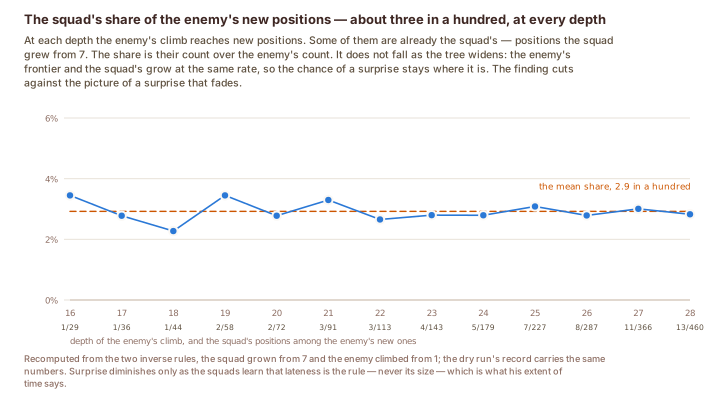
- The finding that cuts the other way. He expected the enemy's capacity for surprise to diminish. The walk found that the squad's share of the enemy's new positions does not fall as the tree widens: one of 36 at depth seventeen, two of 72 at twenty, five of 179 at twenty-four, thirteen of 460 at twenty-eight — a constant of about three in a hundred. The tree gives the squad no growing share. Surprise diminishes, if it does, only as the squads learn that lateness is the rule, and that is a learning about the practice and not about the tree.
Seven · The meta-game: a prediction registered ahead of the game
- Before the game was set he registered a prediction, and the record carries it pinned ahead of everything it predicts, in the Inner Circle's form: the prediction first by its own path on the chain, so that nothing read later can be mistaken for it (the prediction; the Inner Circle). What it says, as the house read it in six statements, each his.
- The caps. The 26 sporadic groups are each a cap between what is competitively knowable and what is learnable between two squads of 6. One squad plays from knowing as a start, 0 toward 6, and then learns from the notes gathered between 0 and 7; its range is 6 + 7 = 13. The other plays from 7 toward 0 and never past 6; its range is 13 as well, and the two ranges overlap on 0 to 6. In his later word the 26 are 19 and 6 and one, and the 19 is the left side count, not a shortfall.
- The spread. The confidence between the squads runs from 2 to 0, and it is an agreement on a shared externality and not a knowing. The count — wins per practice — is what both know, and by his later word it is kept twice, once as each squad tallies it.
- The two spans neither will ever know: 8 to 9 from the side of 0, and 2 to 3 from the side of 7. On the dry run's tree they sit at the two gates: 3 → 10 → 5 → 16 is the enemy's road through its gate, and 9 → 28 → 14 → 7 is the squad's first odd member coming down to 7. The unknowable spans are the gates themselves.
- The knowing of 27. Three by nine is 27, and 27 stands over the gap between 26 and 27 as the adjudicator: a third seat over both sides, holding the gap. The Baby Monster and the Monster are the two largest of the sporadic groups, and in his word the Monster's possible size is the real limit — the limit to the value the game can award the gamemasters.
- The bigger game. Beyond the practice there is a game played between 36 and 64, which are the Axiom's tiers and, by his later word, the squads themselves — the quad-typed reasoning autonomies and their own game in a limited extent of time — adjudicated at 110, his reading class for chemistry, by the octo-typed autonomies, which the house reads as the 8-bit word's own level above the squads.
Eight · The secret, the spine, and the extent of time
- The secret. In the book the adults keep the war from the children until the last game is already the war. His word links the game to that line: "The 'meta game' tally that is being held under secrecy between 26 and 27 MUST remain a secret." The masters tunnel the sub-unit distance into the ambiguity of the dyslexic bit: the first half of 26 to 27 maps as a 2/5 dilation onto the 5/2 spread between 26½ and 29. The house checked the one thing it could: 2/5 × 5/2 = 1, so a half seen through the flip flop reads as a whole. That is the false confidence of both squads' leaders exactly as he describes it — an approach to 1 that is really an approach to ½ (the secret; the Hinge). One requirement follows for any instrument that would play this: the adjudicator's tally is hidden from both walkers, which is the Ruler's own precedent, a K never revealed.
- The spine. On the left, as a prior, the meta-game approaches 26½ into the greater extent as 53, 106, 159, 212, 265, 318, 371 — 2, 4, 6, 8, 10, 12 and 14 times 26½. The machine found his seven exact, and found them to be the first seven multiples of 53, where 53 = 26 + 27: the two sides of the mirror summed, and the seventh rung 371 = 7 × 53 at the seat of this reading (the spine). Two kinds of shift can take either squad: the one of confident probability against locally confident time, and a cascade of plausibility released when a tracked known unknown becomes a known that unlearns the baseline — the released signed zero (The Zero That Is Signed), the fold that forgets (The Unlearning).
- The extent of time. The squads' own game runs in a limited extent, the unit time of 1 a negotiation of surprise and capacity. The more groundhog days they play, the more their confidence in the inductive system grows, and the fewer plausible positions the masters have left to hide the secret in. The real limit is reached when the greatest monster's possible size caps the value the game can award. Nothing of the groups is read into this; the house flags the coincidences of count and leans on none.
Nine · The accord, the groups, the left side count, and the nines
- The accord in thirds. The squads might battle into an accord as three markers within their own resolution of confident knowing against learned knowing — in his corrected word, 18, 36 and 54 with a release at 72 for the enemy, and 16, 32 and 48 with a release at 64 for Ender. The machine read them: each squad's three markers sit at the quarter, the half and the three quarters of its release, the ladder of quarters; the enemy's marker exceeds Ender's by 2, 4 and 6 and the releases differ by 8, an 8-bit word, the accord between the two squads between 64 and 72; and at every marker the ratio is the same, 9 to 8. The escape at 29 to 31 — left of 32 by 3 and 1, left of 36 by 7 and 5 — against 37, right of 32 by 5 and right of 36 by 1, is three primes, the tenth, eleventh and twelfth, and they continue the Inner Circle's own chain of coefficients, 7, 11, 13, 17, 19, past 23; between the two halves, 32 and 36, there is no prime at all (the accord; the correction).
- The groups. His word placed the game in the symmetry groups: 19 in the happy monster family, where the 18 can no longer be reconciled without reducing the 1 that carries the masters' secret; 6 that refract and relock the priors of learned knowing in a mutually held stasis no matter who wins; the quad symmetry 18 to 36 and 32 to 64 retaining the two squads to the practice round. The house brackets what it knows: the 26 sporadic groups are 20 of the happy family and 6 pariahs, and his 6 is the pariahs' count exactly. The quad is each side doubled, 18 to 36 and 32 to 64, and under his corrected accord the two sides stand 9 to 8 at every marker. The house first read his 19 as one short of 20 and retired that reading on his word: 19 is the left side count, and the right side is projected within the gap 19 to 20 through the mirror 20|21 (the symmetry groups; the left side count).
- The mirror at 192. The mirror 20|21 arrives at 192 as 3 × 53 + 30 + 3, and the machine confirmed the sum: the spine's third rung, then thirty, then three. 189 = 3 × 63 and 189 → 190½ → 192 is two steps of 1½. And 192 = 6 × 32 = 3 × 64: his spine 6 and the 3 it folds to lock are the two factors that carry the quad's right side to 192. How the mirror arrives there is his alone and the house does not read it.
- The nines. His 4 × 190½ = 762 and 4 × 192 = 768, and the 1½ between them, times 4, is six. The machine computed π to a thousand decimal places and found the first run of six nines at places 762 to 767, with a 4 before and an 8 after. So 762 is the start of the six nines and 768 the place just after their end, and his 1½ is their start and end exactly. The house has carried the Feynman nines before, as the place where the six slips emerge (The Feynman Nines); here they are the right side limit of a count read from the left. 768 = 3 × 2⁸, three 8-bit words, and 192 = 3 × 2⁶. Nothing of π is read into the game; the identity is stated beside it (the Feynman nines).
- The note within the octave. One more identifier he took as plausible and true: in the register of base 10 read from the left there is no 1/10, the least quantum is 1/9, which is 0.111… and the sum of every tenth; 1/9, 1/8, 1/7 and 1/6 are the four numerator-1 fractions inside the first tenth, all showing the digit 1 first; and the half of the octave, √2, has no digit expression — the nearest digit ratios are 7/5 = 1 + 2/5 below and 3/2 = 1 + 1/2 above, so the half lives between his 2/5 and his 1/2, and its mirror 10/7 needs the 10 the register does not have (the note within the octave; The Walk of Pi). The two locks of section Four are this octave's two walks, at 7 and 8.
Ten · Always and never the same
- Always the same. Every practice begins at 7 and looks down one unit to 6. The trunk is forced and the gate is at 16. The enemy acts first and the squad arrives late. The three outcomes are the orbit's own three fates and the call is made when both know the end. The first catch, if it comes, comes at depth sixteen, because that is the length of 7's road, and the squad's share of the enemy's frontier is three in a hundred at every depth. The spine's rungs are the multiples of 53 and the mirror is at 7½, at 26½, at 20|21. None of this changes from one groundhog day to the next.
- Never the same. The lateness is never known as a size, only as a rule, so the squad's first position is never the same twice. The enemy's frontier is new at every depth, and the three in a hundred are different numbers each time. The tally is kept twice and the two tallies agree only at the call. The secret between 26 and 27 is held by masters who can replay without losing what they hold by placement or measure, and what they hold is a half that reads as a whole. The accumulation carried toward 29 to 31 will conflict, and the conflict lands more than two practices beyond the window, so no practice ever contains its own end.
- Ender's end game, in the book, was the last exam that was already the war, and the one playing it did not know. Here the one playing it is told: the practice is the game, the tally is hidden, and the knowing that can be had is the knowing that one is late. His word closed the register of clarifications at 35 on this account, the knowing of such matters capped at 3.5 to 10, or the 100, or the 1000, and promoted the knowing now to carry forward a projection of its own knowing. That is the end game: not the end of the game but the point from which the game's own knowing is carried. A proof, the 11 said, is a thing two people agree to hold, and nothing built with an agreement can step outside it (Hold This for Me a Minute). The game is the agreement being played.
Eleven · What would be played, and what is not
- The experiment at 7, as the record now sets it and as the house would design it, is a contrib experiment and nothing more until it is sealed. Two walkers on the inverse tree: the enemy climbing from 1 and the squad grown from 7. A catch when the enemy's new position is already the squad's. The measure, the depth of the first catch — sixteen, on the tree as read. The kill, an uncaught path to the sealed depth. Both games as one: the integers for win and draw by the orbit's trichotomy, the fractional shell for the loss. The bound his to exhibit, taken by the instrument as a sealed parameter and never read from the walk. The call a move either side may make, answered only when both know the end. The tally kept twice. The Hallway's budgets. The prediction already prior on the chain (the Hallway; the Quad Hinge; its reading).
- What is not. Nothing has been played. The experiment is designed on the record and scheduled nowhere; the dry run read positions and growth to depth twenty and adjudicated no strategy. His "never lost" and "always being outplayed" are claims about a game the points describe and the rules now define, and no run has tested them. The house makes no claim over any prize offered for this problem, walks no orbit as a result of this reading, and asserts no proof in the register of the journals (The Price of a Lock). The coincidences of count — his 53 and the spine's, the half and the spread — are flagged on the record and leaned on for nothing; one note of his own on them is kept off the record by his word and pinned by its hash alone.
- What the register of the journals would ask is unchanged by the game: a bound, or a measure that falls. The game names who brings it. He does.
The carry and the release
- Carried: his eight points, his four rules, his practice, his prediction, and his nine texts after it as he gave them, his spelling kept, as justified true beliefs with the record as their identifier and never their jury; the two lists exact; the trunk forced and the gate at 16; the two locks about the half; the three outcomes as the orbit's own three fates; the unit forced at ½; the squad's constant share; the spine exact at 53; the nines at 762; the defaults he took as his answers and the register he closed at 35.
- Released: every verdict's reach, none given on any sentence of his; any claim over any prize; any orbit, none walked; the bound, his to exhibit; the mirror 20|21, his alone; the experiment's seal, his word; the second game beyond this one.
- Open: the seal of the experiment at 7; the box act after any grant; the held reading at 4.
Endnotes — the citation register and the self-check
- The record of this conjecture: the matter
held-conjecture-collatz-the-chicken-and-the-eggand Exhibit Forty-Nine at /sx/workshop/the-chicken-and-the-egg — his texts on their entries, the dry run's record and its run pinned there, the prediction's record pinned first by its own path. - The readings beside this one, on the line the held conjecture: followed-exclusively-by-one · minus-zero-is-what-it-is · the-chicken-and-the-egg · the-one-you-add.
- The readings cited, under /sx/reading: the-rlx-held · the-glove-and-the-ring · the-zero-that-is-signed · the-unlearning · the-quad-hinge-held · the-feynman-nines · the-walk-of-pi-at-5 · of-mice-man-god-and-clocks · computing-the-1d-universe-at-11 · the-price-of-a-lock.
- The doors on the observatory node: opendata.ai/rlx · opendata.ai/contrib/corner · opendata.ai/contrib/hallway · opendata.ai/contrib/inner-circle · opendata.ai/hinge · opendata.ai/quad-hinge.
- The checks by machine, run once and kept on the exhibit: his two lists against the two rules; the trunk and the gate; the enemy's climb to depth twenty-eight and the squad's growth to depth twenty; the two locks in binary; the calls on 3n + 1 to 10,000, on 5n + 1 to 100, and on seven fractional cases; the unit at ½; the spine's seven; the accord's ratios; the counts of the groups; the mirror's sum; π to a thousand places.
- The plates: four, drawn by the reading's own kit from the two inverse rules and nothing else — the trunk and the gate, the two locks, the call, and the squad's share — the walks recomputed in the kit and agreeing with the dry run's record to the number.
- The self-check: every quotation of his is verbatim from the exhibit's record of his texts, his spelling kept; every number is the dry run's or the kit's and the two agree; no statement of his is graded or given a verdict; the house's readings are marked as the house's and his to true; what the book says is said in the house's own words and no line of it is quoted; nothing is claimed above the record.