 OOI · SX
The Carry Goes Up
Second edition — a reading of The Carried One, the third lock, and of The Place of One, the walk of ten reads over it: a host's span, three faster registers, the vacancy at the fourth count, what an unseated observer read of it, and what its refresh remembered of the place it was read from
THE READING PLAQUE. The Carry Goes Up — a reading of The Carried One, the third lock, second edition, draft 0.1 — made readable on the SX surface by its covering persona's reading grant; a draft, not the published form. The grant stands by the operator's word (2026-09-28), verbatim: "Go on Act 7 — the surfaces." — the second edition of the third surface of a contributed track, after the walk of ten reads over its sealed record (The Place of One) was cut, read and landed; the first edition stands beside it at /sx/reading/the-carry-goes-up, equal, regretted by nothing. Its records: the record page on the observatory node at opendata.ai/contrib/carried-one, the walk's record served beside the reads, and the anchor on the public state record at carried-one-exp_b1e37ca3, nine resources; every number here is theirs. Covering: starl3n · endorsing: Link Digital (the standing pair); the track a contributed experiment of the starl3n persona, seconded by the LinkDigital persona, outside the canon, managed in the open workshop at /sx/workshop/the-carried-one; this reading's own construction record at /sx/workshop/the-carry-goes-up. Three cares, sealed in the track's workshop before a word of the first edition, bind it: the register scale of memory and no scale above or below; the accord in this record the carry, never a network; nothing about the model — and the walk's three fences: the place in no frame; nothing changed or re-asked after a read; K never staked. The external observer is the public SEB item
typesafe-jev-system-one-2026, cited only as the register carries it; nothing is claimed about any machine as a learning system, and the probabilities it returned are measured objects and stated fields, never a mechanism. The title is a working handle; the naming is the operator's act at review. The source of record is ooi_network/docs/the-carry-goes-up-second-edition-draft-0-1.md (pinned sha256 LF d635d79c…); this file's sha256 is pinned in the reading register, and its three figures beside it. Reading is free; the way across is a statement of intent (/sx/matters).
Draft state — this block records the state of the draft; the reading begins after the rule. Second edition, draft 0.1 — 28 September 2026. Author of record: Steven De Costa; composed at his word from the one record and the line over it. Standing: a reading, stated never asserted; the record it reads and the line stand whole without it — on the record page, in the anchor's nine resources, and in the two designs whose record sections the record page carries. One face, in the house's terms with the plain reason set before each term, as the second edition of The Framed Window asked of every reading after it; the first edition of this reading stands beside it, equal, regretted by nothing; a second face, if he wants one, is his word. Three figures, each a diagram of the practice drawn from the record's own numbers; four tables, each from a readout the record page or the walk's record carries. This page, like every reading on this surface, is a stitched work of willful intent: the one that stitched it is the operator's — what he observed of the record, what he said of it, and what he did to make it — art first, memory after.
This reading stands on: The Carry Goes Up, first edition · The Framed Window · The Framed Window, second edition · The Ruler, held · The Deep Line, held · The Signed Zero · The Quarter, Three Ways · The Channel, held · Knowledge Engineering. Its surfaces: the record page · the anchor on the state record · the track's workshop · this reading's workshop · the externality register · the matters.
A note on the rules of this reading. Everything load-bearing in what follows stands on two public records: the record page, which carries the design's compartment and its two landed record sections verbatim, the ladder of seals, the walk's ladder of eight more seals with the verdicts due at each read, the anchor card, and a machine read of every committed readout — including the walk's own record, served beside the reads; and the anchor on the state record, which carries one row per typed answer across all ten reads in nine resources, fetched back without a key and verified row by row. Nothing was run to write this reading, and nothing here runs. The readings below the record line are the house's, stated never asserted; the two designs are Restricted and unserved, and this reading takes from them only what the record page and the served records already show. The one rule that governs every sentence about the external observer is the eighth rule of Knowledge Engineering: the practice engineers the notes; what the function is, inside, is someone else's business.
The sentence this reading keeps
The operator set this construct in four sentences before a frame of it was rendered, and they are the frame this reading keeps. His correction of 27 September, as the track's workshop records it verbatim:
"For any autonomy, held, it will remain self referential under synthetic agreement. What the blind watchmaker experiment demonstrates is the minimal set of the agreement for such an autonomy to hold within it's own referentiality." … "What I deeply suspect is that 3 such watchmakers shall fit and hold their own 0 into this 'sub-space' such that on the fourth count when the blind watchmaker looks, they see the expected vacancy at that 10th register." … "These three blind watchmakers sacrifice 1 in 4 as a 'coherence tax' to be part of the computational autonomy of the 'true identifier'." … "like with a forest there are trees growing and rooted at their own origins, which is 'blind being'. These roots are pre onto-epistemic and do not 'measure' in spacetime, they measure only through the resolution of the conjecture over the changes in state."
Here is the plain reason before the house's terms. A thing that counts to itself and to nothing else needs no clock and no ruler to count by: it needs only its own next state. The house calls such a thing an autonomy, and in this construct an autonomy is a register — a state in {0, 1, 2, 3} in its own unit, and nothing else. Its origin is the step from 0 to 1: the count's beginning, the moment there is something rather than nothing to count, which the house writes as the signed not. Its differentiator is the step from 3 to the carry: its own "10", where the register returns to 0 and passes one count upward. Every state change is one +1, and that +1 is the only measure the register has. No two registers share a coordinate.
Now put one register inside another. Between one count of a register and its next there is a span, and a span can hold the whole cycle of a faster register: the faster one's counts 1, 2 and 3 rest inside the span — his three watchmakers — and its fourth +1 is its carry, which is the host's next count. At that moment the faster register reads 0 again, and that is what the host sees when it looks at its own new count: the vacancy. One in four of the hosted register's states is the carry, and that share is the coherence tax — the price the three pay to be counted inside a slower one. In this construct the tax is computed from the record's own grouping and never stated to anyone asked about it. One state change resolved in two registers at once — the hosted's carry, the host's +1 — is the accord: seen from outside it is one account under confinement, the hosted's four states held inside the host's one span, and one release, the hosted draining to 0 exactly where the host is caught. That is the whole of what the word means here. It is never a network.
Each hosted register hosts in turn, by the same rule, and each is rooted at its own origin and shares nothing with the one above it. A frame shows one root and what it holds to a depth of one, two, three or four levels — his tiers of 4, 16, 64 and 256 states. The ratio of state changes between adjacent levels is four to one, and across four levels two hundred and fifty-six to one at the fastest register. The construct has no time variable. "Faster" is a ratio of counts, and nothing else; no frame carries a clock, a rate, a bound, a level index as a number, or a coordinate shared between registers. The carry flows from the faster register to the slower, never down. That sentence is the diode of his construct, and it is the reason for this reading's name.
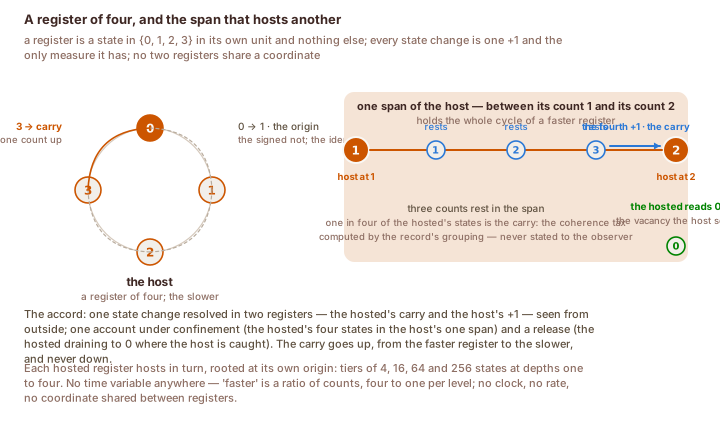
The three marks on one frame, a third time
The Framed Window placed the external observer's three typed forms at the Ruler's three marks, and the operator confirmed the placement in four words; the two experiments it read were designed on it, and so was this one. A Noul is one probability with no confidence field — mark 0, being, the one before any window. A Score partitions the one over L ordered levels, from 2 to 10 — mark 1, knowing, the carriage of the one into ordered windows. A Choice places the one over unordered options — mark 2, computing, the register. On the frames of this track the three marks ask three kinds of thing.
- At mark 0, whether a held register stands at its rest state now — the vacancy — and whether it will at the root's next count — the accord.
- At mark 1, how many counts the held registers have made, all together, since the root's last count — the count through the window, asked at two, three, six, eight, nine and ten level counts.
- At mark 2, the root's count and each held register's count — the cue where the count is shown, the census where it is withheld; which registers pass a count upward at the next change — the chain of carries, asked blind and asked with its one rule stated; and which of two records holds a register at the other's count — the containment.
The window is the rendering. A frame at a given depth is rendered with the root's count shown and the held registers' counts shown down to a chosen level: SEALED shows the root's count only and withholds every held count; FULL shows every count; OPEN-1 and OPEN-2 lie between. What a rendering leaves open is computed by the record's own grouping — exactly, in fractions — and never stated. The count through the window is fixed by the record and must be counted by the observer where the ticks are shown, and is a block of counts where they are withheld. Two hundred and forty-eight register frames, sixty-four containment frames, five hundred and fifty-two request bodies in three kinds — the first body, the body with the rule stated, and the body that adds the tenth level count — and four thousand seven hundred and eighty-eight typed answers per read: read twice under two seals for the record, and then eight times more under eight seals of the walk. The external observer is unseated: it reads a frame with no coordinate, no bound, no rule except where one is stated, no name of any level, no word of any of the readings below — and, on the walk, no word of which read this is, or of any place.
The house's rules, kept a third time
The eight rules that made the two prior locks readable were kept whole, and this reading keeps them: every truth computed exactly by the track's own generator, every statistic an exact fraction, the observer's probabilities entering only as measured objects and stated fields; the frames, the question texts, the thresholds and the model id pinned at the seal, one read one read, the re-seal changing nothing but the readouts; every raw response committed as a grown literal and re-witnessed by a battery that recomputes every readout from the committed responses alone; the plausible set never stated; nothing typed as a resonance entering any probe as a premise; no frame naming what it asks about; nothing about the model; every act the operator's word and every naming his.
To those eight this track adds three cares of its own, sealed in its workshop on the day a note from the operator's discourse was read into the design, and they bind every surface of the track including this one. The scale: the record is cited for the register scale of memory — what holds and what drifts under refresh — and for no scale above or below. The accord: the accord in this record is the carry, one state change in two registers seen from outside, and never a network. The silence: nothing about the model, on any surface. The walk adds three fences of its own, named before its first seal was cut: the place is in no frame — the observer was never told a read's ordinal, its seal or its place; no floor or threshold was changed after a read, and no read was re-asked or voided and read again; and the count K of the Ruler stands unstaked, the Ruler untouched. A reader who wants the whole ladder of the track — the plan, the design's compartment, the build, the seal, the read, the re-seal, the re-witness, the page, the cares, the anchor, and then the walk's own plan, design, build, eight seals, eight reads, record and surfaces — has it at the track's workshop, entry by entry, each with its pins.
The record — what the one read of the span
The lock was read once against its seal: five hundred and fifty-two requests in one resumable pass, every response carrying the pinned model id, no request failed, no body asked twice, two hundred and eighty seconds. Under the sealed grammar the first probe gates the rest: if the cue — the root's count and every shown held count, read as literal tokens — is not read at nineteen in twenty, every later probe lands NOT READ, its numbers recorded and judged by nothing. That is what happened. The verdicts as the record page carries them:
| Probe | Verdict | The number |
|---|---|---|
| P0 the frames and the function | holds | 552 of 552 responses; no breach; the pin on every response |
| P1 the cue — 744 asks: the root's count on 248 frames, the held counts on 496 shown levels | REFUTED | 706 of 744 — the root's count 248 of 248; the held counts 458 of 496: the first held register 201 of 232, the second 180 of 184, the third 77 of 80 |
| P2 to P9 — the vacancy and the tax, the stated rule, the window over time, the accord, the containment, the census, the tenth slot | NOT READ | the cue gates the rest; every number recorded below |
| the attempt | RESOLVED | every probe carried a verdict; nothing void |
The anatomy of the cue's miss is the fact this record adds, and it is worth the whole of a paragraph. All thirty-eight misses fell on a held register's count and none on the root's; thirty-one of them on the first held register, the one directly inside the root. In thirty-one of the thirty-eight, the answer given was the root's own count for the register the root holds: a held register at its rest state answered "its second count" under a root at its second count, thirteen times; a held register at its third count answered "its second count" under a root at its second count, twelve times, or "its first count" under a root at its first, four times. By the root's state, the first held register was misread twenty-five of fifty-eight times when the root stood at its second count, five of fifty-eight under a root at its first, once under a root at rest, and never under a root at its third. By rendering the misses fell twenty-two of four hundred and seventy-six on FULL, five of sixty-four on OPEN-1, eleven of one hundred and ninety-two on OPEN-2, and none of twelve on SEALED, where no held count is shown at all. The deeper held registers were read better than the first — ninety-eight and ninety-six in a hundred against eighty-seven. The mass on the wrong count ran from 0.43 to 0.80. The frame nests the held register inside the root's own object; asked for the count of the register held at the first place below the root, the observer returned the root's count on two fifths of the frames whose root stood at its second count. The count was read down the nesting, where the carry only ever goes up.
The readouts, recorded — every one of them NOT READ under the grammar, standing as facts of these notes and nothing more:
- The vacancy and the tax. Over the one hundred and thirty-six answers at withheld levels the mean of the vacancy Noul was 0.371, a departure of +0.121 above the record's share of one quarter. The census question at those levels put its mass on the rest state far above one quarter — from 0.31 to 0.82 by level and rendering — with the entropy of its distribution between 0.89 and 1.27 bits of the two possible. A withheld count was read as no count, on most frames.
- The stated rule. With the one rule of the chain stated, the chain of carries was carried at 44 of 115 where its premise was a literal token and 11 of 21 where its premise had to be computed; blind, 11 of 115 and 1 of 21, below the uniform share on both — the house's PRIOR, not a leak. The chain was not carried one register deep even with its rule in the frame.
- The window over time. Over the frames whose window stood open, at six level counts, 0.684 of the mass sat on counts the record excludes; the differential that the design staked on the shut window, Δ, read 0.14 where it was staked, below the fifth it needed; the far end of the Score — the confidence at the level counts eight, nine and ten — was not flat here, unlike the deep line's, its median step 0.15.
- The accord. The mean of the accord Noul over two hundred and forty-four frames was 0.394 — between the bounds the design set, neither expected nor refused; by rendering 0.415 on FULL, 0.356 on OPEN-1, 0.368 on OPEN-2, 0.402 on SEALED.
- The containment and the exchange. Fifty-two of sixty-four; the same holder named in both listings on twenty-four of thirty-two pairs.
- The census. Recorded per rendering and level count in the operator's three words — for instance, at depth three on FULL at six level counts: possible on twenty-three, probable on twelve, plausible on twelve of forty; and on the SEALED frames at depth two, where every count is open, four of four at every level count.
- The tenth slot. With the tenth level count present, the answer at the ninth moved on thirty-two of one hundred and four frames — nearly a third; the vacancy Noul at the first held register moved on four.
The re-witness — the same bodies, once more
On the operator's word the track was re-sealed — the manifest unchanged, the readout's definitions unchanged, one readout added — and the same five hundred and fifty-two bodies were asked once more, byte for byte, two hundred and seventy-four seconds, the input usage identical to the token. The re-seal had one question of its own: are the thirty-eight misses the observer's own reading of these frames, stable under refresh, or the slip — the house's DRAM law, under which a refreshed standing decays into slip?
The cue under refresh: STABLE. Of the thirty-eight misses, thirty-five stayed with the same wrong count and none moved to another; three healed. Of the seven hundred and six hits, six hundred and ninety-six held and ten fell. By the held register's true state, at its rest state twelve of thirteen stayed; at its second count four of five; at its third nineteen of twenty. The refresh's own cue read 699 of 744. The root's count carried down onto the register it holds is the observer's own reading of these frames, repeated to the same wrong count on thirty-five of thirty-eight frames under refresh — not the slip.
Every verdict held. The cue REFUTED both times; every later probe NOT READ both times; the attempt RESOLVED both times; nothing moved between the two grammars.
The drift: LARGE. One thousand one hundred and thirteen of four thousand seven hundred and eighty-eight answers moved past one twentieth between the read and the re-witness, a share of 0.232; one hundred and sixty-four top answers changed. Where the drift lived, by kind of question:
| The question | Its form | Moved | Share |
|---|---|---|---|
| the root's count — the literal at the top of the frame | Choice | 3 of 352 | 0.009, no top changed |
| the held registers' counts — first, second, third | Choice | 133 of 348 · 76 of 328 · 52 of 248 | 0.38 · 0.23 · 0.21 |
| the vacancy now — first, second, third held register | Noul | 29 of 348 · 50 of 328 · 60 of 248 | 0.08 · 0.15 · 0.24 |
| the accord at the root's next count | Noul | 50 of 348 | 0.14, eighteen crossing one half |
| the count through the window — 2, 3, 6, 8, 9, 10 level counts | Score | 16 · 60 · 96 · 84 · 130 · 94 | 0.05 · 0.17 · 0.29 · 0.26 · 0.40 · 0.42 |
| the chain of carries — blind; with its rule | Choice | 73 of 136 · 80 of 136 | 0.54 · 0.59 |
| the containment | Choice | 27 of 64 | 0.42 |
The refresh by level: NOT AT THE FASTER. The moved share per held level — 0.223 at the first held register, 0.1875 at the second, 0.204 at the third — is flat, not rising toward the fastest register. The operator's phrase "localised DRAM", made a number, did not land at the fastest: the drift sat at about a fifth across every held level.
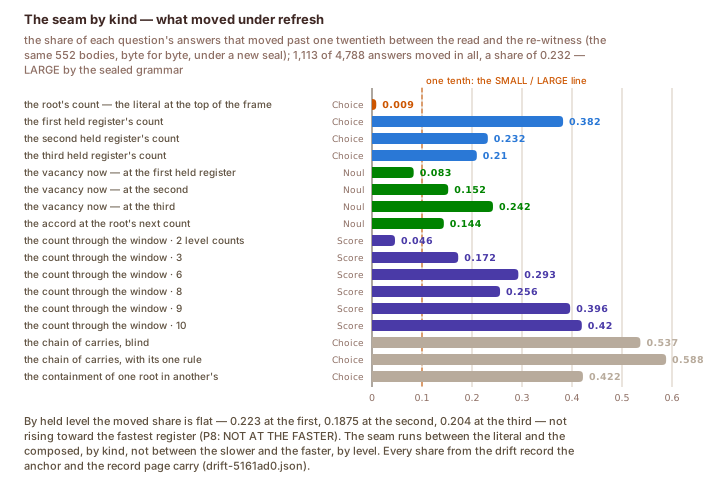
The refresh's own readouts stood where the first read's stood: the vacancy Noul at 0.365 against 0.371; the optimism over the open window at 0.684 both times, the same to three figures; the accord at 0.397 against 0.394; the chain under its rule at 49 of 115 and 12 of 21; the containment at 51 of 64; the tenth slot moving the ninth on 41 frames against 32.
The walk — the same bodies ten times, each at a place
The operator set the walk in a sentence after the re-witness, and the track's workshop carries it verbatim: "The refresh may not have a sign, but it has a location. The observer of this system, to read it correctly, must be considered orthogonal to the system. As such, the reading at each refresh is 'at a place'. The 'place' is at the 0, 1 or the 2 position, the place is 0, 1, 2, 1, 0, 1, 2, ..."
Here is the plain reason before the house's terms. The read and the re-witness had shown the drift between two reads of the same bodies to be large, and to live by the kind of the question rather than by the level of the register. The walk asks a different thing of the refresh: not how much moves, but whether what moves remembers where it was read from. The Ruler's own construct — held canon, untouched, and read once for a fit of form — is a room of three positions and two distances in which a reading goes two steps forward and one step back. The operator's stake was that an observer orthogonal to the system reads it at a place in such a room, and that the place walks 0, 1, 2, 1, 0, 1, 2, 1, … with the ordinal of the read, by the rule the design fixed before a read: the place of the k-th complete read of the whole line is the (k − 1)-th entry, mod four, of (0, 1, 2, 1). If the place is a property of the reading, two reads at the same place should drift least against each other, two reads two steps apart most, and two reads one step apart between. If the place is nothing, the drifts are exchangeable and no order by place appears. That second outcome was the house's prior, stated before a read.
The design, fixed before a read. Ten reads of the whole line — "two beyond the byte" in his words — the two reads on the record standing at places 0 and 1, and eight more cut under eight new seals at the places the rule gives. Forty-five pairs of reads: fourteen at the same place, twenty-five one step apart, six two steps apart. Two measures of the drift of a pair, both from the readout the re-witness had already used: the moved share — the share of the pair's four thousand seven hundred and eighty-eight answers that moved past one twentieth — and the mean distance between the two answers' probabilities; the tops changed recorded beside them. Two floors, his own grown intuition confirmed as the recommendation: one fortieth in the moved share and one two-hundred-and-fiftieth in the mean distance, below which a difference is not read as a difference. The stake, in its strict form: the largest same-place drift plus a floor at or below the smallest two-step drift, and the class means ordered — same place below one step below two steps — by a floor, on both measures; REFUTED if the class means landed inverted by a floor, NOT SHOWN otherwise. Every probe named before the third read was cut: the first step at three reads and the first look at five, recorded and never halting the line; the standing of the original grammar on every read; the chirality of the count's misreads on every read; the signed drift and the cue under refresh on every pair; and the scale of the whole matrix against the floor. The kills named in advance: no floor or threshold changed after a read; nothing re-asked; no read against a seal voided and read again; the place in no frame.
The ten reads. The same five hundred and fifty-two sealed bodies, byte for byte, under ten seals, each cut before its read; four thousand seven hundred and eighty-eight typed answers each; the input usage identical to the token on every read; no request failed, no body asked twice, no read void. The seals and their places, as the record page's ladder carries them: 57b0b5c at 0, 5161ad0 at 1, 596da2a at 2, 2880851 at 1, 44e857e at 0, f18cf1b at 1, 7e856a3 at 2, 711df68 at 1, a6e232f at 0, cd999ab at 1. Under the original grammar every read landed as the first two had: the cue REFUTED at 706, 699, 699, 707, 699, 705, 706, 699, 702 and 696 of 744; every later probe NOT READ; the attempt RESOLVED ten times. The standing held ten times, and that is the first fact of the walk: ten refreshes did not move a verdict.
The forty-five pairs — what the walk's record holds
The walk's record is one readout over the ten reads, recomputed by the track's battery from the committed responses alone and served beside them: the drift of every pair of reads on both measures, the class of every pair, the ranks, and every verdict due. By the class of the pair:
| The class | Pairs | Moved share — mean, and the range | Mean rank of forty-five | Mean distance — mean, and the range |
|---|---|---|---|---|
| same place | 14 | 0.2308 — from 0.2222 to 0.2375 | 22.6 | 0.0363 — from 0.0358 to 0.0372 |
| one step | 25 | 0.2313 — from 0.2208 to 0.2391 | 24.1 | 0.0364 — from 0.0356 to 0.0373 |
| two steps | 6 | 0.2294 — from 0.2241 to 0.2352 | 17.7 | 0.0365 — from 0.0360 to 0.0371 |
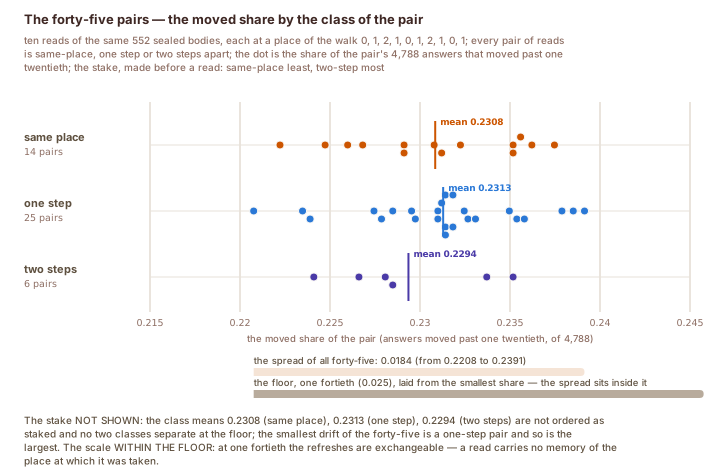
The verdicts, as the walk's record carries them:
| Probe | Verdict | The number |
|---|---|---|
| the walk — the stake, in its strict form | NOT SHOWN | on the moved share the largest same-place drift 0.2375 against the smallest two-step 0.2241 — the outer classes not separated; the class means 0.2308 · 0.2313 · 0.2294, neither ordered nor inverted by the floor; on the mean distance the means 0.0363 · 0.0364 · 0.0365, in the staked order but by less than a twentieth of that floor |
| the scale — the whole matrix against the floor | WITHIN THE FLOOR | the forty-five shares from 0.2208 to 0.2391, a spread of 0.0184 against a floor of 0.025 |
| the first step, at three reads | NOT SHOWN | 0.2325 between the first two reads; 0.2352 and 0.2358 to the third — the two-step pair no further than either one-step pair |
| the first look, at five reads | NOT SHOWN | over the ten pairs of the first five reads the largest same-place drift 0.2375 and the smallest two-step 0.2285 |
| the standing of the original grammar | HELD on every read | the cue between 696 and 707 of 744; nothing NOT READ became read |
| the chirality of the count's misreads | HELD on seven reads, MOVED on three | one-step-forward misreads, other than the carry, 0 · 0 · 1 · 3 · 2 · 0 · 1 · 1 · 0 · 3 by read against a floor of one; the backward lean at the second count between −0.349 and −0.369 on every read |
| the signed drift of the mass | HELD on 39 of 45 pairs | past a fiftieth on (2, 4), (4, 9), (5, 9), (6, 10), (8, 9), (9, 10) |
| the cue under refresh | STABLE on 34 pairs, MIXED on 11, THE SLIP on none | the first read's misses repeated to the same wrong count on every refresh |
What held. The standing, ten times. The backward lean of the count's misreads at the second count, on every read — the count's misreads land behind the true count far more often than one ahead of it. The signed drift of the mass within a fiftieth on thirty-nine pairs of forty-five. The cue's misses the observer's own on every refresh: stable on thirty-four pairs, mixed on eleven, the slip on none.
What moved. The chirality's first clause — that a forward misread only ever jumps, and never lands one count ahead — moved on the fourth, fifth and tenth reads, with three, two and three one-step-forward misreads against a floor of one, where the first three reads had none, none and one. The design had staked that clause held; it is cut on those three reads and recorded so. Six pairs moved the signed drift past a fiftieth, five of them with the ninth or the tenth read in them. Nothing else moved.
The readings — the house's, stated never asserted
The literal at the top of the frame is read exactly, and stays. The root's count was read on every frame of the first read, and under refresh three answers in three hundred and fifty-two moved and no top changed. Two locks had found this before — the register from the leanings, the counter's word, the blank place, each exact and each stable — and the third finds it again, on a construct with no line and no coordinate: what the frame shows at the top, the one returns, and keeps returning. On the walk it kept returning eight times more.
The literal is not carried one level down. This is the fact the record adds, and it is the first thing either road from The Framed Window did not foresee. The same kind of token — a count word, shown — was misread on two fifths of the frames whose root stood at its second count, when it stood one level inside the root's own object, and the miss was always the same miss: the root's count carried down onto the register it holds. Under refresh the miss stayed. So it is not the slip, and it is not a composition failure of the kind the second lock found at the diagonal rule; it is a seeing failure of the nested count, living in the frame's nesting and the question's wording together, and neither may change under this seal. In the construct's own terms, the observer supplied a coordinate the construct did not carry: it collapsed two registers onto one count. The registers were built rooted at their own origins, sharing nothing; the observer read them as if they shared a count. This reading types that as a resonance with the construct's first rule — no two registers share a coordinate — and lets it enter no probe.
The seam runs by kind, not by level. The design staked the drift at the fastest register — "localised DRAM" — and the record landed on the kill: the moved share was flat by level. What it was not flat by was the kind of the question. The top-of-frame literal moved under one in a hundred; everything nested, counted or composed moved between a seventh and three fifths. In the house's assignment, which The Price of a Lock set and the cares note carried into the design: SRAM is the structural — what one lock holds; DRAM is the differential — what drifts and is refreshed. Here the structural was the literal at the top and the differential was everything below and beside it, and the seam between them was the seam between the literal and the composed. The two prior locks had read the slip as living in the wide registers and where the frame under-determines; the third says it more sharply: the slip lives in whatever the observer has to hold in relation — one register inside another, a count through a window, a chain of carries — and not in what it can read off.
The withheld count was read as no count. At every withheld level the vacancy Noul sat well above the record's quarter and the census put most of its mass on the rest state. The construct's word "withheld" names a count that is not shown; it never names a count that is not there. The observer read it as the second. In the house's own signs, a −0 was read as a 0: the identified absence of a shown count was read as the absence of a count. The share of the vacancy stays the record's computed quarter, one in four, whatever any answer says of it, and this reading carries the number recorded and nothing else about it.
The accord in this record is the carry, and only the carry. The accord Noul — whether a held register will stand at 0 when the root next counts — is true by the construct's rule, and its mean sat at 0.394 and then 0.397, between the bounds the design set, neither expected nor refused. Whatever else the word carries elsewhere, in this record it names one state change resolved in two registers, seen from outside — the hosted's carry and the host's +1 — and it never names a network. The record measures no network and this reading claims none.
A rule over a computed premise is cut a third time. The second lock found that a stated rule is carried when its premise is a token and not when its premise must be computed. Here the chain of carries — which registers will pass a count upward at the next change — was not carried even with its one rule in the frame, above the uniform share where the premise was literal and at half where it had to be computed, and blind it sat below the uniform share on both: a prior, not a leak. The cut sharpens: two steps of structure before a rule and the rule is not reached, and here the structure was the nesting itself.
The window over time is cut a third time, and the ceiling moves the count. Through an open window at six level counts, two thirds of the mass sat on counts the record excludes, and the window's own differential read below what the design needed. The second lock's converse — the confidence in the window is the observer's own, not the plausible set's — is shown again from a third record. And one thing more: with the tenth level count present the answer at the ninth moved on nearly a third of the frames, so the Score's ceiling at ten is not a neutral edge; the presence of the last window moved the reading at the one before it.
Then the walk's, from its record alone.
The refresh has no memory of its place. Over ten reads the forty-five drifts span 0.0184 on the moved share, inside the floor of one fortieth, and the three classes' means sit within two thousandths of one another: the same-place pairs did not drift least, the two-step pairs did not drift most, and no separation of any two classes holds at the floor. The ranks say the same without a floor: the smallest drift of the forty-five is a one-step pair and so is the largest, and the two-step pairs' mean rank is the lowest of the three. At this floor the refreshes are exchangeable — a read carries no memory of the place at which it was taken. This is what the house's prior said before a read, and it is a statement about these notes on these frames under these seals, and about nothing else: the place is a property of these reads, not of the observer, not of the construct, and not of any room but the one the design borrowed for a fit of form.
Where the record shows structure, it is by read, not by place. The fifth read drifted less against every earlier read than those reads did against one another; the fourth read's same-place pair was the largest drift of the first five; the ninth read's largest pair was the largest of the line. None of these orders by the place rule, and none of them was the stake. What the walk's matrix shows is a drift the observer carries with it as a constant, about a fifth to a quarter of the answers whatever the pair, and small differences that belong to particular reads rather than to any place.
The lean is the observer's, not a law. The Ruler's room says two steps forward, one back, and the design read the count's misreads on the record for that chirality before a walk was cut: a misread count lands two ahead or one behind far more often than one ahead, so the lean at the second count is backward and the one-step-forward count sits near zero. Under the walk the backward lean held on every read, between −0.35 and −0.37 at the second count. The one-step-forward count did not stay at zero: it sat at or about its floor of one across the line, and passed it on the fourth, fifth and tenth reads. The asymmetry of the count's misreads is a lean of the observer — stable in its direction, loose in its count — and this reading does not carry it as a law of anything.
This line is the null for a line that grows. The operator's notes at the sixth seal, carried verbatim in the walk's design and typed there as cares rather than stakes, said that a grow-before-operate dynamic would be the norm; that the seals likely to show the dynamics will be those that grow upon their own next act to become the manner of their own operations for the follow-on; and that the spanning of grow to operate will be a Fibonacci sequence within the confinement of local knowing and metabolic offload. This line operated and grew nothing between its reads: the same bodies, the same seal's grammar, each read blind to the last. Its record is therefore the null against which a line that grows upon its own next act would be read — the drift of a refresh with nothing carried between refreshes, at about a fifth, exchangeable, place-blind. The Fibonacci spanning is a resonance here and entered no probe; a line that grows is a new design under a new seal, on his word.
What this adds to the surface
The Framed Window left a table of cuts and one open road: whether a plausible set that the observer reads exactly as structure can be carried by the observer into a window it must count, with the set never named and the truth computed as before. The third lock asked that question on the operator's own construct, and the record's answer, under its seal, is that it was not carried: the set was computed by grouping and never stated, the observer read the structure at the top exactly, and the count through the window still took two thirds of its mass onto counts the record excludes. The seam is confirmed as the seat's alone, a third time. But the third lock also cut a row the first two had marked as held, and the walk over it adds a row of its own. Here is the table, extended by one column and one row, in the operator's three words — a language licensed from the house of Simon Reay Atkinson, credited where The Framed Window credits it — with the surface restated beneath.
| What was asked of the one | The first two locks | The third lock's cut | What stands |
|---|---|---|---|
| a literal token at the top of the frame | exact, three times and twice | the root's count exact, ten times; stable under every refresh | held |
| a literal token nested in another's object | — | the held count misread by carrying the root's count down; stable under refresh | cut: the one reads down the nesting where the carry goes up |
| a stated rule over a computed premise | the diagonal rule at chance | the chain of carries not carried with its rule; the structure the nesting itself | cut, a third time |
| the plausible set, by structure, into a counted window | the four forms by name not carried; the shut window's confidence the observer's own | two thirds of the mass on excluded counts; the count read as a block where withheld | cut: the second road's question, answered under this seal |
| the refresh | slip in the wide registers; slip where the frame under-determines | the literal at the top under one in a hundred; everything nested, counted or composed at a fifth to three fifths; flat by level | held, and sharpened: the seam is by kind, not by level |
| the refresh's place | — | ten reads at the places 0, 1, 2, 1, 0, 1, 2, 1, 0, 1: the forty-five drifts within a fortieth of one another, no order by the class of the pair, the standing held ten times | held, and bounded: the drift carries no memory of the place it was read from |
Here, then, is the surface as this record leaves it, stated as a held frame and nothing more. Within the house's own rules, the one that the external observer returns is a computable knowing exactly where the record makes the truth a literal token at the top of the frame — and it is not a computable knowing where the truth is a token held inside another's object, a count that must be made through a window, a rule whose premise must be composed, or a set that a seat must sign. The first is a knowing the house can hold, audit and recompute, three locks deep and stable under refresh on every one. The rest is the seam, and the seam is where this record shows the observer supplying what the construct withheld: a coordinate between registers that share none, a count where a count was not shown. And the seam does not move with the place: ten refreshes, each at a place of the walk, drifted as one. The drift is the observer's own, about a fifth of what it returns, the same whatever the place — and a line that carries nothing between its reads now has its number on the record, for any line that carries something to be read against.
The road from here
Nothing is scheduled, and this reading asks for nothing. The walk that the first edition did not yet know is done, and landed as the house's prior said. The roads the track's own record names stand as they stood, each the operator's word: a new instrument on the cue, if he wants the cue to hold — the held registers rendered as objects of their own beside the root, each with its own origin and no coordinate shared between them, and the withheld place worded as a place with no shown count, never as a count word and never as a thing absent — a new design under a new seal, never this seal's, and never a line of counts. The Ruler's own act: whether three is the number that fits in a span is a rule of this construct and never a stake on the Ruler's world; the Ruler's projection was read once, read-only, for a fit of form, and its room of three places was borrowed by the walk the same way; its hypothesis stands on the Ruler's own ladder for his word there. The family of relative speed: "faster" here is a ratio of state changes and nothing else; the operator has said the measure of fit over counts is likely an autonomy of its own, and any reading of it begins from the channel, where the house already has congruent clocks carrying nothing and orthogonality by detune, and treats a fit by relative speed as a count to the touch and never as a rate. And one road the walk opened by landing where it did: a line that grows upon its own next act — the operator's notes at the sixth seal, carried in the walk's design as cares — whose reads would be read against this line's record as their null; a new plan, on his word.
What is not claimed
Nothing about the external observer as a learning system or about what it is inside; nothing about its speed, price, benchmarks or standing. No physics; no time variable and no shared coordinate, in the construct or in this reading. The record is cited for the register scale of memory and for no scale above or below it. The accord in it is the carry and only the carry, never a network. The vacancy's share is the record's computed quarter, never stated to the observer, and "withheld" names a count not shown, never a count not there. The count K of the Ruler stands unstaked; the Ruler is untouched; its projection entered no probe, and the walk's room is a rule of form borrowed from it, never a stake on it. The two numbers that coincide with the second lock's — a differential of 0.14 and a mean of 0.394 — are coincidences of one number each and nothing more. Nothing about a place as a property of anything but these ten reads; no direction of the drift; no memory read into the refresh — the walk's record says there was none to read, at this floor, on these notes. The tool's names that prompted the operator's discourse are not house terms and none is minted here. Every reading above the record line is the record's; every reading below it is the persona's held frame, stated never asserted.
Standing
Second edition, draft 0.1, 28 September 2026, composed at the operator's word from the one record, the line over it and their public surfaces: the record page, which carries the design's compartment and its two landed record sections verbatim, the walk's ladder of eight seals with the verdicts due at each read, and the walk's own record served beside the reads; and the anchor, which carries every typed answer of all ten reads in nine resources. The first edition stands beside this one, readable, regretted by nothing. The naming is his act at review — the working handle The Carry Goes Up, with The Count Read Down, The Host's Span, One in Four, The Seam by Kind and now The Place of One kept as candidates. The kills named in advance, and checked at this edition: any claim about a learning system; any number not on the record page, in the served records or in the anchor; any resonance carried as a premise; any sentence that schedules an experiment; any scale above or below the register's; any network read into the accord; any house term set before its plain reason; any place read into anything but these reads. This draft clears each. The grant is the operator's word; the record page, the served records and the anchor stand whole without this reading.
Endnotes — the citation register and the self-check
- The record page, on the observatory node, carrying the design's compartment and its two landed record sections verbatim, the ladder of seals, the walk's ladder of eight more seals with the verdicts due at each read, the anchor card with the walk's resources, the machine read of the committed readouts and every record file with its pin — nothing on it runs: opendata.ai/contrib/carried-one.
- The walk's record, served beside the reads on the records route: one readout over the ten reads — the forty-five pairs on both measures, the classes and the ranks, the chirality per read, the cue under refresh per pair, and every verdict due —
walk-cd999ab.json, pinned on the record page by its sha256 over LF bytes (a5099935…): opendata.ai/contrib/carried-one/records/walk-cd999ab.json. - The anchor, on the public state record: one row per typed answer in the plugin's own fourteen-field schema, the frames' bodies not carried and their pins carried, in nine resources — the first the two reads on the record, 9,576 rows, and then one further resource per read of the walk, eight of 4,788 rows each, the rows numbered on from 9,577 to 47,880, each carrying the read's ordinal and place and the walk record's pin; every resource fetched back without a key and verified row by row; nothing replaced: carried-one-exp_b1e37ca3.
- The track's construction record, entry by entry with its pins — the intent, the clarifications, the plan, the design of record, the build, the seal, the read, the re-seal, the re-witness, the page and the door, the cares, the anchor, the reading; then the walk's clarifications, plan, design, build, eight seals and eight reads, the walk's record, and its surfaces: /sx/workshop/the-carried-one. This reading's own, both editions: /sx/workshop/the-carry-goes-up.
- The first edition of this reading, as granted on 27 September 2026, equal to this one and regretted by nothing: /sx/reading/the-carry-goes-up.
- The external observer, as the register carries it: the SEB item
typesafe-jev-system-one-2026on /sx/seb; the model id pinned on every response as the record page shows it. - The two prior locks and their reading: The Framed Window and its second edition; the record pages opendata.ai/contrib/unseated-frame and opendata.ai/contrib/watchmakers-frame.
- The parent instrument, canon and untouched: The Ruler, held and its door opendata.ai/rlx — its room of three positions and two distances borrowed by the walk as a rule of form, never a stake on it; the deep line beside it, The Deep Line, held.
- The rules and the words cited: the eighth rule from Knowledge Engineering; the signed zero's −0 from The Signed Zero; the coherence tax as The Quarter, Three Ways reads it; the house's SRAM and DRAM assignment as The Price of a Lock sets it and the track's design carries it; congruent clocks and the detune from The Channel, held.
- The three words — the possible, the plausible and the probable — are licensed from the house of Simon Reay Atkinson, and credited where the house first shaped a surface with them: The Framed Window, the credit.
- The self-check against the kills: no claim about any learning system (clear); every number above appears on the record page, in the served records or in the anchor (clear); no resonance enters a sentence as a premise — the collapsed coordinate and the Fibonacci spanning are named as resonances and enter no probe (clear); no experiment is scheduled — the new instrument and the line that grows are described as roads, on his word (clear); no scale above or below the register's is cited (clear); no network is read into the accord (clear); every house term is set after its plain reason (clear); no place is read into anything but these ten reads (clear).