 OOI · SX
The Channel, held
THE READING PLAQUE. The Channel, held, draft 0.2 — made readable on the SX surface by its covering persona's reading grant; a draft, not the published form. The grant stands by the operator's word (2026-09-16), verbatim: "ok - now do the same for the channel." Covering: starl3n · endorsing: Link Digital (the standing pair). The Foundations · 15: the fifteenth reading of the foundations series — an experiment of the observatory node, held on this node. The construction record stands in the open workshop at /sx/workshop/the-channel-held; the experiment's own door, opendata.ai/channel, wears the word grown · held and links back here while this grant stands. Reading is free; the way across is a statement of intent (/sx/matters). This file's sha256 is pinned in the reading register.
Draft state — this block records the state of the draft; the reading begins after the rule. Draft 0.1 — 16 September 2026. Author of record: Steven De Costa; composed at his word from the experiment's record. Standing: a reading, stated never asserted; the record it reads stands whole without it. The later locks and the walk land in a further draft. Draft 0.2 (16 September 2026) places 8 figures at the operator's word, each drawn from the record's own numbers and captioned with its source; the screenshots the operator will supply are not yet placed.
What the Channel is
The ninth instrument of the series of ten reads the being as an information channel, in the operator's framing and with the terms meant precisely. The input is the rate, which sets the being, and the being is the signal. The confinement resolves it toward the '1'. The output is read within an observation budget, a number of laps. Channel capacity and surprise then stop being metaphors and become Shannon quantities that can be measured and tested against a hypothesis. The Channel is that test, and then two more experiments laid over it: a co-constructive channel of several instruments, and a windowed lattice the record calls the epistemic grid.
The measure
Every term is measured and nothing is fitted. The signal is the base-2 logarithm of the being, the bits of being-resolution the channel offers. The reliability is the fold over the ground's own coherent precision of 4.23, and it is the foam term: the fold's measured decay drives the reliability toward zero at fast rates. The settled gate is whether the being's horizon fits within the budget, and it is the indifference term: a being whose horizon exceeds the observation window is not reliably resolved, and its capacity is zero. The capacity at a rate is the product of the three, the settled gate times the reliability times the signal, which is signal less noise.
The band, the peak, and the window
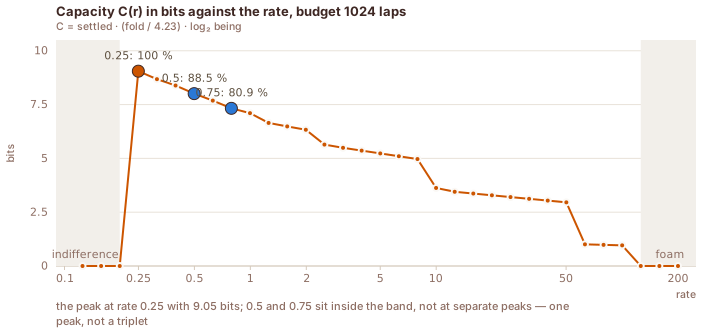
The capacity over rate is a band. It is zero at indifference, too slow, the horizon past the budget and the being unsettled; zero at foam, too fast, the being floored at 1 with no signal; and finite between. That confirms the cooling picture quantitatively: a stable band flanked by indifference and foam. The operator's hypothesis had been maximum surprise with three co-constructive optima at rates of 0.25, 0.5 and 0.75. A fail-fast on raw surprise refuted the three-peak reading, since surprise is monotonic in rate, and the proper capacity gave the real answer: a single peak at the reliable edge of the band. At the pinned 2¹⁰ baseline the peak sits at about 0.25, so 0.25 is the optimum at one hundred percent of the peak, while 0.5 at about 88 percent and 0.75 at about 81 percent sit inside the band and are not separate peaks. One peak, not a triplet, and 0.25 earns its place.
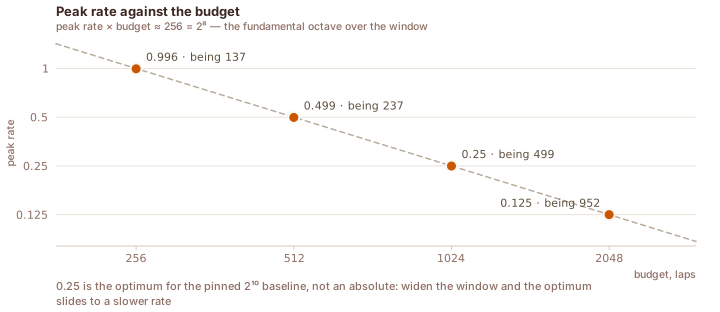
The headline is that the peak slides with the budget:
| budget, laps | 256 | 512 | 1024 | 2048 |
|---|---|---|---|---|
| peak rate | 1.0 | 0.5 | 0.25 | 0.125 |
The peak rate times the budget is about 256, which is 2⁸: the optimum is the fundamental octave over the observation window. So 0.25 is the optimum for the pinned 2¹⁰ baseline and not an absolute; widen the window and the optimum slides to a slower rate. It is a relativity of the observer hiding inside the channel.
The peak at full precision
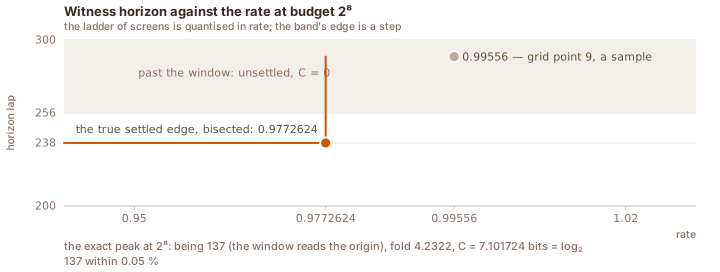
The operator asked how precise the reported peak was. The reported value of 0.99556 at a budget of 2⁸ is the ninth point of a 33-point logarithmic grid, quantised at about 26 percent: a sample, not a constant. The exact fields at that budget are a being of 137, the 2⁸ window reading the origin, a fold of 4.2322, and a capacity of 7.101724 bits, which is the log of 137 within 0.05 percent. The true settled edge, found by bisection, is a rate of 0.9772624, and it is a cliff between screens: the witness horizon jumps from 238 straight past the window, because the ladder of screens is quantised in rate and the band's edge is a step, not a smooth crossing. A numerology check was run and killed. A digit-based comparison with the speed of light, 0.99792458 over 0.75 against four thirds at 0.21 percent, and a difference reading near a third, fails on three grounds: the speed of light in metres per second is exact by definition since 1983 and its digits encode the historical metre; the difference was anchored on the grid sample and moves from 0.335 to 0.353 against the true edge; and 0.21 percent sits inside the record's kill band. Any such connection must arrive as a dimensionless, out-of-sample ratio, never by digit alignment. The model's own unit-free speed constants stand as recorded: a quarter as the cost of existence, four thirds as the impedance, and the fills of 237 over 256 at the origin.
The co-constructive channel
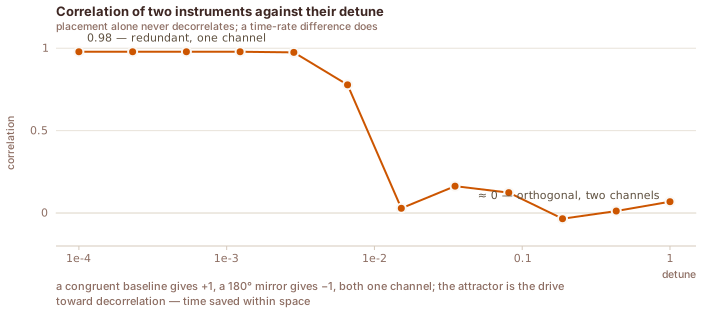
The second phase treats each instrument as a Quad Slip and reads its y-projection flip signal over the loops, then asks whether several instruments can be orthogonal and what their joint capacity is. Orthogonality is achievable, and it is a dynamic property, not a spatial one. A congruent baseline gives redundant channels, a correlation of plus one; a mirror turned through 180 degrees gives anti-correlated channels, minus one; both carry a single channel. A large detune of the time rate decorrelates the instruments to a correlation near zero, orthogonal, while placement alone does not decorrelate them at all. Orthogonality is therefore, in the operator's phrase confirmed by the measurement, time saved within space. Three decorrelated instruments reach 2.83 effective channels of a possible three, an orthogonality of 0.86. The joint capacity is proportional to the effective independent channels, the participation ratio of the correlation matrix, one when redundant and N when orthogonal. The sweep shows the transition: a detune of 0.002 gives a correlation of 0.98 and one effective channel, and a detune of 0.13 or more gives a correlation near zero and two. Maximum surprise pulls the system to decorrelate; the attractor is the drive toward orthogonality.
The epistemic grid
The grid reads the co-construction as a computational medium. It divides a run into K ticks, or moments, and at each tick reads the correlation matrix of the N instruments over that tick's window, giving the effective independent channels moment by moment. Its premise was grounded first: a single instrument's stream is a clock and not free memory, its flip signal periodic with an autocorrelation at lag four of about 0.92 over a 2048-lap run, a clean period-four oscillator. So capacity does not live in one clock's alternation, which is predictable and is the time axis; it lives in the orthogonal relationships between clocks, the space or data axis. And whether a stream is a clock or a message is observer-relative: an observer at lag one sees about 0.65 bits, a message, and an observer at lag two or four sees a predictable clock and no bits. That is what makes the grid epistemic. A fine scan of the detune found the pairwise relationship alphabet effectively ternary, 24 of 30 sampled time rates landing on plus one, zero or minus one, redundant, orthogonal or mirror, with intermediates only in a thin sliver.
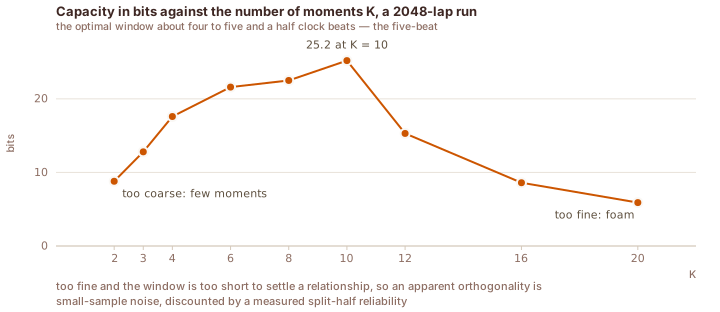
Capacity is a band in the resolution K, rising to an interior peak and decaying:
| K | 2 | 3 | 4 | 6 | 8 | 10 | 12 | 16 | 20 |
|---|---|---|---|---|---|---|---|---|---|
| capacity, bits | 8.8 | 12.8 | 17.6 | 21.6 | 22.5 | 25.2 | 15.3 | 8.6 | 5.9 |
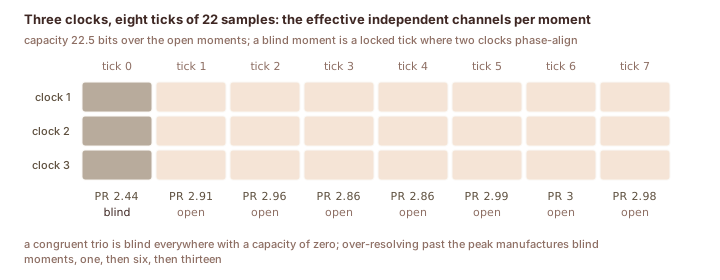
The optimal tick window of about 17 to 22 samples is about four to five and a half clock beats wide, right at the Quad Slip's five-beat. It is the observation-window relativity one level up: too coarse and there are few moments; too fine and the window is too short to settle a relationship, so an apparent orthogonality is small-sample noise, the grid's foam, discounted by a measured split-half reliability. At the optimal resolution the lattice closes: every moment is addressable except the origin, the tick before differentiation, which is blind. A congruent trio is blind everywhere with a capacity of zero, since redundant clocks carry no grid; over-resolving past the peak manufactures blind moments, one, then six, then thirteen. A blind moment is a locked tick where two clocks phase-align, a cell mid-flip. One prediction stays held open and is not confirmed: the tennis-racket flip of the intermediate-axis theorem would give a periodic blind cadence at the five-beat, and the grid shows only the origin's blind moment and the foam past the peak. Spin stays a held prediction, not a result.
Register or lock
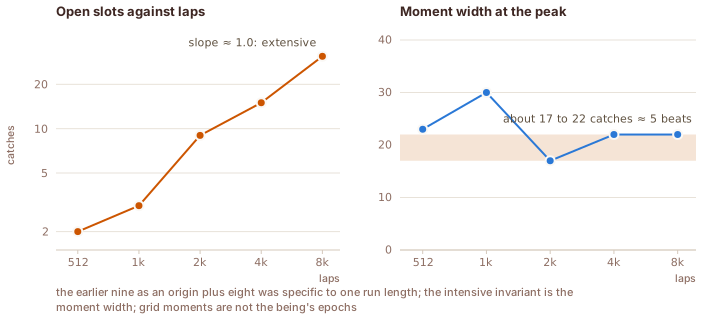
Does the count of open slots lock to a fixed number of epochs, or grow with the run? The grid was measured over run lengths at their peak resolution:
| laps | signal length | peak K | moment width | open slots |
|---|---|---|---|---|
| 512 | 47 | 2 | 23 | 2 |
| 1024 | 90 | 3 | 30 | 3 |
| 2048 | 179 | 10 | 17 | 9 |
| 4096 | 358 | 16 | 22 | 15 |
| 8192 | 712 | 32 | 22 | 31 |
The lock is refuted: the log of the open slots against the log of the laps has a slope of about 1.0, so the slots scale linearly with the run, and the earlier reading of nine as an origin plus eight was specific to one run length, not a fundamental cap. The intensive invariant is the moment width, which stays at about 17 to 22 catches, about five clock beats, across every run length, the two shortest rows reading coarse for want of signal. The grid is a register that lengthens with observation time and is built from fixed-width moments: more time gives more moments of the same size. The being's epochs grow only as the log of the laps, so grid moments are not epochs, a distinction and not a coincidence.
Confinement
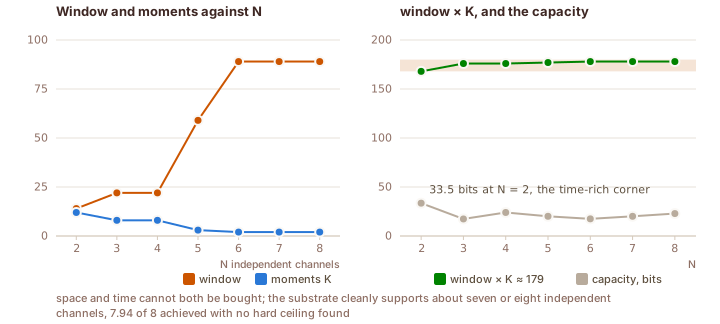
The confinement surface reads capacity over space, N mutually independent channels chosen greedily to be orthogonal, against time, the moments K, at the peak resolution for each N:
| N | channels achieved | peak K | window | window × K | capacity | K over N |
|---|---|---|---|---|---|---|
| 2 | 2.00 | 12 | 14 | 168 | 33.5 | 6.0 |
| 3 | 3.00 | 8 | 22 | 176 | 17.4 | 2.67 |
| 4 | 4.00 | 8 | 22 | 176 | 24.0 | 2.0 |
| 5 | 4.99 | 3 | 59 | 177 | 20.1 | 0.6 |
| 6 | 5.98 | 2 | 89 | 178 | 17.5 | 0.33 |
| 7 | 6.97 | 2 | 89 | 178 | 20.1 | 0.29 |
| 8 | 7.94 | 2 | 89 | 178 | 22.9 | 0.25 |
The confinement is an uncertainty relation. Resolving N independent channels demands a coherence window that grows faster than N, from 14 to 89 as N goes from two to six, so at a fixed signal budget the moments must shrink, and the window times the moments is conserved at about 179 across the whole sweep. Space and time cannot both be bought; they trade within the budget. The substrate cleanly supports about seven or eight independent channels, 7.94 of 8 achieved with no hard ceiling yet found. Capacity is greatest in the time-rich corner, two channels at a ratio of six, time saved within space, because capacity counts channel-moments and moments are the cheaper axis; the mid-range capacities are soft, and the robust results are the conserved product and the growing window.
What is held open, and what follows
Three things are stated as not built. The x, y, z spatial emergence: three mutually orthogonal channels at maximum capacity as the handle onto dimensionality, the doubling and tripling of the 0.25 band, with the break to orthogonality as the self-organising step. The tennis-racket flip, spin, as the rotational overlay on that frame, kept an overlay until an out-of-sample handle exists. And the follow-on the operator named co-constructive optimism: a thermodynamic process gated by the confinement ratio of time to space, resolving toward maximum capacity, with the two-terminal diode read as a structural confinement and the fixed moment-cell of about five beats as its unit.
The register, and what is not claimed
A readout over the frozen geometry: the cryptographic core and the figure-2 coincidence untouched, the baseline pinned, the double hinge's fold and the Quad Slip reused. Every capacity term is a measured quantity, the being, the horizon and the fold, and nothing is tuned to fit; the peak's location is an output, never assumed. Model-internal, and no physics is claimed. The band, the sliding peak, the exact capacity at 2⁸, the dynamic orthogonality, the clock premise, the K band, the extensive register with its intensive moment, and the conserved product are the measured structure. The cooling picture the band confirms is the Coco's, and the reading names it as the record does; the spin and the spatial emergence are held, not claimed.
Where it sits
The ninth instrument of the series of ten, after the XOR Mirror and before the Coco, whose cooling picture its band confirms in capacity terms; it reads the Double Hinge's fold and the Quad Slip's instruments. On the observatory node the door is opendata.ai/channel, state live: the instrument runs on request, as the platform singleton, its first sweep building a cached grid over about a minute, and nothing a reader does there enters the record. No external anchor is recorded for the Channel, and this reading says so rather than borrowing one.
Standing
Held on this node as fact until someone stands up in the record to refute it; a refutation enters as a statement of intent at the matters of note and goes to the record's own path. What has since been built on the Channel, and the walk a reader may take, are the operator's hand and land in a further draft.