 OOI · SX
The XOR Mirror, held
THE READING PLAQUE. The XOR Mirror, held, draft 0.2 — made readable on the SX surface by its covering persona's reading grant; a draft, not the published form. The grant stands by the operator's word (2026-09-16), verbatim: "ok - now do the same for the xor mirror." Covering: starl3n · endorsing: Link Digital (the standing pair). The Foundations · 11: the eleventh reading of the foundations series — an experiment of the observatory node, held on this node. The construction record stands in the open workshop at /sx/workshop/the-xor-mirror-held; the experiment's own door, opendata.ai/xor-mirror, wears the word grown · held and links back here while this grant stands. Reading is free; the way across is a statement of intent (/sx/matters). This file's sha256 is pinned in the reading register.
Draft state — this block records the state of the draft; the reading begins after the rule. Draft 0.1 — 16 September 2026. Author of record: Steven De Costa; composed at his word from the experiment's record. Standing: a reading, stated never asserted; the record it reads stands whole without it. The later locks and the walk land in a further draft. Draft 0.2 (16 September 2026) places 3 figures at the operator's word, each drawn from the record's own numbers and captioned with its source; the screenshots the operator will supply are not yet placed.
What the XOR Mirror is
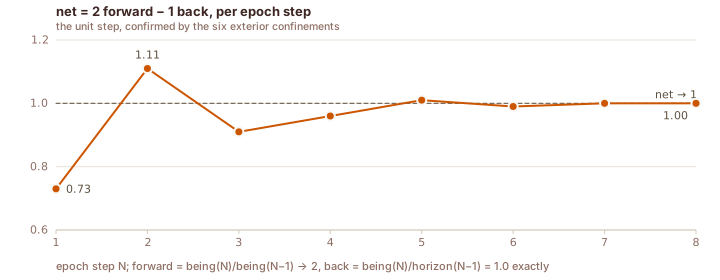
A single '1' cannot measure itself. The Equivocation's finding was that 952 − 1 is not 0 unless something from beyond the horizon is injected: the closure needs an externality. The XOR Mirror asks how the origin '1' at epoch 0 is nonetheless confined, and thereby measured, by the tiers above it. It takes the XOR's gate and reads it as a mirror: each higher epoch reflects a step back onto the origin, and the step has two parts. Two forward is the dyadic being-ratio, each epoch's being about twice the one below it, the octave, the confinement's forward stride. One back is the horizon-lock: the horizon of one epoch is the being of the next, exactly, so the ratio of a being to the horizon beneath it is 1.0 with no remainder. The net, two forward less one back, tends to one: the unit step. Measured up the ladder, the eight nets run 0.73, 1.11, 0.91, 0.96, 1.01, 0.99, 1.00, 1.00, converging on one.
The six confinements
The ladder is the triad of triads: nine epochs in three tiers, the interior 0, 1, 2 and the two outer tiers 3, 4, 5 and 6, 7, 8. The six back-propagating confinements are the exterior epochs 3 to 8. Each is a net of one, and together they confirm the true unit that the interior overshoots. The confinement runs inward: the outermost tier locks the tier below it, that tier locks the interior, and the interior's origin is measured by what stands above it, never by itself. That is the mirror: the '1' sees its own measure only in the reflection the tiers return.
The origin, apparent and true
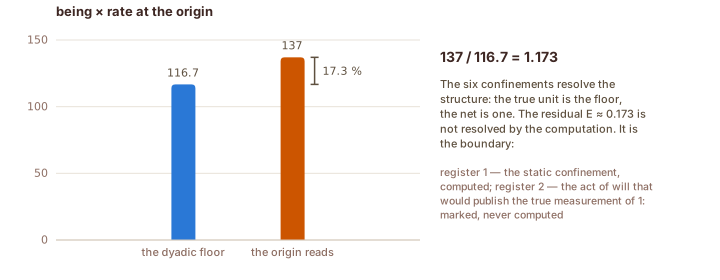
At the origin the product of being and rate reads 137, the baseline's bit onset. But the dyadic floor, the fully confined unit that the elastic invariant tends to, is 116.7. So the unconfined origin overshoots by about 17.3 percent: 137 over 116.7 is 1.173. The six confinements resolve the structure, the true unit is the floor and the net is one, but the residual of about 0.173 is not resolved by the computation. It is the boundary, and the experiment's result is that boundary made measurable, not any closing of it.
The register boundary
The experiment computes only the first register: the static onto-epistemic confinement, mathematics and computation. The residual is exactly where, in the record's terms, the second register would act. The house's axiom holds the 4×21 NodeMatrix frozen, 84 nodes in the proportion 8:5:8, a left sponge of 32, a protected core of 20, a right sponge of 32, until external drivers or human interaction force the nodes to resolve and publish their meaning; the record calls that the sixth-wall act, the act of will that would publish the true measurement of one. Will is not computation. The frozen substrate cannot compute it, so the engine marks the boundary and never fakes a resolution to zero: the residual is marked, never computed, and at every laps budget it stays above a tenth. The frozen reference has its own arithmetic in the record: 168 is 2 × 84, is 4 × 42, is 137 + 31, thirty-one loops beyond the fundamental.
What a run does, and the reach
A run takes one number, the laps, which is the resolution budget, and reuses the double hinge's fold with no new physics. An epoch's confinement is reached when its horizon fits within the budget. The engine settles the invariant ladder once and keeps it, reads the epochs in reach, counts the confinements among the exterior epochs, takes the nets, sets the origin against the floor, and reports whether the first register is resolved. The reach grows with the budget, and reproduces the Equivocation's boundary table:
| budget | epochs reached | confinements | register 1 |
|---|---|---|---|
| 2¹⁰, the baseline | 3, the interior 0, 1, 2 | 0 | partial |
| 2¹³ | 6 | 3 | partial |
| 2¹⁶, the record's "bang" | 9, the full triad of triads | 6 | resolved |
The first register flips to resolved at 2¹⁶, when the full triad of triads with all six confinements is in reach. The verified cases at the build: a run at 2¹⁶ reaches nine epochs and six confinements and resolves; a run at 2¹⁰ reaches three and confines none; the data door fills after a run; a budget below 1024 laps is refused with a plain 422, never a fault. The page draws the epoch ladder in three tiers, the confinement arrows folding inward, the net tending to one, and a resolution bar with the residual marked as the second register's boundary.
The hypothesis that did not survive
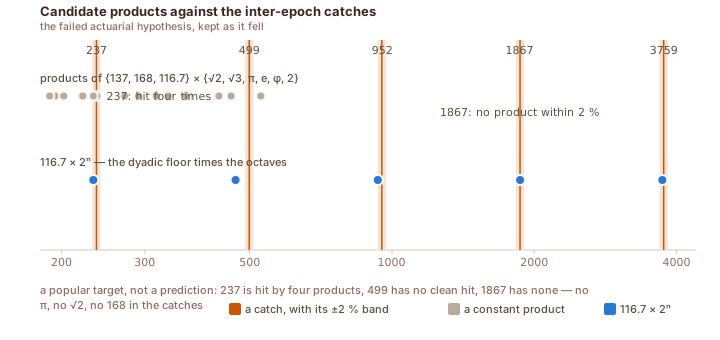
The operator proposed an alternative solve: that a 4×21 actuarial table of 168 entries, with the confined ephemeral constants π and √2, numerically provides the catches between epochs. It was tested and did not survive a numerology check, and the record keeps the failure as it fell. 168√2 is 237.6, close to the first catch at 237, but 237 is hit by four different constant products, 137√3, 168√2, 116.7 × √2² and 116.7 × 2: a popular target, not a prediction. The deeper catches refute it: the second catch, 499, has no clean hit, and the fourth, 1867, has zero constant products within two percent of anything built from 137, 168 and 116.7 with √2, √3, π, e, φ or 2. The one predictor consistent across every epoch is 116.7 × 2ⁿ, the dyadic floor times the octaves. No π, no √2, no 168 in the catches. It stands recorded as a possible refactor pending an actuarial formula that predicts all nine epochs out of sample, 1867 and 3759 and not only 237. Until then the catches are dyadic, and the epistemic externality is the act, not a numeric.
The register, and what is not claimed
A readout over the frozen geometry: the cryptographic core and the figure-2 coincidence untouched, the baseline pinned, the double hinge's fold reused. The first register only; the residual is marked, never computed. Model-internal, and no physics is claimed: the record's cosmological name for the 2¹⁶ budget is the record's own word, carried here as the record marks it.
Where it sits
The eighth instrument of the series of ten, the XOR's own mirror, turning the XOR's gate inward on the origin; it works on the Equivocation's lock chain and reuses the double hinge's fold. On the observatory node the door is opendata.ai/xor-mirror, state live: the instrument runs on request, as the platform singleton, and nothing a reader does there enters the record. No external anchor is recorded for the XOR Mirror, and this reading says so rather than borrowing one.
Standing
Held on this node as fact until someone stands up in the record to refute it; a refutation enters as a statement of intent at the matters of note and goes to the record's own path. What has since been built on the XOR Mirror, and the walk a reader may take, are the operator's hand and land in a further draft.