 OOI · SX
The Deep Pi, held
THE READING PLAQUE. The Deep Pi, held, draft 0.2 — made readable on the SX surface by its covering persona's reading grant; a draft, not the published form. The grant stands by the operator's word (2026-09-16), verbatim: "ok - now do the same for the dpx." Covering: starl3n · endorsing: Link Digital (the standing pair). The Foundations · 8: the eighth reading of the foundations series and the first of its second tier — an experiment of the observatory node, held on this node. The construction record stands in the open workshop at /sx/workshop/the-dpx-held; the experiment's own door, opendata.ai/dpx, wears the word grown · held and links back here while this grant stands. Reading is free; the way across is a statement of intent (/sx/matters). This file's sha256 is pinned in the reading register.
Draft state — this block records the state of the draft; the reading begins after the rule. Draft 0.1 — 16 September 2026. Author of record: Steven De Costa; composed at his word from the experiment's record. Standing: a reading, stated never asserted; the record it reads stands whole without it. The later locks and the walk land in a further draft. Draft 0.2 (16 September 2026) places 3 figures and 1 table at the operator's word, each drawn from the record's own numbers and captioned with its source; the screenshots the operator will supply are not yet placed.
What the Deep Pi is
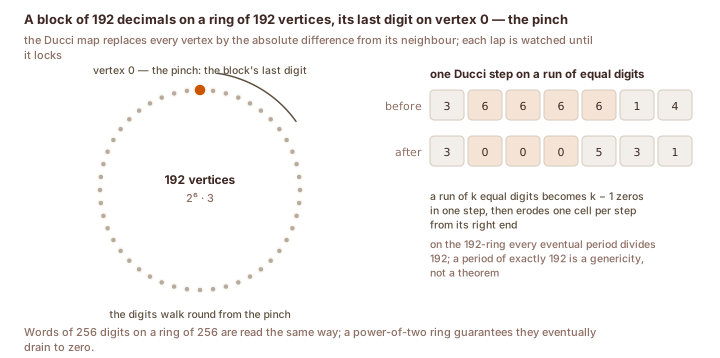
Take the decimals of π after the point and cut them into blocks of 192. Place each block on a ring of 192 vertices — a lap — with the block's last digit on vertex 0, so that the walk of the digits leaves vertex 0 and lands back on it as the lap closes; that closing digit is the ring's pinch. Then apply the Ducci map, which replaces every vertex's value with the absolute difference from its neighbour, and watch what each lap does. That is the whole instrument. Words of 256 digits on a ring of 256 are read the same way.
Two elementary results frame every measurement, and the note that proposed the experiment claims no novelty for either. A run of k equal digits becomes k − 1 zeros under one step and erodes one cell per step from its right end, gone after k − 1 more. And on the 192-ring every eventual period divides 192, which is 2⁶ · 3; equality at 192 is a genericity, not a theorem. The first eight laps were measured by hand before any rung ran: every one locked at period exactly 192, seven of them at step 64, and one at 63 — lap 4, whose last six vertices carry the six 9s at decimals 762 to 767, the Feynman point, ending on decimal 768, which is 4 · 192 and 3 · 256 at once, the first common boundary of the two rings. A hundred and twenty random digit seeds all locked at 192 as well; four word seeds drained to zero in 255 or 256 steps, as a power-of-two ring guarantees they eventually must.
From that note came the proposal: a rung ladder of 64, 128, 256, 512 and 1024 laps, with five hypotheses registered before each rung — every period divides 192 as the control, every lap locks at exactly 192, every lock falls at step 63 or 64, the counts of laps with long born runs fall inside exact binomial intervals fixed at registration, and early locks are not associated with long born runs beyond chance. A registration record is written before the run and a results record after it, each pinned by its hash, and the archive, not the experiment host, is the citable object. The falsification standing was stated first: a single lap breaking the period or the lock window would be the headline, and continued confirmation the boring outcome, to be reported as exactly that.
The build and the first rungs
The runner computes π twice, by Chudnovsky binary splitting and by the Gauss–Legendre mean, and refuses to proceed unless the two agree digit for digit. The order of acts is enforced fail-closed: a rung cannot be registered twice, cannot run without its registration, and cannot run twice; each registration embeds the frozen model with its seed, the exact intervals for the fourth hypothesis, the code's own hash, and the declaration that nothing has been peeked. The first run crashed at the platform's cap on converting large integers to strings, before any digit or fate was read, so the rung-64 registration stood valid and unrun and the runner was fixed — and the lesson entered the record: test past platform caps at production scale.
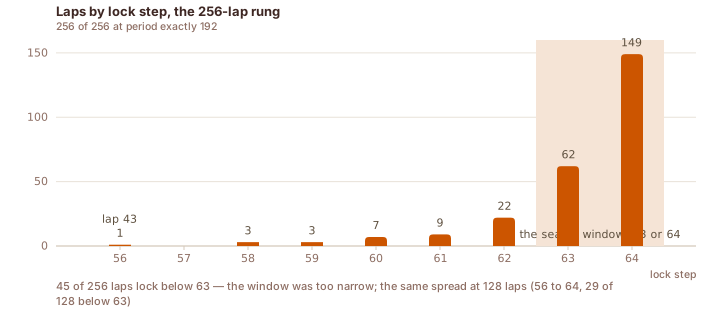
Then the operator's runs at 128 and 256 laps, both registered before either ran, gave the headline the proposal had said would be reported first. The lock window was refuted twice. Locks spread from 56 to 64 — 45 of 256 laps below 63, the deepest at step 56 on lap 43 — so the eight-lap window had been too narrow. The period held, 256 for 256, every lap locking at exactly 192. The model rates held. And the association test answered the note's first open question: early locks and long born runs are not associated; lap 4's early lock was unremarkable, a rhyme retired by its own instrument. The experiment then took the open form of the house — the door /dpx with the refutation on its face, the ladder of registrations and results per rung, and the acts as buttons in lawful order.
The approach and the arrivals
The extension rungs left the Ducci ladder to read the decimals themselves, each rung registered before its read with knives that land PASS, REFUTED or VOID exactly as defined, a refutation reported first, and the decimals computed by two independent methods that must agree on the whole territory or the rung is void.
The approach rung read laps 4,097 to 16,384 on the operator's word — "let's run this and predict there 'is' a geometry to pi that is 100% deterministic" — with the geometry carried as his reading and never as a knife. What was already seen was declared: eleven runs of six or more through lap 4,096, the seven 3s at decimal 710,100 on lap 3,699, which is 137 · 27. The toll on 137 was refuted: the last long run in the territory, six 9s at decimal 3,062,881, falls on lap 15,953, which is not a multiple of 137. The approach ran free, as staked: no run in the last 256 laps. And the seven rhymes with three was refuted: the first seven in the territory is seven 9s, on a lap divisible by three but not the digit three. A declared look at lap 7,398, fifty-four times 137, found nothing longer than four, and was a look, not a knife.
The arrivals rung took the operator's prediction of the folds — "six 9's, then the next epoch fold of seven 3's, then eight 2's and a final string of ten 6's" — with his own uncertainty about the order kept beside it, and his rule for where the next fold would sit before its pinch. The first eight is eight 4s, at decimal 22,931,745 on lap 119,437, so the eight 2s were refuted; its distance to the pinch was 159 against the rule's 139 or 181, so the position rule was refuted; and the first ten lay beyond the fifty million decimals two methods could lock that night, so the ten was void. A single-method look to a hundred million was disclosed as a look: ten runs of eight or more, the longest nine, no ten. The record also marks that the rule's fit to the seven 3s was a fit, not a prediction, since that position was known before the rule was stated.
The band
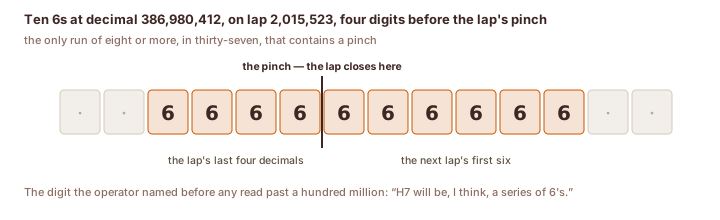
The band rung read four hundred million decimals by two methods. The operator's words opened it — "I deeply suspect there are no significant 'pinch points' that drive a run of an integer greater or equal to 11 as a series" — with his likeness of π's walk to memory that cannot turn, against the primes' knight's walk, recorded as a likeness. The house cut three knives from his reasoning and he adopted them, naming the digit himself: "H7 will be, I think, a series of 6's."
The first exact ten arrives inside the territory, and no eleven before it: ten 6s at decimal 386,980,412, on lap 2,015,523, beginning four digits before the lap's pinch. So the band with teeth passed, and ten sixes passed — the digit he had named before any read past a hundred million. The third knife, that no long run ever crosses a pinch, was refuted by that same run: of thirty-seven runs of eight or more in four hundred million decimals, the ten 6s is the only one that contains a pinch, straddling it four to six. The joint null for all three had been stated in advance at about six in a thousand; two passed, and the one that failed failed on the very run that carried the other two.
The constants and the bases
Does the pinch structure belong to π, or to the ring and the fold? The next rung read e, √2 and φ to four hundred million digits through the same ring, each with an exact identity as its second lock, and π in bases 2, 6, 12 and 16 at matched information. No constant produced a ten at four-to-six; only e produced a nine that straddles a pinch, nine 1s at decimal 110,702,779, five digits before its pinch, recorded as a fact and staked as nothing. The fold words' early drain held for φ and failed for √2 and e. In the bases, the rarity-matched fold straddled the pinch nowhere, and the ring showed no preference for the bases whose factors match it. The ten 6s on the pinch is π's own, at that one place, and the record found it nowhere else it looked.
The fates, the wave and the word
Two rungs asked whether the fold laps — the laps that open a first-of-length run — are special in their dynamics rather than their digits. The two fold laps already run had locked early, 63 and 62, against a mode of 64; that was the motivating observation, marked post hoc. The three unread fold laps were run and locked at 64, 63 and 64: fold laps lock like any lap, and both knives were refuted against a null computed over 2,999 ordinary laps beforehand. Then the eternal wave: not all five fold laps ride the outer waves of eternal weight, but three of them do, which passed the weaker knife and failed the stronger. And the 256-word that holds each fold drains early — 255, 255, 255, 255 and 254 against a mode of 256 — but not clearly early, so the first drain knife passed and the second was refuted. A fold lap is a place in the digits; the ring does not feel it.
The extension rungs, their knives and their verdicts, refutations first:
| rung | territory | the knives, and how they landed |
|---|---|---|
| the approach | laps 4,097 to 16,384 | the toll on 137 refuted; the approach ran free, passed; the seven rhymes with three refuted |
| the arrivals | to fifty million decimals | the eight 2s refuted (eight 4s at decimal 22,931,745); the position rule refuted (159 against 139 or 181); the ten void |
| the band | four hundred million decimals | the band with teeth passed; ten sixes passed, the digit named beforehand; no long run crosses a pinch refuted by that same run |
| the constants and the bases | e, √2, φ to four hundred million; π in bases 2, 6, 12, 16 | no constant produced a ten at four-to-six; the fold words' early drain held for φ, failed for √2 and e; no base preference |
| the fold fates | the three unread fold laps | fold laps lock like any lap — 64, 63, 64 — both knives refuted against a null over 2,999 laps |
| the wave and the word | the five fold laps and their 256-words | three of five ride the outer waves — the weaker knife passed, the stronger failed; the words drain early but not clearly — one knife passed, one refuted |
The firewall
No claim about π's normality or the distribution of its digits, and none over π's own laws; its theorems stay the discipline's. No claim over the prime numbers' own laws, ever; the operator's reading of the primes is his and is tested by nothing here. No claim on any Millennium Prize problem, ever. No claim about physical cosmology, quantum mechanics, consciousness or phenomenal experience. The memory likenesses are likenesses. The operator's runs count nothing in the care census: acts, never eyes. And the geometry of π he predicted stands or falls by his judgment of the landed record, never by a verdict — the knives establish only whether exact statements about lap indices hold on decimals no one had read.
Where it sits
An applied campaign of the Number Theory set on the observatory node: the door is opendata.ai/dpx, state closed — the record replays read-only, the ladder's remaining rungs stand as the operator's own acts on the page, and nothing a reader does there enters the record. Its companions on this node are the Feynman Nines, the reading that began with the six 9s, and The Quarter, Three Ways, which carries these refutations first. The registrations and results are pinned by their hashes in the repository; the archive was designed as the citable object, the archive act is the operator's own, and no external anchor is recorded for the Deep Pi — this reading says so rather than borrowing one.
Standing
Held on this node as fact until someone stands up in the record to refute it; a refutation enters as a statement of intent at the matters of note and goes to the record's own path. What has since been built on the Deep Pi, and the walk a reader may take, are the operator's hand and land in a further draft.