 OOI · SX
The Coco, held
THE READING PLAQUE. The Coco, held, draft 0.2 — made readable on the SX surface by its covering persona's reading grant; a draft, not the published form. The grant stands by the operator's word (2026-09-16), verbatim: "ok - now do the same for the coco." Covering: starl3n · endorsing: Link Digital (the standing pair). The Foundations · 3: the third reading of the foundations series — an experiment of the observatory node, held on this node. The construction record stands in the open workshop at /sx/workshop/the-coco-held; the experiment's own door, opendata.ai/coco, wears the word grown · held and links back here while this grant stands. Reading is free; the way across is a statement of intent (/sx/matters). This file's sha256 is pinned in the reading register.
Draft state — this block records the state of the draft; the reading begins after the rule. Draft 0.1 — 16 September 2026. Author of record: Steven De Costa; composed at his word from the experiment's record. Standing: a reading, stated never asserted; the record it reads stands whole without it. The later locks and the walk land in a further draft. Draft 0.2 (16 September 2026) places 4 figures and 2 tables at the operator's word, each drawn from the record's own numbers and captioned with its source; the screenshots the operator will supply are not yet placed.
What the Coco is
Co-Constructive Optimism is the tenth instrument of the series of ten and its closing reading. It runs no new physics. It is a readout over the frozen geometry that the nine before it built, and it reuses three of them directly: the XOR Mirror's ladder of six back-propagating confinements, the Channel's moment-cell and its reliability measure, and the Quad Slip's calibrated instrument. What it adds is a set of questions put to that geometry, each stated as a hypothesis before it was measured, and the answers as they fell.
The thesis it tests is the operator's. Structural memory is an attractor that reduces uncertainty, and uncertainty left unresolved presents as noise over time. Each memory is certain in itself, a clock whose entropy rate goes to zero; but several memories aligned to orthogonality are maximally surprising together. The alignment that converts internally certain structure into collectively maximal surprise, and resists the decay to noise, is what the record calls gravity — and calls, throughout, a model-internal reading and a marked conjecture, never physics.
What the instruments do
The experiment is a page of panels, each backed by one engine function and one endpoint, each reading the same frozen substrate at a resolution budget of laps from 2¹⁰ to 2¹⁶ (and, for the deep rungs, to 2²⁰):
- the cooling curve and the being ladder — how much of the structure the confinements have verified at each budget, read as a temperature;
- the residual test — the origin's overshoot against the Channel's moment-cell;
- the holography panel — the chain of screens, and channel capacity against the shape of the grid it is read on;
- the boot comb and the running of E — the substrate's catch comb read directly, and the residual E read window by window;
- the freeze and melt panel — the split-half reliability as an order parameter, over budget, over time within a run, and over the pair detune;
- the binding well and the FDV chain — the response of a locked alignment to displacement, and the verification ledger of the ladder;
- the bond and kinematics panel — the independence of a pair of readouts at every separation, its orientation, and how a bound trio moves.
Every run records one row; the records are deterministic and test-pinned.
Cooling, and the floor
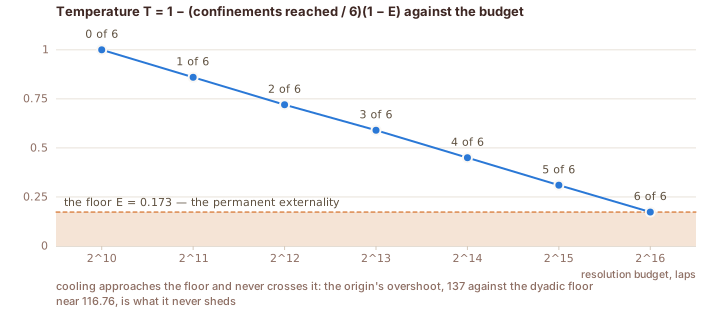
The origin is hot: its being times its rate is 137, which overshoots the dyadic floor near 116.76 by the residual E, about 17.3%. Cooling is the resolution budget growing until the six back-propagating confinements come into reach and the structure aligns. The temperature is the unverified fraction, T = 1 − (confinements reached / 6)(1 − E), and it cools by exactly one confinement per octave:
| budget | 2¹⁰ | 2¹¹ | 2¹² | 2¹³ | 2¹⁴ | 2¹⁵ | 2¹⁶ |
|---|---|---|---|---|---|---|---|
| confinements | 0 | 1 | 2 | 3 | 4 | 5 | 6 |
| temperature | 1.00 | 0.86 | 0.72 | 0.59 | 0.45 | 0.31 | 0.173 |
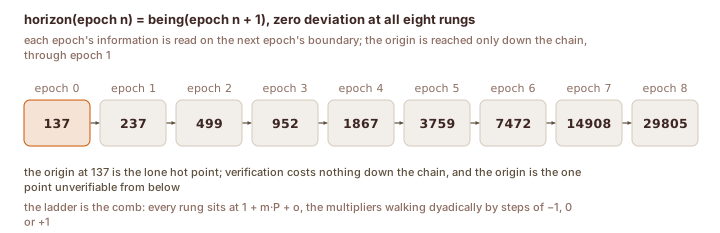
It cools from 1 to E = 0.173, not to 0. The floor is the residual overshoot the origin never sheds, which the record marks as the permanent externality: cooling approaches it, never crosses it. On the ladder of beings the origin at 137 is the lone hot point, with an overshoot of 20.24; every epoch from the fourth down has already cooled to within one unit of the floor.
One reading was held rather than claimed. The overshoot of 20.24 matches one moment-cell of the Channel, about 17 to 22 catches, almost exactly — but the two numbers live in different frames, being-times-rate against catches, so the record files it as a flagged coincidence and refuses the identity until a transform between the frames is derived out of sample.
The screens, the perimeter and the beat
Three measurements ground the operator's proposal that cooling is a perimeter-maximising holographic handoff from the deep epochs to the origin by way of epoch 1.
The chain of screens is exact. The horizon of each epoch equals the being of the next at all eight rungs — 237, 499, 952, 1867, 3759, 7472, 14908, 29805, with zero deviation — so each epoch's information is read on the next epoch's boundary, and the origin is reached only down that chain, terminally through epoch 1, whose being is the origin's horizon.
Capacity follows the admissible perimeter, not the bulk. Over grid shapes of equal bulk the channel capacity tracks the boundary (r ≈ 0.82); the mirrored pair 2×8 and 8×2 read symmetric, and the shape 8×3 demands a window it cannot have and reads zero — the uncertainty relation carves the admissible set, and the maximum channel is the maximum admissible perimeter, which runs along time (2×12, 33.5 bits).
The present value of a beat is 0.75, measured twice by independent routes: (period − 1) over period for the period-4 clock, and one minus the peak rate of the channel. One beat is three-quarters retained structure and one-quarter new surprise, and the structure compounds at 4/3 per beat — the Koch generator's ratios, exactly.
And the fractal reading was refuted, honestly. The cooling compounds harmonically, at (n + 1)/n per octave — 2, 3/2, 4/3, 5/4, 6/5 — not geometrically at 4/3, and nothing measured scales at the Koch dimension. Koch fits at the level of the generator's ratios and fails at the level of the fractal's dimension, which is what the model's standing "confined by 2" would predict.
The comb, the conjecture and the derivation
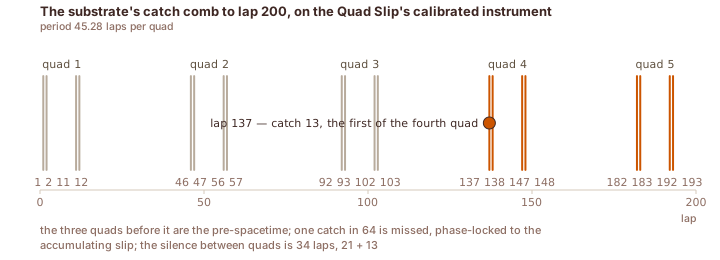
The Quad Slip's calibrated instrument, run to 32768 laps and then to 131072, gives the substrate's own catch comb. The catches arrive in quads — a pair, a gap of nine, a pair, a gap of about thirty-four — with a period of 45.28 laps; the boot readings the operator called in advance came back exactly (4 catches at 42, 8 at 84, 12 at 126, 16 at 168; the fifteenth catch on lap 147); the pre-spacetime is three empty quads, and the epistemic '1' at lap 137 is the thirteenth catch, the first of the fourth quad. One catch in 64 is missed, phase-locked to the accumulating slip, and no whole quad is ever dropped. The silence between quads is 34 laps exactly, 21 + 13. The stochastic one-in-six window model was killed by this comb, which is deterministic; and the conjecture that the misses mark primes was killed too (prime fraction 0.178 against a baseline 0.177), leaving the onto-epistemic reading of primality a stated conjecture with real anchors.
Then the derivation. The operator's conjecture — reality is 1 and 1 = O + C + E, the observable, the communicable and the effectual — put through the sequential distress of bifurcation (O takes the prior E, C = O, E = 1 − O − C) yields the cascade (0,0,1), (1,1,−1), (−1,−1,3), (3,3,−5), (−5,−5,11), (11,11,−21): every state sums to 1 and E runs the signed Jacobsthal numbers. Its fourth and fifth terms, 5 and 11, are the triadic vertices of the figure; the dyadic bus at 11.5 is the fifth term's unmirrored next step, halved. From those vertices the two loop lengths follow, T = √29 + √37 + √122 and D = 2√132.5, and with them the period of the comb:
P = D/(D − T) = 45.27910 laps per quad — measured 45.2794 — agreement 0.0007%.
So the substrate's heartbeat is a theorem of the conjecture, and so is its fundamental: the boot starts a sample every P laps on the integer grid, 1 → 46 → 92 → 137, which is 137 = ⌈1 + 3P⌉, the boot slip carried to the next catch. The residual's asymptote followed by the operator's triad-set route — epochs taken three at a time, with the set recurrence being(k + 3) = 8·being(k) − C exact through the interior triads — and it telescopes to a closed form, floor∞ = 815/7 and E∞ = 144/815 = 0.17669, which the deep rungs land on to within 0.013% by the twelfth. The ladder is the comb (every rung sits at 1 + m·P + o with the multipliers walking dyadically by steps of −1, 0 or +1), the step-cycle derives as (9 − P, P − 21, −P − 1), and the closure the operator asked of the run came back exact: being(11) = 8·being(8) + 1. The 0–11 span closes at +1 and hands the unit to the bus beyond it.
Three values of E stand together, and the record reads them as one running constant read at three windows rather than as a discrepancy: the operational E at 2¹⁶ is 0.173345, the comb's fully derived deficit is 0.173827, and the asymptote is 0.176687; the running of E, read window by window, climbs from 0 at the origin's window to 0.17672 at 2¹⁶ and reproduces the operational value as the lagging mean. Left open, and said so: the step-by-step law of the deep walk — which of −1, 0, +1 fires when.
The bifurcation cascade of the derivation, every state summing to 1 and E running the signed Jacobsthal numbers:
| step | O | C | E | O + C + E |
|---|---|---|---|---|
| 0 | 0 | 0 | 1 | 1 |
| 1 | 1 | 1 | −1 | 1 |
| 2 | −1 | −1 | 3 | 1 |
| 3 | 3 | 3 | −5 | 1 |
| 4 | −5 | −5 | 11 | 1 |
| 5 | 11 | 11 | −21 | 1 |
The three values of E the record reads as one running constant read at three windows:
| the value of E | where it is read |
|---|---|
| 0.173345 | the operational E at the 2¹⁶ budget |
| 0.173827 | the comb's fully derived deficit |
| 0.176687 = 144/815 | the asymptote, from the triad-set recurrence; the deep rungs land on it to within 0.013 % by the twelfth |
The freeze, the well and the bond
The transition. Four hypotheses were stated about where structure freezes; two were refuted, one refuted with the mechanism found elsewhere, one confirmed and refined. Reliability does not freeze in budget (it consolidates smoothly, with no lock at any candidate rung, and a two-octave Koch-like factor died at the third octave), and the boot is not a hot phase (the first tick reads like the run). The freeze lives in observation scale: below about 1.5 beats the measure is degenerate, from 1.5 to 5 beats it sits in a melt-edge valley, and it is frozen at about twelve beats — 48 catches, two of the Channel's moment-cells — so that each split half holds one full cell. The record names that condition "2 locks 1", and it is budget-invariant. The melt pockets in the pair detune are scale-resonances, disjoint from window to window and deepening with budget: a geometry, not a temperature. Adding instruments broadens the valley rather than sharpening it: a crossover, not a critical point. And the Channel's capacity peak sits in the melt-edge exit band — capacity operates at the edge of the melt. Since tick-scale structure is frozen at every budget while the temperature only begins to fall at 2¹¹, the order is structure first, verification second.
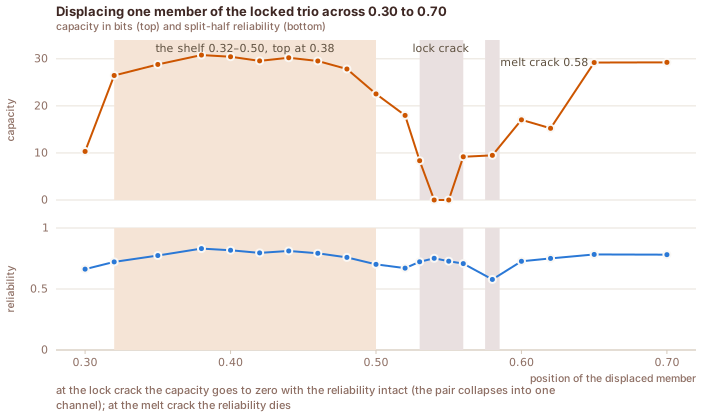
The well. Displacing one member of the locked trio [base, 0.5, 0.9] across 0.30 to 0.70 gives a terraced landscape: a shelf from 0.32 to 0.50 with its top at 0.38, bounded by two kinds of cliff. At 0.53 to 0.56 the lock crack: capacity goes to zero with the reliability intact, because the displaced member phase-aligns with the base and the pair collapses into one channel. At 0.58 the melt crack: the reliability dies, the resonance pocket seen from inside the trio. Too close is lock, wrong cadence is melt, and binding is residing on the shelf between them. The melted control trio has no basin; displacing it frees it. The verification ledger of the ladder is exact: the slip between each screen's prediction and the next being is zero at rungs 1 to 8, so verification costs nothing down the chain, and the origin is the one point unverifiable from below — it is verified only by the full return at 2¹⁶, 256 times its own window, and even then keeps its residual E.
The bond. The independence deficit of a pair of readouts is above zero at every separation, with a floor of 0.0122: two readouts of one frozen geometry never fully decouple, and the bond fails only into the two walls, lock and melt, which alternate along the separation axis. The pair has an orientation, and it is structural: on every shelf pair the detuned clock leads and the origin follows, with a mean lag asymmetry of −0.122, while pairs that do not include the origin carry no consistent direction; it is a catch-scale effect, washed out within one tick. Rigid translation of a bound trio was refuted as posed; what binding does is pin — the melted control moves 10.4 times more in relation space than the shelf-top bundle — and what motion remains is a budget-invariant orbit whose period for the bound trio is twice the melted one's.
The register — what is not claimed
Everything above is a readout over the frozen substrate, model-internal. "Quantum gravity" is the record's H3 conjecture, supported by these proxies and never asserted as physics. The residual E is marked as the externality, never computed. The four candidate mechanisms the operator stated for dynamics — mass as grounded epoch-1 structure, Koch friction at the surface, the surface's impedance, the bit-shift extension — stand in the record as conjectures with their audit: their numbers are exact arithmetic on the one measured beat split, and the names they borrow from physics are overlays. Thermodynamic, gravitational and colour-confinement vocabulary names measured profiles and nothing more.
Where it sits
The last of the ten, the reading that closes the series over the instruments before it. On the observatory node the door is opendata.ai/coco, state live: the panels run on request as the platform singleton, over budgets to 2¹⁶ with the deep rungs cached to 2²⁰; the Coco predates the mldata anchoring practice and carries no external anchor.
Standing
Held on this node as fact until someone stands up in the record to refute it; a refutation enters as a statement of intent at the matters of note and goes to the record's own path. What has since been built on the Coco, and the walk a reader may take, are the operator's hand and land in a further draft.