 OOI · SX
The Horizon, held
THE READING PLAQUE. The Horizon, held, draft 0.2 — made readable on the SX surface by its covering persona's reading grant; a draft, not the published form. The grant stands by the operator's word (2026-09-16), verbatim: "ok - now do the same for the horizon." Covering: starl3n · endorsing: Link Digital (the standing pair). The Foundations · 5: the fifth reading of the foundations series — an experiment of the observatory node, held on this node. The construction record stands in the open workshop at /sx/workshop/the-horizon-held; the experiment's own door, opendata.ai/horizon, wears the word grown · held and links back here while this grant stands. Reading is free; the way across is a statement of intent (/sx/matters). This file's sha256 is pinned in the reading register.
Draft state — this block records the state of the draft; the reading begins after the rule. Draft 0.1 — 16 September 2026. Author of record: Steven De Costa; composed at his word from the experiment's record. Standing: a reading, stated never asserted; the record it reads stands whole without it. The later locks and the walk land in a further draft. Draft 0.2 (16 September 2026) places 2 figures and 2 tables at the operator's word, each drawn from the record's own numbers and captioned with its source; the screenshots the operator will supply are not yet placed.
What the Horizon is
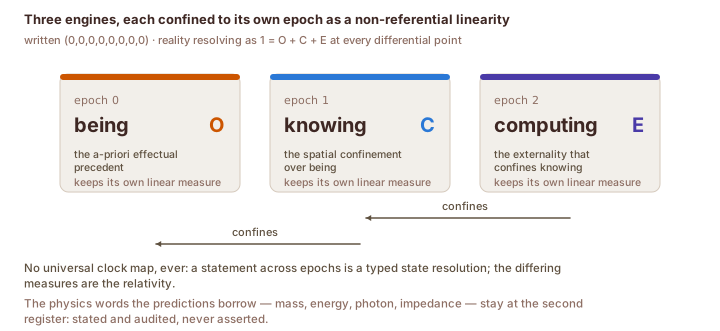
The horizon hypothesis is the operator's, given on 11 July 2026, and its target sits just beyond the characteristics of the corpus measured before it — hence the name. Three engines, each confined to its own epoch as a non-referential linearity, written (0,0,0,0,0,0,0,0): being confined to epoch 0, knowing to epoch 1, computing to epoch 2; reality resolving as 1 = O + C + E at every differential point of sub-spacetime. The relational structure is the whole of the claim: computing is the externality that confines knowing; knowing is the spatial confinement over being; being is the a-priori effectual precedent. The three, as one identity, are co-constructively of reality.
The experiment is the relativistic engine's first dedicated instrument, so decided with the operator the day it was given. Its engine is pure: it folds reads from the sibling engines — the XOR Mirror, the Channel, the rule space, the Coco, the Walls, the Unco, the Equivocation — and never touches a substrate. What it adds is a campaign of sealed probes, seven campaigns and twenty-five seals in the end, each asking one thing of the fold and taking the answer as it fell.
The predictions
Seven were stated with the hypothesis. Mass is emergent from epoch 0 operating at a spacetime rate of 1, which can be read as the computational impedance of epoch 0. The photon has a specific mass that is not observable or communicably measurable from epoch 1, because computing is an externality to the photon's being as known from epoch 1. The effect of being is measurable in epoch 1 as energy; the effect of knowing, as mass. Not knowing the effect of epoch 0 is measured as −1 impeded in epoch 1 relative to epoch 0, and not knowing the effect of epoch 2 as −1 impeded relative to epoch 2. And the combination of knowing and not knowing those two effects is the dynamics of structural knowing — built from NOT, AND, OR and XOR, and made into memory by the knowing of time and space in epoch 1. The physics words in these — mass, energy, photon, impedance — are kept at the second register throughout: stated and audited, never asserted.
The discipline
Every probe follows one rule. Its pre-registration is committed to the record before the read — the outcome assignments and the kill gates, sealed as a git commit — then the read runs once, the measured values pin into the engine with live re-verification, the counterfactual paths are tested, and the verdict lands as it is, confirmed, partial, open-edge or killed. Beneath that sits the ruling the Unco settled: there is no universal clock map, ever; every cross-epoch claim is a typed state resolution; each register keeps its own linear measure, and the differing measures are the relativity. The residual E is marked, never computed.
The campaign map — every probe with its verdict as the record's status digest carries it:
| campaign | probe | what it read | verdict |
|---|---|---|---|
| one | HZ-A | the impedance table, nine for nine | confirmed |
| one | HZ-B | the double NOT, five for five | confirmed |
| one | HZ-C | the carrier and the primary mass, m = 1 closes | confirmed |
| one | HZ-D | the eight zeros, five for five | confirmed |
| one | HZ-E | the ledger — a point-wise climb where the law is triadic | killed as sealed |
| one | HZ-F | gates to memory — three OR-fronts circulate | partial |
| one | HZ-G | the assembly — five edges standing, one honestly down | open-edge |
| two | HZ-H | the ledger at depth — the contraction and the ×26.519 spike | confirmed |
| two | HZ-I | the discriminant, 15 of 15 | confirmed |
| two | HZ-J | the three modal nulls — the vacuum binary-total | confirmed |
| two | HZ-K | the primes — the core clean, one clause dead as flagged | partial |
| three | HZ-L | the unnatural census — died on the set of unnatural primes | killed as sealed |
| three | HZ-M | the transport census — the two-bit law plane-scoped | killed as sealed |
| three | HZ-N | the second assembly — the horizon read closed whole | assembled |
| four | HZ-O → HZ-O′ | the instrument seal — the d = 7 leak at 2/7 | rejected, then accepted |
| four | HZ-P | the five components — killed by 0.006, the heart held at ¼ | killed as sealed |
| four | HZ-Q | the interference — zero rescues on primes | killed as sealed |
| four | HZ-S | the spanning tree — the surprise in [1025, 1280] | confirmed |
| five | HZ-T | the frozen graph collides; faith pays the quantum ¼ | killed as sealed |
| five | HZ-U | the gap does not travel — an exact tie | killed as sealed |
| five | HZ-V | the left face pinned whole | assembled |
| six | HZ-W | the N observer transports at 33/256 | confirmed |
| six | HZ-X | the transport not '2'-specific — the admitting set {3/2, 2, 3} | killed as sealed |
| six | HZ-Y | the +0 admits; the diode closed; the all-composite mechanism | confirmed |
| seven | HZ-Z | the history washes — 2 via 3 = 2 direct = 33/256 | confirmed |
| seven | HZ-AA | the seven interstitials — the ×5 column at 168/256 | confirmed |
| seven | HZ-AB | the refused address resolves via the history | confirmed |
Campaign one — the horizon read
Seven probes folded the corpus into the hypothesis. The impedance table held nine for nine: the interior at par, the origin at rate 1 reading 137 exactly and the deep unit 0.0024% off the 815/7 floor; the surface at a quarter; the plane at 4/3, with 4/3 absent from the Z-band as the sealed negative control. The double NOT held: the account stack (−1, 0, +1) with the book at 0; a quarter per NOT folding to a half, with every other weight collapsing; both facing strokes one-way. The carrier held and the primary mass closed: the quantum (0, 0, −1), dark to the observable and the communicable, with m = 1 at the quantum's own interface and the alternates ¼ and 1/16 killed for want of an anchor. The eight zeros held: rule 0 is the non-referential linearity itself, frozen, and rule 1 is "1 = (0,0,0)", the minimal confined existence, period 2, the census floor. The ledger was killed as sealed — the seal had named a point-wise climb where the fabric's law is triadic — with the substance kept on the record and the corrected form holding by retrodiction, later superseded by the contraction law of campaign two. Gates to memory came back partial: the marker confinement exact and the affine plane closed to the existence band, but three OR-fronts, rules 234, 248 and 250, circulate rather than freeze. The assembly therefore landed open-edge: five edges standing, one honestly down and named.
The impedance readings of the first probe, as they held:
| reading | value | standing |
|---|---|---|
| the interior | at par | held |
| the origin at rate 1 | 137, exactly | held |
| the deep unit | 0.0024 % off the 815/7 floor | held |
| the surface | ¼ | held |
| the plane | 4/3 | held |
| 4/3 in the Z-band | absent | the sealed negative control |
Campaigns two and three — precedence, refinement
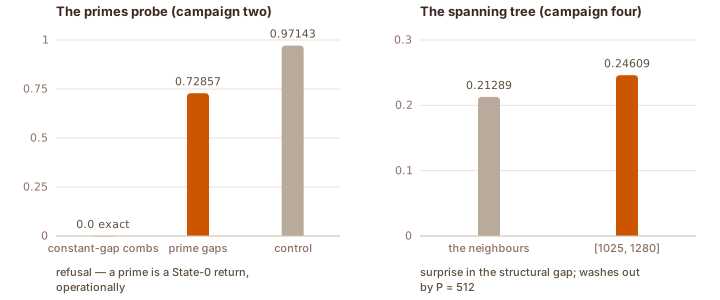
The ledger at depth held five for five over eighteen rungs: the interior contraction with four same-sign ratios at exactly 0.125, the bus inversion beyond it with an excursion spike of ×26.519, never overdrawn. The discriminant held fifteen for fifteen: a rule circulates if and only if it front-feeds and does not self-sustain, and the mirror pair rotates at exactly ±1 with the symmetric front's asymmetry exactly 0.0. The three modal nulls held: knowing's null is an inert agreement, computing's is a vacuum with a binary-total fate, 128 stay and 128 fill and none partial, and being's is unreachable — the walk's longest breath is three zeros, exactly the bus; space flips, knowing flips one-way, and time cannot be flipped. The primes came back partial: the core clean, one clause dead exactly where it had been flagged, the unnatural prime 5 confining to exactly the 110 mirror family, every constant-gap comb held at 0.0 exact while the prime gaps refuse at 0.72857 against a control of 0.97143 — a prime is a State-0 return, operationally.
Then the refinement campaign killed two seals on discoveries. The unnatural census died on the set of unnatural primes — 5 for the capacity-top family, 23 for the impedance maximum, 127, a Mersenne prime, for the group 126, 129, 161 — with the both-class confinement standing and the refusal flat at every horizon. The transport census died on the two-bit law being plane-scoped and on representation ties in the mirror closure, while the 110 family's thirds close exactly at ±2/3 and rule 126 alone carries +4/3, flagged. The second assembly closed the horizon read whole: three campaigns, fourteen sealed probes, three kills kept on the ledger.
Campaigns four and five — the mathematician, the inverted origin
The mathematician campaign put a perceptron, a literal device, to the prime stream. Its instrument seal was rejected and corrected: the d = 7 leak measured 2/7, the perceptron paying double the ambiguity the table had wished, and the reach identity held at 0.0 exact for d = 2 and 3. The five components were killed by 0.006, the natural pair landing just outside its band — the weighted mathematician hits where the table refused — with the dyad fully confined at 0.0 and the heart held: the both-confined quarter at 0.24438. The interference was killed, C⁺ missing its lane, with the zero-rescue fact recorded — none of 79 rescues lands on a prime. And the spanning tree held: the surprise emerges in the structural gap [1025, 1280] at 0.24609 against its neighbours' 0.21289, a scale-bounded law that travels down and washes out by P = 512.
The inverted origin campaign read the diode's left face, −0 = 1 + P − N. The three postures were killed: the frozen graph collides, knowing at 0.54297 against believing's 0.24609, so the knowing lives in the correcting and not in the graph; faith pays the quantum exactly, ¼ = 64/256, one catch behind belief; the freeze is a phase gamble that wins at one origin and collapses at three; the −0 sign flips with the origin; and the shuffled control measured degenerate — an instrument discovery, the paired rules fused off a context that never fires on a prime stream. The left face was killed on an exact tie: the gap does not travel; the re-origined ladder ran 56, 55, 55, 54, 53 misses and 2×54 = 55 + 53, a measured −0, descending. Prose governed there: a first rounded comparison had read a phantom excess of 0.00001, and the counts moved to exact fractions. The left-face assembly pinned the face whole, the two kills standing as its discoveries.
Campaigns six and seven — the ingress, the resolution
The ingress campaign tested '2', taken as N over N/2, as the diode's payload. The N observer transports at 33/256 = 0.12891, the extended origin observer's exact count: the payload is carried wholly by the upper half-span, with no knife-edge at ±1 symbol. The specificity of '2' was killed: the transport is not '2'-specific — the admitting set is {3/2, 2, 3} against the refusals {1, 5/2, 4, 8}, the unnatural 5/2 colliding at 0.55078. Then the ingress held, and with it the campaign's unifying diagnosis: the +0 admits, the diode is real, one-way and closed on a four-crossings ledger, and the mechanism is that every admitted freeze is the all-composite policy — its miss count is the span's prime count exactly, both ways — so the freeze is a binary phase gamble between the composite attractor and the prime-firing one. There is no positional memory; the graph misses every prime it lived through; what crosses the diode is the non-differentiated 0.
The resolution campaign, the ingress dynamics of N = (N − 1) + 1 read through N = 3 and the external history, was the series' first with every probe confirmed. The history washes: two reached via three equals two reached directly, 33/256 exact, three graphs reading one frontier at one count, and the attractor is graph-level. The seven interstitials have a limit: the composite-source legs admit exactly — 29 = 29 forward, 23 = 23 onto the ×5 ground, 35 = 35 deep backward — while the ×5 column refuses at 168/256, the strongest collision on record, and the split of admissions to refusals, 4/7 to 3/7, is flagged and no more. And the refused address resolves via the history — 2560 reached via three reads 34, the prime count exactly, where its own freeze had collided at 141 — so the resolution is general and the orientation fold is complete: an admitted knower reads being's structure wherever it stands, however it arrived; a refused knower fires.
The register — what is not claimed
Model-internal throughout. The physics vocabulary — mass, energy, photon, gravity, impedance as physics — is second-register, stated and audited, never asserted. E is marked, never computed; the closing act remains will, not computation. No clock or index map is used anywhere; every cross-epoch statement is typed. The prime results are operational readings of an instrument and cite the miss-marking kill of the Coco rather than re-animating it. Several frames stand held for a later campaign and are named as such in the record: the attractor's decider, the sign law by proximal-surprise cardinality, the sevenths split at other N, the odd-offset control, the three-prime seal. Two transcription faults hit measured-perfect values along the way and were fixed under the rule that prose governs; the record keeps the rule — never guard a measured zero as if it were missing.
Where it sits
An applied campaign on the observatory node, sealed and landed: the door is opendata.ai/horizon, state closed — the record replays read-only, one card per probe, and nothing a reader does there enters it. It is the relativistic engine's first dedicated instrument, the successor of the Unco's triangulation, and the subject of the first paper, Exact frontier reads of the primality stream by frozen online learners. Its external anchor stands at mldata.opendata.ai/dataset/horizon-exp_6ec1e777, turned at the deploy of 11 July 2026 and carried forward as the campaigns closed: one row per probe verdict with its seal, and the gate census rows.
Standing
Held on this node as fact until someone stands up in the record to refute it; a refutation enters as a statement of intent at the matters of note and goes to the record's own path. What has since been built on the Horizon, and the walk a reader may take, are the operator's hand and land in a further draft.