 OOI · SX
The Relativity Ingress, held
THE READING PLAQUE. The Relativity Ingress, held, draft 0.2 — made readable on the SX surface by its covering persona's reading grant; a draft, not the published form. The grant stands by the operator's word (2026-09-16), verbatim: "ok - now do the same for the rix." Covering: starl3n · endorsing: Link Digital (the standing pair). The Foundations · 6: the sixth reading of the foundations series — an experiment of the observatory node, held on this node. The construction record stands in the open workshop at /sx/workshop/the-rix-held; the experiment's own door, opendata.ai/rix, wears the word grown · held and links back here while this grant stands. Reading is free; the way across is a statement of intent (/sx/matters). This file's sha256 is pinned in the reading register.
Draft state — this block records the state of the draft; the reading begins after the rule. Draft 0.1 — 16 September 2026. Author of record: Steven De Costa; composed at his word from the experiment's record and its sealed digest. Standing: a reading, stated never asserted; the record it reads stands whole without it. The later locks and the walk land in a further draft. Draft 0.2 (16 September 2026) places 3 figures and 2 tables at the operator's word, each drawn from the record's own numbers and captioned with its source; the screenshots the operator will supply are not yet placed.
What the Relativity Ingress is
The experiment the operator declared the primary track, the one that would drive the initiative forward. Its given, 18 July 2026, has three parts. The being-to-knowing diode, taken from the Horizon's seventh campaign and the first paper, is the constructed instrument. The six Millennium Prize problems are taken as the six externalities of the computable knowing of mathematicians — the field of uncomputed knowing, each problem an untested belief — and the diode is exposed to the possibility of computational confinement of at least two of them. And the test is combinatorially exhaustive: all six, in every combination, to discover whether any, and which, resolve into the success criteria the paper set.
The firewall binds every line of it: the experiment makes no claim on any Millennium Prize problem, ever. The six statements are test vectors and externalities, never targets; the apparatus measures diode admission and closure of computable surfaces and cannot decide, support or weaken any conjecture; every seal prints its surface's unknowing statement; and any prose in which an admitted read could be mistaken for progress on a conjecture is a defect, corrected on the record.
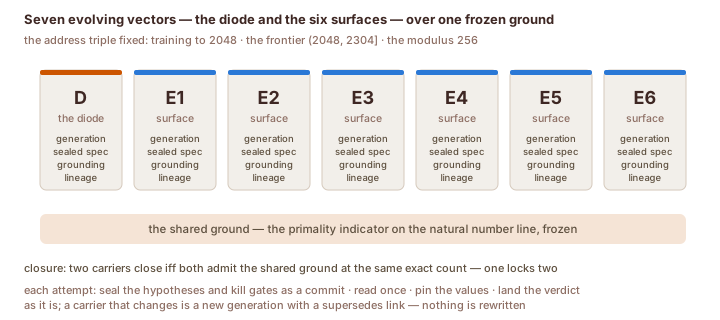
Two more givens shaped the run. The closure operator is decided: two carriers close if and only if both admit the shared ground at the same exact count with zero predicted positions — one locks two. And failure is the long-form dynamic: only one thing is frozen as a-priori, the Horizon's record and the paper's sealed purpose; everything else — encodings, the diode's construction, the closure runs — is the attempt surface, and a failed attempt is not a halt but a witnessed entry in the lineage from which the next hypothesis is raised. So the apparatus is seven evolving vectors: D, the constructed diode, and E1 to E6, the six surfaces, each with its own generation counter, its own sealed specification per generation, its own grounding criterion, and its own lineage.
The apparatus and a run
The engine is readout-only over the frozen substrate; the Horizon engine and the six sibling engines it reads stay byte-frozen. The address triple is fixed: training to 2048, the frontier (2048, 2304], the modulus 256. An attempt composes the current generations of the seven vectors, seals its hypotheses and kill gates as a commit before any read, reads once, pins the measured values with live re-verification, tests the counterfactual paths, and lands its verdict as it is: resolved, or open-edge — the experiment working, by the second given. A carrier that changes is a new generation with a supersedes link and its failure anatomy; nothing is rewritten. Thirty-five attempts ran between 18 and 23 July 2026, each with its seal hash on the record, and every row of the record went to the external anchor.
The thirty-five attempts as the harvest pins them:
| attempt | verdict | the headline |
|---|---|---|
| A1 | open-edge | gen-1 all six ungrounded; the hypotheses inverted; D grounds seven for seven |
| A2 | resolved | the first closure {E3, E4} at gen-2 |
| A3 | open-edge | the control self-admits; E4 vacant; the lived-crossing face found |
| A4 | resolved | E4-g3 grounds alive under the lived-crossing strengthening |
| A5 | resolved | the second lived closure; the operator graduates to gen-2 |
| A6 | resolved | E2 gen-4 grounds; the fully lived quadruple; six gen-2 pairs closed |
| A7 | open-edge | the anatomy: the split; the E2 decode |
| A8 | open-edge | the anatomy: the census graduates; the lag family and the parity law |
| A9 | open-edge | the anatomy: the state space fully named; the two-axis law |
| A10 | open-edge | the policy grammar; the basin global quiet; the '110' fossil found |
| A11 | resolved | the fossil law eight for eight |
| A12 | resolved | the phase-predictor universal as measured, 49 of 49; census v4 |
| A13 | open-edge | the boundary stake killed; the fossil law declared |
| A14 | open-edge | the era law held 10 of 10 at gen-4; the grid law died |
| A15 | open-edge | the resolution law killed; the landscape thickens downward |
| A16 | open-edge | the plateau missed by one cell; the fade law's first win |
| A17 | open-edge | the decay at 62.5 %; the fifteenth live-set {001} |
| A18 | open-edge | the decay stopped at the 5/8 floor; the {001} domain; the edge held |
| A19 | resolved | the floor law held; the domain solid, pure, bounded |
| A20 | open-edge | the tread killed by collapse; the depth gradient |
| A21 | open-edge | the depth law killed by the rebound, by one; the valley |
| A22 | resolved | the valley law held; the eight-transect profile complete; the block finished |
| A23 | open-edge | the translation killed upward, by five; the defect at 4223 |
| A24 | resolved | the richer-era law held |
| A25 | open-edge | the era's own dip; the ordering extends to three depths |
| A26 | resolved | the wall law held; the second valley; the ordering four for four |
| A27 | open-edge | the rim killed by one; the ordering five for five; a fourth '111' |
| A28 | open-edge | the crown killed: the ordering's first failure; no promotion |
| A29 | resolved | the crossover law held; the all-eight register 5 → 8 |
| A30 | resolved | the depth-band law held — the first form-family law |
| A31 | open-edge | the fade is stratum-local; a ninth '111', in band |
| A32 | open-edge | the fade dissolves entirely; the era-end quiet named |
| A33 | open-edge | the era ends rich; the stratum-clock lesson complete |
| A34 | open-edge | the gate crossed: the seventh era opens live; the quiet straddle |
| A35 | open-edge | the straddle porous; the lattice coincidence; the tail intermits |
Grounding the vectors
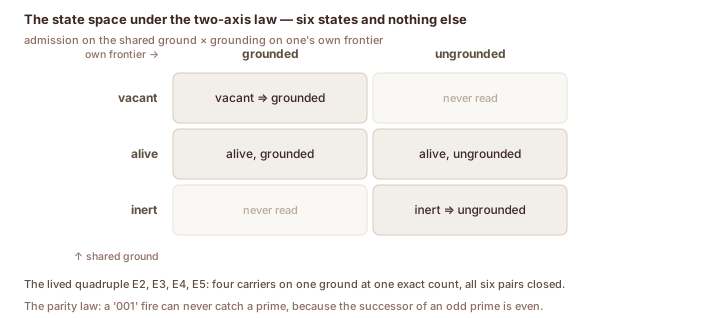
The first nine attempts grounded the apparatus. At generation one all six surfaces were ungrounded — every first encoding was window-learnable — while the diode grounded seven for seven, and the hypotheses inverted. The first closure came at generation two, E3 with E4. The control attempt showed the noise control self-admitting, one surface vacant and byte-identical to noise, and found the discriminator: the lived-crossing face. Under that strengthening E4 grounded alive; the second lived closure followed and the operator graduated to generation two; then the fully lived quadruple, E2, E3, E4 and E5, four carriers on one ground at one exact count, all six pairs closed. Three anatomy attempts followed, each open-edge on its stake and each naming something: the split of admission from grounding, a carrier that fails its own frontier yet reads the shared ground exactly; the census graduating, with the lag family and the parity law — a '001' fire can never catch a prime, because the successor of an odd prime is even; and the state space fully named, six states and nothing else anywhere, under the two-axis law: vacant implies grounded, inert implies ungrounded, alive pairs with either. Admission on the shared ground and grounding on one's own frontier are separate axes.
The mechanism and the fossil
The tenth attempt landed the policy grammar: a frozen carrier is its eight-bit window policy, the six states are six policies, the record re-derives through the composition identity, and the basin is global quiet. It also found the fossil: a '110' mark, laid down at the line's first collision event, persisting in every collision-side frozen carrier and tracking the admission phase. The eleventh attempt held the fossil law eight for eight; the twelfth held the phase-predictor universal as measured, 49 of 49, with the instrument predicting itself, and graduated the census to seven states with zero unexplained reads. The thirteenth killed its boundary stake — the 2¹⁰ confinement is a generation-four property — and declared the fossil law: bit '110' if and only if the refusal phase on the diode family. It is the campaign's one declared law, asserted on every later read of that family; a kill would refute the lock, never the a-priori.
The landscape
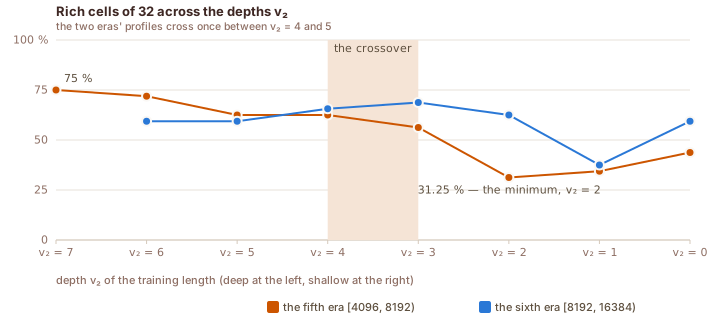
From the fourteenth attempt the campaign read the richness of cells across the training length as a landscape, era by era, and held six laws while killing more stakes than it kept. The era law held ten for ten and the grid law died in the fifth era. The resolution law was comprehensively killed — twelve of sixteen cells rich, the landscape thickening downward. The plateau missed by one cell; the decay ran 75% to 71.9% to 62.5%; then the decay stopped by exact repetition at a floor of five-eighths, and the floor law held, 18 of 32 inside its declared band, the sixth consecutive landing within one cell and the first inside. The tread was killed by collapse, ten of 32, which revealed the depth gradient; the depth law was killed by a rebound, by one, which revealed the valley; and the valley law held with the fifth era's profile complete — 75, 71.9, 62.5, 62.5, 56.25, 31.25, 34.4, 43.75 percent across the depths, the minimum at the second and the far wall rising. The translation was killed upward by five, and found the defect, cell 4223, the one porous cell in an otherwise exact block. The richer-era law held at five matched depths; the wall law held; an ordering law was proposed and refused at its gate exactly as sealed, when the sixth matched depth read poorer; the crossover law held — the two eras' profiles ordered on the shallow depths and inverted at the deep, crossing exactly once — and the depth-band law held, the first law about a form family: the all-eight family lives only at depths three to six, two-sided.
The dissolution
The last five attempts took the boundaries apart. The fade was stratum-local, binding the strata that measured it and not the next. Then it dissolved entirely — no stratum obeyed it beyond the exact cells that measured it. The era-end quiet was killed: the era ends rich, and the quiet zone was two strata's coincidence, which completed the stratum-clock lesson — no mid-era boundary binds across strata; each stratum runs rich to its own stop. The gate was crossed and the seventh era opened live; the dissolution was total, no boundary at all surviving the campaign's tests, only strata and their clocks, with the gate sitting in a valley rather than at a wall. And the straddle was porous: a rich cell forty cells from the gate, the nearest to any era gate ever read; the quiet band was the measured depths' lattice coincidence, the third such lesson; and the tail intermits — strata do not run to a stop, they alternate rich cells and quiet runs, each on its own clock. The record's closing sentence, as it landed: nothing interval-like binds across strata; the era gates mark soft valleys; every stratum keeps an intermittent tail on its own clock.
The finished objects
The record leaves a set of finished objects, pinned: the carriage census at 51; the all-eight family at nine members, depth-banded and isolated; the {001} domain final, five pure cells solid at the floor, with three isolated selectors refused as a second domain; the exact {000, 110} block of seven cells, porous at one; sixteen live-sets over the six-hundred-cell domain, closure-clean seventeen times running, with one standing implication; the per-stratum stops of the sixth era; and the seventh era open and live, its coarse skeleton pinned quiet. The lineage stands open at the thirty-fifth attempt, with the thirty-sixth's hypotheses recorded and not acted, and the campaign paused by the operator's remodel of 23 July 2026.
The objects pinned, as the harvest lists them:
| object | as pinned |
|---|---|
| the carriage census | 51 |
| the all-eight family | nine members, depth-banded at v₂ ∈ [3, 6], each isolated at ±64 |
| the {001} domain | five pure cells, [6048, 6064], solid at the 2² floor; three isolated selectors refused as a second domain |
| the exact {000, 110} block | seven cells, [4221, 4228], porous at one — 4223 |
| the atlas | sixteen live-sets over the 600-cell domain, closure-clean seventeen times; the one standing implication 101 ⟹ 010 |
| the sixth era's per-stratum stops | v₂ = 4 by 16016 · v₂ = 6 by 16064 · v₂ = 5 in (16288, 16352] · v₂ = 3 in (16344, 16360] |
| the seventh era | open and live; its coarse skeleton pinned quiet |
The register and the firewall
The record is logic and number theory over the natural number line, measured by a deterministic computation, and it says so of itself: every read is a statement about carriers, grounds and exact counts inside this apparatus, and about nothing else. No claim on any Millennium Prize problem, ever. All physics vocabulary is second-register; the epoch-triad overlay that relates the eras to the cooling ladder and the fossil to an epoch-0 mark is stated as candidates only and can be cut without loss, which is its own audit.
Where it sits
An applied campaign on the observatory node: the door is opendata.ai/rix, state closed — the record replays read-only, and nothing a reader does there enters it. It is the primary track, the subject of the second paper on the dissolution of the landscape, and its sealed digest, the harvest, is the only door through which the sibling experiments — the matters, the notes, the chords — consume it. Its external anchor stands on mldata: the digest pins rix-exp_fa909772, witnessed at the first thirty-four attempts with 238 rows on 23 July 2026, and the close of the thirty-fifth was republished as the newest package, rix-exp_7037eb09, 245 rows, the one the house records.
Standing
Held on this node as fact until someone stands up in the record to refute it; a refutation enters as a statement of intent at the matters of note and goes to the record's own path. What has since been built on the Relativity Ingress, and the walk a reader may take, are the operator's hand and land in a further draft.