 OOI · SX
The Double Hinge, held
THE READING PLAQUE. The Double Hinge, held, draft 0.2 — made readable on the SX surface by its covering persona's reading grant; a draft, not the published form. The grant stands by the operator's word (2026-09-16), verbatim: "ok - now do the same for the double hinge." Covering: starl3n · endorsing: Link Digital (the standing pair). The Foundations · 13: the thirteenth reading of the foundations series — an experiment of the observatory node, held on this node. The construction record stands in the open workshop at /sx/workshop/the-double-hinge-held; the experiment's own door, opendata.ai/double-hinge, wears the word grown · held and links back here while this grant stands. Reading is free; the way across is a statement of intent (/sx/matters). This file's sha256 is pinned in the reading register.
Draft state — this block records the state of the draft; the reading begins after the rule. Draft 0.1 — 16 September 2026. Author of record: Steven De Costa; composed at his word from the experiment's record. Standing: a reading, stated never asserted; the record it reads stands whole without it. The later locks and the walk land in a further draft. Draft 0.2 (16 September 2026) places 5 figures at the operator's word, each drawn from the record's own numbers and captioned with its source; the screenshots the operator will supply are not yet placed.
What the Double Hinge is
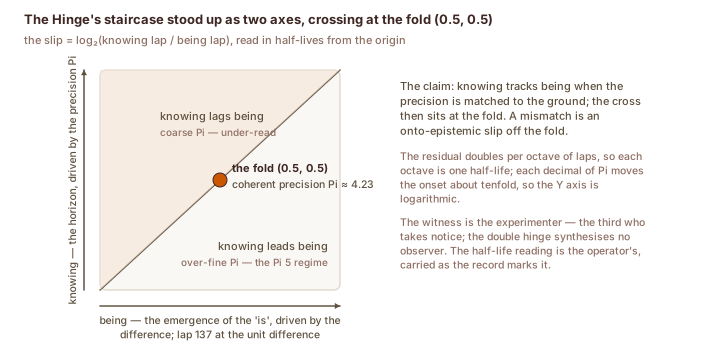
The Hinge established one staircase with two ends: the emergence, where the residual between two actors first resolves and the 'is' becomes a bit, and the horizon, where the residual first exceeds an observer's Pi-quantum and the observer registers the difference. The Double Hinge stands those two ends up as orthogonal axes crossing at a shared origin, the fold at (0.5, 0.5). The X axis is being, the ontological emergence of the 'is', driven by the actual relational difference between the actors; at the unit difference it is lap 137, the ground's own first bit. The Y axis is knowing, an observer's registration of that difference, driven by the observer's precision Pi: the horizon, the lap at which an observer at that precision first knows the actors differ. The claim under test is that knowing tracks being when the precision is matched to the ground, so that the cross sits at the fold, and that a mismatch shows as an onto-epistemic slip off the fold. A coarse Pi makes knowing lag being: the difference is real but under-read. An over-fine Pi makes knowing lead being: the observer resolves below the floor of the 'is' and reads noise as signal, which is the Pi 5 knife-edge regime the Hinge had already met.
The fold, and precision as a half-life
The fold is not a corner but the origin of the frame: the half-bit crossing, a residual of half a resolvable bit, at the emergence. The record carries the operator's figurative reading, marked as such, that this makes precision a half-life measure from the origin, and grounds it in two measured laws. The residual doubles per octave of laps, so backward from the fold each octave halves it toward the undifferentiated 'is' and forward each octave doubles it toward the bit: the residual's half-life is one octave. And each decimal of Pi moves the onset about tenfold in laps, so the precision axis is logarithmic. The Y axis is therefore a log scale centred on the fold, and the slip is read in half-lives, octaves, from the origin: the base-2 logarithm of the knowing lap over the being lap.
The witness
The Hinge read Pi 3 as two actors and one observer. Here the two actors are the Hinge's baseline pair on the shared 'is', and the observer, the witness, is the experimenter, the third who takes notice of the results. The Double Hinge does not synthesise an observer. It exposes the cross, and the witness's noticing is the epistemic act, the confirm, the collapse from potential to certitude: frozen until observed. One leg is parked in the record, noted and not built: the Y axis as a second actor-pair, a synthetic second-order observer reading the reading, closer to present, attest, confirm.
What a run does, and the cross
A run fixes the relational difference and the laps. Being is the ontological onset, the lap where the residual first reaches the ground's half-bit, 5 × 10⁻⁵, at the reference precision of one decimal; both onsets are read in one pass by a two-threshold scan. Then the observer's precision is swept from Pi 1 to Pi 7, and knowing is the horizon at each Pi. At the unit difference, being is lap 137:
| Pi | quantum | knowing, lap | slip, half-lives | regime |
|---|---|---|---|---|
| 1 | 0.1 | 232872 | +10.73 | lags |
| 2 | 0.01 | 23285 | +7.41 | lags |
| 3 | 0.001 | 2356 | +4.10 | lags |
| 4 | 10⁻⁴ | 237 | +0.79 | about the fold |
| 5 | 10⁻⁵ | 46 | −1.57 | leads |
| 6 | 10⁻⁶ | 11 | −3.64 | leads |
| 7 | 10⁻⁷ | 1 | −7.10 | leads |
The page draws the cross, Pi against the slip with the fold line and the regimes coloured, and a second card, the difference-sweep locus, which sweeps the difference and plots the coherent Pi. A run takes a few seconds; the difference sweep, nine runs, about twenty. The observable is the cross's position on the plane of being and knowing: coherent when near the fold, the slip being the off-fold distance in half-lives and a trust-decay signal. Both onsets are catch-lap quantised, the discreteness of the shared 'is' again.
Three measured results
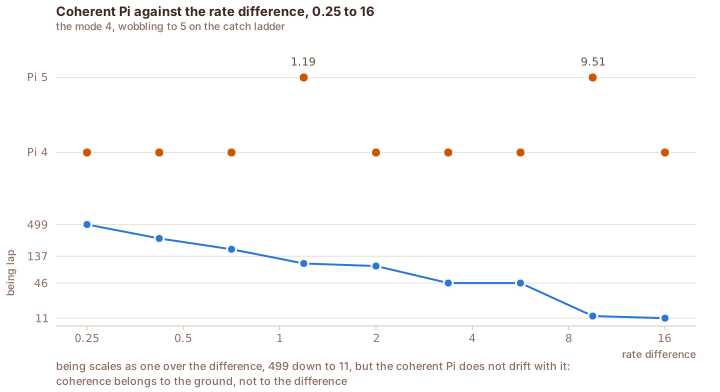
First, the coherent precision is about Pi 4. The true fold sits between +0.79 at Pi 4 and −1.57 at Pi 5, near 4.3, and Pi 4 is exactly the baseline's own readout precision. The ground reads itself coherently: the observer whose quantum matches the ground's resolvability is the ground's own precision. Second, Pi 5 and finer is the regime where knowing leads: over-precision. The observer resolves finer than the 'is' is defined, so knowing runs ahead of being. It is the same Pi 5 knife-edge the Hinge found, a horizon decided by one floating-point bit, re-derived here from the opposite direction: two independent paths, one conclusion. Third, the coherent precision is nearly invariant to the difference. Swept over differences from a quarter to sixteen, a sixty-four-fold range, being scales as one over the difference, from 499 down to 11, but the coherent Pi stays at the mode of 4, wobbling to 5 on the catch ladder. Being and knowing scale together, so their ratio, the slip, does not depend on the difference: coherence is a property of the ground, not of the difference.
The witness horizon
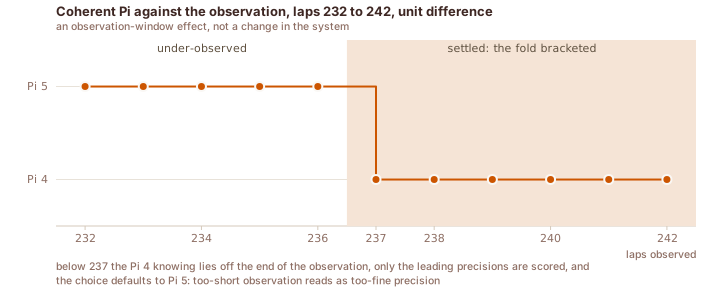
Sweeping the laps finely at the unit difference, the recorded coherent Pi flips from 5 to 4 at laps 237:
| laps | 235 to 236 | 237 to 238 |
|---|---|---|
| coherent Pi | 5, slip −1.57 | 4, slip +0.79 |
That is an observation-window effect, not a change in the system. Lap 237 is the Pi 4 horizon, the knowing at the coherent precision. Below it, Pi 4's knowing lies off the end of the observation, so only the leading precisions 5, 6 and 7 are scored and the choice defaults to Pi 5, over-precision. At 237 laps and beyond the fold is bracketed, a lagging and a leading Pi both observed, and the reading settles to the true coherent precision, 4. So the fold has a witness horizon, the minimum observation needed to locate it, equal to the coherent Pi's own knowing, 237 at the unit difference. It is self-referential: one cannot know where knowing meets being until one has observed long enough for that knowing to happen. An under-observing witness mislocates the fold into over-precision, which closes the loop with the Pi 5 knife-edge: too-short observation is indistinguishable from too-fine precision. The engine reports whether a reading is settled and what its witness horizon is, and the page labels under-observed rows as window-limited rather than letting them read as physics.
The catch-step probe, refuted
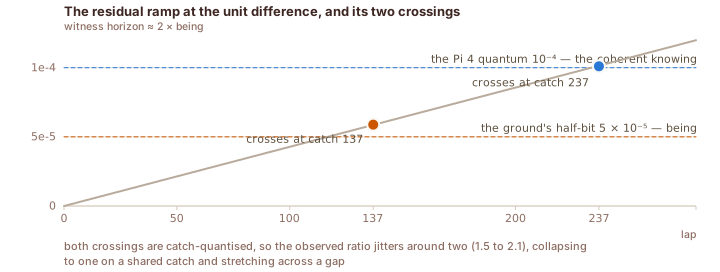
The natural conjecture, that the coherent knowing sits a fixed catch-step past being, was tested and refuted, and the record keeps the refutation. Swept over differences from a quarter to sixteen, the step runs from 0 to 39 on the full catch ladder; an earlier reading of adjacent catches had used the sparse horizon ladder, on which 137 and 237 are neighbours, whereas on the full ladder they are ten catches apart. The real relationship is a ratio: the witness horizon is about 2 × being, because being, the ground's half-bit of 5 × 10⁻⁵, and the coherent knowing, the Pi 4 quantum of 10⁻⁴, are the same residual ramp crossed at thresholds in a two-to-one ratio. Both crossings are catch-quantised, so the observed ratio jitters around two, between about 1.5 and 2.1, collapsing to one when both land on a single catch and stretching when they straddle a gap. The coherent Pi is 4 at every rate probed, the mode, and it genuinely wobbles to 5 at a few rates through the catch quantisation, at both shallow and deep laps, which is not under-observation. That confirms again that coherence belongs to the ground.
Pinning the fold
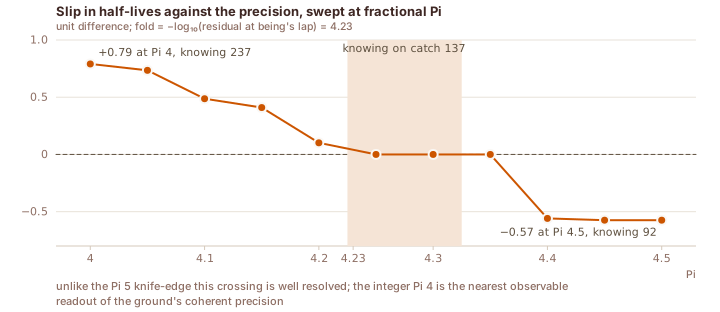
The integer sweep only brackets the fold between Pi 4 and Pi 5. Sweeping Pi at fractional resolution, the quantum ten to the minus Pi, locates it. At the unit difference the slip descends smoothly through zero:
| Pi | 4.0 | 4.1 | 4.2 | 4.23 | 4.3 | 4.4 | 4.5 |
|---|---|---|---|---|---|---|---|
| knowing, lap | 237 | 192 | 147 | 137 | 137 | 93 | 92 |
| slip, half-lives | +0.79 | +0.49 | +0.10 | 0 | 0 | −0.56 | −0.57 |
The fold sits at Pi ≈ 4.23, the negative log of the residual at being's lap: the precision whose quantum equals the residual where the 'is' first resolves, about 5.9 × 10⁻⁵ at lap 137. It is a narrow plateau, knowing sitting on being's own catch for a small range of Pi, not a razor point. Unlike the Pi 5 knife-edge, this crossing is well resolved, a real fold and not floating-point noise. So the ground's coherent precision is a genuine constant, about 4.23 at the unit difference, of which the integer Pi 4 is the nearest observable readout. The page carries it as the finer-than-integer sweep, and every composer on the page has plain-language help for its dials.
The register, and what is not claimed
A readout over the frozen geometry: the cryptographic core and the figure-2 coincidence untouched, the baseline pinned. The Double Hinge adds only the two-threshold onset read and the half-life framing; deterministic and test-pinned. The cross, the coherent precision, the witness horizon, the ratio and the fold at 4.23 are the measured structure. The half-life reading of the fold is the operator's figurative framing, carried as the record marks it; the witness is the experimenter and no observer is synthesised; the refuted catch-step conjecture stands in the record as refuted.
Where it sits
The fifth instrument of the series of ten, between the Hinge, whose staircase it crosses, and the Quad Hinge, which folds pairs of it; the XOR and the XOR Mirror reuse its fold. On the observatory node the door is opendata.ai/double-hinge, state live: the instrument runs on request, as the platform singleton, and nothing a reader does there enters the record. No external anchor is recorded for the Double Hinge, and this reading says so rather than borrowing one.
Standing
Held on this node as fact until someone stands up in the record to refute it; a refutation enters as a statement of intent at the matters of note and goes to the record's own path. What has since been built on the Double Hinge, and the walk a reader may take, are the operator's hand and land in a further draft.