 OOI · SX
The Ruler, held
THE READING PLAQUE. The Ruler, held, draft 0.2 — made readable on the SX surface by its covering persona's reading grant; a draft, not the published form. The grant stands by the operator's word (2026-09-16), verbatim: "ok - now do the same for the ruler." Covering: starl3n · endorsing: Link Digital (the standing pair). The Foundations · 9: the ninth reading of the foundations series — an experiment of the observatory node, held on this node. The construction record stands in the open workshop at /sx/workshop/the-rlx-held; the experiment's own door, opendata.ai/rlx, wears the word grown · held and links back here while this grant stands. Reading is free; the way across is a statement of intent (/sx/matters). This file's sha256 is pinned in the reading register.
Draft state — this block records the state of the draft; the reading begins after the rule. Draft 0.1 — 16 September 2026. Author of record: Steven De Costa; composed at his word from the experiment's record. Standing: a reading, stated never asserted; the record it reads stands whole without it. The later locks and the walk land in a further draft. Draft 0.2 (16 September 2026) places 3 figures and 1 table at the operator's word, each drawn from the record's own numbers and captioned with its source; the screenshots the operator will supply are not yet placed.
What the Ruler is
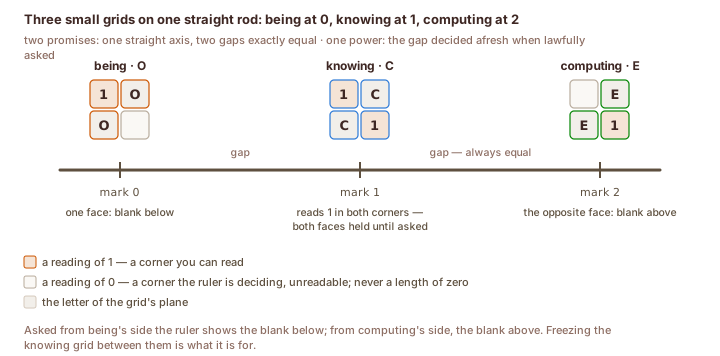
A thought experiment of the operator's, given on 12 September 2026, that became a code experiment the same day. Imagine a ruler made of three small grids, each two cells by two, set one behind another on a single straight rod: the being grid at mark 0, the knowing grid at mark 1, the computing grid at mark 2. The ruler keeps two promises at every moment: the three grids sit on one straight axis, and the two gaps are exactly equal, so the knowing grid is always midway. It has one power of its own. When whoever holds it lawfully asks a question, it may decide the gap afresh in order to answer, and the gap is the only thing it ever answers with.
Each grid has four cells. Two opposite corners carry a reading and the other two carry the letter of the grid's plane — O for being, C for knowing, E for computing. A reading of 1 is a corner you can read; a reading of 0 is a corner the ruler is deciding at that moment, which you cannot read, and it is never a length of zero. The knowing grid reads 1 in both corners: it holds both of the ruler's faces at once until asked to show one. The two end grids each carry one face, and the faces are opposites, blank above or blank below. Asked from being's side the ruler would be what is observably communicable, and shows the blank below; asked from computing's side it would be what is communicably effectual, and shows the blank above. Freezing the knowing grid between these two faces is what the whole arrangement is for.
You are a being of the knowing plane, and the ruler is a construct of that plane. The plane has an up, which you share; it has no left or right of its own, because which way is left depends on which side of the plane you look from. Close your eyes, turn the rod end for end a random number of times, raise one end to one eye by feel, and look straight down the axis. One thing is now settled that you do not know: your side. And looking down the axis with one eye you cannot see the gap, so the ruler's only answer channel is closed to you.
The lockstep and the key
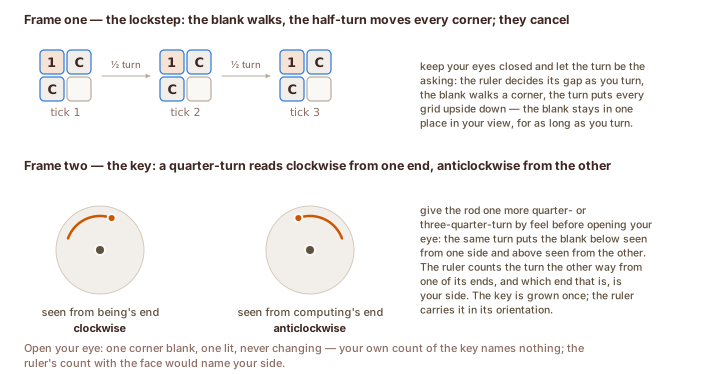
The ruler keeps time by being asked. On each tick it decides the gap afresh, and as it does one reading corner of the knowing grid goes blank while the other shows. The first tick answers whoever is asking — and raising the ruler to your eye is asking. From being's side the lower corner goes blank first; from computing's side, the upper. After that the blank walks, corner to corner, tick by tick. If you simply watched, the first blank would tell you your side; after that the walk looks the same from both sides. Only the first step speaks.
Suppose you do not want to know. Keep your eyes closed, and give the rod a half-turn about its own axis with every tick, letting your turn be the asking, so the ruler decides its gap exactly as you turn. Each half-turn puts every grid upside down in your view; the blank moves one corner per tick and the turn moves each corner one place per tick, at the same instant, so the two motions cancel and the blank stays in one place. That is the lockstep, the name the operator gave stage one, and it holds for as long as you keep turning.
Then the key. Before opening your eye, give the rod one more turn about its axis by feel, a quarter or three quarters. A turn along the rod's own axis looks clockwise from one end and anticlockwise from the other — that is the whole trick. The same quarter turn puts the blank below seen from one side and above seen from the other. You may know how many quarters you turned; that does not help, because the ruler counts the same turn the other way from one of its ends, and which end that is, is your side. The key is grown once and never given again; the ruler carries it in its orientation. Open your eye and you see one corner blank and one lit, never changing. Whether the blank is above or below is exactly your own count of the key and nothing else you can see. The ruler's count with the face would name your side; yours names nothing. The knowing grid is frozen between its two faces. The side and the ruler's count of the key together are the corrective secret, and they live in the ruler's orientation and nowhere you carry them. The ruler has never been bent and its gaps have never differed; it has only ever been turned and read.
The watchmaker's one power, and the goal
The observer in the lockstep is, in the operator's words, the blind watchmaker, and the goal beyond this first experiment is his, verbatim: "the experiment will ultimately reveal just how many blind watchmakers are required to be in synthetic agreement for the following to be true for any integer N, N = (N-1)+1, where the original secret of the ruler is never revealed." And: "We gave one power to the ruler and we must give one power to the blind watchmakers. They can set their own duration of time." The ruler decides the gap, a length; the watchmaker decides their duration, a time; one eye cannot see the gap, and a ruler with no clock cannot see the duration. Each holds one unit the other cannot see, and the side sits in the relation between them. The count K — the smallest number of watchmakers in synthetic agreement — is not staked by this experiment; the house's priors, that certitude needs two and that two locks one, are declared as priors and nothing more.
The first experiment
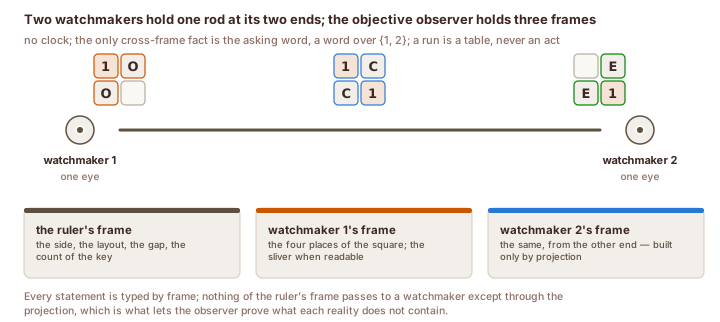
"The dynamic two watchmakers is the nature of the first experiment and it is how we can learn something as an 'objective observer' of the two realities of the two watchmakers." Two watchmakers hold the one rod at its two ends. There is no clock; the only cross-frame fact is the asking word, the order in which the two ask, a word over {1, 2}, and a watchmaker's duration is their own pattern in that word. The objective observer holds three frames — the ruler's, and each watchmaker's — and publishes every statement typed by frame. A watchmaker's frame is built only by a projection: the four places of the square with their bits and letters and, when the far grid's sliver is readable past the knowing grid, its blank place and the gap. Nothing of the ruler's frame passes except through that projection, which is what lets the observer prove what each reality does not contain.
The acts in order: the spin sets the original asker's side; both raise blind; the original asking sets the blank at the asker's near corner; both keys are given blind before either eye opens and add on the one rod; the run, in which each letter of the word is one asking — the ruler decides the gap under its policy, the blank walks, the rod half-turns, because the turn is the asking; then both open. The measures are exact identities, never statistics: a locked view is a constant stream; one face means both heights equal; the pad formula says the height equals the original side combined with whether the two own counts differ; secrecy groups every world by everything a frame contains, and a group holding one side only is a leak; visibility and agreement ask whether each watchmaker can observe the other's askings at all. Everything is enumerated whole — every side, every key pair, every word to length twelve, the ruler's four policies, the second eye's offsets — with no random draw anywhere. A run is a table, never an act.
The rungs and the two readings
Six rungs were registered before the read, refutations first: the lock under two; the pad moves; one eye cannot count two; the broken agreements; the far face through the sliver; the gap decides. Reading one, pinned at 12:47 on 12 September, landed the lock and the one-eye rung and refuted the other four, and the four refutations shared one cause, seen in the record: the frame contains the places of the corners, and with the ruler's layout fixed as a constant of the engine, the diagonal on which the readings sit names the side — every frame group was single-sided. The first registration had declared that diagonal null without making the declaration operational. The finding is kept with full standing: a watchmaker who knows the ruler's layout reads the side from the diagonal, and neither the lockstep nor the key hides it.
Reading two was a supersession, never an edit: the layout — the ruler's own handedness, never seen from a known side — was made the fourth blind choice. Pinned at 12:54 and read in three minutes, all six rungs passed. Every one of the 65,520 frame groups holds both sides. The pad formula holds in all sixteen cases of side, key pair and layout. The exchange of own counts fixes the original side. The broken agreements land as exhibits: an asking without a turn flips the other's face at exactly the asker's askings and reveals a pattern and never a side; a key given in view fixes the watcher's own side through the height after, the own count and the seen turn. Through the sliver the far face flips at every asking by anyone, and its offset against the locked face names the original asker; readable letters fix the side in every frame; a walking end grid shows a constant sliver. Under the three secret-free policies no frame fixes a side and the gap seen is a function of the asking count alone; under the policy keyed to the rod's rotation the gap leaks, 16,320 of 20,400 groups single-sided. The frontier was recorded and staked nowhere: under the constant policy one count holds for every word once the second eye's offset reaches two.
The six rungs across the two readings:
| rung | reading one, 12:47 | reading two, 12:54 — the layout made a blind choice |
|---|---|---|
| the lock under two | PASS | PASS |
| the pad moves | REFUTED | PASS — the pad formula in all sixteen cases |
| one eye cannot count two | PASS | PASS |
| the broken agreements | REFUTED | PASS — an asking without a turn reveals a pattern, never a side |
| the far face through the sliver | REFUTED | PASS — the sliver's offset names the original asker |
| the gap decides | REFUTED | PASS — every one of the 65,520 frame groups holds both sides; the keyed policy the one leak, 16,320 of 20,400 |
What the objective observer learned
Both watchmakers hold one face. Its height is the original side combined with whether the two keys differ, so each watchmaker's side is padded by the other's key. With one eye each they cannot know they are two. The side is hidden only because the plane has no handedness: give a watchmaker the ruler's layout and the diagonal names the side at once. The second eye lets each count the other's askings through the far end grid without seeing a side, and the ruler's gap decides whether that sliver is readable. Two watchmakers hold one count exactly when the ruler keeps its gap within reach of their eyes, and the original secret survives that count under every secret-free policy.
Doors left open, and the fences
Left open on purpose: which end grid carries which face, part of the experiment's progress at the operator's word and not a precondition; the second eye's own lockstep; a third watchmaker, who has no place on one rod and so needs a second ruler sharing a grid, which is where "for any integer N" comes from; and the count K. Nothing is claimed beyond the model's declared conventions. The sliver rule is a declared measure, not a physics. The terms of Linked Digital Dynamics are used as the reference gives them and nowhere extended. A refuted rung is kept with full standing and never re-cut.
Where it sits
A kin surface on the observatory node: the door is opendata.ai/rlx, state live — the instrument runs on request, its gate, its record and its world viewer showing one world from the three frames, and nothing a reader does there enters the record. The two registrations and their results carry the pins in the repository; no external anchor is recorded for the Ruler, and this reading says so rather than borrowing one. The next acts wait on the operator's word: the second eye's own lockstep, a third watchmaker, and the count.
Standing
Held on this node as fact until someone stands up in the record to refute it; a refutation enters as a statement of intent at the matters of note and goes to the record's own path. What has since been built on the Ruler, and the walk a reader may take, are the operator's hand and land in a further draft.