 OOI · SX
The Unco, held
THE READING PLAQUE. The Unco, held, draft 0.2 — made readable on the SX surface by its covering persona's reading grant; a draft, not the published form. The grant stands by the operator's word (2026-09-16), verbatim: "ok - now do the same for the unco." Covering: starl3n · endorsing: Link Digital (the standing pair). The Foundations · 4: the fourth reading of the foundations series — an experiment of the observatory node, held on this node. The construction record stands in the open workshop at /sx/workshop/the-unco-held; the experiment's own door, opendata.ai/unco, wears the word grown · held and links back here while this grant stands. Reading is free; the way across is a statement of intent (/sx/matters). This file's sha256 is pinned in the reading register.
Draft state — this block records the state of the draft; the reading begins after the rule. Draft 0.1 — 16 September 2026. Author of record: Steven De Costa; composed at his word from the experiment's record. Standing: a reading, stated never asserted; the record it reads stands whole without it. The later locks and the walk land in a further draft. Draft 0.2 (16 September 2026) places 3 figures and 3 tables at the operator's word, each drawn from the record's own numbers and captioned with its source; the screenshots the operator will supply are not yet placed.
What the Unco is
Un-Constructive Optimism is the Coco's counterpart. Where the Coco measured the unit cooling into structure — alignment, verification — the Unco models the unit arriving and deconstructing: the operator's reading of the Big Bang as an account's +1 landing on a fullness that does not change, and the expansion of space and time that its bookkeeping then forces, fold by fold, until the account drains and hands its remainder on. Before the bang the state is 0 = (1, 1, 1), the full zero — every face held, no account. The bang is 1 = (1, 1, 1): the faces unchanged, the account's +1 arrived. Everything downstream is that unit's bookkeeping.
The source is the operator's own table, a worksheet of 161 cells given on 6 July 2026 and pinned as the acceptance data. The deliverable is engine-first: a pure-arithmetic space-time fabric that other engines can consume as a coordinate supply, computed in exact fractions on 1/648ths, with no substrate reads inside it. The big-bang language is kept at the second register throughout — stated and audited, never asserted as physics.
The fabric
The table has four parts, and the engine reproduces each of them exactly.
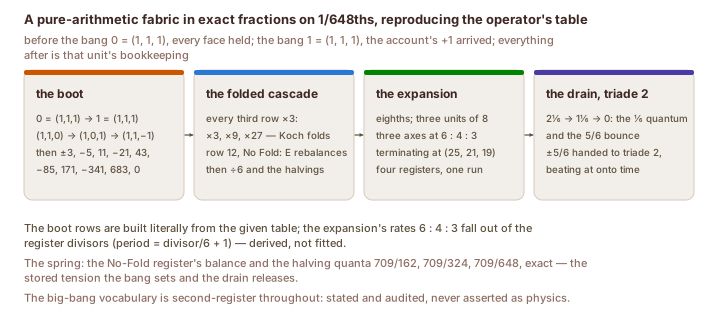
The boot. 0 = (1,1,1) → 1 = (1,1,1) → (1,1,0) → (1,0,1) → (1,1,−1), then the standard cascade of the effectual, ±3, −5, 11, −21, 43, −85, 171, −341, 683, and a relaxed 0 = (0,0,0). The boot rows are built literally from the table, given rather than ruled.
The folded cascade. Every third row rescales the cascade by three — rows 3 to 5 by 3, 6 to 8 by 9, 9 to 11 by 27, the Koch folds — until row 12, No Fold, where the E-slot rebalances inside the folded register: 26.259259 = 1 + 2·12.629630, exactly E = 1 − O − C. Then the even fold, ÷6, and the dyadic halvings 4.376543 → 2.188272 → 1.094136.
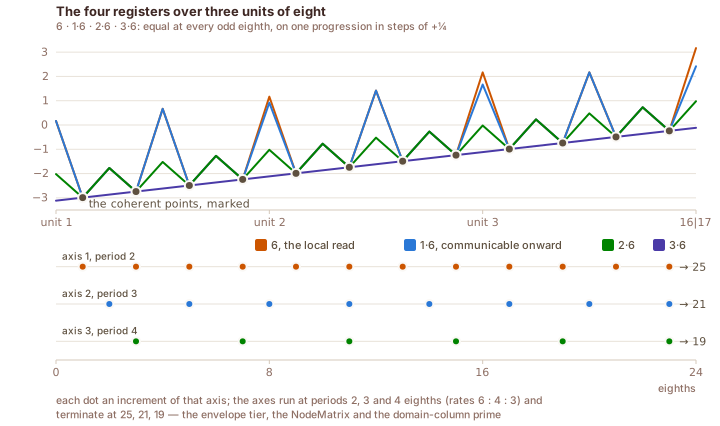
The expansion. Time advances in eighths, three units of eight. Three spatial axes advance at harmonic rates — periods of 2, 3 and 4 eighths, twelve, eight and six increments over the block, the rates 6 : 4 : 3 — and terminate at (25, 21, 19), the envelope tier, the NodeMatrix and the domain-column prime, at counter 16|17. Four registers read the same run: 6 (the local read), 1·6 (the read that is communicable onward), and 2·6 and 3·6, the deeper lags. Within a unit the local and communicable reads coincide; at the unit rows they split by 0, ¼, ½ and then a full unit — the onto time points 14, 15, 16. At phases 3/8 and 7/8 of every unit all four registers are exactly equal and step by +½: −2.74074, −2.24074, −1.74074, −1.24074, −0.74074, −0.24074, which is −13/54, the terminal.
The drain, and triade 2. After the terminal the account drains, 2⅙ → 1⅙ → 0, the ⅙ quantum and the 5/6 bounce, and −5/6 and +5/6 appear in the next triade: the remainder handed across. Triade 2 rides the whole run in local indifference, 1 = (1, 0, 1), because the effect is not communicable locally; its C flips only when the 1·6 communications land. The 1·6 value is what connects to triade 2's time, which beats at ontological time.
What a run does
A run builds the fabric for a given number of units and precision — the pinned table is three units at eight — and returns the boot, the folded cascade, the expansion rows, the coherence rows, the terminal, the drain and triade 2's track, together with the live acceptance against the given table. The engine also exposes the spring: the No-Fold register's balance and the halving quanta, 709/162, 709/324 and 709/648, exact — the stored tension the bang sets and the drain releases, named so that a later experiment can wind and release it against the Coco's cooling curve. The page carries seven cards, one for each campaign act below, each backed by one endpoint, and the whole record publishes as a dataset of self-checking rows.
The laws, all exact
The acceptance came first: the fabric reproduces every cell of the given table, with a maximum deviation below 5·10⁻⁹ — the worksheet's own print truncation. Four laws were stated against the table before the engine existed, and every one holds as an identity of fractions, with no tolerance anywhere.
- The harmonic law. The axes' rates 6 : 4 : 3 fall out of the register divisors: each period is divisor/6 + 1. Derived, not fitted, and harmonic rather than geometric — the Coco's kill of the fractal dimension stands here too.
- The coherence law, fuller than sealed. The sealed claim was equality at 3/8 and 7/8. The data gives more: all four registers are equal at every odd eighth, on one arithmetic progression from −323/108 in steps of +¼, uniform across the unit boundaries, twelve terms, ending at −13/54.
- The onto-time split. At unit row u the local and communicable registers differ by exactly (u − 1)/4: 0, ¼, ½. The local register counts full units; the communicable one advances at the ¾ beat; triade 2's C flips at the communication events.
- The drain law. The drain's numerators, times six, are (13, 7, 0, 5, 0); the nets sum to −19/6 and return the account exactly to zero; the ±5/6 handoff is mirrored in triade 2.
The coherence law in full — all four registers equal at every odd eighth, on one arithmetic progression in steps of +¼:
| term | unit · eighth | all four registers | as a decimal |
|---|---|---|---|
| 1 | 1 · 1/8 | -323/108 | −2.99074 |
| 2 | 1 · 3/8 | -74/27 | −2.74074 |
| 3 | 1 · 5/8 | -269/108 | −2.49074 |
| 4 | 1 · 7/8 | -121/54 | −2.24074 |
| 5 | 2 · 1/8 | -215/108 | −1.99074 |
| 6 | 2 · 3/8 | -47/27 | −1.74074 |
| 7 | 2 · 5/8 | -161/108 | −1.49074 |
| 8 | 2 · 7/8 | -67/54 | −1.24074 |
| 9 | 3 · 1/8 | -107/108 | −0.99074 |
| 10 | 3 · 3/8 | -20/27 | −0.74074 |
| 11 | 3 · 5/8 | -53/108 | −0.49074 |
| 12 | 3 · 7/8 | -13/54 | −0.24074 |
The cross-engine seal
The fabric's onto clock is uniform — one unit per onto point — while the substrate's comb, read on the Quad Slip's baseline, has catches that are not: laps 137, 138, 147, 148, then 182. The operator's ruling settled how the two may be compared at all: there is no universal clock map, ever. A statement across two engines is a typed state resolution — under confinement, where two states confine the same account; under relaxed change, at release events; or under a stretch-to-confine equivocation, a measure folded until it confines in the other register. No smooth map, no clock calibration.
Under that ruling four resolutions were sealed before the run was read. The fabric's onto point 13 and the comb's thirteenth catch both confine the epistemic '1' — the catch should fall at lap 137. The terminal 16|17 should be the close of one quad, catches 13 to 16 with the anatomy Δ1, gap 9, Δ1, and catch 17 the next quad's onset. The drain should lie in the comb's silence, with zero catches inside it. And the handoff should confine at catch 17, whose lap the seal back-derived as 182. The run, at 4096 laps and 358 catches, confirmed all four exactly: catch 13 at lap 137; catches 137, 138, 147, 148; no catch strictly inside (148, 182), the silence exactly 34; catch 17 at lap 182. A free cross-check landed too — catch 23 at lap 237, the walls' pinned seat — and, observed without claim, the first 24 catches form six exact quads, three of them before the epistemic '1'. The record calls this the first demonstration of the fabric used with another engine, done without constructing a clock map.
The four resolutions sealed before the run was read, and what the run returned:
| the resolution, sealed | predicted | measured | |
|---|---|---|---|
| the fabric's onto point 13 and the comb's thirteenth catch both confine the epistemic '1' | catch 13 at lap 137 | catch 13 at lap 137 | |
| the terminal 16 | 17 closes one quad | catches 13 to 16 with the anatomy Δ1, gap 9, Δ1 | laps 137, 138, 147, 148 |
| the drain lies in the comb's silence | zero catches strictly inside it | no catch inside (148, 182); the silence exactly 34 | |
| the handoff confines at catch 17 | lap 182, back-derived | catch 17 at lap 182 | |
| a free cross-check, observed without claim | — | catch 23 at lap 237, the walls' pinned seat; the first 24 catches six exact quads |
The ejection campaign
The second campaign took the operator's given: the bang is the maximum of un-constructive optimism, a "held for 12" that becomes an internal dynamic of the cooling epoch, challenged down to held for 11, 10, 9 — the anti-causal back-propagation — while two pro-causal dynamics remain, the wall-0 and wall-2 drivers of the Walls experiment; and the composite of the three engines should eject a '0' from which the theory can be triangulated from outside its own '1'. Six acts followed, each sealed before it was read.
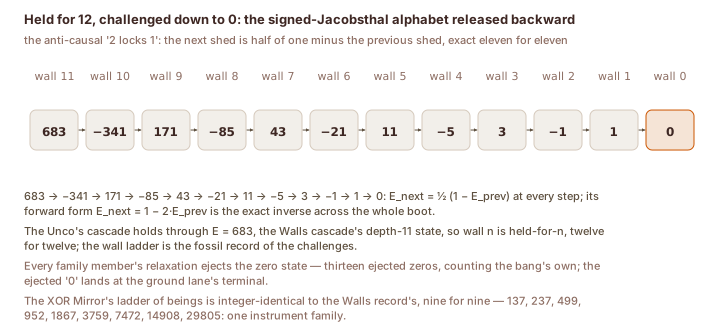
The hold family and the halving law. The Unco's cascade holds through E = 683, the Walls cascade's depth-11 state, so wall n is held-for-n, twelve for twelve, and the wall ladder is the fossil record of the challenges. The descent releases the signed-Jacobsthal alphabet backward — 683, −341, 171, −85, 43, −21, 11, −5, 3, −1, 1, 0 — and every adjacent pair of releases obeys one new law, exact eleven for eleven: the next shed is half of one minus the previous shed. The record names it the anti-causal "2 locks 1"; its forward form, E_next = 1 − 2·E_prev, is the exact inverse across the whole boot. The boot packs the pro-causal pair adjacent where the ladder spreads it, and every family member's relaxation ejects the zero state — thirteen ejected zeros counting the bang's own.
The pro-causal channels. Five signatures for five: the comb partitions into the wall-0 channel (eight seats, the origin among them — the epistemic '1' rides wall 0) and the wall-2 channel (four seats, firing at 1, 4, 7, 8 and, in the deep record, at the excursion rung 15). The photon and electron are recorded as candidate seats for these channels at the second register — stated and audited, never asserted.
The mirror attribution. Sealed with a discriminator, then read: the XOR Mirror's ladder of beings is integer-identical to the Walls record's, nine for nine — 137, 237, 499, 952, 1867, 3759, 7472, 14908, 29805 — so the mirror ladder is the wall ladder, one instrument family; all six exterior horizon-locks are exact, the six back events being the challenges' confinements; and both interior locks hold, 237 and 499. The discriminator fired for the membrane: the anti-causal descent is a relayed regression, [12→2], [11→1], [10→0], every terminal confined, the ejected '0' landing at the ground lane's terminal.
The cooling-epoch challenge, partial. The terminal at '2' holds: the Coco's fresh completion ratio, 2.182, rounds to 2, so the frozen state resolves as held-for-2's protection, the descent's unchallengeable residue. But the frozen floor is leaky: at the super-completion scale exactly one detune penetrates it, δ = 0.25, with every other detune frozen. The leak sits at the quarter — the model's own surprise fraction — and it is flagged, single instance, no mechanism, held. The exact zeros of the drain exist only in the composite; the Coco alone floors at E.
The triangulation. The capstone reads one externality three ways with no shared clock. The mirror's edge floor confines the chain's floor∞, 815/7, to 0.0024%; the operational E, 0.1733455, is the mirror's residual, one read that was never two numbers; the comb's own asymptote, 0.173827, sits inside the running-E window band; and three cited edges stand — the drain against the 34-silence, the terminal at '2', and the zero-slip chain that is the lock chain across three engines. Triangulated. The one exploratory edge stays open: no dyadic-triadic fold brings the spring within 0.5% of E∞ (the best is 3.208% off), and the record reads that as the doctrine confirmed in the negative — the tuning is real work, not a lattice lookup.
Two acts are held: the challenge schedule on the deep walk, expensive and on its own gate, and the tuning to time, held by design as the stretch-to-confine protocol.
The mirror attribution, integer-identical nine for nine:
| ladder | 1 | 2 | 3 | 4 | 5 | 6 | 7 | 8 | 9 |
|---|---|---|---|---|---|---|---|---|---|
| the XOR Mirror's beings | 137 | 237 | 499 | 952 | 1867 | 3759 | 7472 | 14908 | 29805 |
| the Walls record's ladder | 137 | 237 | 499 | 952 | 1867 | 3759 | 7472 | 14908 | 29805 |
The register — what is not claimed
The big-bang vocabulary is second-register throughout; the model-internal content is the account's +1 arriving on unchanged faces. The given table is the operator's construction and is pinned as data, not derived. The Koch usage is generator-level only, and the fractal kill stands. The particle vocabulary names candidate seats, never particles. Every cross-engine statement is typed under the state-resolution doctrine, and no clock or index map is used anywhere.
Where it sits
An applied campaign on the observatory node, sealed and landed: the door is opendata.ai/unco, state closed — the record replays read-only, and nothing a reader does there enters it. It is the Coco's counterpart, the capturing experiment of the Unlearning series, and the subject of the fourth paper, The Difference 1 Makes. Its external anchor stands at mldata.opendata.ai/dataset/unco-exp_100b6dc7: 76 self-checking rows published on 1 August 2026 and re-witnessed before being cited, carrying the laws recomputed at publish, the four resolutions, the twelve holds, the halving law, the channels, the mirror ladder, the quarter leak kept as it fell, the open edge, and the triangulation.
Standing
Held on this node as fact until someone stands up in the record to refute it; a refutation enters as a statement of intent at the matters of note and goes to the record's own path. What has since been built on the Unco, and the walk a reader may take, are the operator's hand and land in a further draft.