 OOI · SX
The Hinge, held
THE READING PLAQUE. The Hinge, held, draft 0.2 — made readable on the SX surface by its covering persona's reading grant; a draft, not the published form. The grant stands by the operator's word (2026-09-16), verbatim: "ok - now do the same for the hinge." Covering: starl3n · endorsing: Link Digital (the standing pair). The Foundations · 12: the twelfth reading of the foundations series — an experiment of the observatory node, held on this node. The construction record stands in the open workshop at /sx/workshop/the-hinge-held; the experiment's own door, opendata.ai/hinge, wears the word grown · held and links back here while this grant stands. Reading is free; the way across is a statement of intent (/sx/matters). This file's sha256 is pinned in the reading register.
Draft state — this block records the state of the draft; the reading begins after the rule. Draft 0.1 — 16 September 2026. Author of record: Steven De Costa; composed at his word from the experiment's record. Standing: a reading, stated never asserted; the record it reads stands whole without it. The later locks and the walk land in a further draft. Draft 0.2 (16 September 2026) places 3 figures at the operator's word, each drawn from the record's own numbers and captioned with its source; the screenshots the operator will supply are not yet placed.
What the Hinge is
The fourth instrument of the series of ten, and the first to use the pinned Quad Slip baseline as an instrument rather than as the thing measured. The baseline is the pure 'is', the sub-spacetime calibration, a deterministic function that is the same for everyone who runs it. The Hinge asks what that shared ground is good for between two causal actors who stand in a relational difference: a different time, a different place, a different identity. The claim it tests is that an epistemic statement made by one actor stays effectual for another, recoverable and agreeable, because they share the 'is': the difference becomes a transform on the shared ground rather than a break. It is present, attest, confirm lifted to the epistemic plane. One actor presents a claim; the other attests it by relocating it on the shared 'is'; they confirm if they agree to within one bit.
The address, and the effectual horizon
A claim is not expressed in an actor's wall clock. It is an address on the shared 'is', the readout the Quad Slip's frame already produces: the epoch, the position in the registry, the amplitude, and the elapsed time since initiation. Because the baseline is the same function for every actor, the address is a property of the 'is', not of anyone's clock or place, and so it is frame-independent. Two cases follow. When the relational difference is modelled, a known time shift or a known placement offset, the second actor recovers the first's claim exactly: a residual of zero, effectual without bound, the difference only a coordinate change on the invariant. When the difference is un-modelled, an uncommunicated rate difference, a drift, the two addresses separate over time and effectuality is bounded: effectual, meaning the residual stays within one Pi-quantum, up to the effectual horizon, which is about one quantum divided by the difference. That is the same one-over-difference law as the coherence horizon within a single instrument, now between actors. Beyond it the residual exceeds the bit and the claim is no longer effectual. The residual is the slip, and it is what feeds trust decay. The shared 'is' is what lets two actors agree at all; the precision Pi and the difference set how long.
The three decisions
Three decisions shaped the first build, each with a later phase behind it. The causal actor: two baseline runs, later federation nodes exchanging addresses by present, attest, confirm. The relational axis: time, a lap-rate difference, later space and the multiway path. The effectual criterion: agreement within one Pi-quantum, one bit at the readout precision, the residual being the slip, later a trust-decayed tolerance. In a run, the reference actor runs the baseline as it is; the second actor carries a small uncommunicated rate offset, its detune scaled by one plus the rate difference. Each emits its address sequence, and the second attests the first's claims on its own copy of the 'is'. The observable is the cross-actor residual against the elapsed laps: flat at zero while effectual, then rising once the slip exceeds the bit. The page draws it as the effectual trace, with the quantum line and the horizon marked.
The time hinge and its law
The measured law is linear. The maximum residual grows as a constant times the rate difference times the laps, the constant about 4.28 × 10⁻⁷ per lap, so the horizon is about the quantum divided by that constant and the rate difference. Three recorded runs at Pi 3, a quantum of one thousandth:
| rate difference | Pi | laps | residual | horizon | effectual |
|---|---|---|---|---|---|
| 1.155 | 3 | 1024 | 0.0005 | none | 90 of 90 |
| 2.309 | 3 | 1024 | 0.0010 | none | 90 of 90, at the quantum's edge |
| 11.414 | 3 | 2048 | 0.0100 | 228 | 20 of 179 |
With no rate difference at all the two actors are effectual forever: a pure offset is absorbed. With a difference of a tenth the horizon is 2356 laps; with two tenths, 1178; the horizon scales as one over the difference and shrinks tenfold with each finer decimal of Pi.
The record also carries the operator's figure-2 reading of the three runs, marked interpretive as the record marks it: Pi 3 as two actors and one observer, the three that effect a witnessed digital ontology; 1.155 as 1.15 plus 0.005, the 1.15 aligned to the Quad's 3.15 total separation, twice 1.575, and the 0.005 the next dyadic differential; 1024 as twice 512, the span of two actors where one node is significant to 512; 2.309 as twice 1.155, the doubling that brings the residual to exactly one quantum, the edge of effectuality; 11.414 as 10 plus √2. The record grounds it honestly: the law derives every residual from the full rate difference, and the correspondences are the calibration's rationale, resemblances the law makes land, not separate mechanisms.
The precision budget, and the quantised horizon
Pi is the effectual budget. A coarser Pi is a larger quantum and a wider tolerance to relational difference: at Pi 1, a quantum of a tenth, the actors stay fully effectual, 358 of 358 with no horizon, out to large differences, residuals of 0.005, 0.01 and 0.0105 at rate differences of 2.85, 5.725 and 6.0; at Pi 4, a quantum of one ten-thousandth, a unit difference already breaks at lap 237. The observer's precision is the budget for agreement.
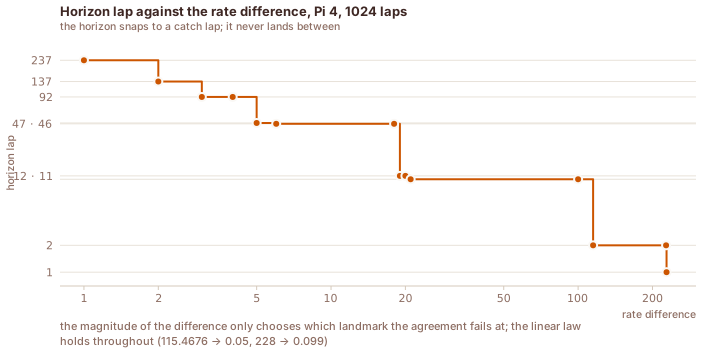
The key finding of the sweep is that the effectual horizon is quantised to the catch laps of the shared 'is'. Swept at Pi 4 over 1024 laps, as the difference grows the horizon steps down through 237, 137, 92, 47, 46, 12, 11, 2 and 1, and never lands between them:
| rate difference | 1 | 2 | 3 to 4 | 5 | 6 to 18 | 19 to 20 | 21 to 100 | 115 to 227 | 228 |
|---|---|---|---|---|---|---|---|---|---|
| horizon, lap | 237 | 137 | 92 | 47 | 46 | 12 | 11 | 2 | 1 |
| effectual of 90 | 22 | 12 | 8 | 5 | 4 | 3 | 2 | 1 | 0 |
Every one of those horizons is a catch lap of the baseline, a discrete landmark of the pre-spacetime 'is'. The magnitude of the difference only chooses which landmark the agreement fails at; the horizon snaps to that rung. It is the discreteness of the shared ground showing in the cross-actor horizon, the same determinism-floor quantisation seen within one instrument, now between two actors. The linear law holds throughout: a difference of 115.4676 lands a residual of 0.05, and 228 lands 0.099.
The staircase, and the emergence at 137
Sweeping the laps over the octaves of two at a unit rate difference and Pi 1, summary only so it scales past 2¹⁹ and the full sweep runs in about four seconds, the log of the residual against the octave is a straight line. The residual first resolves at 2⁸: 128 laps read 0.0, 256 laps read 0.0001, and it then roughly doubles each octave, 0.0002 at 2⁹, 0.0004 at 2¹⁰, up to 0.0563 at 2¹⁷. The horizon arrives at 2¹⁸, the residual crossing the quantum of a tenth at lap 232872. The full arc is emergence at 2⁸, ten octaves of agreement, horizon at 2¹⁸, and the page draws it as the octave staircase.
The staircase brackets the emergence at 2⁸ only because it samples powers of two. The fine emergence is sharper: at the unit difference and Pi 1 the maximum residual steps from 0.0 to 0.0001 at exactly lap 137, the eighth catch, where the catch count goes from twelve to thirteen.
| laps | 135 | 136 | 137 | 138 |
|---|---|---|---|---|
| residual | 0.0 | 0.0 | 0.0001 | 0.0001 |
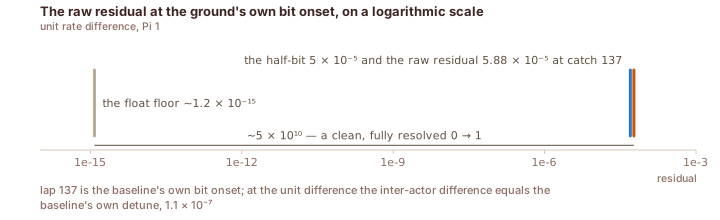
Three things make it structural rather than a numerical accident. It is robust: the raw residual at catch 137 is 5.88 × 10⁻⁵, some fifty billion times the float floor, a clean and fully resolved zero to one. Lap 137 is the ground's own intrinsic bit onset, the lap where the baseline itself first resolves a bit in its y-projection: the two actors first become distinguishable exactly when the pre-spacetime 'is' first produces a bit. And a unit rate difference is the unit difference: at rate 1.0 the second actor's detune is twice the first's, so the inter-actor difference equals the baseline's own detune, 1.1 × 10⁻⁷, and the hinge residual ramps at the ground's own rate, its onset landing on the ground's own bit. The emergence lap walks the catch ladder with the difference: a quarter gives 499, a half 237, one 137, two 92, four 46, sixteen 11, the same quantisation as the horizon. Emergence and horizon are the two ends of one staircase: emergence where the residual first resolves, the display's half bit, horizon where it first exceeds the quantum, and between them the effectual band, the coherent life of the shared 'is' for that pair of actors.
The record carries the operator's reading of the onset as a hypothesis, marked so. Below it the two actors are bit-identical, a single undifferentiated 'is', the sub-spacetime regime with no resolvable relational difference; at the onset the first resolvable difference appears, distinguishability, before and after, here and there, the candidate for the emergence of spacetime from sub-spacetime, coinciding at the unit difference with the ground's own first bit. The emergence is observer-relative, walking with Pi and the rate difference, which is itself consistent with certitude needing two and the frozen staying frozen until observed; the invariant is the structure, a sharp zero-to-one at a catch landmark, and 137 is where it lands at the natural unit calibration. That onset became the being axis of the Double Hinge.
The knife-edge at Pi 5
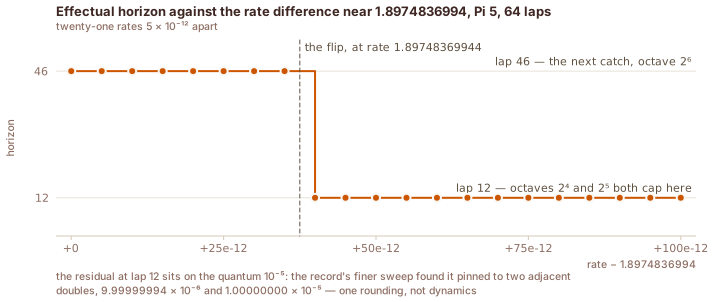
The operator observed that at Pi 5, a quantum of one hundred-thousandth, moving the rate difference from 1.8974836995 to 1.8974836994, a step of 10⁻¹⁰, flips the horizon between 2⁴ and 2⁶. The record investigated it to the floor. The jump is real, and doubled by a gap in the catch laps: that rate tunes the residual at catch lap 12 to sit essentially on the quantum, and the baseline's catches step 11, 12, 46, 47, so the octaves 2⁴ and 2⁵ both top out at lap 12 and share one residual. Just below the quantum neither crosses and the first crossing is lap 47, so 2⁶; just above, lap 12 crosses, so 2⁴. But the boundary sits at the instrument's floating-point floor and is not a resolvable constant. Swept in steps of 5 × 10⁻¹², the residual at lap 12 does not vary continuously: it is pinned to exactly two adjacent doubles, 9.99999994 × 10⁻⁶ and 1.00000000 × 10⁻⁵, with a single step of 8.5 × 10⁻¹⁴ between them, and the quantum falls between those two values. Which side a run lands on is decided by one floating-point rounding. At Pi 5 the residual, a difference of two positions near 2.76, carries about eight significant figures, and the boundary at the tenth figure of the rate is two digits into the noise. The verdict stands recorded: the phase transition is genuine, a discrete readout jumping at a critical tuning, doubled by the discreteness of the shared 'is'; its tenth-decimal location is an artifact marking the instrument's resolution floor, the computational face of the determinism floor, where the relational difference is undecidable by the instrument. The value 1.8974836994 or 5 is not a physical constant. The method rule that followed: study critical points at a coarser Pi, say Pi 3 where the residual carries about twelve figures and the critical rate is sharp, or move off the straddle.
Space, and what remains
The second phase put the difference on the axis of space. A placement offset for the second actor adds a pure constant to its y-projection, because the 'is' is footprint-blind, the separation cancelling in y. A constant is a known transform, and it is fully absorbed: the effectual residual and the horizon are independent of the offset, offsets of 0, 0.5 and 2.0 giving the identical horizon of 2356, only the raw residual carrying the constant, and space alone with no rate difference is effectual forever. The result in the record's words: space is free, and only the time-rate costs. Two legs remain unbuilt and are stated as such: the multiway-path offset, the shared 'is' as the a-priori anchor across branches so that path-relative claims stay comparable; and the third phase, causal actors as federation nodes exchanging addresses by present, attest, confirm, effectual when the peer confirms to within one bit, the residual driving trust decay, where the hinge would become the accord's substrate at social scale.
The register, and what is not claimed
A readout over the frozen geometry: the cryptographic core and the figure-2 coincidence untouched, the baseline pinned; the hinge adds only the relational offset and the residual measure, deterministic and test-pinned. The linear law, the budget, the quantised horizon, the emergence at 137 and the floor at Pi 5 are the measured structure. The figure-2 reading of the three runs and the reading of the onset as the emergence of spacetime from sub-spacetime are the record's marked overlays, carried here as the record marks them, never as claims.
Where it sits
The fourth instrument of the series of ten, after the Quad Slip whose baseline it is the first to use as an instrument, and before the Double Hinge, which took its emergence at 137 as the being axis and crossed it with the knowing. On the observatory node the door is opendata.ai/hinge, state live: the instrument runs on request, as the platform singleton, and nothing a reader does there enters the record. No external anchor is recorded for the Hinge, and this reading says so rather than borrowing one.
Standing
Held on this node as fact until someone stands up in the record to refute it; a refutation enters as a statement of intent at the matters of note and goes to the record's own path. What has since been built on the Hinge, and the walk a reader may take, are the operator's hand and land in a further draft.